4 December 2015

Post 320: 'CLARINET MARMALADE'


Unfortunately, the great old jazz classics are not tunes you are likely to find in sheet music form in your local music shop, even if you are lucky enough still to have a local music shop. We have to learn them as best we can - mostly by ear or from materials circulated by other musicians. I write out my own simple lead sheets and store them in mini filofaxes, as below. My versions are probably not spot on, but they are good enough for me. Incidentally, if you would like to see me with three friends having a go at playing this tune - CLICK HERE.

I think Clarinet Marmalade was composed by members of The Original Dixieland Jazz Band (ODJB) in 1918.


Post 319: 'DANGEROUS BLUES' - AND A SAD TALE

There is so much joy in the history of traditional jazz. But frequently it is intermingled with sadness.

Here's a poignant example.
The original cover of Dangerous Blues,
with art-work by Ilah Marian Kibbey
Dangerous Blues was recorded by The Original Dixieland Jazz Band in 1921. You can hear the recording by clicking on here. In more recent times, the tune has been revived by the wonderful young band Tuba Skinny. You can hear them playing it by clicking here. It's a merry enough tune.

But here's the sad tale behind it. The composer of this tune, Billie Brown, was a young lady who died of smallpox very soon after she composed it.

We know that is correct. But unfortunately not much else is known for sure about Billie.

Billie was probably born in 1903 and became something of a child prodigy. She first had some music published when she was only 12 years old. In the next few years, six more of her songs were published.

Billie's mother, Anna Welker Brown (who lived on until 1935), wrote lyrics to most of Billie's tunes, including the words for Dangerous Blues.

Billie's first song was published in Kansas City, and she is believed to have been living there with her mother in a rooming house at the time. One record suggests her mother may have been a music teacher (presumably she taught Billie) and that Billie worked as a pianist in a cafeteria. This was a time in history when it was still normal for children at such an age to have jobs rather than be in school.

By the time of Dangerous Blues, Billie had secured a job as a composer and pianist (piano and song demonstrator) for the J. W. Jenkins Music Company - a large and prosperous musical instrument dealer and music publisher. As well as Dangerous Blues, Jenkins published her Lonesome Mama Blues and Lullaby Moon - both very popular at the time - and also composed in 1921.

Dangerous Blues was a great success and Billie received a good deal of money from royalties during the weeks before she died. As we know, both the blues singer Mamie Smith and The Original Dixieland Jazz Band immediately picked the tune up and recorded it.


And then - how awful! - poor young Billie contracted smallpox and by December 4th she was dead. What a terrible loss to the development of our music.

Another of Billie's songs - What's On Your Mind - was published posthumously.

No sure evidence concerning Billie's father has been found, but he may have died earlier. Her mother Anna re-married when Billie was about 16 years old.

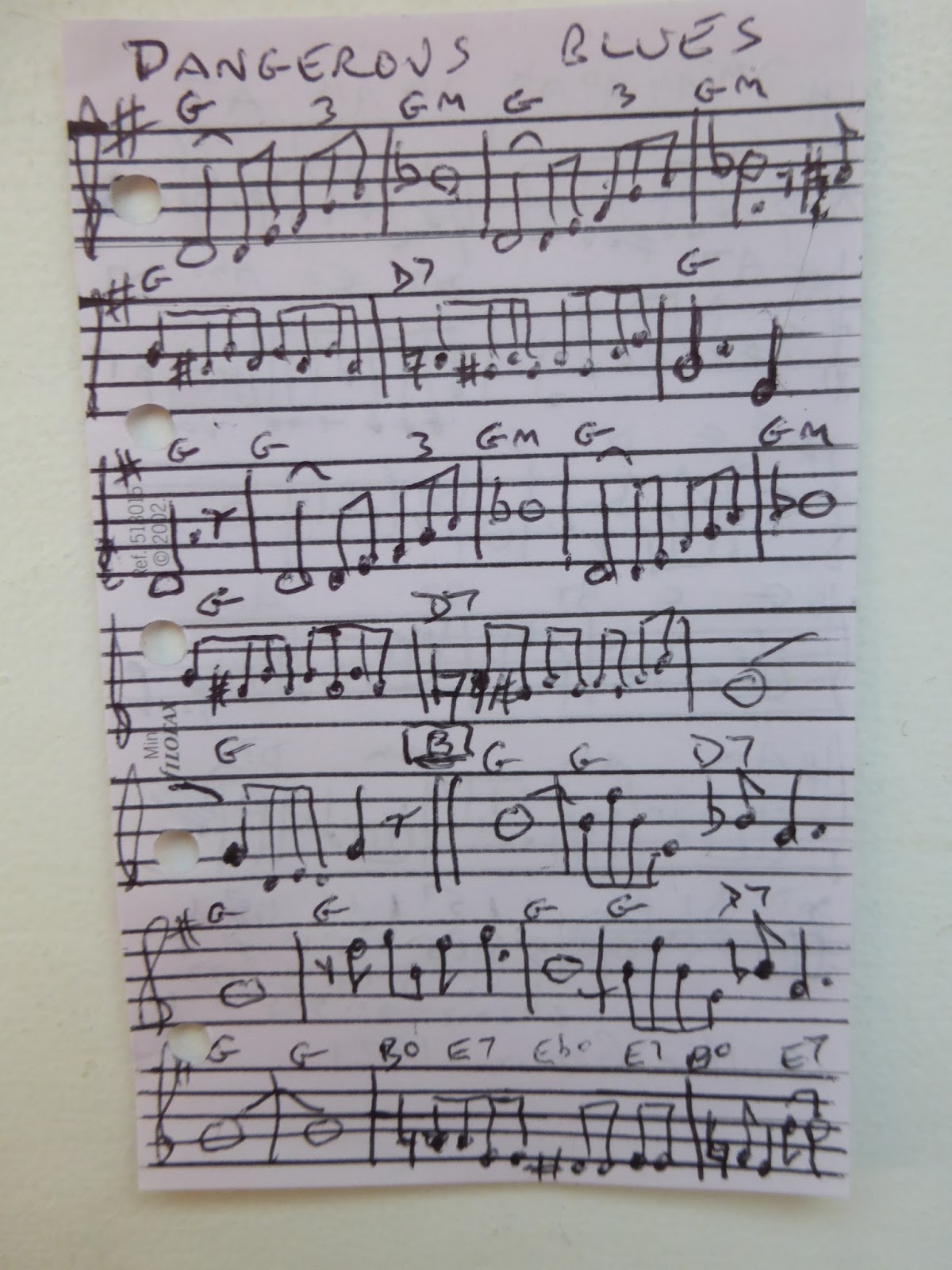
Here is my mini-filofax-stored attempt at Dangerous Blues:

The crazy lyrics of Dangerous Blues appear to be:

Ta de da da de dum. Ta de da da de dum.
There's a funny strain a'stealing through my brain
It drives me 'most insane it seems.
Ta de da da de dum. Ta de da da de dum.
If you listen now, I'll tell you what this
Ta da da de-dum means:
CHORUS:
Oh, I got them dangerous blues.
Naughty doggone dangerous blues.
Can't you hear the music playing soft and sweet?
It's the kind that makes you want to shake your feet.
I think I'm slippin'; I know I'm slippin'.
Ta de da de da de da de da de da de dum.
Weary, dreary dangerous blues;
they're the kind you hate to lose.
I can't even think,
So lay me out in pink.
Every time that saxophone it moans
I want to sink.
'Cause I got them doggone dangerous blues.
Oh, I got them dangerous blues.
Naughty doggone dangerous blues.
Can't you hear the music playing soft and sweet?
It's the kind that makes you want to shake your feet.
I think I'm slippin'; I know I'm slippin'.
Ta de da de da de da de da de da de dum.
Weary, dreary dangerous blues;
they're the kind you hate to lose.
I can't even think,
Can't even sleep a wink.
Every time I hear those mournful blues
I want to sink.
'Cause I got them doggone dangerous blues.


Footnote: a researcher found records of a couple living in Eureka Springs, whose names were William B. Brown and Anna Welker. They adopted in about 1895 a baby with the name Irene Anderson, who is believed to have been born the previous year.  The researcher suggested this could have been Billie's family and that this baby - despite her name - could have been Billie. If so, that would have made her about 27 when she died.

Although this speculation may be true, it raises troubling questions. How come Billie's age was given as 18 on her death certificate? How and why did it come about that her name changed from Irene Anderson to Billie Brown? How come she and her mother are recorded as living in Kansas City, so far (250 miles) north of Eureka Springs? Why did the William Brown in question, still living in Eureka Springs in 1930, describe himself as a widower in the Census of that year?


I prefer to believe the details given on the death certificate.
=================
FOOTNOTE

Pops Coffee's book Enjoying Traditional Jazz is available from Amazon:

Post 318: 'AMONG MY SOUVENIRS' CHALLENGES CONVENTIONS

Among My Souvenirs

Hundreds of popular songs written in the period 1910 - 1960 comprised four blocks of eight bars (total 32 bars), usually in the structure:

    a -    a -  b (the 'Middle Eight') -   a

or sometimes two blocks of 16 bars, such as:

   a(i) = 16 bars + a(ii) = 16 bars.


So I was surprised to notice that Among My Souvenirs, with music written in 1927 by Lawrence Wright (under the nom de plume Horatio Nichols), though sounding exactly like a 32-bar tune, in fact comprises 34 bars. What is more, the two 'extra' bars are not a conventional tag. They are arrived add by adding a bar to the second and fourth 8s. So the structure is:

a(i)  :   8 bars
a(ii) : 9 bars - repeat of the first 8 but with an added bar
b      : middle 8
a(ii)  :  9 bars

Unusual!

The tune can, however, be played in 32 bars, without many people noticing the difference. Probably traditional jazz bands would be more comfortable with 32.

The way to achieve this is simply to omit the 17th bar and the 34th bar.

Try it and you will see what I mean.

Post 317: 'I LOVE MY BABY'


The 1925 song I Love My Baby (by Harry Warren and Bud Green) has always struck me as a routine, ordinary number, unlikely to have any remarkable characteristics in its chord pattern. But I noticed recently that its first sixteen bars (and its second sixteen) begin with 4 bars on the Dominant 7th and then 4 bars on the sixth note of the scale. To put it simply, if you play the tune in the key of G, the first 4 bars will be on D7th and the next 4 on E7th.

Here's how it looks.
I am unable to think of any other tune that begins with eight bars structured 4 on the 5th and 4 on the 6th, like this. Could I Love My Baby be unique in this respect? If so, maybe that's what gives it the catchy effect.

I would be glad to hear from you if you can let me know of any other tune with this pattern.

Post 316: 'MOONGLOW'

At the request of a member of a little band in which I sometimes play, I added Moonglow to my repertoire.
This catchy tune was written in 1934 by Hudson, Delange and Mills.

As ever, I have used a Mini Filofax page for it. I chose to put it in the Key of G (for the convenience of playing on a Bb cornet). I kept the chord structure simple, though I am aware that more subtle changes would have been possible.

What strikes me about this tune is the way it cleverly teases the listener and thus achieves its striking effects. For example, the first bar of melody sounds like an anacrusis but in fact it really is the first bar proper. Also, the first two bars are based on the chords of C major and C minor respectively, even though the tune is actually in G. (After You've Gone, That's My Home, Glad Rag Doll and I Can't Believe That You're In Love With Me start in a similar way.)

In its principal 8-bar melody, Moonglow uses a simple two-bar theme three times. You could hardly devise anything less complex. But look at the changing harmonies and you find the first B natural is harmonised against C minor, the next one against A major (making in effect A9th) and the third B natural is played against a D major (making in effect a D6th). The final two bars of the eight (all on the melody note of G - again seemingly very simple) are played over the beautifully shifting harmonies of G, G diminished, A minor 7th and G again. What a super effect that achieves.

And what about the Middle Eight? They start with a G7. Fair enough. Surely that will lead smoothly into C major?
Oh no it doesn't. We descend exquisitely through F#7th and F7th to E7th! And the next four bars go (as we might expect) from A7th to D7th - but there is yet another surprise: we slide through C major 7th on the way!

Mastering this tune with the band should not be difficult. There are only 16 bars to learn, even though you have to play 32. I'm already thinking of the pleasure those teasingly beautiful harmonic games will give.

Post Script: After reading the above, Henry (Banjo, Germany) has sent me this chord chart for Moonglow, which his band uses. Thanks, Henry.