30 June 2017

Post 522: LOOSE MARBLES JAZZ MASTER CLASS!

I must thank blog reader Phil Lynch for recently advising me to watch a particular YouTube video. It has given me huge pleasure.

I am referring to a video of The Loose Marbles playing at Abita Springs in 2016. It runs for over 50 minutes and I will give you the link to it later.
Craig and the Bass Sax
The band on this occasion comprised no fewer than ten musicians. Normally, such a number could be a recipé for disaster. I dread to think what a horrible din would result if three guitarists, a banjo player, a drummer and a double bass all got together in the rhythm section of some of the English pub bands I have seen.

And yet, such a combination in The Loose Marbles is so disciplined and restrained that it underpins the music with a gentle foot-tapping pulse. Here, because the musicians are all virtuosos, all conforming to the house-style set by the leader Michael Magro, the music throughout is beautifully melodic and played with a loving delicacy. There is no mere exhibitionism, no attempt by any of the players to show off their own technical prowess. Instead, there is huge respect for melody, balance and for each other.

The reeds set the tone. Such tunes as Song of the Islands, A Flower Lei, Postage Stomp, Last Night on the Back Porch, The Isle of Capri (played briskly) and Home on the Range are all led by the clarinet. And in Take Me Out to the Ball Game, the first chorus is played on the bass saxophone by the versatile Craig Flory.

Yes, the tunes feature the bass saxophone; and Craig has an important rôle in this line-up, especially as - despite having ten musicians - there is no trombone.

Multi-instrumentalist Tyler Thomson is seen here among the guitarists; and he even gets to take a neat little solo in Isle of Capri. And that fine and sartorially-elegant musician Matt Bell plays slide guitar - with the instrument on his lap, producing some lovely Hawaiian effects. (Friend James Sterling has told me Matt is playing a resonator all-steel guitar and that the correct terminology for what he is playing is 'lap steel'.)

You have only to catch the happy look on Matt's face at certain points in this video to see that he knows the music this band is making is something really special.

The great Marla Dixon provides some very sweet vocals, for example in 'A Flower Lei' and 'Last Night, on the Back Porch'. And in her trumpet-playing, she adapts brilliantly to the requirements of the Magro style. We find her often playing deft, muted phrases in support of the melodies of the three reed players in this unusual 'front line'.

I must mention that the programme includes the song The Sweetheart of Sigma Chi. It is a lovely waltz tune. It is very rarely played and I guess many of my readers will never have heard of it. I can tell you Sigma Chi was a college fraternity founded in the mid-19th Century at Miami University in Oxford, Ohio. The song was composed in 1911 by Byron D. Stokes (words) and F. Dudleigh Vernor (music).

The final tune in the programme is Tight Like This - a catchy minor-key number composed by trumpeter Langston Curl in 1928 and made famous by Louis Armstrong.

The musicians I have not yet mentioned are Julie, Tomas, Max, Robin, and John - all of them superb and on absolutely cracking form.

I have written before about The Loose Marbles and the importance of this band in 21st-Century traditional jazz. To read my article, CLICK HERE.

To enjoy the video for yourself:

27 June 2017

Post 521: 'DEAR ALMANZOER' (TUBA SKINNY)

'Dear Almanzoer' was composed in 1927 by Oscar ‘Papa’ Celestin and was recorded in New Orleans by his band in April that year.

You can watch a video I made of Tuba Skinny playing this tune:

In their performance, Tuba Skinny have kept very closely to the structure of the original recording, even though their instrumentation is slightly different from Celestin's. Playing, like his band, entirely in the key of E flat, they open with the 16-bar VERSE (03 seconds – 26 seconds). This VERSE, which unfortunately is played only once in the entire recording, is in my opinion the most attractive part of the whole piece: it is both catchy and merry. It ends on the chord of B flat 7th, which leads neatly into the tonic at the start of the 32-bar CHORUS (played from 27 secs. to 1 min. 12 secs.).

After this, there are FIVE successive improvisations on a 12-BAR BLUES structure. The opening two are played by the clarinet (Jonathan, 1 min. 13 secs – 1 min. 47 secs.). EXACTLY AS ON THE CELESTIN 1927 VERSION, Jonathan’s first Chorus is backed by off-beat stop chords and the second by single and double stop chords. Getting this tricky rhythmic pattern right is a fine example of the care and trouble Tuba Skinny take in preparing their music for public performance.

The third 12-bar blues is taken by Shaye on cornet (1 min. 48 secs. - 2 mins. 04 secs.); and the final two by Barnabus on trombone (2 mins. 05 secs. - 2 mins.40 secs.). Note here a very small difference from the original Celestin recording: Tuba Skinny have reversed the order of events with the cornet and trombone solos.

To end the piece, Tuba Skinny (like Celestin) do not go back to the Verse (which is a pity in my opinion, as it deserves a second hearing); instead they simply play through the 32-bar CHORUS one more time, ending with a double snap from Robin's cymbal.

When I filmed this video (in 2015), the only vantage point I could get in the large crowd was right behind Jonathan. However, I hope this angle helps you appreciate Shaye’s fingering and also the energy and hard work she has always put into her playing. Unlike most cornet and trumpet players, she rarely allows herself a break. When she is not leading the ensemble or soloing, she still contributes – gently decorating the solos of Jonathan and Barnabus.

The whole performance is so respectful of, and faithful to, the original Celestin recording. It shows beyond doubt the loving care with which Tuba Skinny re-create such forgotten gems from long ago. 'Dear Almanzoer' may also be heard on Tuba Skinny's 'Blue Chime Stomp' CD, recorded in 2015, in a performance remarkably similar to this one, though Robin, like percussionist Abby Foster in the 1927 Celestin recording, at the very end gives only a single snap on the cymbal, rather than a double.

24 June 2017

Post 520: WHERE IS DECATUR STREET? IN NEW ORLEANS?

Have you heard Decatur Street Blues? I expect you have. If not, you can enjoy a lively 1922 performance of it made by Leonia Williams and Her Dixie Band BY CLICKING HERE.

Leonie was a native of New Orleans and her 'Dixie Band' comprised five musicians, - Phil Napoleon on trumpet, Frank Signorelli on piano, Miff Mole on trombone, Johnny Costello on clarinet, and Jack Roth on drums.

The song was composed in 1922 by Tausha 'Tosh' A. Hammed and Clarence Williams, with words by Mercedes Gilbert.

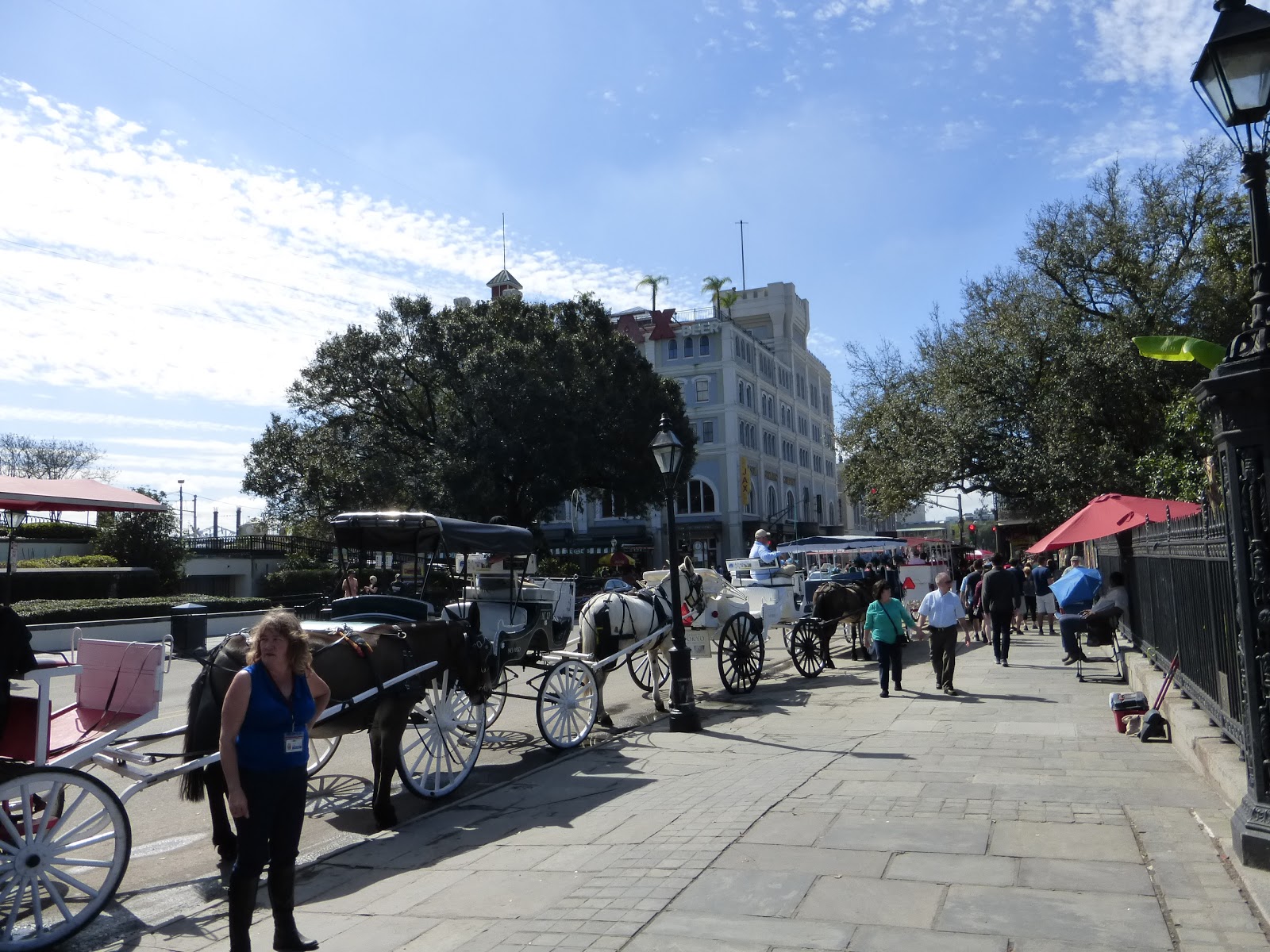
I thought until today that the title of the song referred to Decatur Street in New Orleans. (By the way, they pronounce it Di - CAYY - ter, with the stress on the second syllable.) This is one of the favourite roads of every visitor to the French Quarter - this road, in fact:
But today, giving close attention to the words of the song, I found it's actually Decatur Street in Atlanta, Georgia! We're even told to hear a gentleman called Eddie Heywood 'whip those ivories' down 'at eighty-one'. This would be the Atlanta jazz pianist Eddie Heywood, whose son - also called Eddie Heywood - became even more famous and ran a sextet in the 1940s.

I guess the scene has changed beyond recognition since Eddie played there.
Decatur Street, Atlanta - today.

21 June 2017

Post 519: 'GRAVIER STREET BLUES' AND JOHNNY DODDS

The year was 1954 and I had discovered the wonderful early New Orleans-style jazz music coming to us in London on recordings from America. One of the first - what a great introduction to the heady effects of raw New Orleans jazz! - was Gravier Street Blues, composed by Clarence Williams in 1924 and played by Johnny Dodds and His Orchestra. The recording was made in 1940. I have recently learned Johnny recorded it, in fact, just two months before he died.
Johnny Dodds
This tune - catchily melodic, even though largely made up of simple riffs played in a 'bluesy' manner - galvanized my interest in this branch of music. I loved the combination of Johnny's clarinet with Natty Dominique's cornet. 

On the recording, there are, incidentally, good solo choruses from Johnny himself and from Lonnie Johnson on guitar.

As was often the case in the days of 78rpm recordings, the whole piece is completed in about two and a half minutes - a lesson to us all in the impact value of brevity.

A Johnny Dodds enthusiast has generously put this recording on YouTube for us all to enjoy. So please see whether you can share my enthusiasm:
https://www.youtube.com/watch?v=EIRKIP_k1Tw
Gravier Street, by the way, is very central in New Orleans. It runs parallel to - and between - Tulane Avenue and Perdido Street, not far from 723 Jane Alley, where Louis Armstrong was born.

I struggled to work the tune out for my mini filofax system and came up with a version typical of my amateurish approach. But then I found the great Lasse Collin had put up a leadsheet on his site: http://cjam.lassecollin.se
So here is Lasse's, followed - for what it's worth - by mine.
Many thanks, Lasse:
Mine:


18 June 2017

Post 518: IS TRADITIONAL JAZZ 'ERUDITE'?

I was at a traditional jazz concert recently when a lady in the audience said she was enjoying it very much but that she didn't 'normally listen to such erudite music'.

I was struck by the word 'erudite', partly because it's not a word you often hear these days, but even more because it was a word I had never myself applied to traditional jazz.

However, when I reflected on it afterwards, I came to see that it really was a clever choice of word and very appropriate to our music.

If we think of traditional jazz only as a pleasant noise that makes us tap our feet and want to dance, we are missing the enormous amount of learning that lies behind it. And the greatest musicians make it look so easy that we may not recognise how 'erudite' it is. 
The Merriam-Webster Dictionary defines 'erudite' as 'having or showing knowledge that is gained by studying'. The Concise Oxford Dictionary tells us that 'erudite' means 'remarkably learned'. It comes from the Latin erudire, meaning to instruct.

When you think about it, you find a huge amount of erudition behind every performance of traditional jazz.

The musicians have had to:

master the techniques of playing their instrument(s) [many hundreds of hours of practice];

study the history of traditional jazz and learn from the work and recordings of past masters;

learn to play in various keys and become fluent in the appropriate chords and arpeggios - major, minor, diminished and so on - and be able to improvise freely around them;

study and learn to use syncopation, riffs, jazzy devices and a variety of tempos and rhythms; 

understand the structures of the tunes;

learn and hold in their heads the melodies and harmonic progressions of many tunes [often hundreds];

study the role of their own instrument and use this knowledge effectively in contributing to the playing as a team-member;

master the conventions and the methods of communication within a performance.
Compared with most conventional kinds of musicians who play instruments directly from printed music and without any requirement to improvise or deviate from what is written, jazz musicians may be considered exceptionally erudite.

Imagine you would like to speak a foreign language but you are starting from scratch. Think how much study it will take for you to reach a point when you will be able to hold a fluent natural conversation with native speakers of that language.

Learning to play an instrument in a traditional jazz band is very similar to that.

Yes, well said that lady: traditional jazz is erudite all right.

15 June 2017

Post 517: BEGINNERS' FAKE BOOK

I have written before about the value of fake books (sometimes called 'busker's books') to traditional jazz musicians, especially in the early stages of mastering your craft.

But beware. Some fake books - though crammed with tunes - are not as helpful as you may expect. They contain very few tunes the traditional jazz musician is likely to play.

But you can find less pretentious books that provide the leadsheets (words, notes and chords) of quite a few essential tunes. Such is 101 Pub Favourites for Buskers. Pub favourites tend to be in most cases traditional jazz favourites too; and they are often among the simplest tunes you need to master.
So from this book, for example, you can learn such tunes as After the Ball, You Always Hurt the One You Love,  Ain't She Sweet, Bill Bailey, On a Slow Boat to China, Nobody's Sweetheart Now, I'm Gonna Sit Right Down and Write Myself a Letter, I Can't Give You Anything But Love, and so on. Here, for example, is On The Sunny Side of the Street - as you can see, very clear and easy to learn from. AND it even includes the Verse (which many musicians don't know).
I bought this book way back in 1986, would you believe, when I was at the stage of getting started and trying to play a few simple tunes in a group formed by three friends. It was produced by Wise Publications. There were several others in the '101' series.

I doubted whether these books were still on sale three decades later. But a quick internet search showed me that you can easily still order a new copy for about £18 (i.e., U.K. price) or you may obtain a used copy much more cheaply.
==========
By the way, if you may be interested in reading my e-Book called 'Playing Traditional Jazz', which is for jazz players and would-be jazzers, click here:
https://www.amazon.com/dp/B01MS38JVI
This will let you sample-read a few pages.

12 June 2017

Post 516: HOW TO MANAGE A JAZZ BAND

It's tough being a band manager. That's why I think it's the duty of all members of a band to support their manager in every way they can and to appreciate his efforts on their behalf.

What do you think is the most important skill a band manager needs? Playing an instrument outstandingly well? Wrong. If you want to run a band that attracts plenty of worthwhile gigs, your business skills are likely to be more important than your musical skills.

In my view, here's what a band manager needs.

1. Man management
Recruit the right musicians and keep all members of your band content and well-behaved - and happy to be part of the team.
2. Customer-relation skills
Courteous and meticulous attention to customers' comments and correspondence.
3. Common sense
For example, don't waste time quoting a fee the client obviously can't afford. Don't play music inappropriate to the occasion.
4. Musical expertise
Obviously essential, but less important than business skills.
5. Optimism
Don't be disheartened by knocks and setbacks. Always smile and look cheerful on stage.
6. Policy
Costume, style, repertoire, etc. Read my blog post about this by clicking here.
7. Willingness to devolve
Let other members of the band be the Musical Director and the Announcer if they are better qualified for these duties.
8. Business and marketing skills
Publicise your band in the most effective ways. And always have business cards available. 
9. A sense of humour
An obvious help - especially in the jazz world.


Here's another bit of advice. Communicate with your audience!

I remember a classical music concert at the Wigmore Hall in London. At the start, amidst applause, the musicians walked on to the stage, and without a word took their seats, played their two pieces, bowed and went off. After the Interval, exactly the same procedure occurred.

The musicians were some of the best in the world. Their playing was sublime. But throughout the two hours of the concert, nobody spoke one word to the audience. This is a convention with some classical music performers, but I think it is a pity. 

I have attended some classical concerts where the musicians have told the audience something about the music and have given a few other bits of information about themselves and where else they will be playing. On one occasion The Wihan String Quartet pleased the audience with a question-and-answer session.

In traditional jazz, too, when you have been booked to give a formal concert and your audience is politely seated, listening attentively to all you play, I think it is important for the band leader - or someone acting as spokesperson/announcer - to have a few words with the audience between tunes.
Speaking to the Audience:
Kenny Ball was a jazz musician who
set a good example.
This is good for achieving a rapport and is also helpful in letting the audience know something about the tunes, the history of our music and about the band.

It is inexcusable to take no notice of the audience between the end of one tune and the start of another, as I have occasionally seen bands do. Why do some bands not even tell the audience the titles of tunes with which they may be unfamiliar?

Remarks to audiences don't have to be profound or scholarly. They can be relatively trivial. For example, you could say which towns the musicians come from. You could say where you have been performing recently. You could tell them it's the banjo player's birthday. Little scraps like this help to establish a good relationship.

And don't feel compelled to tell jokes. There's no need to do so unless your timing and delivery are good and the jokes are of a kind that will not give offence.

Speaking to an audience is not easy. So regard this as another skill you need to develop. It may even be worth practising things you will say.

Something else to avoid is the poor discipline we often witness. Between tunes, members of the band on stage talk among themselves and guffaw at each other's comments - while the audience is left with no idea what is going on.

And there's no excuse for the band members to argue among themselves about what to play next, while the audience sits waiting. From the audience's point of view, this kind of behaviour is irritating. But some bands are guilty. Cut it out!

9 June 2017

Post 515: SET THE STOPWATCH!

Here's something we can learn from those 1920s recordings: even tunes with two or three themes can be given a very good performance in under four minutes if they are well presented, with the emphasis on ensemble work.

I have been listening again to recordings made in 1927 by the great Sam Morgan's Jazz Band. Their versions of Bogalousa Strut and Mobile Stomp are both completed in under three minutes.

I also listened to some of the historic recordings made by the Armand Piron Orchestra in the 1920s. Their recording of the tricky 3-parter Bouncing Around runs for less than three minutes. The classic Mamma's Gone Goodbye takes just over three minutes.

And yet these recordings are exemplary - totally enjoyable and satisfying. They do not leave us feeling they are too short or that the tune is incomplete. The arrangements and the ensemble work are exciting and tight. The performances even incorporate clever little introductions and codas, perfectly executed.

Compare this with the playing of so many bands today. Tunes are spun out for seven or more minutes with almost all members of the band taking 32-bar solo choruses (sometimes two choruses). The tune drags on repetitively even though the band has nothing more to 'say'.

Yes, I know those early recordings were limited to about three minutes because that is all the recording processes of the time could cope with. But this discipline made the musicians produce their very best - distilling music of the highest quality within the imposed time limit.

May I suggest we give this matter some thought?

One bandleader friend has recently done so. Within his programme he deliberately includes a number of good tunes that he wants his band to play in about three minutes. This is achieved by omitting solo choruses and putting the emphasis on getting the tunes right, with clever interplay between the instruments.

To hear how it was done - way back in 1927 - click on this video. It's the Sam Morgan Band.
https://www.youtube.com/watch?v=JdOnRREDTuw
================
Reader James Buck has sent this comment:

Ivan,
I could not agree more.  No wonder some people are put off jazz by extended solo choruses that do and say nothing to the audience.

Best wishes, regards,
Jim.

6 June 2017

Post 514: WHO'S ON TROMBONE? - ANSWERS

In Post 513, I offered you a little picture puzzle. Who were the four trombonists?


A.
B.
C.
D.
The answers are:
A. Jim Robinson
B. Louis Nelson
C. Haruka Kikuchi
D. Charlie Halloran


Congratulations to all who sent in correct answers. The first three were Cleber Guimarães of Brazil, Marinus-Jan van Langevelde of Holland, and Ann Cuthbertson of Australia.

3 June 2017

Post 513: WHO'S ON TROMBONE?

Today a little picture puzzle for you.

Can you identify these four great traditional jazz trombonists - two from the past and two very active today.


A.
B.
C.
D.
I will publish the answers in Post 514 on 6 June. I shall include the names of the first three people to send me the correct answers. If you would like to take part, do so by e-mail to:
ivantrad (at) outlook (dot) com