Welcome, Visitor Number

Translate

26 October 2016

Post 441: MINOR KEY VERSE; MAJOR KEY CHORUS

With thousands of tunes available in the traditional jazz repertoire, there are bound to be many that musicians never learn or get to play. However, I am sure we all keep striving to learn new ones - especially those we have been intending to pick up for months.

That's why I set about learning I'm Coming, Virginia today. It was a tune composed in 1927 by Donald Heywood and Will Marion Cook. I first enjoyed it on a Jack Teagarden recording decades ago. And of course the Bix Beiderbecke version is a classic.

I wanted the full song - Verse included. So I found the 'dots' on Lasse Collin's wonderful site (many thanks, Lasse!) and I entered them into my mini filofax system.
But what was this? The verse was in a minor key but the Chorus was in the major.

This made me wonder how often this switch from minor to major occurs in the popular old songs.

I guess there must be many whose verses in minor keys have been long forgotten and only the Chorus is now played. An example is the very popular Hindustan. It has a minor-key 16-bar verse, but I do not recall hearing any band play it in recent years. Similarly, Japanese Sandman has a 20-bar Verse in a minor key (usually Eb minor), followed by a 32-bar Chorus in the major key (Eb major, usually).

I think I'm right in saying that At The Jazz Band Ball, That Da Da Strain, She's Crying For Me, Shim-Me-Sha-WobbleWillie The Weeper and Lil Hardin's Droppin' Shucks all start with a minor theme and then have a second theme in the related major key. And the 1929 song The Ghost of the St. Louis Blues by J. Russel Robinson, with words by Billy Curtis, certainly has a 'spooky' minor Verse with a major Chorus. Exactly the same is true of Chloe.

Another is a nearly-forgotten song called I Don't Know Nobody Here and Nobody Knows Me, composed in 1924 by Jo Trent and Will Donaldson. The piano music shows a 16-bar Verse in D minor leading into an 18-bar Chorus in the key of D major.

And Lil Hardin uses the minor very heavily in the early stages of Perdido Street Blues before inviting the musicians to play 12-bar choruses in the related major key.

Cole Porter worked wonders with the minor-major effect in I Love Paris, where the first sixteen bars offer a lovely melody in a minor key and the second sixteen - like a flower suddenly blossoming - use virtually the same melody an octave higher but now in the major key.

Cole Porter plays a similar trick in My Heart Belongs to Daddy, which is essentially in a minor key, though there is a 'blossoming out' into the major in the second half of the Chorus, before the tune settles back on the minor in its final bar. And if you look closely at Cole Porter's You'd Be So Nice To Come Home To, you discover that he very skilfully contrasts minor with major chords.

There are tunes such as I'm The King of the Swingers, where we begin in the minor (I'm the King of the Swingers, the Jungle VIP.....) and then switch to the related major key (Oh oobee do, I wanna be like you.....) for the second half of the Chorus. And I think Mama's Gone, Goodbye may be said to have a minor verse leading into a major chorus.

But I am stumped in trying to think of other interesting examples.

Maybe you can help me?
=============
Reader responses

It seems that readers are just as stumped as I am. Only two responses have arrived so far. Robert Duis in the Netherlands offers Chega De Saudade, which has a verse of 32 bars in the minor, followed by a 36-bar chorus in the major. It is a 1958 bossa nova by Antonio Carlos Jobim. I have not personally heard a traditional jazz band play it. And Richard Bogen in Phoenix, Arizona, has told me that Shine On Harvest Moon (music composed in 1908 most probably by Nora Bayes-Norworth) has a 16-bar Verse in the relative minor. I did not know the Verse, but I have found it on the internet and yes: Richard is right.
===========

23 October 2016

Post 440: THE EXTRA CRISPY BRASS BAND

I discovered The Extra Crispy Brass Band during explorations on YouTube recently. I had not previously come across this group.
I enjoyed what I heard. And a good thing about this band is that its members are relatively young.

I have since found out - easily enough from the internet - that the band was formed in 2011 and is based in Milwaukee, Wisconsin. That's more than 1000 miles north of New Orleans; or, to put it another way, it's on the west shore of Lake Michigan, about 90 miles north of Chicago.

The Extra Crispy Brass Band aims to play in the tradition of such New Orleans brass bands as The Dirty Dozen and The Olympia. Indeed, the band was founded and is led by trombonist Gregory Cramer, who used to live in New Orleans.

As is common practice with brass bands, there are no chord players (banjo or guitar) but they double up with two trumpets, two trombones and have at least one saxophone. The percussion (two players) is the essential department. Such bands of course usually have as their basis great rhythms laid down by the drummers and sousaphone, generating pulsating riffy excitement. This band certainly works that way.

For a well-made video to give you some idea of their appearance and sound, CLICK HERE - where they are playing Royal Garden Blues.

Or CLICK HERE for sounds even more typical of the street parade bands.

20 October 2016

Post 439: SIT OR STAND TO PLAY TRADITIONAL JAZZ?

Should musicians be seated while playing traditional jazz? My answer is YES.

Obviously there are circumstances where musicians have no choice. If you play in a street parade, for example, you have to be on your feet. And some string bass players and sousaphone players claim to be more comfortable standing up. That's fair enough; though even some of them can and do sometimes benefit from using a chair or perching on a stool.

I have heard it said that trombonists need to play standing up to give 'freedom to their lungs'. I do not accept this argument. Classical orchestral trombonists - who are almost invariably seated - have no difficulty in producing a triple forte when required. And our best young trombonists today (such as Barnabus Jones) happily play sitting down.

As a general principle, I believe our musicians should be seated whenever possible. Why? Because you need to be comfortable and relaxed to contribute well in a traditional jazz ensemble. You are less likely to over-blow and more likely to listen carefully to your colleagues. The teamwork will be better.

I have written before about the layout of bands and recommended that the formation should be a semi-circle or arc rather than a 'front line' with other musicians behind it. Combine this with having everyone seated and you have the perfect formula for good teamwork and communication.

AN ARC:
Perfect for relaxed playing
and good communication within the band.

But when we see a trumpet and trombone at the front of a stage, the instruments pointing directly over the heads of the audience, there is something inherently exhibitionist and aloof in the very posture. Unless the musicians are specially careful, it encourages playing that is too loud and it diverts their attention from where it should be - on how the band as a whole is sounding.
That's the way to do it!

Look at photos of the great bands from the early days of our music. Clearly, they enjoyed being well supplied with chairs.


The evolution of the standing, pretentious 'front line' seems to have occurred later.

I am pleased to note that in recent years, even though the fashion for standing up still persists in many (mostly long-established) bands, the younger generation of fine traditional jazz musicians generally adopts a comfortable and relaxed seated posture and a formation that enables them to put teamwork first.

When you are eighty-two years old, I can tell you playing a two-hour gig standing up is very tiring. That's another overwhelming reason for being seated!

17 October 2016

Post 438: AT THE JAZZ BAND CONCERT - PLAYING REQUESTS

It often happens - especially at less formal gigs - that bands receive requests from the audience to play particular tunes.

Should the band play requests or not?

I have come across bands who have a fixed playlist to which they adhere rigidly, refusing to take any requests. On the whole, I think this is a pity. However, I can appreciate that the musicians in such cases want to sound as competent as possible and want to be heard at their best, especially if they have a well-prepared, well-rehearsed programme.

Sometimes a band receives a request that seems crazy in the circumstances. For example, a trio comprising clarinet, guitar and string bass is asked to play South Rampart Street Parade - a number that requires a big band and, ideally, at least one powerful trombonist. Or you have a request to play Stranger on the Shore (a clarinet feature) at a time when there is no clarinetist in the line-up. The person making the request is thinking of the pleasure he derived from recordings and is unable to grasp the limitations of the instruments in front of him.

Surprisingly, I have seen some musicians attempt to oblige even when 'asked for the impossible' in this way; but the result is more often than not disappointing. So it is better to deflect such requests and explain why they are impractical.

An irritating experience that I'm sure many musicians will recognize is this: someone comes up to you and requests a tune; you agree and start playing it for him. Then you notice that he has wandered off into the distance and is in animated conversation with somebody, neither of them bothering to listen. What is the point of such requests? I have no idea. Maybe such people simply wish to show off to their friends that they actually know the name of at least one tune!

I have been present on occasions when a band has been requested to play a tune that is obviously not in its repertoire. Two or three of the musicians say they vaguely know it and the band agrees to 'give it a go'. The result has usually been messy and it would have been better if the band had simply declined the request. I accept that audiences seem to admire these brave attempts but on the whole I do not think it is good for a band in public performance to be seen struggling.

The tunes most often requested (in my experience) are When The Saints Go Marching In, Sweet Georgia Brown, Stranger on the Shore, Twelfth Street Rag and Tiger Rag. All bands can play these very readily - they have had to do so hundreds of times. Some musicians groan when they are asked to play When The Saints yet again; but it is their job to please the public, so their best tactic is to blot out memories of all previous performances and do their best to play the tune in a fresh and appealing manner.

On the whole, I think bands have to put the customer first and should welcome requests. But they should also be prepared to say a polite 'No' rather than risk making fools of themselves.

12 October 2016

Post 437: BAD, BAD, CLARINET PLAYING! AND 'HIAWATHA RAG'.

I have touched on this subject before; but it is a particularly sore topic with me right now, following an experience a few days ago.

I am referring to a bad habit of a few clarinet players. Sometimes they play the melody for all or most of the ensemble work. In other words, they duplicate the trumpet-player's job.

My worst experience of this was several years ago. The tune Hiawatha Rag was announced. As you probably know, this is a lively and interesting number, played at a bright tempo.

For a pleasant video of the tune played well:
It's not easy, because it has a special introduction, followed by Theme A, which involves some pretty runs, and then Theme B - with a kind of marching motif. Then Theme A is played again before the band moves (with a change of key) into the final 32-bar Theme C, on which solos are improvised. To finish, you play a coda that is extracted from Theme A.

Immediately after we started, I noticed the clarinet man was playing nothing but the trumpet part - my part. So we were on exactly the same notes. How pointless. I tried hard to switch to a sort of clarinet part on my trumpet, but I was struggling. When we came to Theme C, the clarinet was still tootling away on the precise notes of the melody. As this is the main theme and frequently improvised upon, I found it a bit easier to create a sort of 'clarinet part' on my trumpet at this stage.

Goodness knows what the clarinet player thought he was doing.

(In the video mentioned above, by the way, the clarinet takes the first time through Theme C as a solo. This is fine and had obviously been agreed by these good folk in advance - to give the trumpet a break.)

And now, at a recent gig, with a different clarinet player, I had another bad experience. Most of the gig went well, and the clarinet man did his job efficiently. But in two of the tunes, I heard him doggedly playing the melody. These were easier tunes than 'Hiawatha Rag', so I managed to improvise some sort of counter-melodies without too much difficulty when I realised what was happening. But then he would suddenly drop the melody and start to play a more conventional clarinet part. This made the band sound poor: for a few seconds nobody was playing the tune. I would rapidly get back to it, only to find that he followed me - on exactly the same notes!!

So may I appeal to clarinet players?  If you are tempted to do this kind of thing, please discuss it with the trumpet player first. Nobody minds the clarinet taking the lead in an ensemble occasionally but this should not happen in a way that takes fellow musicians by surprise and causes problems for them.

11 October 2016

Post 436: YOUR LOCAL BAND NEEDS YOU!

The world of traditional jazz desperately needs more musicians - especially young ones. I have written on this subject before (about three years ago) and hundreds of people read the article, so it seems to be a topic worth considering again.

Would you consider playing in a traditional jazz band? How should you go about it?
You must start by reaching a reasonable level of technical proficiency on your chosen instrument. If you are a complete beginner, you will need lessons to get you started, mainly to set you up with good habits. I would recommend finding a qualified professional music teacher rather than someone who happens to play traditional jazz. (Players do not necessarily make good teachers.) Make sure you learn about scales, keys, chords and arpeggios and it will help if you learn to read music, at least at a basic level. After that, practice will be your main pursuit.
If you are already a competent musician, it does not follow that you will move easily into traditional jazz. Good piano soloists sometimes find it hard to adapt to their rôle in a band. Teamwork is the key to success in traditional jazz and players of the piano, guitar and banjo have to accept that for most of the time their job is simply to lay down the correct chords, firmly and clearly, rather than display virtuoso skills.

The one exception may be highly-skilled double bass players. If they are willing to adjust to the style and hardly use the bow at all, they can contribute extremely well with nothing more to guide them than the band's chord book. I remember how, during the 1950s, there were some double bass players, members of the symphony orchestras based in London, who would finish a concert with their orchestra and then head to a jazz club where they would join a traditional jazz jam session. It was easy enough for them to jump from Handel to Handy and from Mozart to Morton.

Becoming good enough to perform traditional jazz in public doesn't mean passing lots of exams. But be warned: it can take hundreds of hours of hard work in the woodshed.

You should start early on learning some tunes from the traditional jazz repertoire - easy ones to begin with. Laissez Les Bons Temps Rouler is a particularly good and easy one as it is fun but uses very few notes and virtually only two alternating chords.

Soon you could try Algiers StrutTin Roof BluesWhen The Saints Go Marching InCareless LoveDown By The Riverside, and Lily of the Valley.
There are plenty of sources of printed music, such as busker's books. But an excellent site you should consult is Lasse Collin's, where there's enough to keep you going for years: CLICK HERE TO VIEW.

And here's an important tip: when you first learn a tune, make sure you learn it accurately. If you get into a habit of playing a phrase or a sequence of chords wrongly, it is very hard to unlearn them later, after the tune has become embedded in your brain and fingers.

Develop an understanding of and fluency in different keys. Those most commonly (but by no means exclusively) needed in traditional jazz are Bb, Eb and F. Next most common are Ab and C.

Listen to lots of traditional jazz - especially noting the part played by your chosen instrument - to get a feel for what is required. Use the wonderful resource of YouTube. When you are ready, try playing some tunes along with bands on YouTube. That's almost as good as 'sitting in'.

A similar idea is to play along with backing tracks. Some of these are also freely available on YouTube. This will give you a great chance to assess your progress because, if you are confident and not discordant with a backing track, the chances are you will fit in with a jazz band.

Link up with other musicians. Maybe you can form a band in your town, starting with a nucleus as a trio or quartet. Meet regularly in one of your houses to rehearse and expand your repertoire.

How do you find these musicians? Put the word around among all your friends and acquaintances. Chat in the local music shop. Advertise in the local newspaper. See whether anybody in a social group is interested (e.g. in England, the U3A). There may be a regional website on which you can seek (free of charge) other musicians.

Listen to live traditional jazz bands and talk to the musicians: they are very good sources of information about both learners and established players in the area and may be able to put you in touch with people who could join your group.

For information on which bands are playing where, there is probably a regular publication you can consult. For example, here in England we have the monthly Jazz Guide - available in clubs and from bands and also by post if you pay the very reasonable subscription (payments by PayPal are accepted). You should be able to see a sample page and full information by clicking HERE.

And specifically for the North-West of England, a gentleman called Fred Burnett altruistically runs a website giving full bulletins concerning jazz in his region: click here.

When you feel ready, begin to practise more challenging and more complex tunes: there are hundreds in the repertoire.

Unless you are a born genius, you will need to learn the standard chords and also practise improvising your way though common chord progressions. In particular, work on the Circle of Fifths and The Sunshine Sequence and the basic 12-bar Blues Sequence as these will be useful in hundreds of jazz tunes. If you don't know what I mean, look at the blog posts in which I have written about them.

Are you worried about improvising? Watch Charlie Porter's excellent videos. For an example CLICK HERE.

When your group is good enough at fifteen or so tunes, start playing gigs! You can give your band a name and offer yourselves for free to a local pub or residential home and get your band officially launched.

Also, when you have built up confidence by playing along with YouTube, ask whether you may sit in for a couple of tunes with an existing band. Most bands are so keen to keep the music alive that they readily give opportunities to anyone who shares that mission.

Make sure you give your telephone number and email address to everyone who may be able to help you in the future - especially band-leaders. It may be worth having some business cards printed.

Band-leaders and agents keep lists of musicians within a radius of seventy miles. You never know when you may receive a call to deputise for a musician who is ill or on holiday.

Eventually you may succeed in obtaining a place in a reputable well-established band. There is a rapid turn-over of personnel and a need for new blood, especially these days when many elderly musicians are hanging up their trumpets and clarinets.

Most of today's traditional jazz musicians have gone through the stages I have described above, except that in their day they did not have the enormous benefit of YouTube and such sites as Lasse Collin's to help with learning and training. In years gone by, players had to listen to records and later to cassettes in order to pick up tunes by ear and learn from the masters.

8 October 2016

Post 435: KAT'S GOT KITTENS!

One of my friends says every jazz programme should include at least one bit of nonsense. And I know a couple of fans who constantly request The Cat's Got Kittens (often written as The Kat's Got Kittens).

It is not a tune that's easy to find on YouTube - or anywhere else. I don't know its origin. But the earliest recording of it seems to have been made in New Orleans on 15 May 1945, when the singer was Edward 'Noon' Johnson (1903-1969) and the supporting band included George Lewis, Lawrence Marrero, Baby Dodds, Bunk Johnson and Alcide Pavageau. Here's a picture of Noon Johnson in later years, playing an instrument he invented - the bazooka - along with Kid Sheik Colar (trumpet) and George Guesnon (banjo).
The Cat's Got Kittens could have been 'composed' by anybody (maybe Noon himself). All that was needed was to put some nonsense words and a slightly different melodic emphasis to You Can't Escape From Me (aka San Jacinto Stomp), (words by Charles French, music by Erskine Hawkins and Sammy Lowe). It was published and recorded in 1939.

Fifty years after the Edward 'Noon' Johnson recording, The Cat's Got Kittens was popularized by Cliff 'Kid' Bastien (1937-2003), when he played for years in Toronto.
Cliff 'Kid' Bastien
You can access his storming version - and purchase it, if you wish - BY CLICKING HERE. (Then click on the arrow to make it play.)

And Marla Dixon - herself from Toronto and inspired by Kid Bastien's band - can sometimes be persuaded to sing it at The Spotted Cat in New Orleans, with The Shotgun Jazz Band.

It's a merry and simple tune to play. It works well in Bb. Need the chords? Just think You Can't Escape From Me. I am deeply indebted to my friend John Whitehorn for supplying me with copies of the sheet music.

For a clear performance by a British group CLICK ON TO THIS VIDEO. It's the The Black Cat Jazz Band.
--------------------------------
Footnote:
Friend and Correspondent Carsten writes:
I, in turn, was doing a bit of research in relation to 1930s British dance bands and suddenly had my memory jogged about Henry Hall's recording of An Elephant Never Forgets (they famously recorded Bananas, too, of course).  In case it's capable of incorporation into your humorous repertoire, here's a YouTube clip - my favourite line in the lyrics is "You can soft-soap an antelope, but an elephant never forgets".   https://www.youtube.com/watch?v=1rqC4gje5_c

5 October 2016

Post 434: WHAT ARE 'BLUES'?

A reader asked me to explain the type-names we come across in traditional jazz tune titles. 'What is the difference between a Drag and a Rag?' he asked. 'What exactly is a Stomp? How do you define Blues?'
Little did he know I am just as confused about these matters as he is. There is plenty to read on the subjects, both in books and on the internet; but agreed definitions are not easy to come by.

Worst of all is trying to define Blues. In the 1940s, the first 'Blues' I became aware of were the songs of Bessie Smith and her contemporaries. There were tunes such as Backwater Blues and Blue Spirit Blues. I was led to believe the Blues were mournful songs, expressing suffering or regrets, or at least wistfulness and nostalgia. The books I read suggested they had arisen from the chanting of African slaves and were structured on a familiar twelve-bar chord pattern (three four-bar blocks). They used a scale in which flattened thirds, fifths and sevenths were common.

But just think of the heritage of tunes with 'Blues' in the title today.

There are songs called 'Blues' that are really just run-of-the-mill pop music of ninety years ago (normally 32-bar structures). Think of Beer Garden Blues (a conventional 32 bars in AABA structure). Think of Tishomingo Blues, Sugar Blues (this one actually an 18-bar, including tag), Bye Bye BluesWild Man Blues, Rent Party Blues, and Davenport Blues.

When professional composers got to work on writing 'Blues', their inventiveness took them far beyond creating one mournful melody of 12 bars. You find Yellow Dog Blues, Savoy Blues, Riverside Blues, Perdido Street Blues, Royal Garden Blues, Jackass Blues, Aunt Hagar's Blues, Dippermouth Blues, Livery Stables Blues, Beale Street Blues, Canal Street Blues, St. Louis BluesWest End BluesTin Roof BluesChimes Blues - all having two or more (often very cheerful) 12-bar themes and in some cases further structuring, such as 'bridge' passages and key changes.
The early classic Crazy Blues has a long, continuous vocal that runs through three themes. Only the middle one comprises 12 bars; but you would hardly be aware of it.

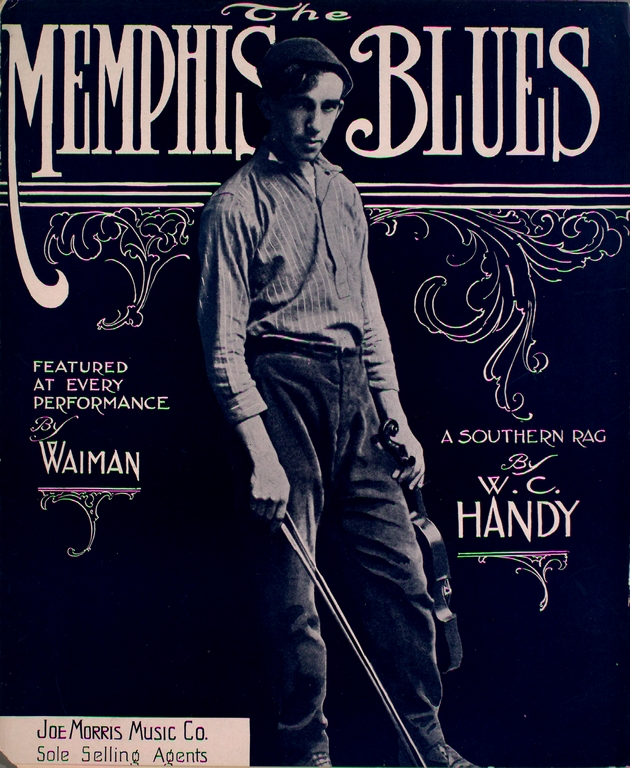
There are tunes with a 12-bar theme but also a substantial and memorable verse that is played before it. Think of Memphis Blues.
There are plenty of 'Blues' that are lovely wistful compositions that do not include a 12-bar theme at all - Basin Street Blues, Melancholy BluesWabash Blues, Michigander BluesOwl Call BluesWinin' Boy Blues, Faraway Blues, for example.

Some tunes called 'Blues' have no 12-bar theme and nothing 'bluesy' about them, but are simply well-structured fun numbers. Think of Wolverine Blues, Blue Grass BluesDangerous Blues and Jazz Me Blues.
Sometimes the 12-bar blues structure turns up in unlikely places. For example, Mahogany Hall Stomp (yes - it's called a stomp) has a simple main second theme of 12 bars on which the musicians improvise. The same thing happens in She's Crying For Me, Copenhagen, and especially in The Chant, which sounds like a very tricky piece, even though there is a simple 12-bar section tucked away within it as a basis for improvisations.

And what about Tom Cat Blues? It actually sounds like the 12-bar song Nobody Knows The Way I Feel This Morning leading (usually with a change of key) into the 16-bar Winin' Boy Blues.

And consider Weary Blues. Band-leaders often tell you it is not a blues and it is certainly not weary. In fact the first two themes are 12-bar structures, though they whip along in such a way that you would hardly notice. Then, with a change of key, you are into the pulsating familiar 16-bar theme on which sparkling improvisations are possible.

So: what kind of tune may be called a 'Blues'? As John Gore, my favourite school-teacher, used to say to us pupils in his Latin class 70 years ago: 'Tot homines, quot sententiae' [There are as many opinions as there are people]. He was quoting Terence, the Roman dramatist who lived 22 centuries ago.

2 October 2016

Post 433: THE NEPTUNE BAND - A DELIGHT

In my explorations of traditional jazz, I come across delightful discoveries. The most recent has been the The Neptune Band of Zimbabwe. This band no longer exists but it flourished over 30 years ago. It was exceptional in being an authentic-sounding 'early New Orleans' style band based not in New Orleans but in the heart of Africa. It was also exceptional in that it was made up of four children from one family, their teacher and his teenage son.

Although this band was a new discovery for me, my friend and correspondent John Whitehorn told me he heard the band in the 1980s and he kindly supplied me with some information about them.

So here's the story of how the band got started.

It was created by a gentleman called Cesar Jose Fratantoni. A dentist by profession, he was of Italian descent but grew up in Argentina. He mastered the clarinet and piano and was devoted to New Orleans jazz, particularly collecting and learning from the recordings of King Oliver and Jelly Roll Morton. He moved to Africa in 1971 and took a great interest in African music. Later he adopted into his household five children - Sabina Siankope (who became the band's banjo player) and her four brothers. They helped in the household and he helped them with their education and trained them as The Neptune Band, with his own son - Stephen Cesar Fratantoni - on cornet.

They practised together for two hours every day, with only Mr. Fratantoni and his piano to guide them. (My guess is that Mr. Fratantoni himself had purchased all the instruments.) In 1981, following four such years of hard work, Mr. Fratantoni was determined to take his 'family band' to New Orleans, so that they could be heard there and also learn from the other musicians in the City. He had to obtain a huge overdraft from his bank to fund the trip.

So (with its drummer aged only 11 and its cornet player 15!) the Band went to New Orleans, where it gave some concerts, even including one in Preservation Hall. It was extremely well received. The great Allan Jaffe, the man who owned and developed Preservation Hall, was very impressed. Here he is (second right) with The Neptune Band in a photo taken by Dick House.
And the Mayor of New Orleans formally conferred on The Neptune Band the status of Honorary Citizen.
The Band went on to play at the Breda Festival in the Netherlands in 1981 and also performed in Hanover, Germany, in 1984.

It is Mr. Fratantoni himself who in recent years has put several of the band's recordings on YouTube. Try Chattanooga Stomp (CLICK HERE TO ENJOY IT), recorded when the band was in New Orleans in 1981. Have you ever heard such a delightful, gentle performance?

The members of the band, in addition to Mr. Fratantoni himself on clarinet, were Triwell Sianjkope (17, bass), Sabina Violet Siankope (25, banjo and vocals), Daniel Ndoga Siankope (19, trombone), Stephen Cesar Fratantoni (15, cornet) and Japhet Sikeba Siankope (only 11, brilliant, especially for one so young at the time - percussion).

Mr. Fratantoni obviously set out with a clear policy to play authentic early New Orleans jazz, with plenty of melody, no exhibitionism, strong team-work and ensuring that all instruments could be clearly heard. The effect is that the playing sounds very simple, though of course this simplicity is deceptive. The emphasis is on ensemble rather than prima donna solos. Fratantoni himself said in an interview: 'For me this music is like the baroque Italian music. It is classical. You know classical music is often very simple and it is often difficult to play because it is so simple.' I know exactly what he meant.

They played the music with restraint and respectfully – respectful of the music itself and also of each other: that is what - for me at least - makes the sound of this band delightful and distinctive.

The banjo and bass players are very solid; and the 11-year-old on the drums could serve as a model for anyone wishing to become a percussionist in a traditional jazz band.

CLICK HERE for a historic recording where we see them (in Preservation Hall!) playing Tiger Rag in a gentle manner, the like of which you may never have come across before. It is amazing to think how young they were. How well Mr. Fratantoni had trained them!

Or CLICK HERE for a recording of them playing Steamboat Stomp in 1984.

You can hear them playing Careless Love Blues in Lyon, France, in 1986 BY CLICKING HERE. This performance is again remarkable for the apparent simplicity of the music and also for including the 12-bar Verse which many bands omit. 


And you can hear a relaxed performance of the King Oliver number Snake Rag BY CLICKING HERE.

This is traditional jazz the way I like it. Discovering this band with its wonderful young musicians has brought me pleasure; and I hope it is a pleasure you will also enjoy. There are several more examples of their work on YouTube if you care to explore.
-------------------
FOOTNOTE
It seems opinions are divided on this band. I'm not alone in my enthusiasm. I have had responses from readers such as these:

Many thanks, Ivan: great. I'd not come across the band before, but they're quite something, I agree. I, too, like their clean, simple and authentic-sounding style - the clip of their Steamboat Stomp is excellent, in my view.... I've been listening to, and enjoying, more of The Neptune Band's offering on YouTube. What a fine outfit! I've particularly enjoyed their version of High Society, seemingly recorded at a well-attended live concert in Switzerland in 1987. It follows a very decent piano solo of King Porter Stomp at 3'40" into the clip: CLICK HERE. 
(Carsten in England)

This is the first that I have heard this band, and yes, they are indeed something special. (Wally in Canada)

I had not heard of the band, but have to say how much I enjoyed their playing. A lovely relaxed,steady tempo that made the music swing!
Sure were something special in my opinion. (Clarinet player John in England)

I saw The Neptune Band several times in New Orleans some time in the 1980s. I heard that Mr. Fratantoni had taught them by playing some of the American Music recordings... but they played in a gentle and constrained ensemble style. (John W. in England)

Fantastic story of this Italian/Argentine/African Dentist and his African (Children) Band. My dentist is a serious music-lover and I have sent it to him as well. Interesting to read this band was at The Breda Jazz Festival in 1981. Thanks for this very PURE STORY and best regards. (Robert in the Netherlands)

What a fascinating story about the Neptune Band! The recording is superb. I'll track down a few more on YouTube later, when I have some free time. (Bill, cornet-player, England)

Lovely stuff! I had never heard of them before. (Randy in Louisiana)

Everyone is entitled to his or her own opinion; and others have not been so keen. One described the band as 'not technically proficient' and another said he would not have bought a ticket to hear them.

Well done. For the chap who announced that he would not buy a ticket, may I have his reservation if it is still available? (W. in Canada)