Welcome, Visitor Number

Translate

Showing posts with label teamwork. Show all posts

27 November 2017

Post 572: GREAT TRADITIONAL JAZZ IN A FEW SECONDS

To appreciate the finer points of traditional jazz and the genius of great players, it sometimes pays to concentrate on exactly what is happening in just a few seconds of music.

That is what I am inviting you to do today.

I would like you to click on a YouTube video and then focus on just EIGHT seconds of the performance. I will give you the link in a moment. But first let me set it in context.

The musicians (Tuba Skinny) are playing a tune called Crumpled Papers. This was composed just a few years ago by Michael Magro. It is a relatively simple tune - a 12-bar in the key of D minor. But it has amazing energy and gives plenty of opportunities for exciting improvisation.

In this video, the band plays straight through the tune 15 times. So in total we have 15 x 12 = 180 bars (measures) of music.

For the first couple of choruses, the tune is played by the ensemble, led by the cornet, in a straightforward manner. Then we have a similar two choruses, again ensemble, but led by the cornet producing some variations in the form of chromatic runs.

But now comes the fifth chorus; and this is the one on which I'm inviting you to focus. Shaye on cornet passes the lead to Barnabus on trombone.

Note exactly what Shaye is doing in this chorus during the eight seconds running from 1 minute 44 until 1 minute 52. Barnabus has taken on the melody but she is decorating it by running around (on the D minor chord) in her own subtle, energetic and tasteful way. The two phrases for you to note occur from 1 minute 44 seconds to 1 minute 46 seconds, and from 1 minute 49 seconds until 1 minute 52 seconds. I put it to you that those few notes demonstrate traditional jazz playing and teamwork at its very best. (In most other bands, the trumpet player or cornet player would have dropped out at that point, taking  a breather.)

Now here's the link, with thanks to James Sterling for being there to video the performance for us:

Shaye is always like this - modestly creative, and energetic, instinctively playing notes that are just right and make the band as a whole sound wonderful. She is not one of those self-important players who like to show off their technique by playing pointless screaming high notes. Also, as you see in this and hundreds of other videos, she cleverly directs the musical traffic, so that even a short and simple tune such as Crumpled Papers is developed in a way that is full of variety and excitement.

13 October 2017

Post 557: HOW TO PLAY AND HOW NOT TO PLAY JAZZ - CHALK AND CHEESE

I watched and listened to two well-filmed YouTube performances by traditional jazz bands. While doing so, I jotted down my thoughts. They were:

Band A
Opaque sound, bottom-heavy; bland interpretation; succession of tedious 32-bar solo choruses; lethargic; tempo dragging; textures blurred; musicians looking bored; two players chatting to each other during another's solo chorus; not much sense of teamwork; lack of variety in the dynamics; clichés; signs of strain in the playing.

Band B
Plenty of drive; bustling energy, even in supporting teamwork; clear textures; well-judged tempo; meticulous attention to detail; delicacy of shading; superb ensembles and attack; varied dynamics.

There is such a wide range in the quality of traditional jazz to be seen on YouTube!

Which two bands were these? It would be invidious to name them. But I can tell you the first was a well-known elderly English band filmed at an English jazz club. The other was a band directed by a young lady on cornet, filmed in a New Orleans street.

11 November 2016

Post 444: THE SIDNEY STREET SHAKERS - CD WITH A MISSION

An exciting discovery has been The Sidney Street Shakers, a new young band based in St. Louis, Missouri. In particular, important jazz-history research has led to their first CD - Laughing My Weary Blues Away.

This band (basically an eight-piece) was formed in 2013 and is managed by multi-instrumentalist Kellie Everett. The musicians take pride in the contribution of St. Louis to early jazz history. They have set out to revive and recreate tunes composed and played by St. Louis musicians in the 1920s.

They claim the early history of jazz in St. Louis (as compared with that of New Orleans) has been relatively neglected. For example, quoting from their CD's liner notes: 'The greatness of St. Louis' music is due to St. Louis talent. Music didn't come to the city via the river; and that kind of thinking obscures the important contributions of St. Louis artists like Charlie Creath. Louis Armstrong was in the Waifs' Home in New Orleans when Creath was playing cornet in P. G. Lowrey's travelling show circulating early music ideas.'

They also want to remind us that some of the earliest recordings were made in St. Louis and that mixed-race bands performed there surprisingly early in the history of jazz. 

Kellie Everett must have done a phenomenal amount of work in researching the bands (most of whom left no recordings) and the jazz music they played. I guess you - like me - have never heard of the bands from whose work Kellie made her selection - The MissouriansHarry's Happy FourDewey Jackson's Peacock Orchestra, Powell's Jazz Monarchs and others. Kellie must have spent hundreds of hours transcribing the music from old recordings. Eventually she settled on a representative 15 tunes for inclusion on this CD.

You can find most of the 1920s performances of the originals on YouTube. Doing so helps you appreciate how meticulously the transcriptions have been made and how very closely these recreations follow the originals.
Accompanying the CD is a booklet largely written by historian Kevin Belford. Into eight small pages it crams a mass of information about the bands and the 15 tunes.
The CD has been really well recorded. The acoustics and balance are just right. You can hear every instrument clearly.

The music is played in a bright but respectful, accurate, tight, non-exhibitionist style by a group of fine musicians. They obviously work from Kellie's detailed transcriptions. The tunes invariably have arresting introductions and neat, clever codas. There is a clockwork, pulsating rhythm. Two-bar 'breaks' are well organised and constantly crop up (Jelly Roll Morton would have approved!). The trumpet - mostly stating the melody, is usually muted, and there is strong flavouring from the saxophones, including the bass sax which Kellie herself plays, Adrian Rollini-style. There are solos against stop chords; and you find 'Doo Wacka Doo' riffs here and there. Occasionally you may detect a kazoo, or even a comb-and-paper; and the voices of the musicians are built in to some of the arrangements - most noticeably in Laughing Blues, where an entire chorus of this 12-bar tune in F is filled with half the band laughing while a few keep the rhythm going - just as on the original 1926 recording by Powell's Jazz Monarchs.

The performances are peppered with short improvised 'solos' but these are always pretty, melodic and unpretentious rather than flashy - and that's just how I like them.

The great Chloe Feoranzo constantly provides flowing, lyrical decorations, whether on Clarinet or C Melody Sax, and she takes some sweet solo breaks. In Hot Stuff, Chloe shares a 32-bar theme with pianist Mary Ann Schulte (this is similar to what happens on the original 1929 recording of this tune by Oliver Cobb's Rhythm Kings). What a good player Mary is! She constantly provides the perfect underpinning of the music but she also shows herself very capable when given a chance to take a solo, as in Blue Grass Blues. This piece is extraordinary: it begins like something out of Chopin; and ends reminiscent of the final theme of 'Wolverine Blues'! To sample that track, you are welcome to CLICK ON HERE FOR A VIDEO THAT I HAVE PUT TOGETHER.

Mary also has a pivotal rôle in Market Street Stomp. Chloe and Mary produce some fluent and pretty work on East St. Louis Stomp.

Kellie Everett herself plays so well throughout (bass and tenor sax) - showing that the bass sax can be a punchy alternative to a sousaphone or string bass and also that the instrument is capable of decent melody-making in its own right. The strings (Joe Park, Joey Glynn and - on some tracks - Jacob Alspach [he also plays trombone]) are always solid and have a chance to shine in Blue Blood Blues. The washboard and drums are played sympathetically by Ryan Koenig and Matt Meyer. Student percussionists could learn a lot by listening carefully to their discreet, sensitive support of the rest of the band. Kyle Butz is also very good on trombone: he plays on six of the tracks. Timothy John Muller, who, I gather, is also the on-stage music director of the band and helped Kellie considerably in preparing the scores, is - I'm proud to say - a fellow countryman of mine! He comes from Penrith in England. Tim leads with a mainly-muted trumpet, stating the melodies and producing variations very tastefully. 

The tunes are all new to me. I was specially impressed by Soap Suds which seems to be a complex piece with a final theme that reminds me (harmonically) somewhat of Bogalusa Strut, though it's played in the unusual key of G. The little solos by Chloe and trombonist Kyle Butz are good examples of those pretty improvisations I mentioned.

Ozark Mountain Blues - an up-tempo number in Ab and anything but 'bluesy' - brings out powerful performances from all the band, and gets the CD off to a good start. And Swinging The Swing is a brisk, merry tune to add to our collection of tunes using the Bill Bailey chord sequence.

Hot Stuff is a tune we could all easily and profitably add to our repertoires - a medium-tempo straightforward AABA 32-bar in Eb, with a familiar chord progression.

The band takes its name from the Sidney Street that is a thoroughfare running west for over two miles from the Mississippi in St. Louis. The band used to rehearse in an apartment on that street when they first formed. On the evidence of Google Maps, it is a mostly leafy residential street with some attractive-looking houses.

Some videos of The Sidney Street Shakers have been put up on YouTube. But these videos fail to do justice to their music. Some present only fragments of tunes. CLICK HERE for part of a performance of 'San', which at least gives a reasonable idea of how the band looks and sounds.

In most of the videos, the background noise or the acoustics of the venue make it very difficult to appreciate what the band is doing. In some, the visuals are poor, with jerkiness, persons blocking the view, or a lack of focus on those who are actually playing. So, if you are interested in hearing this band or learning more about early St. Louis music, you need to obtain the CD. It's available at:

http://bigmuddyrecords.com/product/laugh-my-weary-blues-away/

By the way, Kellie Everett, the driving force behind the whole project, and who plays the saxes so well, has also been playing the banjo for twelve years. With two other members of the band, she belongs to the St. Louis Banjo Club. Trumpet-player T. J. Muller has also become a fine plectrum banjo player.

Further good news is that the jazz scene in St. Louis is growing, in combination with the local swing dancing revival.

20 October 2016

Post 439: SIT OR STAND TO PLAY TRADITIONAL JAZZ?

Should musicians be seated while playing traditional jazz? My answer is YES.

Obviously there are circumstances where musicians have no choice. If you play in a street parade, for example, you have to be on your feet. And some string bass players and sousaphone players claim to be more comfortable standing up. That's fair enough; though even some of them can and do sometimes benefit from using a chair or perching on a stool.

I have heard it said that trombonists need to play standing up to give 'freedom to their lungs'. I do not accept this argument. Classical orchestral trombonists - who are almost invariably seated - have no difficulty in producing a triple forte when required. And our best young trombonists today (such as Barnabus Jones) happily play sitting down.

As a general principle, I believe our musicians should be seated whenever possible. Why? Because you need to be comfortable and relaxed to contribute well in a traditional jazz ensemble. You are less likely to over-blow and more likely to listen carefully to your colleagues. The teamwork will be better.

I have written before about the layout of bands and recommended that the formation should be a semi-circle or arc rather than a 'front line' with other musicians behind it. Combine this with having everyone seated and you have the perfect formula for good teamwork and communication.

AN ARC:
Perfect for relaxed playing
and good communication within the band.

But when we see a trumpet and trombone at the front of a stage, the instruments pointing directly over the heads of the audience, there is something inherently exhibitionist and aloof in the very posture. Unless the musicians are specially careful, it encourages playing that is too loud and it diverts their attention from where it should be - on how the band as a whole is sounding.
That's the way to do it!

Look at photos of the great bands from the early days of our music. Clearly, they enjoyed being well supplied with chairs.


The evolution of the standing, pretentious 'front line' seems to have occurred later.

I am pleased to note that in recent years, even though the fashion for standing up still persists in many (mostly long-established) bands, the younger generation of fine traditional jazz musicians generally adopts a comfortable and relaxed seated posture and a formation that enables them to put teamwork first.

When you are eighty-two years old, I can tell you playing a two-hour gig standing up is very tiring. That's another overwhelming reason for being seated!

5 December 2015

Post 321: 'DUSTY RAG'

It was 23rd December 2015 and I started the day as usual by dealing with my large email jazz correspondence and then checking to see what was new on YouTube. I found that RaoulDuke504 - the great Louisiana-based film-maker - had just put up another video of Tuba Skinny playing a few days earlier in the French Quarter.

On the face of it, this video is nothing out of the ordinary. The tune is May Aufderheide's Dusty Rag (from 1908) in the sort of performance that the Tuba Skinny musicians probably regard as routine and unexceptional. They give a simple unpretentious interpretation, without special effects and complexities. What's more, there seems to have been a workman using an electric drill somewhere off-camera, so there are irritating occasional whirring noises in the background.

And yet, this is such an enjoyable performance that it reminds me why I consider the playing of Tuba Skinny to be streets ahead of most of the bands whose efforts I watch on YouTube.
Todd Burdick
It's not easy to put my finger on exactly what makes them so good. I think it's a mixture of the following. The drumming (by Robin Rapuzzi) is so intelligent, tasteful and unobtrusive. The string players are completely solid in supplying accurate harmonies and four-to-the-bar rhythmic support. Todd Burdick (tuba - though he plays a sousaphone on this occasion) as ever provides a bass line that is elegant, accurate and appropriate. The 'front line' (clarinet, cornet and trombone) listen to each other carefully: they interweave their musical lines and harmonies with subtlety and with a total absence of flashiness or exhibitionism. The emphasis is on teamwork: players support each other. (Note how even when the sousaphone has a little 16-bar 'solo', Barnabus gives gentle support on the trombone.) Also, the band takes care with setting a perfect tempo - and maintains it. Finally - and I think this is very important - there is no electronic amplification of any kind. Everyone plays acoustically. We can hear every instrument, and we can appreciate the various 'voices' and blending tones.

I hope you will share my pleasure if you watch the video by clicking here.

What makes other bands less good? They nearly always fail in one or more of the respects I have mentioned. The drumming is too loud or insensitive: one or more of the players is an exhibitionist; there is limited evidence of teamwork; amplification is allowed to unbalance the band and distort sounds,.... and so on.
Tuba Skinny at the end of 2015
On a related matter, I would like to quote from two emails I received. The first is from a gentleman who lives in Florida. He became a keen fan of Tuba Skinny after discovering the band early in 2015:

I have commented to others that Tuba Skinny is, in my humble opinion, the best trad jazz band in the world. Of course I haven't been exposed to every band in the world, but I haven't heard one better. Shaye forgoes what I call 'acrobatics' on the horn to play the actual music with her impeccable phrasing and reverence for the music. There is no show off in her, trying to prove how facile she is on the cornet like many players, who only do so to the detriment of the music.

And this one is from a gentleman in England:

I've just been listening to the 3 recordings on You Tube of Tuba Skinny playing Blue and Lonesome. All are good but the one that thrills me most is played on Royal Street 4/11/14 on Digitalalexa. Erika's singing and the instrumental work are in perfect sympathy. They caress the melody and play both individually and collectively in the best New Orleans tradition. How do they do it so well? I've now listened to several of the other New Orleans busking groups and there isn't one, including those involving some of the regular TS musicians, which comes within a mile of what they achieve. Wonderful, wonderful jazz . What a find.

3 September 2015

Post 258: SHAYE COHN'S MOZARTIAN QUALITIES

I have said before that Shaye Cohn's playing reminds me of Mozart. In particular, it makes me think of the viola part in Mozart's string quartets.
Here's why. Mozart's quartets are like lively interesting well-informed conversations between four intelligent and sympathetic friends. If you study the viola's rôle in a Mozart string quartet, what do you discover? 
Extract from a Mozart String Quartet
 - highlighting the Viola's rôle.
The viola sometimes takes the lead (playing the melody, you could say) but more often you find it responding, commenting cleverly and perceptively on the remarks of the others, coming up with surprising original thoughts, sparkling and witty, or sad, sympathetic and pensive as the occasion demands. It can play very quickly, producing a lot of notes rapidly when there is something exciting to say. But the viola does not show off or attempt to dominate. It both compliments and complements the contributions of the other instruments.
Mozart (1756 - 1791)
Shaye's playing in any jazz ensemble is exactly like that. She is not a showy player. Not from her will you hear those screaming, raucous, high-note 32-bar solo choruses to which so many traditional jazz trumpeters resort (though she easily plays notes such as A5 [SPN] when the melody requires - as in Variety Stomp and Dallas Rag). One of my readers emailed me to say he watches her solos 'with anticipation. What comes next? Her playing is so unpredictable'. I know exactly what he means. The rest of us can play corny cliché-ridden improvisations but Shaye seems effortlessly to come up with phrases that are magical and stunning in their originality.

She is so energetic in her playing and her thinking. One of my regular correspondents - Lou in the USA - has twice sent me emails in praise of Shaye; and they are worth quoting:
I couldn't agree with you more. I find myself more and more separating her horn from the rest of the piece. I've discovered that she has a very versatile tongue. One just knows that she doesn't have to think about what's coming next for her. She may think ahead for the arrangement, but her playing just flows naturally. I can hear the little notes she drops here and there that she just has to do because they belong. 
and:
I marvel at her stamina in numbers like 'Weary Blues'. She just blows her heart out, all in such a matter of fact way.
think Lou is absolutely right.

Shaye produces a unique tone that perfectly encapsulates the blues feeling that is at the heart of so much of our music. Listen closely to her busy fluent phrases, often muted and in the background, interwoven brilliantly into the polyphony of her band's wonderful music. That's why I am reminded of the viola in Mozart's string quartets.

Shaye has an instinctive understanding of rhythmic possibilities, subtle and surprising harmonies and progressions, even when improvising at high speed. She can 'bend' notes to great effect and in exactly the right places.

She always works hard to encourage great teamwork from the band, not just to display her own skills. Her playing takes account of (and usually directs) all that is going on around her.

Bearing in mind that she is not only brilliant on the cornet but is also one of the very best on the piano and violin (and is an arranger and a formidable composer - just think of Pyramid Strut and Tangled Blues, for example), I have to say I have not come across a traditional jazz musician who impresses me more than Shaye. She is simply the best.

13 August 2015

Post 246: WHAT IS GOOD TRADITIONAL JAZZ?


I received this e-mail:

Hi Ivan,

You have strong opinions about what is good traditional jazz and what is bad. I know nothing about music. I can't read music. I never learnt to play an instrument. Can you please explain to me what makes some jazz performances better than others?


Wow! That's a tough question.

So let me say right from the start that appreciating any kind of art is a very personal matter. What pleases me may not please you. And that is just how it should be. So I will answer the question in my own way but shall not be surprised if you hold a completely different opinion.

Knowing about music


First, I don't think it's essential to know a lot about music in order to be stirred by traditional jazz or to feel the excitement that it generates. But it does add a little to the intellectual side of appreciation. For example, if you are listening to a piece made up of several different sections (e.g. Buddy's Habit or Climax Rag), it is satisfying to understand which point in the music the band has reached and to be aware when it modulates into a different key. It also makes it a little more interesting if you know something about the chord progression, no matter what tune the band is playing. In other words, you may appreciate it just a little more if you know about the 'grammar' of the music.

But with or without such knowledge, I think it's possible to distinguish between really well played traditional jazz and the not so good.

Preparing and Rehearsing

I think some bands over-rehearse. Things become too arranged and formalized. Much of the freedom and looseness that are features of the best traditional jazz are lost if the players have to concentrate too hard on their 'part' in the 'arrangement'. There is stiffness in the playing of some bands using this approach, especially if they become over-reliant on printed music on stands in front of them.

At the opposite extreme, it is common enough for good traditional jazz to be played without any rehearsal or preparation. Bring together the right mix of experienced players and a fine concert can occur.

But in general I think the best traditional jazz is produced by bands who rehearse at least occasionally, mainly to discuss their music and clarify their approaches to their repertoire. They should tidy up the trickier moments, ensure they are all using the same tune structure and chord progression and they should agree on any special tune endings. The little bit of extra work put in like that can be appreciated and pays off in a better public performance.

Amplification

In general, I think traditional jazz is likely to sound better if played without amplification. (So much 'music' in the last fifty years has been made hard to bear - for me, anyway - by the use of electronic devices and massive amplification.) It is so pleasant to hear musicians in a room with good acoustics and no amplification. You appreciate the sounds of all the instruments in their natural glory. There is no electrical 'humming' or blurring of tone. Performances in Preservation Hall (or in London's Wigmore Hall) testify to the truth of this.

But I accept that bands - in special circumstances - sometimes need amplification. In these cases, it is best if it can be kept to a minimum, for example one microphone for use by the vocalist.

Melody and Soul

Most tunes in our repertoire have stood the test of a very long time. So a good band performance must respect a good melody. There is soul in these old tunes and a good performance finds and expresses that soul. We should hear the melody clearly - maybe decorated and caressed; but it should always be there at the heart of the music. As the late great Chris Blount (clarinet) once said to me, 'If there's no soul, it's just a load of notes.'

Tempo

A good traditional jazz band sets a tempo which is appropriate to the tune and its chosen interpretation; and keeps to that tempo - other than for special effects. It's bad traditional jazz when a tune drags. (I have noticed this quite a lot in YouTube videos.) It can happen either because the tune is started too slowly or because the band slows down during the performance or because of labouring from the rhythm section - especially the drummer. (I don't know why, but On The Sunny Side of the Street is an example of a tune that is particularly prone to labouring!)

Collective Improvisation

When - in ensemble choruses - one instrument (usually the trumpet) is stating the melody, there should be creative support from the other 'front line' instruments (normally the clarinet and trombone). Teamwork is the key to great traditional jazz. If teamwork is good, the performance is more likely to impress. The support will use syncopation and counterpoint. It will be decorative and yet also - by finding the best phrases and harmonies - will push the tune along. You will feel that all three front-line players are listening and responding to each other's ideas and statements. Among today's top players, Barnabus Jones, Haruka Kickuchi and Charlie Halloran (trombones) and Chloe Feoranzo, James Evans, Jonathan Doyle, Aurora Nealand and Ewan Bleach (reeds) are examples of musicians to study on YouTube if you want to see this done supremely well.

Jazzy Devices

This is really an aspect of improvising. But it is important enough to deserve separate mention. A good performance (certainly an exciting one) usually requires a generous dose of those devices that make jazz - especially traditional jazz - so distinctive. Notes bluesily bent or flattened (in the right places), glissandi, breaks, syncopation, the use of 6ths and 9ths where they take us by surprise - all these elements enrich the performance. Without this 'jazziness' you may be left with some very pretty music for dancing but it will lack the spirit of early New Orleans jazz.

Rhythm Section

First, as my friend Barrie said to me, the expression 'rhythm section' is relatively modern and misleading. The whole band should think of itself as the rhythm section. But these days when leaders refer to their rhythm section, they mean the part of the band likely to consist of two or three or four players selected from percussion, banjo, guitar, piano, bass [string or brass]. In a good performance, these players will, as the saying goes, 'sound like one man'. They too must listen carefully to each other and to the trumpet, clarinet and trombone. In so many of the elderly British bands I have heard, or watched on YouTube, they certainly do not sound like one man: often the drummer is too loud and his rhythmic patterns are disruptive to what his colleagues seem to be trying to achieve. At least for the brighter and quicker tunes, most of the time the rhythm section in unison should play a pulsating but not too loud four-to-the-bar poom-poom-poom-poom (not um-CHUCK-um-CHUCK). This pumps the front line along and sets the audience's feet tapping. A good drummer drives the band without being loud or exhibitionist and a good pianist subjects his skills (in ensembles) to the need for a steady rhythmic and chordal underpinning of the music.

Solo Choruses

In performance, most bands include a sequence of 'solo' choruses (normally 32 bars, or even 64 bars) by several of the players in every tune. Often these solos have nothing much of interest to say (they are what Chris Blount would have called 'just a load of notes'), though, if the band has a very good pianist, they give him a rare opportunity to show what he can do. Often solo-takers try to play something stretching to the full their technical skills - showing how clever they are. I suppose this is fair enough if they are technically brilliant. Festival audiences can be counted on to applaud this sort of thing. But my view is that flashy and often raucous solo choruses are not an essential part of good traditional jazz.


Fortunately, in solo choruses a few players are technically brilliant and highly creative at the same time (James Evans again is a great example).

On the whole, though, I don't enjoy a performance padded out with numerous dull solo choruses in which the players have nothing but a string of clichés to offer. I prefer the more creative, unpredictable kind of playing (as best exemplified in the performances of Tuba Skinny) where one player takes the lead for a short time (perhaps 16 bars) but usually other players provide decorative accompaniment to this kind of 'soloing' (another example of good teamwork). Such playing gives the audiences constant delightful surprises.

Sometimes a rather special chorus contributes to a pleasing performance. For example, a band may try a 'front-line-only' chorus and even better a full-band quiet chorus (just tickling the notes) before turning up the volume for the end of the tune.

Ending the Tune

I like a tune to end well, either crisply or with a neat rehearsed coda. I think messy endings are bad.

Band Demeanour

I like all members of the band to take the music seriously. I do not like it when there is much talk between players during the performance of a tune. (Guffaws at each other's private 'jokes' are even worse.) Discreet hand signals for directing the music should be enough.

Listening Test

I will end by giving this tip to my enquirer - and to anybody else like him. When you next listen to a traditional jazz recording, try focusing your ear on just the bass player. If it's a good band, you will be amazed at the precision and importance of his or her contribution.

Now try focusing on just the clarinet. Listen carefully to the notes he or she is playing. How well and how cleverly do they blend into the overall sound?

Try listening intently to the drummer or indeed any of the instruments and you may be surprised at how much your appreciation of what the individuals do (or fail to do) helps you to sort out performances that are really 'good'.

14 June 2015

Post 226: TRADITIONAL JAZZ - A HORRIBLE DIN!

I must be honest: on very rare occasions I find the sound of a traditional jazz band to be a horrible din.
There are very good traditional jazz performances and very bad ones. I wonder whether you would agree with the following. (For the purpose of these examples, I am talking about the musical sounds produced by a six-piece or seven-piece band.)

LEVEL ONE - THE LOWEST - HORRIBLE DIN LEVEL: Most of the instruments are unnecessarily and excessively amplified. The drummer plays too loud and doesn't take much note of what the front line players are doing. The rhythm section sounds like one collective bass drum. The front line players - especially in full ensemble - take an 'every man for himself' approach and blast away, regardless of what notes the others are playing. It is sometimes impossible for a listener to pick out instruments individually (especially bad if there are four in the front line). The result is a horrible noise! A din!

LEVEL TEN - THE HIGHEST - TOP QUALITY LEVEL:  All instruments individually can be clearly heard. There is little or no amplification. The percussionist plays discreetly, never drowning out other instruments but always decorating and complementing what is going on. The rhythm section plays like one man, maintaining a steady, pulsing beat, never dragging and never speeding up (unless as part of an agreed special effect). The front line players listen carefully to each other, producing wonderful polyphony and syncopation by complementing and responding to what the others are doing and not trespassing on the same notes. The overall effect is like the best chamber music of the classical music world.

In practice, most traditional jazz performances fall somewhere around LEVEL EIGHT. Yes, most are closer to the top quality level than the horrible din level.

9 June 2013

Post 101: CLARINET (AND SAXOPHONE) PLAYING - GOOD AND BAD

Please note: this article was first written with clarinet playing in mind. But it applies to saxophone players as well.

To hear a clarinet player doing just what a traditional jazz clarinet player should, CLICK ON THIS VIDEO. The clarinet listens well to the trumpet lead and harmonises beautifully. It is a great demonstration of what can be achieved even with very limited resources.

My friend Jonathan Graham - a fine guitarist and a trumpet player - told me he has been listening to lots of jazz recordings from the 1920s and has come to the conclusion that the clarinet is usually the most important instrument in the band.
It is the clarinet player who provides the drive, the energy, the decoration of the melody, syncopation, tone colouring, most of the polyphony - in fact much of the 'jazziness' of the music.

A good clarinet player has to know the chord changes of every tune - either by rote or intuitively - and he has to be a master of rapid arpeggios. His fingering must be confident and fast. He must also be skilful at throwing occasional long bluesy notes into his playing - usually flattened thirds and sevenths.

I guess that good clarinet players have spent hundreds of hours practising scales and arpeggios, perhaps backed by recordings that give them a clear melody around which to weave their magic.

The best clarinet players avoid playing right on the beat - especially on the first note of every bar. Coming in after the first quaver or on the second beat contributes better to the syncopation. They also avoid playing too many bars comprising nothing but quavers and crotchets. Triplets, semiquaver runs, dotted notes and trills - as well as those 'hanging' long bluesy notes mentioned above - add so much to the excitement.

Above all, in ensemble work, where the trumpet is stating the melody, you won't catch good clarinet or saxophone players on exactly the same notes as the trumpet. Why? For three reasons.

First, such duplication means a waste of the band's limited resources.

Second, it misses an opportunity for harmony and polyphony.

Third: the timbres of the two instruments clash. Listen to a trumpet alone playing, for example, a C for four beats. Fine. Now listen to a clarinet alone playing the same C for four beats. Fine. Now have them both together playing that C for four beats. Not so good. The sound is much less pleasant.

So, where the trumpet is assigned to stating the melody, the clarinet and saxophone must steer clear of it. (I have recently heard a jazz performance ruined by a saxophone player who was very loud, very weak on 'teamwork' and trying to play - most of the time - the same notes as the trumpet.) And this includes Middle Eights. Although Middle Eights can be tricky, the clarinet or saxophone player should take the trouble to learn their chord progressions correctly rather than cop out and simply play the melody of the Middle Eight (duplicating what the trumpeter is doing and annoying the rest of the band into the bargain), as I frequently hear a clarinet player do.

The situation can be particularly bad if a band has both a clarinet and a saxophone playing, probably in addition to trumpet and trombone. If the reed players do not play as team members, with a high level of musical awareness, the result can be excruciating. 

It is acceptable for the clarinet or saxophone to play the melody only when it is agreed in advance that it will 'take the lead', while the trumpet player either drops out for these bars or switches to improvising around the melody. Also, when playing a 'solo' chorus, the effect can sometimes be very pleasant if the clarinet player stays very close to the melody, perhaps in a low register. This can make a good contrast after an ensemble chorus led by the trumpet.

Breaks are another feature of traditional jazz in which the clarinet or saxophone can contribute so much to the excitement of the music. (If you don't know what I mean by 'break', I am referring to those moments when all the instruments except one drop out after the first beat of the bar, leaving that one instrument to play something interesting and decorative. Breaks are often assigned to the clarinet.)


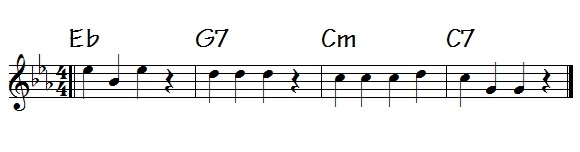
Consider for example the famous 4-bar break in Jazz Me Blues. A weak clarinet player may simply play this:
Technically that is all right. But it is hardly dynamic and exciting. It would be far better to play something on these lines:


In addition to all this, of course, the clarinet or saxophone often plays the melody - either because the tune is a clarinet feature, or because the band is a small group perhaps without a trumpet, or because the band has made an arrangement of the tune in which either the whole of the melody or one of the strains (in a rag, for example) is best played by the clarinet - if only for variety. All these situations give the clarinet player a great opportunity to demonstrate the instrument's beautiful tones and its expressive, soulful capabilities.

For an example of a modern clarinet-player and saxophone player getting things absolutely right, CLICK ON THIS PERFORMANCE. The clarinet player is John Doyle and the saxophonist is Ewan Bleach. It is also a joyous example of traditional jazz teamwork at its best.
========================

FOTNOTE
The book Playing Traditional Jazz, by Pops Coffee, is available from Amazon.