Welcome, Visitor Number

Translate

15 December 2014

Post 158: GREAT LADY JAZZERS TODAY

Doreen
I can't keep pace with what's going on. There are so many thrilling videos on YouTube of YOUNG musicians in New Orleans reviving and refreshing in modern ways the great old traditional jazz music of the 1920s and 1930s.

And you - dear readers - keep sending me emails saying 'Have you watched.....?' and making a recommendation or two. So I am constantly being introduced to bands I had not heard before.

One thing that has struck me forcibly is the number of young LADIES who are now involved in making the music. So I want to say a word or two on that topic today.

Of course, there have been ladies playing traditional jazz (and plenty providing the vocals) since the earliest days. Mainly, though, they were pianists. Today, it's not unusual to come across - for example - a lady jazz trombonist.

I have always thought Lil Hardin has been under-rated. She was the force that propelled her then-husband Louis Armstrong into prominence. But she was also a fine classically-trained pianist and one of the important early composers of jazz tunes, some of which are now standards. Without her composing for Louis (and others) and playing the piano on so many early recordings, the jazz legacy would be much the poorer.

Today, we have many brilliant ladies involved in the music. Having written so much about them before, I will refrain today from mentioning the great ladies of Tuba Skinny. But here are some of the others whose work I admire, together with suggested introductions to them on YouTube.

Bria Skonberg (trumpet) and Emily Asher (trombone): CLICK HERE.

Marla Dixon (trumpet) runs The Shotgun Jazz Band in New Orleans and their music has become the most exciting to be heard anywhere: CLICK HERE.

Haruka Kikuchi grew up in Japan but has been settled for quite a while in New Orleans. It would be difficult to find a better traditional jazz trombonist anywhere on the scene today. Click here.

Doreen Ketchens (clarinet)  is a great improviser, bandleader and entertainer on the streets of New Orleans: CLICK HERE. And (for interesting interview information): CLICK HERE.

Debbie Schreyer (banjo) has an extraordinary mastery of the instrument: CLICK HERE.

Aurora Nealand (reeds) is a technically brilliant player and also no mean singer: CLICK HERE.

Chloe Feoranzo 
(clarinet, sax, singing) is absolutely sensational; and still so young. Have you seen her amazing performance of Bye Bye Blues (final two minutes) in the duet with James Evans? Click here.
Chloe
Gunhild Carling (trombone, trumpet, etc.) has been playing jazz well since she was a little girl:
CLICK HERE. As an adult, Gunhild has played any number of instruments and in various combinations of musicians: CLICK HERE.

Annie Hawkins (string bass), based in England, is an Australian-born, much-in-demand musician, who adds enormous power and zest to every band in which she plays. CLICK HERE.

Any others you would like me to add to this list?
=================
Anita Thomas (reeds)
Ivan,
Add Anita Thomas to your list.  She is a great clarinetist originally from Australia. Appears 
in numerous YT videos.  She has been the clarinet instructor many times at the Jazz Camp 
sponsored by the Sacramento Traditional Jazz Society.
Stan Cummings

Betty Smith (saxophone)
Sam Wood would like to draw our attention to this lady from the English Midlands, who died in 2011 at the age of 81.

14 December 2014

Post 157: FROM 'CALL OF THE FREAKS' TO 'GARBAGE MAN BLUES'

'Stick out your can! Here comes the Garbage Man!'

I have enjoyed this song ever since I first heard it three years ago. It's simple, catchy and requires only the singing of the above words three times over a basic 12-bar blues.

However, having got round to studying the tune and writing it out (by ear) today, I discovered it has quite a history.

Originally it was 'Call of the Freaks', recorded in 1929 by both the Luis Russell Orchestra and the King Oliver Orchestra. I am uncertain who composed it. Possibly it was King Oliver (perhaps collaborating with Dave Nelson) or more probably it was Luis Russell.

Within a  year or two, it was recorded by the Luis Russell band as 'New Call of the Freaks', said to be by Russell's percussionist, Paul Barbarin. In fact, I can't detect much that is 'new' about this version. Maybe it was the words that were written by Barbarin.

Certainly, about this time it had acquired the 'Garbage Man' vocal chorus and it caught on with vaudeville-type singers, such as Milton Brown and his Musical Brownies. By then, it was renamed 'Garbage Man Blues'.

A further stage (in my opinion one we could have done without) involved a few singers thinking it funny to add scatological lyrics.

But in its latest manifestation - performed by that great young band Tuba Skinny - it is simple, infectious, innocuous and pure delight.

To enjoy it, CLICK ON HERE.

There's much that makes this piece appealing. Best played at a tempo of crotchet = 150, it begins by vamping these two bars.
They can be repeated anything from four to eight times. Then there can be some solo choruses - either 12-bars or 16 bars (over the continued vamping of the above bars). Then we have this little bridge:
It leads us into the 12-bar blues, with the 'Stick out your can' vocal.

Following this, the 12-bar blues pattern may be repeated ad lib; but a good coda is provided if the band plays the 'bridge' again to finish.
===============

My book 'Tuba Skinny and Shaye Cohn' is available from Amazon:


13 December 2014

Post 156: 'SEEMS LIKE OLD TIMES' - A LOVELY SONG BY CARMEN LOMBARDO


Browsing jazz bands on YouTube, I came across something specially delightful: Loose Marbles playing Seems Like Old Times.

If you don't know the tune - and whether you play in a band or not - may I recommend it to you?

The great cornet-player Shaye Cohn (though barely visible in the video) was this time playing piano, with Barnabus Jones on trombone. Michael Magro was on clarinet and Ben Polcer on trumpet.


I did not previously know this tune. It is relaxed, very melodic, easy to pick up and a good one on which to improvise. To watch the video: CLICK HERE.

I found that the tune was written by Carmen Lombardo in 1945.

I also found from other performances by singers on YouTube that it has touching words - about a couple who have been in love for many years and whose love is just as strong as ever.

So, all in all, a great song and one I am very pleased to have come across.

I spent time on my keyboard, trying to play along with the video. I soon noticed that - in terms of chord progression - it comes in the 'Salty Dog' category. That is to say it begins with four bars based on the chord of the sixth note of the scale and these are followed by four bars based on the chord of the second note of the scale.

There is no middle eight: it has one of those 16 + 16 structures, easy to memorise.

Finally, as I usually do, I wrote up my attempt at Seems Like Old Times in my mini filofax, so that I can have this as a future aide-mémoire. Although Loose Marbles was playing it in the Key of F, I put it in G as that is more convenient to me as a Bb cornet player.


12 December 2014

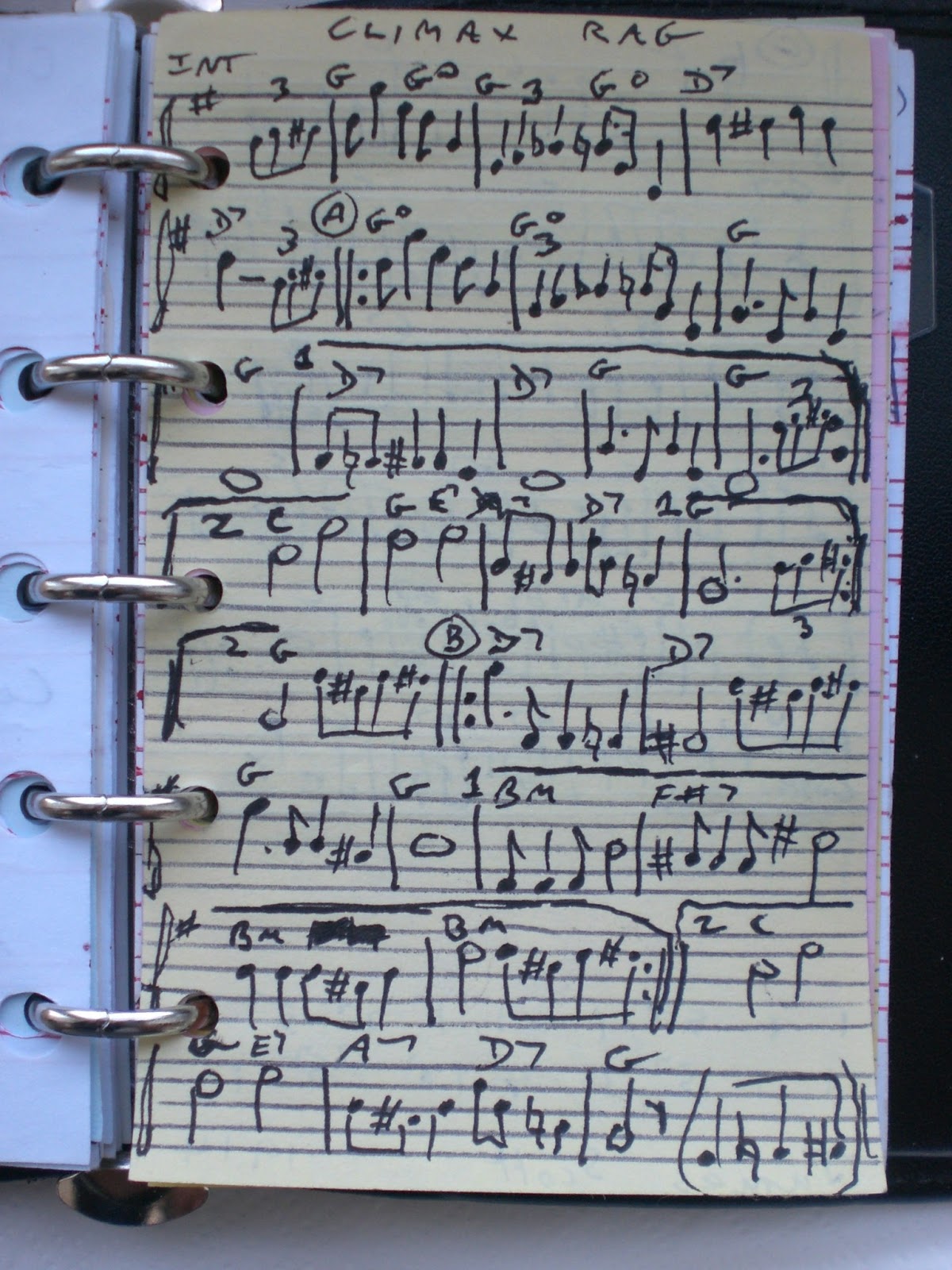
Post 155: JAMES SCOTT'S 'CLIMAX RAG'

Many bands have Climax Rag in their repertoire. I'm pleased about this because it's a good old number by James Scott from as long ago as 1914; and it's good to see the best of the old tunes being kept alive. It's a romping tune and not too difficult to play.

doubt whether the version played by traditional jazz bands today is totally as written (no doubt basically for piano) by Mr. Scott all those years ago. Traditional jazz bands have passed on a version which has evolved over the generations. It is normally performed with an Introduction followed by two 16-bar themes in Concert F, and then the main 16-bar theme in Bb.

For my private amusement I worked out my own mini-filofax lead sheet of Climax Rag for me to play on the Bb cornet.


11 December 2014

Post 154: 'DELTA BOUND' - ALEX HILL AND TUBA SKINNY

Delta Bound is a great haunting song: it descends through semitones, with a fair sprinkling of minor and diminished chords. It is a 32-bar tune, with the familiar  a - a  -  b  -  a   structure.

Those of us who are fans of Tuba Skinny (i.e. almost the entire population of the world) have been introduced to it through the singing of Erika Lewis. It was on Tuba Skinny's CD entitled Rag Band - released in 2012.

However, it seems the song dates from as long ago as 1934. It was composed by Alex Hill, who was a jazz pianist in Chicago during the 1920s. Although he worked with many of the 'big names', it is not surprising if you have never heard of Alex Hill. The poor chap lived only to the age of 30. 

Alex Hill

On YouTube there is a video of Erika singing this song with Tuba Skinny in its early days. View it by clicking here.

Erika sings Delta Bound in the key of Bb and it goes something like this:


However (typical of Tuba Skinny) the band usually plays a first chorus in the key of F before Erika takes over. The Band also reverts to F to round off the performance.
Erika Lewis

10 December 2014

Post 153: 'LOVE SONGS OF THE NILE'

Love Songs of the Nile is a beautiful tune that I first came across when I heard that very fine English trumpeter Cuff Billett playing it with his band in the 1990s. I have since discovered that it has been recorded by many of the best traditional jazz bands. The great Shotgun Jazz Band of New Orleans has the song in its repertoire. Here's their cracking version of it:
Click here to view on YouTube.
Apparently this song was written for a 1933 film called 'The Barbarian'; and it was sung in the film by Ramon Navarro. The composers were Nacio Herb Brown and Arthur Freed. (Nacio Herb Brown also wrote You Stepped out of a Dream and You Were Meant for Me.)

You can hear it played by the band of De De and Billie Pierce (with George Lewis on clarinet and Louis Nelson on trombone) if you
CLICK HERE.

John Dodgshon of California wrote to me about this tune, pointing out that some jazz bands play a version with a 'simplified' chord sequence. John is right. There is a difficulty in bars 9, 10, 13 and 25 of the Chorus, where the 'simplified' version, possibly based on the De De and Billie Pierce recording, has for example F major chords where there should be Ab7s. Here is the recommended correct lead-sheet that John has kindly sent me. It includes the Verse.


9 December 2014

Post 152: 'BLACK CAT ON THE FENCE'

A correspondent says he is trying to work out how to play Black Cat on the Fence.

As it happens, I went through the same experience. I listened to a couple of recordings of the tune and tried to make a lead sheet by ear. Here's the lead sheet to Black Cat on the Fence that I came up with for inclusion in my mini Filofax. It's actually in Bb but I put it in C to suit my transposing cornet.


I tried the tune out with friends and it went quite well, partly because it is fairly easy to play and to improvise upon. It is a pretty rag that is best taken at a medium tempo.

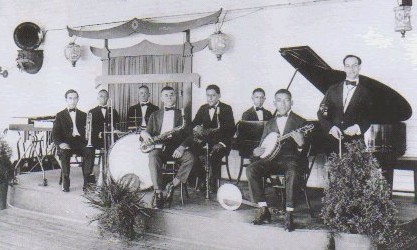
My friend Brian Hutchinson in Australia has much more recently sent me a link to the American Music recording made in 1949 by Louis Delisle's Band in a private house in New Orleans. Here is a picture of the band that Brian sent to me:
The musicians are (left to right) Johnny St. Cyr, 'Big Eye' Louis Nelson Delisle, the tune's composer Charlie Love, Louis Nelson, and Ernest Rogers. Missing from the photo is the string bass player Austin Young.

And here is a link to the recording:
CLICK HERE.

I had never been sure who wrote the tune, or when. The record tells us it was Charlie Love. (Recently a source gave the composers as Waller, Brooks and Razaf in 1929. But I suspect that is wrong: I think this source was confusing it with Black and Blue. So I'll stick with Charlie Love.)

Ken Colyer made Black Cat on the Fence popular in England a few decades ago. Listen to him playing the tune:
CLICK HERE.

8 December 2014

Post 151: 'NEARER MY GOD TO THEE'

I added Nearer My God to Thee to the handwritten collection of music in my mini filofaxes. It's easy to find on the Internet.

I was surprised to discover that although the famous words of this hymn were composed in 1841 (as a religious poem) they were not set to the music we know them by today until 15 years later.

The poet was Sarah Flower Adams of Loughton, Essex, in England. Here she is:


Her sister Eliza set the poem to music, but Eliza's version did not catch on.

Sarah died young (in 1848) and so did not live long enough to hear her poem become famous when performed to music by Lowell Mason. How very sad!


But Mason, the prolific American composer of hymn tunes, who set it to music in 1856, lived to the age of 80.

Later, other composers - including Sir Arthur Sullivan - produced yet more tunes to which this poem could be sung.

I thought it useful to have Mason's tune in my collection because jazz bands are on rare occasions called upon to play it.

They are also often called on to play What a Friend We Have in Jesus - another hymn that appeared first as a poem. It was written in 1855 by Joseph M. Scriven, an Irishman who had settled in Canada. Fate dealt him severe blows: twice in his life he was engaged to be married and both fiancées died before the marriage could take place.

He wrote the poem as a present to comfort his mother, back in Ireland, with no idea that it would ever be published.

It wasn't until 1868 that Charles Crozat Converse set it to music. Crozat was an American lawyer and composer, who had studied in Leipzig, Germany, and at the Albany Law School in the USA.

7 December 2014

Post 150: SHAYE COHN SHOWS HOW TO DIRECT THE TRAFFIC

I'm about to discuss a performance of Say Si Si, which Tuba Skinny were playing at the dba in New Orleans. But first I must thank David Wiseman, who was there to video it for us. David sent me his video, allowing me to upload it to YouTube. You may watch it by clicking on here.

Conditions in the dba are noisy and crowded. Filming is difficult. But David did well by getting close to the stage. He did more than that - something very unusual: instead of trying to show us the whole band, he kept the focus on Shaye Cohn.


So this video is perhaps unique in that enables us to study close-up exactly what Shaye does throughout an entire tune.

As so often, Tuba Skinny seat themselves in an arc. They have taught the world how much better this is - for audience and band members alike - than having a 'front line' with a 'rhythm section' behind it. It is easy, for example, for Shaye to catch the eye of any of her colleagues and with the slightest signal let them know what she wants them to do.

So let's work through the performance.

As usual, Shaye starts by hearing the tune inside her head and testing with her right foot the tempo that will be perfect for it. When she is happy with this, she counts the band in: 'One! Two! One, two three, four'!'

The band plays an agreed four-bar Introduction and then launches into the First Chorus (at 13 seconds). At the end of this chorus, in which Shaye states the melody fairly simply, she indicates to Craig (by leaning towards him at 50 seconds) that he is to take the lead in the Second Chorus. But while he does so, she does not take a rest (as most trumpet and cornet players would) but instead decorates his solo with pretty and delicate backing, mainly using the lower notes. As Craig finishes, Shaye leans towards Charlie (1 minute, 28 seconds), indicating that he is to take the Third Chorus. Again, Shaye does not rest: she plays long harmonizing notes to support his solo, encouraging Craig to join her in doing so.

Notice her flicking finger signal to Jason at 2 minutes 06 seconds. She is telling him she wants him to trade phrases with her in the Fourth Chorus. That's exactly what they do - first with eight bars at a time, and then four. The bars she plays are fine examples of the creativity we always associate with her.

At 2 minutes 43 seconds, a mere glance at Todd is enough to tell him he is to lead in the Fifth Chorus. As he does so, Shaye establishes a simple harmonizing riff behind him - a riff in which she is quickly supported by Craig and Charlie. Shaye seems to enjoy the fun of doing this: at around 3 minutes 09 seconds, we see her smiling even as she plays!

As Todd's Chorus ends, she indicates with a finger raised and a twirl of her cornet (3 minutes 19 seconds) that there is to be just one more Chorus and that she wants everybody playing.

So the Sixth Chorus finds everyone letting rip, Shaye herself improvising in the most exciting way with some lovely runs around the melody. She ends the tune, as so often, snappily on the third beat of the 32nd bar.

Just for a micro-second (at 4 minutes 00 seconds), it seems as though she might play one of those cornet-led 2-bar codas that she sometimes throws in. It is as if the idea fleetingly crosses her mind. But she immediately rejects it.

I think it was judicious to do so. She knew the ending was perfect as it stood and needed no further embellishment.
=================
The book Tuba Skinny and Shaye Cohn is available from Amazon.


30 November 2014

Post 149: 'MEET ME BY THE ICEHOUSE, LIZZIE'

Friend Ralph was playing at a jazz gig when someone in the audience requested Meet Me by the Ice House, Lizzie. Unfortunately the band could not oblige as they didn't know this song.

Ralph later did his homework and then told me I might find this number enjoyable if I looked for it on You Tube.

It turned out that Meet Me by the Ice House, Lizzie was made famous in the 1930s by the Hoosier Hotshots. The Hoosier Hotshots (based in America) seem to have combined vaudeville with very good musicianship (including some unusual home-made musical instruments) to produce comic song  recordings that were popular through the middle of the Twentieth Century.

According to one source, Meet Me By the Ice House, Lizzie was composed in 1935 by someone called Cletus M. Wickens.

So I listened to the song performed on YouTube by the Hoosier Hotshots and I had to agree it was a very attractive, amusing number, and well suited to traditional jazz. This is mainly because it has a simple 32-bar structure (16 + 16 [no Middle Eight]), with an elementary chord sequence. Its words are of course comical, so adding a vocal - if your band has a willing singer - would be fun too.

I tried to work it out by ear and came up with the following lead sheet for Meet Me by the Ice House, Lizzie. On the recording, The Hoosiers perform it in the unusual Key of D; but I have put it into F, as this is more comfortable for me on the cornet.


26 November 2014

Post 148: V - I - V - I THE SWEET SUE CHORD PROGRESSION


Among the many chord progressions at the opening of famous tunes is the one known to traditional jazz musicians as the SWEET SUE PROGRESSION.

It begins on the Dominant 7th, with the Tonic as the next chord. (Often this pattern is then repeated before further developments.) To put it simply, if you’re in the key of C, you begin these tunes on G7th (usually two bars) and then move on to C. 

This progression is very useful when composers fancy bouncing back and forth between the dominant and the tonic. It is simple and therefore popular with improvisers.

Examples:

Absolutely Positively
April Showers 
Auf Wiedersehen 
Avalon 
Black Bottom Stomp [final strain] 
Blue Chime Stomp [2nd theme]
Dallas Rag
Do What Ory Say 
Gatemouth
His Eye Is On The Sparrow 
I'm Blue and Lonesome, Nobody Cares for Me
I Wish I Could Shimmy Like My Sister Kate 
Jealous 
Louisiana
Martinique
Miss Annabelle Lee 
My Life Will Be Sweeter Some Day
Pretty Baby 
Say Si Si 
So Do I 
South [second strain] 
Sweet Sue 
That’s A Plenty [final strain] 
Up Jumped the Devil
Way Down Yonder In New Orleans 
Willy The Weeper [second strain] 
Winin’ Boy Blues 


It is also the basis of several tunes known as 'Stomps'.

25 November 2014

Poast 147: PEANUT BUTTER MAKES GIGS POSSIBLE

Is playing traditional jazz hard work?
It depends what you mean by 'hard work'. Sometimes it doesn't feel like work at all. If you have a really good gig, where everything gels and both the band and the audience have a great time, you end up on a high.

But there IS a lot of hard work, both at the gigs and before them. The work involves mastering and storing a lot of music and related information inside your head and also keeping the relevant muscles in shape (fingers, lips, whatever). This becomes increasingly difficult as we age. Obviously a lot of practice is important.

Haven't you noticed too that you can feel very tired after a long gig? That's when you know hard work has been involved.
Peter Jenns
And don't you find that long gigs leave you feeling very hungry? They drain your resources. My old tuba-playing buddy Peter Jenns (who died in August 2006) always used to say he was starving after a gig and, no matter how late he arrived home, he always had a couple of toasted peanut-butter sandwiches before he went to bed!


Post 146: THE HARMONIC IMPACT OFTHE FIRST NOTE

I wanted to find out on what chord most popular songs start, and what effect this chord has.

I carried out an unscientific survey. But I believe my general conclusions are about right.

I selected at random 60 songs that have stood the test of time - tunes such as Tea for Two and I Can't Give You Anything But Love and It Had To Be You. I then noted the chord with which they start. I am referring to the first chord of the first bar of the Chorus (i.e., omitting any anacrusis).

Five of the tunes turned out to be in minor keys. That's just 8% of the total. These tunes certainly had a 'minor' feel but this did not necessarily make them sad.

I am going to give my attention to the other 92% - those in major keys.

Of these, no fewer than 50 tunes (that's a whopping 83% of all the tunes I looked at) started on the major chord of the tune's key. A tune in the key of F, for example, would start on the chord of F major.

I found the effect of this is to establish firmly and clearly where we are: there's no attempt at subtlety.

Of these 50 tunes, I categorised 38 as bright and cheerful in character, which means about 63% of all popular tunes are likely to be bright, cheerful, un-challenging and starting on the major chord of the home key.

The figure is about what I would have expected; and probably you would too.

But this leaves twelve tunes (20% of all I studied) that begin on the major chord of the home key but are more subtle and complex, perhaps with elements of sadness, nostalgia or melancholy. These include such tunes as I'm In The Mood For LoveSmoke Gets In Your Eyes and I'm Getting Sentimental Over You. If you look at the inner workings of these tunes you find minor chords, diminished chords and other surprises (such as a 7th based on the flattened third note of the scale in I'm In The Mood For Love). These chords make the tunes harder to learn but they also give the songs their distinctive colours and make them linger in our minds, it seems to me.

The only tunes from my original 60 not yet mentioned are five in major keys that do not start on the chord of the major key, so that's just 8% of the total. Four of these are 'bright' tunes, the other one less so. These tunes do not seem to lose any impact as a result of not starting on the key chord. Usually they begin on the Dominant 7th, and very quickly inform our ear of the key we are in. An example is (The Bells Are RingingFor Me And My Girl.

To sum up my main findings:

83% of popular songs are in major keys and begin on the major chord of the home key.

8% of popular songs are in minor keys.

(Note: all percentages are rounded to the nearest whole number.)

12 November 2014

Post 145: PAPA OSCAR CELESTIN'S 'TUXEDO RAG'

My effort to produce a lead sheet for Tuxedo Rag (by ear) resulted in this.


I do not know how accurately my effort represents the tune as played by trad jazz bands.

I think the tune is associated with and probably composed by the bandleader 'Papa' Oscar Celestin and dates from about 1923. Celestin was born in 1884 and moved to New Orleans, where he ran the band at the Tuxedo Dance Hall. Even after the dance hall closed, he continued to call his band the 'Tuxedo' Jazz Band.

10 November 2014

Post 144: LANGSTON CURL AND 'TIGHT LIKE THIS'

Ever heard of Langston Wesley Curl? Probably not.

But he was a useful musician in the mid-Twentieth Century. Curl, who was born in Virginia in 1899, became a fine trumpet-player in New York and Detroit and appeared on many records - notably those made by McKinney's Cotton Pickers.
But he withdrew eventually from the music scene, switched to a different career, and lived to the age of 92.

He was also a composer. And I'm particularly interested in his simple but very effective 16-bar tune called 'Tight Like This', which uses catchy repeated minor-key arpeggios. Even Louis Armstrong liked and recorded this one.

But I was first attracted to the tune when I heard Tuba Skinny playing it.

You can hear them doing so BY CLICKING HERE.

Or you can watch them in a more recent performance BY CLICKING HERE.