Welcome, Visitor Number

Translate

Showing posts with label 'Climax Rag'. Show all posts

2 December 2019

Post 611: RECOMMENDED GREAT TRADITIONAL JAZZ VIDEOS

I leave you some recommendations for videos of traditional jazz bands active in recent years. If you have not seen these videos before, I hope you will enjoy them. If you have seen them, I am sure you will enjoy watching them again!

First, for a relaxed, moving, unpretentious but beautifully-played performance, showing just how perfect a musical form traditional jazz can be, try Whenever You're Lonesome, Just Telephone Me played by members of The Shotgun Jazz Band. The video runs for about five minutes:

For an example of a great jazz band playing one of the very complex tunes from our repertoire - Deep Henderson - watch Tuba Skinny in this next video. It runs for a little over three minutes. Notice how all members of the band, working from memory rather than printed arrangements, play wonderfully as an ensemble through all three sections of this challenging piece, not to mention taking in their stride a change of key and linking passages:


Now, for some passionate 'no frills' traditional jazz, coupled with brilliant musicianship and generating great excitement, I would like to offer you a performance of Royal Garden Blues that I myself had the privilege of filming. This one runs for under five minutes:


Next, I offer you a performance of a good old jazz standard - Savoy Blues - played by The Shake 'Em Up Jazz Band. This video runs for a little under five minutes. I recommend it because it shows what happens when six outstanding musicians come together and - with great respect for each other - play wonderfully as a team, just as our bands should. This performance too is unpretentious and yet you will hardly find a better rendition of this piece anywhere:


Finally, if you have time to sit back for a full half hour and watch six outstanding musicians play a varied programme ranging from storming stuff such as Climax Rag to the tender Love Songs of the Nile, may I urge you to watch this video? You will also hear such tunes as Oriental Man, Yearning, Mobile Stomp and I Can't Escape From You. As one observer said, 'It's the kind of music that makes you cry with joy!' Click on it here:


In my opinion, this is the best 'half-hour live concert' video to have appeared in several years.

16 January 2016

Post 368: CHLOE, CONRAD, AND THE SHOTGUN JAZZ BAND

In case you missed it when I wrote about it several months ago, I must recommend to you a delightful video that is highly appropriate at this time of year. It features Chloe and Conrad.

But first I must tell you about a wonderful coincidence.

Nearly a year ago one of my readers - Phil in America - recommended that I should look at this particular video made by these two people of whom I had never heard. I was completely charmed and bowled over by it and I have since watched it many times.

It was Chloe Feoranzo and Conrad Cayman playing (and singing) What Are You Doing New Year's Eve? - a Frank Loesser song from 1947. Have a look. You won't regret it.
CLICK HERE TO WATCH.
And here's the coincidence: on Wednesday 8th April 2015, I happened to be visiting New Orleans for the first time in very many years. That night, at The Spotted Cat, I thought I recognised the guitarist guesting with The Shotgun Jazz Band. It was none other than Conrad Cayman. I had admired his work and he had enjoyed my blog. Although we had never met, we were instantly so happy at this chance encounter. As Conrad said, isn't this indeed a wonderful world - in which technology can bring together as instant friends two people from opposite sides of the globe?

Conrad told me he is now a full-time professional musician, working mainly in traditional jazz in the Los Angeles area (for example with Chloe in The JC Jazz Crew and in The Big Butter Jazz Band), though he has various other musical projects. You can find a good range of the work of both Conrad and Chloe on YouTube.

We also discovered an interesting example of how ideas spread in the world of traditional jazz. I had commented in one of my posts about the way Tuba Skinny - in a particular tune - had reversed the usual situation by having the 'front line' play stop chords as support to a solo chorus from a banjo. Conrad decided to try a similar technique on his forthcoming JC Jazz Crew album with guests Katie Cavera and Corey Gemme (see their Facebook page): the horns hit the 2nd and 4th beats while the bass takes the melody in a Verse. Conrad said it worked really well.

Chloe and Conrad are both regular members of The JC Jazz Crew, together with Justin Au.

Conrad is rightly proud of the videos of himself and Chloe and also those of Justin with his brothers and uncle. You could try these and then explore where they lead:
CLICK HERE
or (including Katie Cavera)
CLICK HERE.
Like me, Conrad was having a holiday in New Orleans and getting involved in the jazz scene as much as possible.
I meet Conrad Cayman

We have this photo souvenir of our meeting; and I'm pleased to say Conrad immediately emailed it to Chloe, who was touring in Australasia.

And you can watch the video I made that evening of The Shotgun Jazz Band (including Conrad) giving a storming performance of Climax Rag. Just click here  and you will see why I considered that one of the highlights of my visit to New Orleans. With Conrad - John, Twerk, Haruka, James and Marla were all on terrific form.

Happy Christmas and a Happy New Year to you too, Chloe, if you read this!

30 March 2015

Post 194: 'CLIMAX RAG' PLAYED BY SHOTGUN

Have you seen this video of Marla Dixon's Shotgun Jazz Band? They are playing Climax Rag, written by James Scott 100 years ago. We are all indebted to the videomaker codenamed bljl1223 for making this available to us on YouTube.
Haruka Kikuchi
It has so much to offer:

1. sensational playing and teamwork;

2. super breaks;

3. a stomping and precise rhythm section (John, Tyler and Justin);

4. James Evans and Haruka (having recently settled in with this band) really enjoying themselves and playing some amazing unrestrained stuff;

5. a 'quiet' chorus;

6. a front-line-only chorus;

7. a super raw final chorus;

8. a fun coda;

9. twelve variations on the final Chorus with a range of entertaining and interesting treatments;

10. Marla's dynamic leadership throughout.

The whole performance is driven along by the pulsating poom-poom-poom-poom rhythmic pattern (rather than um-chook-um-chook) that I personally find thrilling and entirely appropriate to this type of tune.

Try for yourself. Set your feet tapping by

12 December 2014

Post 155: JAMES SCOTT'S 'CLIMAX RAG'

Many bands have Climax Rag in their repertoire. I'm pleased about this because it's a good old number by James Scott from as long ago as 1914; and it's good to see the best of the old tunes being kept alive. It's a romping tune and not too difficult to play.

doubt whether the version played by traditional jazz bands today is totally as written (no doubt basically for piano) by Mr. Scott all those years ago. Traditional jazz bands have passed on a version which has evolved over the generations. It is normally performed with an Introduction followed by two 16-bar themes in Concert F, and then the main 16-bar theme in Bb.

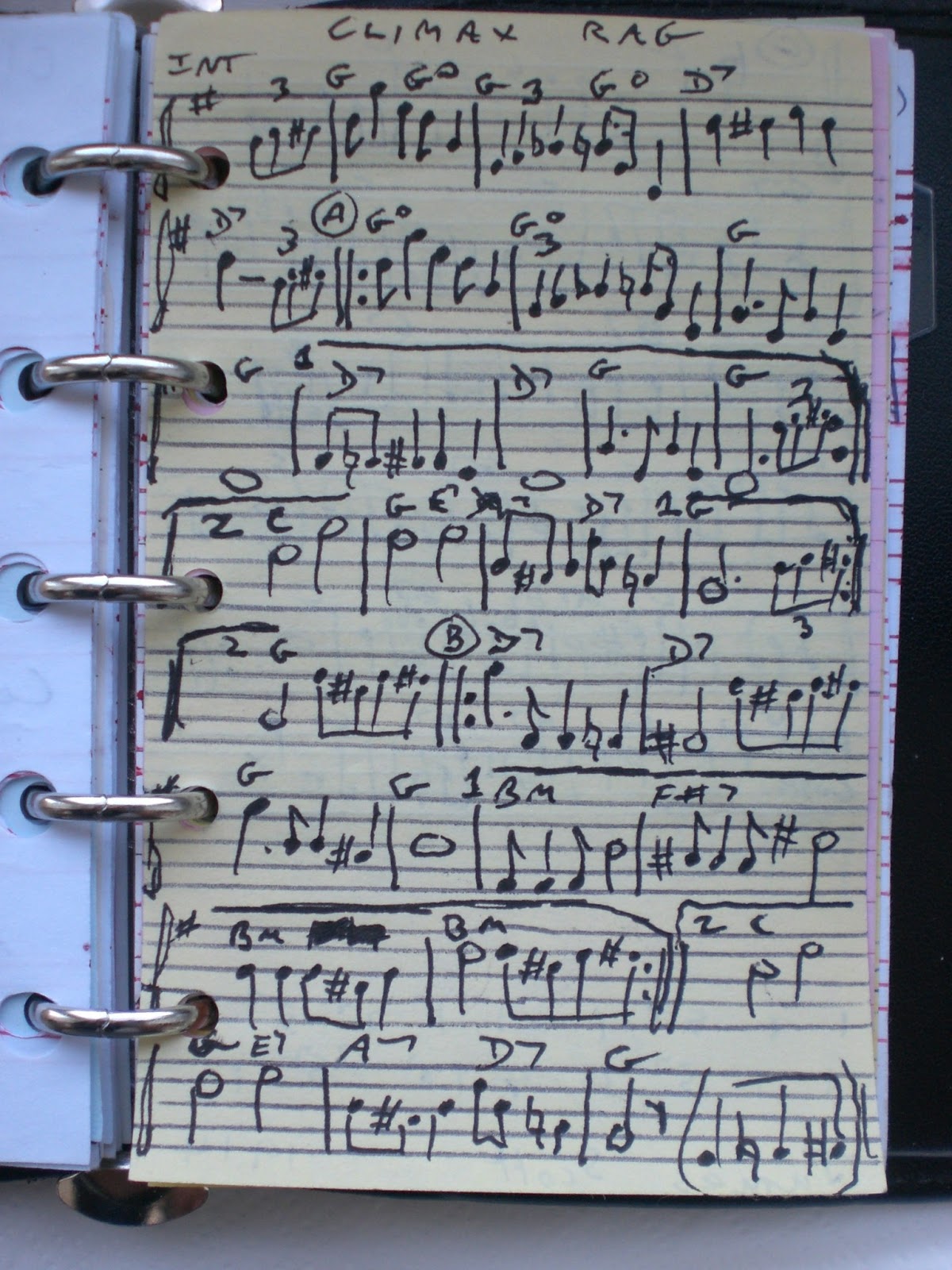
For my private amusement I worked out my own mini-filofax lead sheet of Climax Rag for me to play on the Bb cornet.


11 May 2013

Post 72: ENDING THE TUNE


A musician who is uneasy about confusion in bands when they are bringing tunes to an end has suggested I write on this topic. I'm happy to do so, for reasons that will become obvious.

I don't enjoy hearing bands ending a tune in a messy way - and I'm sorry to say this happens all too often. At worst, some of the players in the band think they are on the Out-Chorus and play an 'ending' while others keep going into another Chorus. The result is a shambles. Another type of messy ending occurs when one or two clever-dick players at the end of the tune take it upon themselves to play a few extra notes or start a two-bar or four-bar 'tag', forcing the other players to snatch up their instruments and try (unsuccessfully) to give the impression this was intended.

So this is a topic every band should talk about. A policy should be agreed.

The simplest solution is the 'chopped' ending. I like this. For example, every player stops dead on the first or third beat of the 32nd bar in a 32-bar Out-Chorus. This always has an impact, it sounds dramatic and it impresses the audience. Listen to the end of this performance for example: Click on here.

But if you must add something, then everybody needs to know that there will be a 2-bar or 4-bar tag (usually through the chord sequence IIm  -  V7  -  I), or even possibly that the final eight bars will be repeated. These endings should be polished at a rehearsal. Or at least they should be discussed and agreed in advance.

Of course it's essential that all members of the band know when the Out-Chorus is happening. The simplest solution is for one musician (most often the trumpet player) to give an indication by raising his instrument and ensuring that all can see it. (When playing seated, sticking out a leg has become a fashionable signal.) But there are more subtle methods. You can surely devise one with your colleagues easily enough.

Sometimes a problem is caused when a singer is delivering the lyrics in what might or might not be the final Chorus. Do we play one more instrumental Chorus after the singer, or do we bring the song to a conclusion on the singer's final note? Someone must clearly decide and signal. 

Another idea is to get away occasionally from the conventional barn-storming Out-Chorus ending. This requires pre-planning or discussion. How about devising a quiet low-octane ending (possibly with only two or three instruments playing the final 16 bars)? It can be very effective and give the audience a pleasant surprise.

Several famous tunes have acquired special codas and endings that have become an almost obligatory part of the performance. Think of Screamin' The Blues, Bouncing Around, Black Cat on the Fence, Joe Avery's PiecePanama Rag, Perdido Street Blues, Pasadena. And there are a few tunes in which the Coda is by convention a repeat of the Introduction, examples being Bogalusa Strut and Clarinet MarmaladeIf you are playing such tunes, you probably know what is required. But in such cases there's no harm in checking first that all members of the band are clear about what they have to do at the end.

Most bands these days play a great fun ending to Climax Rag (an ending which, incidentally, could be used with many other tunes). Everyone needs to know it's coming and that the little 2-bar phrase will be played twice - no more, no less:

21 April 2013

Post 52: JAZZ IN A MINI FILOFAX


My project to collect hundreds of tunes played by traditional jazz bands and to store them in mini filofaxes never ends. I enjoy making my own lead sheets in miniature and being able to carry so many tunes around conveniently. Likewise, every newly-added tune slots easily into its place in alphabetical order.

Generally, I can get a complete tune on to one page of mini filofax, though the more complicated multi-part pieces, such as rags, sometimes run to three pages.

Open up one of these delightful little books and this is the sort of thing to be found.


Most musicians play from large sheets of printed music on a music stand, so my system would not work for them. But for my purposes, as an aide-mémoire, the mini filofax is ideal.

I attempt to play the keyboard and the cornet, and my repertoire is limited to popular music, mostly from the period 1850 to 1965. More than half the tunes have choruses in a 32-bar structure, and it is easy to get 32 bars on to one mini filofax page – even easier if there is some repetition that can be indicated as such  (usually in the first and second ‘eights’).

Is it really possible to get the whole of Climax Rag on to a lead sheet that is just two sides of one mini filofax page? Yes.
I use only the MINI size because I want portability, simplicity and minimalism. I start with a blank page. I rule stave lines and leave sufficient space between the staves to enter further information, such as chord names and repeat signs.
All I need are the notes of the tune and the letters representing the chord changes. When I’m playing the keyboard, I improvise the chords in the left hand.

Sometimes, if I need the lyrics too, I also write out the words.

By the way, you can watch a beautifully-judged performance of Tuba Skinny playing Climax Rag in January 2016 BY CLICKING HERE.

Where do I find my tunes? I have a sack full of buskers’ books and old printed music. If I need a tune that is not in a book or available on the Internet, I try to pick it out by ear and – using my keyboard – work out the harmonies for myself.

When my friends and I get together to play, we do not use sheet music. We allow for plenty of improvisation. So we do not need music stands, either. However, we all do our homework first; and that means learning the tunes before we get together.

So I take a mini filofax with me whenever I’m travelling. While on the bus or train or having my mid-morning coffee in one of our excellent cafeterias here in Nottingham, I learn a tune or two.
When playing with my friends, I sometimes keep tunes handy, just in case I need to check something.