Welcome, Visitor Number

Translate

Showing posts with label The Spotted Cat (in New Orleans). Show all posts

1 January 2017

Post 462: THE BEST TRADITIONAL JAZZ OF 2016

James Sterling
Looking back on 2016, the most exciting performance of traditional jazz I heard in the entire year was played by the unlikely combination of string bass, banjo, and TWO C melody saxophones - just four instruments. The musicians were Tyler Thomson, John Dixon, James Evans and young Chloe Feoranzo. The tune was Bye Bye Blues.

It started pleasantly and conventionally enough. But notice what happens from 2 minutes 56 seconds in the four final choruses. First we have the two saxes 'trading eights'. Then at 3 minutes 32 seconds (how the excitement is building!) they play a chorus 'trading fours'; next at 4 minutes 08 seconds they top this with a chorus 'trading twos'. Finally at 4 minutes 45 seconds they play an ensemble out-chorus which has the whole place rocking. I still feel breathless every time I listen to this. Everybody at The Spotted Cat knew they had just witnessed something very special.

I was there - but not using my camera. Thank goodness James Sterling was on hand to video it for the rest of the world! He deserves our deepest gratitude.

Watch the video for yourself by clicking:

20 February 2016

Post 395: JAMES EVANS, CHLOE FEORANZO - AND A MAGICAL MOMENT


During my April 2016 visit to New Orleans, one moment stood out as the most wonderful and magical.

I was in the audience at The Spotted Cat on Saturday 9 April when The Shotgun Jazz Band was playing. Chloe Feoranzo, the great young clarinet and saxophone player (and singer) had moved to New Orleans only a few days earlier and had not yet even finished unpacking her belongings. But she was already sitting in with some bands and booked to play in others.
The Shotgun Jazz Band, 9 April 2016
Left to Right:
Chloe Feoranzo, John Dixon, Marla Dixon,
Tyler Thomson, James Evans (here, unusually, on trombone)

With so many musicians engaged elsewhere in French Quarter Festival duties, The Shotgun Jazz Band was short of its regular staff: they had no trombone player. So the brilliant James Evans (like Chloe, one of the world's greatest traditional jazz reed players and also a very good singer) switched to trombone for some numbers (yes, he can play that instrument very well too!). And Chloe played the full gig on reeds.

When we reached the final number of the second set, Marla Dixon left the stand to go among the audience with the 'tips bucket' as she always does. This left James and Chloe in charge of the music. They chose to play Bye Bye Blues, both using their C Melody Saxes. It was a stunning performance that I shall never forget.

Thank goodness for James Sterling! He - a reader of my blog - had driven over from Florida and was filming it on his mobile phone. Thanks to James, you too can now witness (on YouTube) this very special performance of Bye Bye Blues.

It is astonishing to think that only four musicians were involved (two of them on saxes) and that such pulsating music resulted. We have John Dixon on banjo and Tyler 'Twerk' Thomson on string bass (in my opinion the best combination in the world, when it comes to driving music along in a rock-steady 4/4). The piece starts off normally enough with James Evans introducing the melody. The excitement gradually builds up. Note what happens from two minutes 55 seconds, after John Dixon's chorus. James and Chloe play one chorus 'trading eights' and then one 'trading fours' and then another 'trading twos'. Absolutely thrilling. It is amazing what is produced by James Evans and this young lady half his age. Just look at the faces of James Evans and Tyler Thompson. They knew something very special was going on. Finally, there is a throbbing 'all-in' chorus in which the two sax players are positively bouncing in their seats. I can tell you the audience loved it and there were tears of joy in the eyes of seasoned veterans.

Now turn up the volume and please watch the video for yourself by clicking here.

I spent quite a bit of time chatting with video-maker James Sterling and his wife Markay during my visit and I can tell you he is a wonderful and generous gentleman.

18 January 2016

Post 370: THE SHOTGUN JAZZ BAND - AN UPDATE

During my April 2016 visit to New Orleans, I managed to attend three gigs by The Shotgun Jazz Band.
The Shotgun Jazz Band at one of its performances
in April 2016.
This wonderful band, that plays pulsating, raw, passionate traditional jazz, had provided me with some of the best moments of my previous visit - in April 2015. At that time, I made a video of them playing Royal Garden Blues. It was a remarkable, thrilling performance of that tune. If you haven't yet seen it, I hope you will kindly do so by clicking here.

The members of The Shotgun Jazz Band were so warm-hearted, friendly and amusing to chat with. When I returned in April 2016 and went straight to The Spotted Cat to hear them, I was greeted like an old friend.

In April 2015, the string bass player, Tyler Thomson, had been on crutches, having broken a foot while playing basketball. In 2016, there were no crutches but he told me he had recently had another accident involving the other foot. He wrongly thought for a time that he had broken that too. The outcome is that he has given up basketball and put on just a little weight. But he told me he is very happy with his body shape! I have said before in this Blog that I think Tyler is currently the best string bass player in the world for the kind of traditional jazz I enjoy. And he happens to be a pretty good pianist too - and not at all bad as a singer. I made some videos of the band during the April 2016 visit, and you can watch one in which Tyler sings the Stephen Foster song from 1853 'My Old Kentucky Home' - by clicking here. (On this particular video, the reed player is Craig Flory.)

On banjo, the Band as ever has John Dixon, playing accurate rock-solid 4/4 alongside Tyler. What a team they are! Impossible to beat. They have very rarely had a drummer since their young percussionist (Justin Peake) went off to College. When Justin is with them, the rhythm section is sensational. (Remember that great Abita Springs video: if you haven't yet tried it, please do so BY CLICKING HERE.)

John's wife, Marla Dixon, leads the band on trumpet and vocals. Her playing is technically brilliant and both her trumpet-playing and singing are passionate.

I had been asked by friends to find out whether the band would be likely to tour in England some time soon. Marla told me that, although touring could be very appealing, the Band had no plans to do so in the foreseeable future. The reason was simple: they were so happy in New Orleans. They currently had four regular gigs every week, not to mention quite a few other invitations to play, either as a band or individually as guests in other bands. And I could see for myself that, whenever they played, they were surrounded by large numbers of enthusiastic and adoring fans, many of whom had travelled thousands of miles to be there.

One of the reasons why the band is so great is that, since early 2014, they have had James Evans playing clarinet and saxes (and sometimes trombone). James, who is unquestionably one of the most talented improvisers in the world, as well as being technically super-skilled, is also a great team player. Marla did very well to secure his services almost from the time he moved to New Orleans from the U.K.

The trombonist in 2015 (seen in the Royal Garden Blues video) was the great Haruka Kikuchi. But by 2016, she had branched out into many other activities and was playing in several bands, including one of her own. So The Shotgun Jazz Band was using Charlie Halloran and occasionally others on trombone. Or, as I mentioned above, James would switch to trombone with someone else invited to play reeds.

Chloe Feoranzo - one of the most brilliant reed players in the world, and still under 25 years of age, had just moved to New Orleans when I arrived there in April 2016. Chloe told me she intends to remain in New Orleans for the foreseeable future. Marla invited her to play with The Shotgun Jazz Band and the result was sensational. Note the final two minutes of this video, in which she trades bars in Bye Bye Blues with James Evans. Just watch the looks on the faces of James and of Tyler Thomson during those four final choruses. They knew this was something really special. CLICK HERE TO WATCH THE VIDEO.

That great musician Ben Polcer frequently plays piano with The Shotgun Jazz Band. He also switches to trumpet occasionally, giving Marla a break - for example, while she is carrying the 'tips jar' among the audience near the end of a set.

If you would like more information about the forming and evolution of this great band, please read the post I wrote after my April 2015 visit. You can do this by clicking on here.

16 January 2016

Post 368: CHLOE, CONRAD, AND THE SHOTGUN JAZZ BAND

In case you missed it when I wrote about it several months ago, I must recommend to you a delightful video that is highly appropriate at this time of year. It features Chloe and Conrad.

But first I must tell you about a wonderful coincidence.

Nearly a year ago one of my readers - Phil in America - recommended that I should look at this particular video made by these two people of whom I had never heard. I was completely charmed and bowled over by it and I have since watched it many times.

It was Chloe Feoranzo and Conrad Cayman playing (and singing) What Are You Doing New Year's Eve? - a Frank Loesser song from 1947. Have a look. You won't regret it.
CLICK HERE TO WATCH.
And here's the coincidence: on Wednesday 8th April 2015, I happened to be visiting New Orleans for the first time in very many years. That night, at The Spotted Cat, I thought I recognised the guitarist guesting with The Shotgun Jazz Band. It was none other than Conrad Cayman. I had admired his work and he had enjoyed my blog. Although we had never met, we were instantly so happy at this chance encounter. As Conrad said, isn't this indeed a wonderful world - in which technology can bring together as instant friends two people from opposite sides of the globe?

Conrad told me he is now a full-time professional musician, working mainly in traditional jazz in the Los Angeles area (for example with Chloe in The JC Jazz Crew and in The Big Butter Jazz Band), though he has various other musical projects. You can find a good range of the work of both Conrad and Chloe on YouTube.

We also discovered an interesting example of how ideas spread in the world of traditional jazz. I had commented in one of my posts about the way Tuba Skinny - in a particular tune - had reversed the usual situation by having the 'front line' play stop chords as support to a solo chorus from a banjo. Conrad decided to try a similar technique on his forthcoming JC Jazz Crew album with guests Katie Cavera and Corey Gemme (see their Facebook page): the horns hit the 2nd and 4th beats while the bass takes the melody in a Verse. Conrad said it worked really well.

Chloe and Conrad are both regular members of The JC Jazz Crew, together with Justin Au.

Conrad is rightly proud of the videos of himself and Chloe and also those of Justin with his brothers and uncle. You could try these and then explore where they lead:
CLICK HERE
or (including Katie Cavera)
CLICK HERE.
Like me, Conrad was having a holiday in New Orleans and getting involved in the jazz scene as much as possible.
I meet Conrad Cayman

We have this photo souvenir of our meeting; and I'm pleased to say Conrad immediately emailed it to Chloe, who was touring in Australasia.

And you can watch the video I made that evening of The Shotgun Jazz Band (including Conrad) giving a storming performance of Climax Rag. Just click here  and you will see why I considered that one of the highlights of my visit to New Orleans. With Conrad - John, Twerk, Haruka, James and Marla were all on terrific form.

Happy Christmas and a Happy New Year to you too, Chloe, if you read this!

11 December 2015

Post 329: THE WORLD'S BEST TRADITIONAL JAZZ ALL-FEMALE FRONT LINE?

Could this have been the world's best all-female front line? They were playing at The Spotted Cat in November 2014. It was The Shotgun Jazz Band. I watched the performance streamed live on Playjones. And the ladies were (left to right) Haruka Kikuchi, Marla Dixon and Aurora Nealand.


What a pulsating performance it was!
The Spotted Cat
(photo courtesy of my friend Bill Stock)

5 September 2015

Post 260: LUCKY JIM - A VISIT TO NEW ORLEANS

A September Night on Frenchmen Street
I had an email from Jim Sterling, an elderly Florida resident and regular reader of my articles. Jim shares my tastes in traditional jazz and also experiences the same joy as I do when witnessing the finest performances.

In mid-September, Jim undertook the long drive to New Orleans to spend a couple of days catching what he could of the music.

As I have never been in New Orleans at such a time of year, I was happy to learn from Jim how well the music is supported even when it is not 'festival' season. There was standing room only in such places as The Spotted Cat. Jim wrote: 'The amazing thing was that it was a Monday night in September, not the height of the tourist season and not a weekend night. But the street was packed with locals and tourists.'

Although, in such a short visit, Jim inevitably missed some of the performers he would have liked to catch, he was thrilled to meet and have good conversations with the reed player Earl Bonie, who was deputising for Aurora Nealand in The Royal Roses. Jim wrote 'Earl grew up in New Orleans and played for years on the steamboats and with the Dukes of Dixieland for about ten years. He also plays on large ocean-going cruise ship bands'.

Jim also enjoyed in Frenchmen Street 'an impromptu street performance by a brass band of mostly young black musicians so I had to stop and listen to their spirited playing'.

At The Spotted Cat, Jim caught The Jazz Vipers. 'I really enjoyed their playing, as well as the Royal Roses, though their style is not the same era of traditional jazz as Tuba Skinny. Both bands did more swing numbers, Duke Ellington, Count Basie, and Fletcher Henderson/Benny Goodman style. I have been a fan of that style since my college days. I actually got to see and hear both Ellington and Basie shortly before they died... The highlight of the Jazz Vipers was their performance of Basie's One O'Clock Jump. And JUMP it did! It brought down the house, along with a couple doing the Lindy Hop while they played. The dance floor cleared of other dancers when they got going and it seemed to inspire the band even more'.

Just as I would have been, Jim was thrilled to meet and speak with the musicians, including some who were passing by and looked in for a while. These included Jenavieve Cooke (who sang a song with the Vipers) and Haruka Kikuchi, back from her European tour and shortly heading to Japan for a festival.

Jim managed to video some numbers, so watch out for his YouTube offerings. This one (CLICK ON HERE TO VIEW) brilliantly captures the atmosphere in Frenchmen Street on a September night.

He says: 'If you can't tell,  I am still on Cloud Nine about the experience'. I know the feeling.

14 August 2015

Post 248: THOSE SCRUFFY MUSICIANS OF NEW ORLEANS!

Tuba Skinny: Scruffy? Unprofessional?
In recent months, a few elderly musicians have complained about the 'scruffiness' of the young bands who currently busk so brilliantly on the streets of New Orleans.

There was even a minor debate on this topic in the English 'JAZZNORTHWEST' web-site, sparked off by a comment from Louis Lince, the great banjo-player, bandleader and former jazz magazine publisher. He said: '...if Tuba Skinny want to play concerts in the UK they will have to smarten themselves up. Dirty jeans/cut-offs, tennis shoes and t-shirts are NOT the way to go.' I smiled when I read this, as I thought Louis was making a good ironic joke - deliberately mimicking a long-retired colonel living in Kent - the kind of man who used to write to the newspapers under the pseudonym 'Disgusted, Tunbridge Wells'. But I later came to realise he meant what he said.

And this week a correspondent (who says he is a 'huge fan' of Tuba Skinny) wrote to tell me he wishes the band would 'become more professional'. He says 'I wish they would smile more, dress better and look like they are having fun'. He goes on to name particular members of the band, saying they look bored and that one appears to be in dirty clothes.

He asked me to give my opinion. Well, here it is.

I must warn you first that - sadly - at the time of writing this article I have never personally seen Tuba Skinny. So I'm not well placed to judge. But I have spent many hours watching them on dozens of YouTube videos.

I am a very old Englishman and I grew up amidst the British conventions of the 1940s. Those conventions were still influenced by Victorian and Edwardian manners and by military discipline, because our school-teachers and fathers and grandfathers - our rôle models - had fought in the First or the Second World War.

So in my working life, I was required to wear a clean shirt, a smart suit and a tie every day - even in the hottest weather. (I did not enjoy doing so.)

If I had turned up for work with a tattoo or with a ring through my nose, I would have been summoned to the boss's office and sacked.

So you can see that the culture from which I come is alien to that of the young jazz musicians on the streets of New Orleans. But what they and I have in common is a love of traditional jazz and a desire to play it as well as we can.

I feel envy and admiration for the courage and determination of those young people who (in some cases after a good college education) have thrown up the chance of becoming bankers or business executives or lawyers or accountants in order to busk on the streets. I suspect some of their critics are unconsciously envious of them too. While honing their music-making skills, they barely make enough to pay the rent; they have to buy their clothes from charity shops (what the Americans call 'thrift shops'), and make do with old bicycles for transport.

I can understand audiences being disappointed because some of these young musicians do not always look cheerful. But when you are playing session after session in 80 degrees to 90 degrees Fahrenheit (26 degrees to 32 degrees Celsius) - sometimes till 3am as at The Spotted Cat - and repeatedly playing the same tunes, it is difficult to appear always fresh and cheerful. Sometimes you will look weary. What makes it harder is that you are constantly pestered by tourists wanting to 'sit in' or to be photographed with you or keen to tell their friends they talked to you.

By the way, I have frequently seen Shaye smile in videos. I think it's only because she is such a thinker and because she concentrates so hard on what is going on that she sometimes gives the impression of looking too serious.

I don't object to their casual laid-back approach to life. As far as I can tell from the many videos, they keep as clean as is possible in the hot, humid and sometimes dusty conditions. Their dress for busking is appropriate to the weather and the environment. At commercial gigs it is 'smart casual' and that's fine with me.

[Edited note - added several months later: I have now seen the band on the streets of New Orleans. I stand by all I have written. They are clean and smart, wearing sensible casual clothes that are just right for the hot climate and the music scene in which they participate.]

On tour, they typically attract audiences of 500 happy, excited, mainly young people. How many of our bands dressed in jackets and ties could do that?
Thank goodness we all agree the music they produce is - as my correspondent said - 'fabulous'.
--------------
Footnote: I have received many emails in response to this post. Nobody so far has agreed with the view that Tuba Skinny are 'scruffy'.

Here is a selection. First from Fred Burnett who runs the JAZZNORTHWEST web-site:


Hi Ivan,
In case you hadn’t seen it, there’s a  whole debate on this subject on my site which started back in July 2012 and the last entry being towards the end of April this year.
I appreciate though that Tuba Skinny first got cited as an example by Louis this year after Norman Gibson resurrected the subject.
Fred

From an Englishman who visited New Orleans in April:


Morning Ivan

Totally agree with your comments. The band members might appear to be bored and uninterested but they all take their work seriously. Off duty they are chatty, charming and great fun. We had long chats with most of the band and they were happy to share their thoughts on their music and their fans. When I told Shaye that she had inspired me to start playing cornet again after 20 years she was genuinely chuffed. Bill

Here's another email from England:

Hi Ivan
I want to say how much I agree with your view of Tuba Skinny. The dissenting voices come from that club that does so much to kill off accessible jazz: the old man's club playing old man's music. The accent is on 'man'.
There are two women in Tuba Skinny. Not girls, not ladies. Women.
If it's image you're after then get a band full of shop window dummies.
The future of acoustic swing has been passed to another generation. 
Long live the music of the future.
Alan

And another:

Hello Ivan,

I must say I agree with your every word about Tuba Skinny's dress.  Contrary to the quoted comment, casual clothes are not necessarily dirty or scruffy!

Tuba Skinny is a street band and I don't see any problem if they choose to appear in more formal settings dressed like a street band.  I'm just trying to imagine Metallica performing in grey lounge suits.

After the hottest two weeks of the year, I guess a lot of orchestral musicians would prefer T-shirts to white tie and tails!

Sam  

And one from a Dutch reader:
Dear Ivan,
Also I find this band: fabulous
The band members should receive all our respect: I feel some shame that this discussion is raised here in Europe.
Tell those elderly musicians, that they better should write a letter to Obama, that this band should receive a subsidy or prize for safeguarding this jazz heritage.

Rgs, Jan

10 July 2015

Post 235: STEPHANIE NILLES - ALL TOO RARE A JAZZ PIANIST

Stephanie Nilles
I was in The Spotted Cat, New Orleans, one evening in April 2015, enjoying a thrilling programme by Aurora Nealand's band. Partnering her on the front line was James Evans, and these two outstanding reed players were producing some thrilling choruses both individually and together, and obviously enjoying themselves hugely. Aurora is the kind of player who seems hardly ever to stop smiling, even when she is playing.

But something else quite wonderful also caught my attention.

There was a young lady pianist 'sitting in'; and her playing was possibly the best I have ever heard in a traditional jazz band. In the ensembles and backing the solo choruses, she did just what was needed - lightly sketching in the chords and fitting in with any rhythmic patterns established by the guitar and bass. But  whenever she was given a solo chorus, it was as if Franz Listz had suddenly occupied the piano stool. Using the entire width of the keyboard, she produced some astounding improvisations, notes tumbling and cascading from the keys - but always clearly on the correct harmonic progression. It was thrilling musicianship. On top of that, she even offered an occasional vocal, which she sang in an entertaining way, with an unusual light, girlish voice that brought back memories of the late Blossom Dearie.

Who was this amazing performer? Nobody around me in the dense crowd was able to tell me.

Fortunately, while sheltering from rain a couple of days later, I met Aurora Nealand and had the opportunity to ask. She told me the lady was a good friend of hers - Stephanie Nilles.

Back in England, I consulted the internet to find out more about Stephanie.

She is described as a 'Chicago-born jazz/punk/barrelhouse musician' who has been 'hustling around the United States, Europe, and Canada.... averaging 150 gigs a year, and captivating unsuspecting listeners with a voice that would make Jelly Roll Morton look orthodox and Ma Rainey look sober'.

But her background (I was not surprised to find) was a classical training. She studied piano and cello from the age of six, was a finalist at the Young Concert Artists' International Competition, a gold medalist at the Fischoff Competition, and had performed on National Public Radio on three separate occasions by the age of seventeen. At twenty-two, she had graduated from the Cleveland Institute of Music with a degree in classical piano performance. She moved to New York City, where she began writing songs and performed regularly on the east village anti-folk scene.

Stephanie has made several CDs and has also been involved in numerous music projects in both Europe and America. On the internet, you can find plenty about her activities, but these quotations will give you some insights into Stephanie and her music: '....a highly accomplished, award-winning young pianist with a degree in classical performance and the whole world ahead of her chucks it all over to eke out a bohemian living playing punk clubs and sleeping in her car'; 'Her compositions are often dizzyingly witty'; 'Writing truthful and poignant stories of the world as it is'; 'With a voice that manically switches from sultry soul to wild yelping, not to mention mad piano skills and a wild performance energy, Nilles has the talent to shuffle past the mediocre label props grinding their teeth on Top 40 radio today'.

My message is: if you ever have a chance of hearing Stephanie Nilles playing in a traditional jazz band, jump at it. You will be in for a treat. But I think the opportunities may be exceptionally hard to come by. It seems that playing in a traditional jazz band is something she does all too rarely. I was so lucky to be there on one of those occasions.

This video will give you some idea of what Stephanie Nilles is capable of - just with a voice and a piano:
CLICK HERE TO VIEW.

And with a small band:
CLICK HERE.

Possibly, you may not enjoy her style in these far-from-trad-jazz YouTube videos. But I can assure you that - on that great night in New Orleans - Stephanie accepted all the disciplines of traditional jazz and that her playing in Aurora's band was sensational.

14 June 2015

Post 225: GET THE RIGHT HAT!

If you are a serious fan of New Orleans jazz, or aspire to play it - you really must obtain the appropriate headgear.

So I returned from my 2015 trip to New Orleans with four caps.


Of course, there are many more available in that city. I particularly liked those commemorating places where jazz is played. But I bought just four; a chap can use only so many.

First (on the left) we have the simple 'New Orleans' cap, made by Bol (in China!). It is comfortable, robust and available in various colour combinations. Next comes the jazz-specific blue cap (also available in other colours, such as grey - very appealing). It mentions the French Quarter and manages to get a discreet 'Jazz', with a saxophone representing the 'J', on the peak. I am very fond of this one, which is 100% cotton and made in China by Sun Products. I am currently wearing it daily here in Nottingham.

Finally come two very special caps. The Dew Drop cap commemorates the amazing historic Dew Drop Hall, about which I wrote in a blog post. You can read the post if you  CLICK HERE.
The Dew Drop Hall

I chose the light-coloured cap but there were other options. This 100% cotton cap was manufactured in Bangladesh by the company Port Authority.

Finally, having spent so much time at the great jazz bar The Spotted Cat in Frenchmen Street, I could not resist their special distinctive black souvenir cap.
The Spotted Cat

This is also 100% cotton and was made in China by Port and Company. You can watch a video of a great performance I witnessed of The Shotgun Jazz Band playing 'Royal Garden Blues' at The Spotted Cat by clicking on here.


All four caps are comfortable and have adjuster straps at the back. Their peaks - especially that on the blue 'French Quarter' cap - are effective in giving the eyes some protection from the sun.

And here's a collection of caps brought back from the French Quarter Festival in 2017 by my friend Peter, who lives in London.

It goes without saying that, if you wear a New Orleans cap, your appreciation of the music will be enhanced; and musicians wearing the caps will find their playing rapidly improves.

20 March 2015

Post 189: SMOKING

When my father was a soldier during the Second World War, one of the kindest and most generous things wives or relatives thought they could do was to send packets of cigarettes to 'our boys'. Smoking was considered fashionable and normal.
How times have changed!

I'm lucky. I am a non-smoker. Several times, in my youth, I wished I could give up non-smoking, but I lacked the will to do it.

When I was 60 years old and trying to play traditional jazz, I was kindly allowed to sit in with a band playing regularly in a Norfolk pub here in England. It was a great learning experience for me. I joined the band and stayed with it for several years. But breathing inside the pub was unpleasant: there was a fug of tobacco smoke. Many in the audience (not to mention three members of the band - one of them a doctor!) were serious smokers. At the end of every gig, my eyes were sore, my hair and skin were stinking and my clothes needed to go straight in the wash.

On top of all this, goodness knows what damage was being done to the health of everyone in the pub. (Those three smoker musicians, by the way, have all since died.)

After a few years, at the start of 2004, the pub landlord was enlightened enough to put up a notice banning smoking from the bar in which the band played (though not in the rest of the pub). This made a huge difference. I enjoyed the gigs so much more.

As you may know, a ban on smoking in public places was eventually introduced by law in the UK in July 2007. Since then, playing in jazz bands in indoor venues has become much more pleasurable.

Why am I picking on this subject today? Because a blog reader told me how sad it was to see musicians having to endure such a smoky atmosphere when they played at some jazz venues in America. This blog reader (O.K. - it's Wally, from Canada) admits that he himself is a smoker. And yet he is understanding enough to appreciate that singers and trumpet players, for example, have to gulp air in through the mouth rapidly and frequently while performing. They need to fill the lungs with good air - not something choking and lethal.
Sadly, some of the musicians themselves are smokers - even among those young stars in New Orleans whose generation ought to know better. I am saddened. We have come to love these brilliant young people; and their music brings us so much pleasure. It is a pity they do something that not only makes their work harder but will probably shorten their lives.

But there is some good news. I visited New Orleans in April 2015, and was pleased to note that smoking was by then banned in some of the venues in which the bands play. And I noticed very little smoking during my several visits to The Spotted Cat. I was also told by locals that a law-enforceable ban (as in England) was due to come into force on April 22, a few days after I left.

4 June 2013

Post 96: LUTHJENS - A PIECE OF JAZZ HISTORY

I have long been vaguely aware that there once was a 'Luthjens Dance Hall' somewhere in New Orleans and that our mid-Twentieth Century traditional jazz heroes played there. But it was not until The Shotgun Jazz Band announced that they had recorded their 2014 CD entitled 'Yearning' at Luthjens that my curiosity was further aroused. (The CD, by the way, presents the music with a wonderfully clear 'empty hall' acoustic.)

I have set out to discover what I can about Luthjens and I learned, for example, that there had been an earlier Luthjens Dance Hall at a different location.

But I have not been able to discover any more than I am about to tell you; so if any reader can put me right on a point or two or send me more information, I would be glad to hear from you.

Here's the story.

There has always been a great fondness for dancing in New Orleans, so it is not surprising that many dance halls sprang up. Obviously they gave plentiful employment to musicians.

Having a good night out was not too expensive. The halls themselves would be sparsely furnished. There were bare wooden tables and simple chairs or benches.

Luthjens Dance Hall was situated in the 1200 block of Franklin Avenue (I think at the junction with Marais Street).
The original Luthjens Dance Hall
The location, among quiet tree-lined streets, was pleasant. It was about a mile north-east of the French Quarter.

How did the Hall get its name? It was established by Mrs. Clementine Luthjens, who was born in New Orleans in 1880. (Probably there was some German ancestry - at least on her husband's side: there had been plenty of migration of German people with the surname 'Luthjens' (or, more commonly 'Lutjens' without the 'h', I guess becoming 'Luthjens' in the USA).

She bought the humble, unpretentious building (previously a seafood restaurant) and set it up as a 'beer parlor and dance hall'. Steadfastly, she employed only the authentic old-style black jazzmen. She wanted the establishment to be family-friendly: she liked couples to bring the children. (However, it later acquired the nickname 'The Old Folks' Home': its patrons tended to be elderly white people.)

Informal dress was encouraged. Prices charged for drinks were reasonable. So it was the most economical venue in New Orleans if you wanted to hear the 'good ol'-fashioned' jazz; and tourists often sought it out. Dancing took place on Fridays, Saturdays and Sundays. On the other nights of the week, Luthjens was merely a kind of bistro, complete with a juke-box.

Many of the legendary musicians of the mid-Twentieth Century played there. Emile Barnes is believed to have led the first band. Later came such players as Big Eye Louis Nelson, George Lewis, Joseph Bourgeau, Alton Purnell, 'Slow Drag' Pavageau, Lawrence Marrero, Harrison Brazlee, Louis Gallaud, George Henderson, Alcide Landry, Ernest Rogers, Benny Turner, Peter Bocage, and Charlie Love; and in the final years the virtual 'house band' was that of De De and Billie Pierce.

The patrons liked the more stately forms of dancing and disapproved of 'jitterbugging'! The two-step, the one-step and the waltz were mostly in demand.
As you can see, it was quite a small building. So I imagine that - if you had a band and about 60 dancers in there - it would have felt crowded. The band was 'protected' from collisions with dancers by being placed at one end of the hall on a small bandstand two feet off the floor, (as at The Dew Drop Hall).

Sadly, the Luthjens Dance Hall in that photo burnt down in the early hours of Saturday, 30 January, 1960, with the loss of the lives of both Mrs. Clementine Luthjens (then aged 81) and her son Jules (aged 50), who were living in the back apartment of the premises. By that time, Mrs. Luthjens was a wheelchair-bound invalid. I wonder whether her son died while trying to save her: we shall never know. Perhaps it is not surprising that a fire - even in a one-storey building - could have had such dreadful consequences: it seems to have been a flimsy wooden structure, covered by tar-paper. Perhaps a smouldering cigarette end, left by a customer, caused the fire. Apparently smoking 'while dancing' was forbidden, but I suppose there was plenty of smoking by customers relaxing at tables.

Clementine's nephew Jerome Luthjens in 1961 opened a new Luthjens at 2300 Chartres (at the corner of Chartres and Marigny Streets - less than a mile from the original building). This was a more substantial brick-built hall, again of one storey, though with a flat roof. It was about half a mile nearer to the Mississippi, or - to put it another way - a mere 250 metres east of the present-day Frenchmen Street jazz bars, such as The Spotted Cat, The Three Muses, and The Maison. It too was in a pleasant, leafy area, among pretty houses - many of them of the 'Shotgun' type.

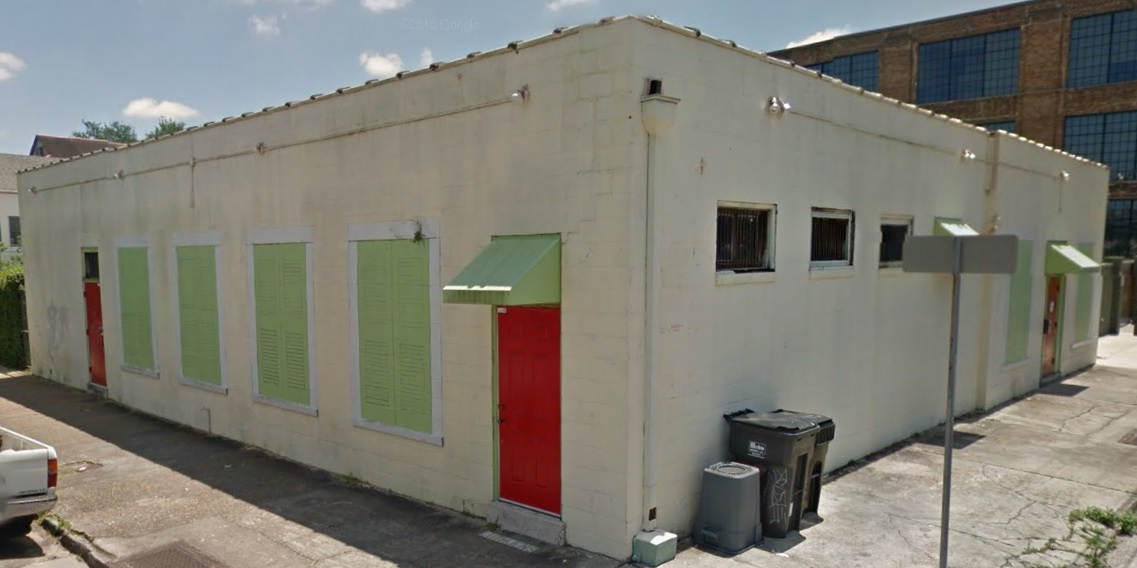
Jerome Luthjens ran this dance hall until his death in 1975. It continued in business under the management of his widow Louise until 1981, when it finally closed. With the help of Google Maps, I have located the building as it appears today:
In more recent times, bands have not been giving public performances at Luthjens. The reasons may be partly that the area has been re-classified as a 'residential zone' and partly that Luthjens no longer has a liquor licence and mainly that about one-third of the building is now occupied by a recording studio. Here's how it looks inside:
This was where, in 2014, The Shotgun Jazz Band made their CD. They chose not to use the main studio's facilities or equipment. They just set up on the stage as if at a regular gig and used a combination of room microphones and and close microphones.

The resulting product was excellent and nostalgic. Amy Johnson filmed them in the Hall while they were recording one of the tunes. You can watch the video by clicking here. Although there is no audience present, it gives us an idea of what it was like to play there, especially as this band has so much in common with the De De Pierce Band of half a century earlier.

By the way, the name is sometimes given as Luthjen's Dance Hall; but this is the result of a punctuation error. Mrs. Luthjens' name definitely ended with the 's'. It should be written Luthjens' Dance Hall or Luthjens Dance Hall.

[with thanks to several readers, including John Dixon, who have already sent me helpful information]