Welcome, Visitor Number

Translate

Showing posts with label 'Weary Blues'. Show all posts

7 October 2017

Post 555: MAKIKO TAMURA AND P TIME SELECTION - GREAT JAZZ FROM JAPAN

Just watch this video of young Japanese musicians playing High Society. Wouldn't you agree that they are emerging as one of the very best traditional jazz bands in the world? CLICK HERE TO VIEW.

I have written before about the very fine jazz being played in the Tokyo area by young Japanese musicians.

Well, there has appeared a batch of videos put up on YouTube by that very generous film-maker who calls himself ragtimecave. They show a band called P Time Selection and I must recommend them to you. To watch them playing Ballin' The Jack, CLICK HERE. And for Creole Love CallCLICK HERE.

You can also see them playing at the Sumida Street Jazz Festival in Tokyo on 19 August 2017.
Unfortunately, the Jazz Festival was outdoors on  a breezy day,  so the sound quality is not quite perfect. But you can't help admiring the balance, the skills of the individual players, the fine improvisations, and the teamwork.

According to the video-maker, the musicians are Tamura Makiko (clarinet), Kitaura Yasuri (trumpet), Mauyama Tomomitu (banjo), Imaizumi Mari (keyboard), Arai Kentaro (bass) and Miwa Tomohiko (drums) and Watanabe Taiki (trombone).

Many of us have admired the wonderful playing of Tamura Makiko. And now here she is also in the rôle of leader. What a great band she has assembled! Her own playing throughout is a joy. You could start with their fine performance of Careless LoveCLICK HERE.

For a contrast of tempo, try this cracking performance of Weary BluesCLICK HERE.

In the other P Time Selection videos, you will find such tunes as Panama and a very spirited version of Jesus on the Main Line. There is even Do You Know What It Means To Miss New Orleans? with a very sweet vocal from Tamura.
=================
And now - in June 2018 - I have received the email below from Dag Ekholm in Sweden. I agree with what he says: Tamura Makiko's band has reached a sensational new level, probably as good as anything you will find anywhere. Watch their version of West End Blues, filmed on 19 May 2018, by the excellent RagtimecaveCLICK HERE.

The musicians, we are told, are:
Tamura Makiko, clarinet
Kanno Atushi, trumpet
Watanabe Taiki, trombone
Imaizumi Mari, piano
Arai Kentaro, bass
Miwa Tomohiko, drums
Maruyama Tomomitu, banjo

Dag's email:
I have long considered Makiko Tamura one of the best New Orleans jazz clarinetists in the world today. I am also a great fan of her band, P-Time Selection, an excellent band with all very talented and skilled musicians, in my opinion.
There were several wonderful recordings of P-Time Selection last year, 2017, e.g. Feb 17, May 20, Aug 19 and Sep 18, as you have also mentioned in your blog.
Makiko made only three videos (and a few audios) during her visit to New Orleans in Oct 2017, all of them fantastic, one with Shotgun Jazz Band. Then she recorded a wonderful and highly inspired ”Tamura Makiko session” in November with a smaller group
But after that not so much happened during the winter – there were a few sessions with PTS which I find good but slightly less interesting. So I began to wonder if they were losing momentum.
But then it explodes with the session May 19, recently. I was completely stunned and speechless. It is so excellent!! I think it is a breakthrough, that the band has taken a leap to a completely new level.
I am no musician, only a listener and fan of N.O. music, and I can not analyze it. But I hear the new sound, the brilliant ensemble play and inspired solos by all of the members. The trumpet player is new and very skilled. Mari on piano is better than ever before. Furthermore they seem very happy. It really sounds as something new and great.

6 February 2017

Post 474: 'SHAKE IT AND BREAK' - SORTING OUT THE CONFUSION

You may have noticed that our jazz bands play two quite different tunes that are both called Shake It and Break It. This used to cause me confusion and I learn from correspondents that it has puzzled some of you too.

Although I may be wrong on some points, I will try to sort out the confusion by explaining what seems to have happened, as far as I can tell.

SHAKE IT AND BREAK IT  (1)

This tune was composed in 1920 by Lou Chiha (music) and H. Qualli Clark (lyrics). No, I did not make these names up!

It consists, after an Intro, of three strains of 16 bars each.

As played by our jazz bands, the first strain (normally played twice) seems to be in a minor key and involves some arpeggios being prettily run around. The second strain is in the related major key and its main characteristic is that it is a stuttering melody allowing for two two-bar breaks.  This is the strain used by most bands for the improvising of solo choruses.

The original words of the song suggest that it's about a 'new dance' in which the ladies 'shake' their taffeta dresses.

There is a terrific recording of the King Oliver Band playing what I have described so far. They play that first strain and then stick entirely on the second strain. Listen to the recording by clicking here.

Today's top band - Tuba Skinny - uses only the same two strains as King Oliver: CLICK HERE.

Many other bands (like Oliver's and Tuba Skinny) omit the third strain completely - finding quite enough to work on in the first two strains.

However, the tune and lyrics of the third strain dominate in blues singer Charlie Patton's recording entitled Shake It and Break It from 1929. So, although this has the same title, it sounds quite different from the King Oliver version. Charlie plays just this melody - not the two strains heard on the Oliver recording.

When the tune is played today by jazz bands, the third strain is sometimes added to the two previous strains and is played in the same key as the second strain and there is a vocal for this third strain only - a vocal that freely adapts the words of the original.

A reader has kindly sent me a photo-copy of Chiha and Clark's original printed music:
SHAKE IT AND BREAK IT (2)

This tune is often introduced by bands as Shake It and Break It; but it is actually Weary Blues, composed in 1915 by Gates, Matthews and Green. As you probably know, Weary Blues (which sounds anything but weary), has three strains. The first two are both 12-bar blues, usually played in F. The melodies are snappy and memorable.

Then there is a third strain, usually in Bb. This is exciting, with rapid riffs full of quavers, and a chord sequence on which musicians love to improvise. So this is the strain on which solo choruses are played.

Why do some bands announce this tune as Shake It and Break It? I am fairly sure it is because they fit words to that third strain. They are pretty well the same as those of the third strain in the 'official' Shake It and Break It ('Shake it! Break it! Hang it on the wall', etc). That, I think, is what has caused the confusion.

CLICK HERE for a performance of Weary Blues - played brilliantly by one of today's greatest bands and without the vocal - but under the title of Shake It and Break It.
For a performance of Weary Blues (correctly titled) but with the Shake it and Break It lyrics sung by Ben Polcer at  4 minutes 11 secs, click here.

====================
FOOTNOTE
The books Enjoying Traditional Jazz and Playing Traditional Jazz - both by Pops Coffee - are available from Amazon.


5 October 2016

Post 434: WHAT ARE 'BLUES'?

A reader asked me to explain the type-names we come across in traditional jazz tune titles. 'What is the difference between a Drag and a Rag?' he asked. 'What exactly is a Stomp? How do you define Blues?'
Little did he know I am just as confused about these matters as he is. There is plenty to read on the subjects, both in books and on the internet; but agreed definitions are not easy to come by.

Worst of all is trying to define Blues. In the 1940s, the first 'Blues' I became aware of were the songs of Bessie Smith and her contemporaries. There were tunes such as Backwater Blues and Blue Spirit Blues. I was led to believe the Blues were mournful songs, expressing suffering or regrets, or at least wistfulness and nostalgia. The books I read suggested they had arisen from the chanting of African slaves and were structured on a familiar twelve-bar chord pattern (three four-bar blocks). They used a scale in which flattened thirds, fifths and sevenths were common.

But just think of the heritage of tunes with 'Blues' in the title today.

There are songs called 'Blues' that are really just run-of-the-mill pop music of ninety years ago (normally 32-bar structures). Think of Beer Garden Blues (a conventional 32 bars in AABA structure). Think of Tishomingo Blues, Sugar Blues (this one actually an 18-bar, including tag), Bye Bye BluesWild Man Blues, Rent Party Blues, and Davenport Blues.

When professional composers got to work on writing 'Blues', their inventiveness took them far beyond creating one mournful melody of 12 bars. You find Yellow Dog Blues, Savoy Blues, Riverside Blues, Perdido Street Blues, Royal Garden Blues, Jackass Blues, Aunt Hagar's Blues, Dippermouth Blues, Livery Stables Blues, Beale Street Blues, Canal Street Blues, St. Louis BluesWest End BluesTin Roof BluesChimes Blues - all having two or more (often very cheerful) 12-bar themes and in some cases further structuring, such as 'bridge' passages and key changes.
The early classic Crazy Blues has a long, continuous vocal that runs through three themes. Only the middle one comprises 12 bars; but you would hardly be aware of it.

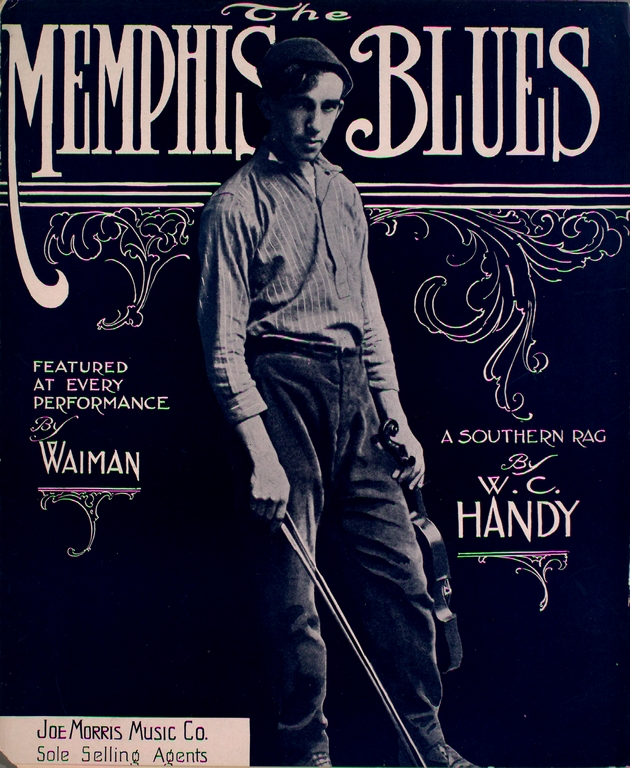
There are tunes with a 12-bar theme but also a substantial and memorable verse that is played before it. Think of Memphis Blues.
There are plenty of 'Blues' that are lovely wistful compositions that do not include a 12-bar theme at all - Basin Street Blues, Melancholy BluesWabash Blues, Michigander BluesOwl Call BluesWinin' Boy Blues, Faraway Blues, for example.

Some tunes called 'Blues' have no 12-bar theme and nothing 'bluesy' about them, but are simply well-structured fun numbers. Think of Wolverine Blues, Blue Grass BluesDangerous Blues and Jazz Me Blues.
Sometimes the 12-bar blues structure turns up in unlikely places. For example, Mahogany Hall Stomp (yes - it's called a stomp) has a simple main second theme of 12 bars on which the musicians improvise. The same thing happens in She's Crying For Me, Copenhagen, and especially in The Chant, which sounds like a very tricky piece, even though there is a simple 12-bar section tucked away within it as a basis for improvisations.

And what about Tom Cat Blues? It actually sounds like the 12-bar song Nobody Knows The Way I Feel This Morning leading (usually with a change of key) into the 16-bar Winin' Boy Blues.

And consider Weary Blues. Band-leaders often tell you it is not a blues and it is certainly not weary. In fact the first two themes are 12-bar structures, though they whip along in such a way that you would hardly notice. Then, with a change of key, you are into the pulsating familiar 16-bar theme on which sparkling improvisations are possible.

So: what kind of tune may be called a 'Blues'? As John Gore, my favourite school-teacher, used to say to us pupils in his Latin class 70 years ago: 'Tot homines, quot sententiae' [There are as many opinions as there are people]. He was quoting Terence, the Roman dramatist who lived 22 centuries ago.

11 August 2016

Post 425: 'FAREWELL BLUES' AND 'WEARY BLUES'

King Oliver and His Dixie Syncopators
James Sterling of Florida has established himself since 2015 as one of the leading video-historians of the contemporary New Orleans scene. One of his videos, filmed in June 2016, is of Tuba Skinny playing Farewell Blues (CLICK HERE TO ENJOY IT).

This tune was composed in 1922 by Elmer Schoebel, Leon Rappollo and Paul Mares for The New Orleans Rhythm Kings, who recorded it that year; but Tuba Skinny have modelled their version very closely on the 1927 recording by King Oliver's Dixie Syncopators (which you may hear BY CLICKING HERE). Oliver's version, in its turn, fairly closely followed the NORK original.

Watching it, I was reminded of the very simple and yet rewarding chord progression on which Farewell Blues is based. It is essentially a 16-bar A-A-B-A structure that goes like this:

I      | V7  |  I      | I
I      | V7  |    I    | I
VI7 | VI7 |  II | Io
I      | V7   |    I   | I


It is pretty well the same as the final theme of Weary Blues. This is not surprising because it is said that The New Orleans Rhythm Kings had the 1915 composition Weary Blues in their repertoire and developed Farewell Blues from that final theme. 

One reason why it is so attractive to play around with and improvise on is that the 'A' part is so simple; and the other reason is that the  chord and melody note in Bar 12 are nerve-tinglers. This is the most striking chord in the sequence. (By the way, some chord books give it as VIb7 rather than 1o; but this makes no great difference. Think about it: they are virtually the same.)

Farewell Blues is normally played at a steady and stately pace, whereas Weary Blues tends to be performed a good deal faster. But in all other respects, over these 16 bars, the chords you play and the improvisations you invent could be interchangeable.

Although Farewell Blues is little more than a simple 16-bar theme, the melody can be given some interesting treatments. For example, King Oliver (and Shaye in Tuba Skinny) both play the tune through first starting on the dominant (F in the key of Bb). It is as if they are harmonising a third above the melody. In later choruses, they do indeed start the chorus on the D. Later still, Shaye (just like  King Oliver) plays flattened 7ths at the start of all the 'A' Sections (another device that many bands employ effectively with Weary Blues).

So it's amazing what can be done (and what fun a band can have), even when starting out with a very simple blueprint.

Here's the 16 bars of Farewell Blues twice through - first starting on the F, and then in the D.
And here is the comparable theme from Weary Blues:

23 December 2015

Post 338: TUBA SKINNY SHOW US HOW TO PLAY TRADITIONAL JAZZ

As you probably know, Tuba Skinny occasionally spend a week in Italy. For the end-of-2013 trip, they had John Doyle on reeds. By then, I had come to the conclusion that he is one of the greatest clarinet players in the history of traditional jazz; and I am now even more convinced. His technique and inventiveness are amazing, and yet he subjects his talents (as do all players in this great band) to the Tuba Skinny house style, in which everyone puts teamwork first and there is no room for exhibitionists.

In these videos (we must be very grateful to a film-maker codenamed NewOrleansJS for presenting them to us), we can enjoy these performances:

Big Chief Battleaxe (Thomas S. Allen, 1907). This is a routine performance by Tuba Skinny standards, which means it is far better than most bands could produce. But it seems to be the first number in their programme. You sense they are 'loosening up' and perhaps slightly affected by some tiredness after the long journey from New Orleans. As usual, Shaye directs the operation with all those little signals she has developed.

Crazy 'Bout You (Big Bill Broonzy and the State Street Boys, 1935). This is a simple, catchy 16-bar tune. Shaye starts on cornet and then switches to piano, taking a solo that reminds us she is also one of the best New Orleans pianists at present. It's a very happy number and Erika has the audience clapping along with her spirited, rocking vocal.

Willie the Weeper (Walter Melrose, Marty Bloom and Grant Rymal, 1920). The band plays a 4-bar Introduction; and then they go into the second theme of Willie The Weeper. Barnabus and John contribute lustily throughout. There is fine ensemble work and great backed solos on the second theme, though Shaye alone takes a solo (one of her amazing arabesques) on the first (G minor) theme. Note Shaye's direction of the band again. She takes so much trouble before they start - to get the tempo exactly right. Also note the brilliant final few notes with which she chops the tune off at the end.

Weary Blues (Artie Matthews, Mort Greene and George Gates, 1915). Unfortunately this recording starts well into the tune, missing the opening themes (in F) but we still have the Bb theme, with plenty of amazing, exciting stuff, played at a cracking pace. One of the highlights occurs where Shaye plays a terrific solo against offbeats from all six of the other players.

Six Feet Down (Erika Lewis, 2009). Erika sings her own superb composition in F; and there is a great solo by John, against ensemble background. The ever-popular Robin Rapuzzi also struts his stuff on washboard.

How can you view these videos? Go to YouTube and type in 'Tuba Skinny Orvieto 2013'. That should bring them all up.