Welcome, Visitor Number

Translate

Showing posts with label John Dixon (banjo). Show all posts

27 July 2017

Post 531: HOW TO PLAY TRADITIONAL JAZZ - AN EXAMPLE TO FOLLOW

I received an interesting request. A reader said he likes traditional jazz but doesn't understand how it works. He asked me to pick a video of a band playing a tune and to 'talk him through it', explaining what is going on.

I am happy to do this and will try not to be too technical, though I think you may appreciate it if I at least make a small number of technical points that everyone should be able to grasp.
I have selected The Loose Marbles playing Take Me Out To The Ball Game in the video you may watch by clicking on this link:

We have to thank the video-maker 'Wild Bill' for filming it.

As it happens, this is also a very good performance, demonstrating well what great musicians can do with simple material.

So what do we find?

Take Me Out To The Ball Game - like hundreds of our tunes, comprises 32 bars. This means that, to get through it once, you beat one-two-three-four 32 times. The Loose Marbles choose to play through it seven times, so they play 7 x 32 = 224 bars in all. To put it another way, this means the performance contains 224 x 4 beats, making 896 beats in all - if you should wish to count! They play the tune entirely in the key of Bb, which is the most commonly used key in traditional jazz.

Throughout the performance, note how the rhythm players beat out a pulsating  but fairly gentle four-to-the bar, driving the music along in a most exciting way. (So many bands fail to achieve this.)

I have said the band runs through the tune seven times. So what happens in each of those seven choruses?

CHORUS ONE: 01 seconds - 32 seconds. Unusually, it is the clarinet who firmly states the tune, but note how tastefully he is supported by the trombone and trumpet.

CHORUS TWO: 32 seconds - 1 minute 03 seconds. This time, Barnabus on trombone presents the melody, but the clarinet and trumpet now provide decoration.

CHORUS THREE: 1 minute 03 seconds - 1 minute 36 seconds. Now the trumpet takes the lead; but the clarinet and trombone do not drop out. They give subtle, decorative support. By the end of this Chorus, the rhythm players have obviously had to go through the tune's chord progression three times, pumping out 3  x 32 x 4 beats = 384 beats! Get it? All of the rhythm players are working to the same chord chart. If they didn't, something would sound wrong. Here's how the chords for the 32 bars of this tune seem (to me) to run. You will notice that the musicians do not need to have this chart in front of them. They have memorised it.
Bb
Bb
F7
F7
Bb
Bb
F7
F7
G7
G7
Cm
Cm
C7
C7
F7
F7
Bb
Bb
F7
F7
Bb
Bb7
Eb
Eb
Eb
Bbo
Bb
G7
C7
F7
Bb
Bb

CHORUS FOUR: 1 minute 36 seconds - 2 minutes 06 seconds. For variety (and to give the 'front row' a little rest), this chorus is taken by the banjo. The great John Dixon gives us a very fine 32 bars.

CHORUS FIVE: 2 minutes 07 seconds - 2 minutes 39 seconds. Robin plays this as a percussion solo, improvising 32 bars for us. Note that, while he does so, Todd, Julie and John provide punctuation, striking some chords (for example, the first beat of every other bar) to remind us where we are in the tune.

CHORUS SIX: 2 minutes 39 - 3 minutes 08 seconds. Marla takes this as a vocal. Note how the pulsating 4-to-the-bar rhythm is maintained behind her. And, at 3 minutes 05 seconds, watch the leader Michael hold up one finger to signal to the band that he wants just one more chorus. So everybody clearly knows when the tune must be brought to an end and they can work to make this final chorus something of a climax.

CHORUS SEVEN: 3 minutes 09 seconds - 3 minutes 42 seconds. This is indeed a fine ensemble chorus. You may also note that Robin plays a double beat on the drum at 3 minutes 34 seconds and again at 3 minutes 35 seconds. This respects a very old tradition: for many decades it has been the custom in marching brass bands for the drummer to give this signal just eight bars before the end of a tune, to make absolutely sure everybody knows it is coming to an end.

The last thing to observe is that the tune ends abruptly on the third beat of the final bar - the 32nd bar. The fourth beat (the 896th beat of the performance) is left completely silent. This a clever and effective way of ending tunes - especially quick ones. Its use is widespread. (Sometimes a band adds a 'tag' or 'coda' - an extra little phrase to round the piece off; but I like the chopped 'sudden death' ending, as demonstrated so well here by The Loose Marbles.)

13 January 2017

Post 466: SAM MORGAN - AND HIS NEW ORLEANS JAZZ BAND IN 1927

Some very important recordings were made in 1927 by Sam Morgan. His Band played not only in New Orleans, but also in other towns, such as Galveston, along the Gulf Coast.

While Armand Piron's Orchestra was at the same time playing sophisticated, genteel jazz, Morgan's style was just a little more gutzy, pulsating and robust, though still melodic. The band took great care with establishing and maintaining the right tempos - notably for dancing.
That's Sam seated behind the cymbal; with big Jim Robinson and his trombone.
Sam Morgan, born in 1895, was the trumpeter/leader; and his brothers Isaiah (also on trumpet) and Andrew (tenor sax and clarinet) played in his band. On trombone he had the great Jim Robinson, whose fame spread further when he played in bands well after Sam Morgan had died at the age of only 41 (poor Sam suffered a stroke in 1925 and another in 1932). Earle Fouché played clarinet and alto sax. Robinson's cousin Sidney Brown was on bass. Tinke Baptiste and Walter Decou were at various times on piano. Johnny Dave was on banjo. The drummers over the years were Roy Evans and Nolan Williams.

Today Sam Morgan is best remembered for the eight tunes his band recorded in New Orleans over two sessions in 1927. Three of these were spirituals (Over in the Gloryland, Down By The Riverside and Sing On); but the credited composer for all the other five was Sam himself:

Bogalusa Strut
Everybody's Talking About Sammy
Mobile Stomp
Short Dress Gal
Steppin' On The Gas

Have a listen to Morgan's band playing Mobile Stomp:
CLICK HERE.
And now hear it played by one of today's best jazz bands:
Bogalusa Strut, by the way, is said to be a re-interpretation of the first two themes of Scott Joplin's Rose Leaf Rag. If you listen to that rag, you will hear at once that the harmonic progressions are indeed the same.

Mobile Stomp, though in 4/4 time, is said to use the melody of  The Waltz You Saved For Me; and indeed the two melodies are almost identical. But according to my researches so far, it seems The Waltz You Saved for Me was composed in 1930 - after Mobile Stomp, so it is probably unfair to suggest that Morgan 'lifted' his tune from the song.

Most traditional jazz bands in the 21st Century not only show influences of the Sam Morgan Band in their playing and musical arrangements but also still have at least a couple of Morgan's tunes in their repertoire.

And the fact that the Morgan Band recorded the three spirituals seems to have set the precedent that traditional jazz bands must now include spirituals in their programmes. (It is believed the band would never have played spirituals for dances but recorded some only because the recording engineer requested them.) Similarly, the band demonstrated (as in Mobile Stomp) - I think for one of the first times on record - the excitement generated when you play stop-time choruses.

So we all owe a great deal to Sam Morgan. And we are also indebted to Jim Robinson who, in later years, revived and perpetuated his music, and also made us aware of other tunes Morgan's band liked to play. (See the comments from John Dixon below). 

Sam Morgan's House in New Orleans
---------------

John Dixon (of The Shotgun Jazz Band in New Orleans) has kindly sent me the following information:
It’s worth noting that more can be learned from the interview with Andrew Morgan from the book ‘The End of the Beginning’ (by Barry Martyn [Jazzology Books, 1998]). Morgan speaks at length about the recording of those cuts (most of the tunes were not in their regular repertoire prior to the recording).

Also, Jim Robinson’s Riverside Living Legends LP ‘Jim Robinson’s New Orleans Band’ is an important record because it was the re-recording of Mobile Stomp and Bogalusa Strut that brought those tunes out of retirement and made them traditional New Orleans jazz standards. When they recorded that album, Jim didn’t even remember how they went. The producers went to Tulane to the archives, got the old SMJB records and played them for the band. The takes you hear recorded on Jim’s record were done just moments after they learned the songs. That record is also chock full of other Sam Morgan band tunes that they regularly played but didn’t record; Apple Tree, Yearning, Whenever You’re Lonely. Also featured on that Riverside LP are George Guesnon and Alfred Williams - both Sam Morgan Jazz Band alumni (though not in the lineup that was recorded). Guesnon is especially well-recorded on Jim’s record. It’s one of my favorite records. 

I’ve attached an image of the backside of the LP I took with my phone, perhaps you can read the album notes.

Thanks!

John


It is possible to read the liner notes. Click on and enlarge.
================

5 January 2017

Post 463: NEW SHOTGUN ALBUM! WHAT A TREAT! 'STEPPIN' ON THE GAS'

What a treat to start 2017!

On New Year's Day Marla and John Dixon's Shotgun Jazz Band released their latest Album, entitled Stepping On The Gas.

It was recorded, like their previous one, at the former Luthjens' Dance Hall. The acoustics were again terrific. Every instrument can be clearly heard. Basically, a six-piece band was used. This was the regular five - Marla Dixon on vocals and trumpet, John Dixon on banjo, James Evans (reeds), Charlie Halloran (trombone) and Tyler Thomson on string bass - plus David Boeddinghaus on piano. But on six tracks they became a 'Big Band' by adding Ben Polcer on trumpet and Tom Fischer on reeds.

I believe the combination of John Dixon on banjo and Tyler Thomson on string bass is just about the greatest in the world for driving along the raw style of New Orleans jazz in rock-steady four-to-the-bar form, and they are well complemented here by the totally dependable David Boeddinghaus. As for James Evans, he is now established as one of the greatest reed-players to be heard anywhere. He has that wonderful artist's knack of making everything sound relaxed, even though he always plays in a hugely creative and technically brilliant manner. And fans of the trombonist Charlie Halloran will particularly enjoy his lusty contributions on such numbers as Smiles, My Old Kentucky Home, She's Crying for Me, and Old Miss Rag. He adds so much to the gutsy, gritty qualities of which the band is proud. Marla, of course, is a gem - great as a band-leader, one of the best trumpet-players and always passionate and distinctive in her singing. She seems to me to know virtually every tune in the book and to have memorised the words of hundreds of songs.

This recording is specially exciting because, in terms of personnel, width of repertoire and quality of the arrangements, it is the most ambitious Album the band has made.

I often complain that bands spin out tunes for seven or eight minutes, even when nobody is dancing. They seem to think almost every member of the band must solo on at least one 32-bar chorus. Such performances can be so dreary. It would be better to keep tunes brief (as they were on the great recordings of the 1920s).

On this Album, The Shotgun Jazz Band seems to have adopted exactly that philosophy. Eight of the tunes are completed in under three minutes. And only three tracks run for over four minutes. This also allows for a goodly number and variety of tunes on the Album: there are 18 in all. 

As the title suggests, much of the Album is inspired by the work of the Sam Morgan band, whose recording of Stepping on the Gas (1927) is closely imitated by the Shotgun, right through to the neat Coda. The Sam Morgan band used two reeds and two trumpets. I guess that is why the Dixons added the extra two instruments for this track. Their 'Big Band' is used to good effect on this tune, as well as on She's Crying for Me, Down by the Riverside and Old Miss Rag.

Throughout the Album, notice the use of neat, intelligent head arrangements usually showing great respect for the original recordings. For example, White Ghost Shivers (for me the most interesting discovery) closely follows the original recording made in the 1920s by The New Orleans Owls. It is a romping number which, to my ear, appears to begin with a spooky theme in C minor, followed by a 16-bar theme in E flat and a further 16-bar theme in A flat – both the latter allowing for plenty of little breaks. There is a great Coda, just as on the original 1920s recording.

She's Crying for Me - also played by the 'Big Band' - is similarly close to the original 1925 New Orleans Rhythm Kings version composed by Santo Pecora. Essentially in A flat, it is complete with the two key changes taking it into and then out of F for a 12-bar blues interlude.

With some of the tunes, you feel immediately as if you were at The Spotted Cat, with Marla's regular band of five or six musicians in cracking form. This is especially true of Smiles, The Curse of An Aching Heart, Pretend, Whenever Your Lonesome, and My Old Kentucky Home. On this last number, Tyler is the singer: it has become one of his party pieces.

There are some interesting performances of obscure numbers. For example, Rose of Bombay is a tune I had not heard before. Apparently it was recorded in 1923 on an Edison Cylinder by Rudy Wiedoeft's Californians. It is a pleasant leisurely number with a Verse followed by a 32-bar Chorus somewhat reminiscent of Hindustan: it uses plenty of minims and semi-breves.

Then there is Guilty – not the song of that name recorded in the 1930s by such singers as Billie Holiday and Al Bowlly - but rather one written and recorded in 1974 by Randy Newman. Marla sings it, accompanied by John on the banjo for a whole two minutes before the full band joins in.

In Breeze and Moonlight Bay the band plays the Verses as well as the Choruses! I bet there were not many of us who knew these Verses.

Marla Dixon
Marla also sings I Hate a Man Like You; and the entire Album begins in a surprisingly simple, tasteful way with Gulf Coast Blues, the 1923 composition by Clarence Williams, recorded by Bessie Smith, which Marla sings mostly with accompaniment by David on piano - very much on the lines of the original, with David taking the Clarence Williams rôle.

Another interesting vocal is How Am I To Know?, sung by James Evans. Apparently it comes from a 1920s film called 'Dynamite' and was composed by Jack King with lyrics by Dorothy Parker, no less! 

The old pop tune Pretend You're Happy When You're Blue, composed by Lew Douglas, Cliff Parman, Frank LaVere and Dan Belloc, is very pleasantly performed, with a vocal from Marla. Why did it take so many people to compose it?! (I believe it was actually Lew Douglas who did most of the work.) After the final vocal, the Shotgun round it off (as also in My Old Kentucky Home) from the Middle Eight - a tactic we should all adopt from time to time.

Charlie takes the lead very movingly on the oldest composition on the Album - Deep River, which is the final track and very effectively winds down the concert. What a beautiful way to bring the Album to an end!

Finally, I must make a special point about Old Miss Rag. The Shotgun Jazz Band plays the tune correctly - having studiously gone right back to the original sheet music. There are three themes, two of which are in F, with the final theme in Bb. THIS is how we should all be playing it! But I'm afraid most bands these days offer a slipshod version in which we play just the first and third themes - and both in the key of F.

W.C. Handy would be disappointed with us. But he would be thrilled to hear the authentic version offered here by the Shotgun.

But now you need to know how to obtain the Album. The simplest way is on line. I found that it downloads in less than half a minute. The wonders of technology! Here's where to go:
https://shotgunjazzband.bandcamp.com/

18 January 2016

Post 370: THE SHOTGUN JAZZ BAND - AN UPDATE

During my April 2016 visit to New Orleans, I managed to attend three gigs by The Shotgun Jazz Band.
The Shotgun Jazz Band at one of its performances
in April 2016.
This wonderful band, that plays pulsating, raw, passionate traditional jazz, had provided me with some of the best moments of my previous visit - in April 2015. At that time, I made a video of them playing Royal Garden Blues. It was a remarkable, thrilling performance of that tune. If you haven't yet seen it, I hope you will kindly do so by clicking here.

The members of The Shotgun Jazz Band were so warm-hearted, friendly and amusing to chat with. When I returned in April 2016 and went straight to The Spotted Cat to hear them, I was greeted like an old friend.

In April 2015, the string bass player, Tyler Thomson, had been on crutches, having broken a foot while playing basketball. In 2016, there were no crutches but he told me he had recently had another accident involving the other foot. He wrongly thought for a time that he had broken that too. The outcome is that he has given up basketball and put on just a little weight. But he told me he is very happy with his body shape! I have said before in this Blog that I think Tyler is currently the best string bass player in the world for the kind of traditional jazz I enjoy. And he happens to be a pretty good pianist too - and not at all bad as a singer. I made some videos of the band during the April 2016 visit, and you can watch one in which Tyler sings the Stephen Foster song from 1853 'My Old Kentucky Home' - by clicking here. (On this particular video, the reed player is Craig Flory.)

On banjo, the Band as ever has John Dixon, playing accurate rock-solid 4/4 alongside Tyler. What a team they are! Impossible to beat. They have very rarely had a drummer since their young percussionist (Justin Peake) went off to College. When Justin is with them, the rhythm section is sensational. (Remember that great Abita Springs video: if you haven't yet tried it, please do so BY CLICKING HERE.)

John's wife, Marla Dixon, leads the band on trumpet and vocals. Her playing is technically brilliant and both her trumpet-playing and singing are passionate.

I had been asked by friends to find out whether the band would be likely to tour in England some time soon. Marla told me that, although touring could be very appealing, the Band had no plans to do so in the foreseeable future. The reason was simple: they were so happy in New Orleans. They currently had four regular gigs every week, not to mention quite a few other invitations to play, either as a band or individually as guests in other bands. And I could see for myself that, whenever they played, they were surrounded by large numbers of enthusiastic and adoring fans, many of whom had travelled thousands of miles to be there.

One of the reasons why the band is so great is that, since early 2014, they have had James Evans playing clarinet and saxes (and sometimes trombone). James, who is unquestionably one of the most talented improvisers in the world, as well as being technically super-skilled, is also a great team player. Marla did very well to secure his services almost from the time he moved to New Orleans from the U.K.

The trombonist in 2015 (seen in the Royal Garden Blues video) was the great Haruka Kikuchi. But by 2016, she had branched out into many other activities and was playing in several bands, including one of her own. So The Shotgun Jazz Band was using Charlie Halloran and occasionally others on trombone. Or, as I mentioned above, James would switch to trombone with someone else invited to play reeds.

Chloe Feoranzo - one of the most brilliant reed players in the world, and still under 25 years of age, had just moved to New Orleans when I arrived there in April 2016. Chloe told me she intends to remain in New Orleans for the foreseeable future. Marla invited her to play with The Shotgun Jazz Band and the result was sensational. Note the final two minutes of this video, in which she trades bars in Bye Bye Blues with James Evans. Just watch the looks on the faces of James and of Tyler Thomson during those four final choruses. They knew this was something really special. CLICK HERE TO WATCH THE VIDEO.

That great musician Ben Polcer frequently plays piano with The Shotgun Jazz Band. He also switches to trumpet occasionally, giving Marla a break - for example, while she is carrying the 'tips jar' among the audience near the end of a set.

If you would like more information about the forming and evolution of this great band, please read the post I wrote after my April 2015 visit. You can do this by clicking on here.

13 January 2016

Post 363: HOAGY CARMICHAEL'S 'JUBILEE'

I was lucky enough to be at The Spotted Cat in New Orleans on 9 April 2016, when The Shotgun Jazz Band, in eight-piece form, played a rollicking tune called 'Jubilee'. Not only that; I managed to make a video of it - one you can watch by CLICKING HERE.

This tune was new to me, so when I returned to England, I set about trying to find out who wrote it and when. The first thing I discovered was that there was not much evidence of it on YouTube. There were several songs with the word 'Jubilee' in the title, but not one of them was the tune I had heard - until I came to one solitary video of a jazz trio playing it in 1991.

So it does not seem to be a tune in the standard repertoire of our bands. This is a pity, as it deserves to be. May I recommend it to band-leaders?

With help from my American correspondent Larry Smith, I learned the song was composed by none other than Hoagy Carmichael, with words by Stan Adams. They wrote it for a 1937 film called 'Every Day's a Holiday', in which Mae West and Louis Armstrong both appeared.
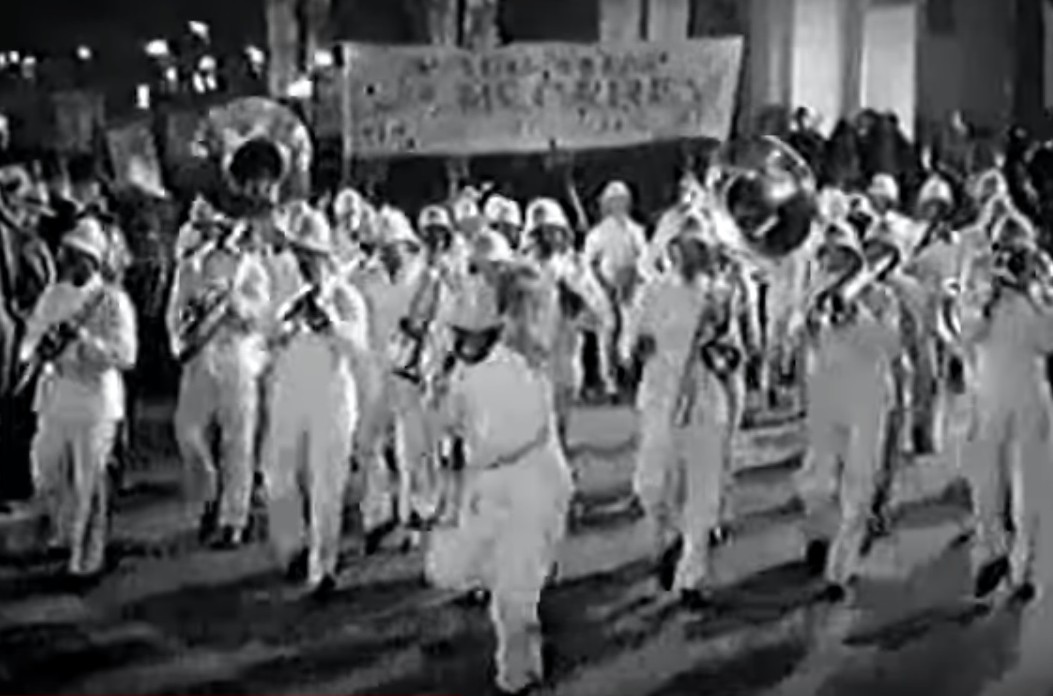
Louis Armstrong at the front of the Parade Band
in the film 'Every Day's a Holiday' (1937).
When you first listen to the tune, you sense that mastering the chord progression should be easy enough. And you also feel that the song has a 'tag'. You discover that it is a tune of 36 bars, unlike the common 32-bar form. What has happened is that Bars 29 and 30 are repeated twice, thereby spinning out the ending, so that it becomes a 36-bar song.

The Shotgun Jazz Band played the tune in the key of Eb Concert; and it went something like this:
If you would like the words, you can get them direct from Louis Armstrong at 50 seconds into this historic film extract:  CLICK HERE.

As for chords, you may be able to get away with a simplified version, for example:
I
I
I
I
I
I
I
I
III
III
III
III
III
III
III
III
IV
IV
IVm
IVm
I
I
II7
V7
I
I
I
VI7
II7
V7
II7
V7
II7
V7
IIm:V7
I
(It is a 36-bar tune)

But if you are happy to work at something more sophisticated, try this:
I:VIm7
IIm7:V5
I:VIm7
IIm7:V5
I:V7
I:V7
I
I
III:I#m
IV#m:VII7
III:I#m
IV#m:VII7
III:VII7
III:VII7
III
III
IV
IV
IVm
IVm
I
I
VIm6
VII7
I:VIm
IIm7:V7
I
VI7
II7
V7
II7
V7
II7
V7
IIm7:V7
I
(It is a 36-bar tune)
John Dixon, who is to be seen laying down the chords in the Shotgun Jazz Band video, has read this article and has kindly sent me this very helpful information - an even simpler way of approaching it:
For purposes of learning the chord progression, it’s easier to think of it as I, vi, ii, V in Eb, and then I, vi, ii, V in G (or the 3rd of whatever your root is), as it really swaps keys and it makes it easier to shout out the changes to someone on the fly. The whole thing is more like an exercise in technique than a regular tune. 

Footnote:
While doing my little bit of research, I came across a suggestion that Jubilee had actually been written at least ten years earlier, because there is a 1928 recording by Frankie Trumbauer and His Orchestra of a tune called Jubilee. So I checked the Trumbauer recording and can confirm it is a quite different tune, even though it has the same title. Trumbauer's tune was actually written by Willard Robison (the composer of A Cottage For Sale).

20 December 2015

Post 335: A GREAT VIDEO OF THE SHOTGUN JAZZ BAND


I am re-publishing this recommendation in case there are still a few people who have not yet watched this great YouTube jazz video - in my view the best and most exciting, sizzling, energetic performance of New Orleans traditional jazz to appear on YouTube in the last thirty months.

It runs for over half an hour, with high-definition pictures and top-quality sound.

So switch off your TV and just settle to this marvellous little concert that will bring tears of joy to the eyes of any traditional jazz lover.

It's The Shotgun Jazz Band playing Climax Rag, Love Songs of the Nile, Oriental Man, I Can't Escape, Yearning and Mobile Stomp.

This is raw New Orleans jazz at its best. Leader Marla Dixon stamps her dynamic personality on everything. She is flanked by great players - James Evans (from Beaumaris, Wales) on reeds and Barnabus Jones on trombone. All three of them are on terrific form and their ensemble work is an example to us all. But this band also has a perfect rhythm section - Tyler Thompson on bass, John Dixon on banjo, and Justin Peake on drums. John has kindly let me know that Tyler's favourite string bass player is Slow Drag Pavageau and that John's own banjo hero was George Guesnon. John added that they were both 'solid 4/4 players'. He told me the 'genesis of The Shotgun was via the Happy Pals in Toronto which has become the incubator for some great musicians. Marla and Tyler both got the start there. The Happy Pals were directly influenced by the Kid Thomas band, so that 4/4 revival beat of Sammy Penn is also a large influence.'

That explains a lot. The Shotgun Band gives an extraordinary demonstration of just how New Orleans-style rhythm backing should be. Justin Peake is a drummer about whom I know virtually nothing. But it seems he was led to this style of music by the Dixons themselves. On the evidence of this Abita Springs performance I would rate him right up there with the best.

Enough of me. Get on to the video by clicking here.

-------------
Post Script

Reader Phil has sent me this email:

Hi Ivan,

I agree with you regarding the Shotgun Jazz Band's Opry
video. I can't remember being so blown away... in recent memory.
Everything was so perfect...an amazing band, an amazing crowd
that pushed the band to its peak and even that old southern
guy at the end (looked to be straight out of Hollywood central
casting), plus awesome video/sound work...just perfect!
"What a show, what a show".

I don't know how TS let James Evans get away! If there's a
better clarinet/sax combination around, I haven't heard it.