Welcome, Visitor Number

Translate

Showing posts with label front line. Show all posts

29 May 2015

Post 216: A VERY SPECIAL PERFORMANCE - 'ALMOST AFRAID TO LOVE'

Tuba Skinny has given us a mind-boggling performance that serves as a lesson to us all. We have to thank the generous and prolific film-maker codenamed digitalalexa for making it available to us on YouTube. (I will give you the Link to it shortly.)

am speaking about Almost Afraid to Love. This is a song I had never heard of. But banjo-player Stan Cummings of Sacramento kindly informed me it was composed by Ann Turner in 1938 and made famous at that time by the great blues singer Georgia White.
Georgia White
On the face of it, no performance could be simpler. It's just seven choruses of a 12-bar blues in C - 84 bars of music in all.

But the way it is interpreted is exemplary - demonstrating all that is great about traditional jazz at its best. Just listen.

Chorus 1: Against a solid foundation provided by the tuba, washboard, guitar and bass drum, the cornet introduces us to the tune; but the music is like a conversation between three old friends. Using her cup mute, Shaye makes the sad statements and Barnabus (trombone) and Ewan (clarinet) respond sympathetically to everything the cornet says.

Chorus 2: Erika begins to sing, telling the story with an uncluttered accompaniment. What a solid foundation Todd gives (as usual) on the tuba!

Chorus 3: Erika completes the story - with Shaye providing tasteful background colouring, using the cup mute.

Chorus 4: Ensemble. Both the cornet and trombone are muted now. This is another chorus sounding like a conversation between three old friends. It reminds me of the string quartets of Haydn and Mozart. Some of the phrases are exquisite - such as Shaye's phrase responding to the trombone at 1 min. 49secs.
[I think this must be one of Shaye's favourite phrases - you hear it frequently in her playing.]

Chorus 5: The 'conversation' continues; with Evan making assertive statements on his clarinet, while the cornet and trombone reply 'Yes, we know. It's a shame. You're so right!'

Chorus 6: Erika resumes the song.

Chorus 7: Erika completes the song, but with the others performing like the Greek Chorus from Oedipus Rex - commenting sympathetically on the events of the story. It is outstandingly good four-part interplay with the singer. And as the performance comes to an end, there's one more surprise in store. Shaye picks up her 'jam funnel' mute for a strong conclusive effect in the final two bars, descending a C minor arpeggio.

There is nothing strenuous or over-loud or showy or raucous about this performance. There are no screaming high notes. The playing gives the illusion of being totally relaxed, simple and effortless. But the apparent simplicity conceals art of the highest order.

30 March 2015

Post 194: 'CLIMAX RAG' PLAYED BY SHOTGUN

Have you seen this video of Marla Dixon's Shotgun Jazz Band? They are playing Climax Rag, written by James Scott 100 years ago. We are all indebted to the videomaker codenamed bljl1223 for making this available to us on YouTube.
Haruka Kikuchi
It has so much to offer:

1. sensational playing and teamwork;

2. super breaks;

3. a stomping and precise rhythm section (John, Tyler and Justin);

4. James Evans and Haruka (having recently settled in with this band) really enjoying themselves and playing some amazing unrestrained stuff;

5. a 'quiet' chorus;

6. a front-line-only chorus;

7. a super raw final chorus;

8. a fun coda;

9. twelve variations on the final Chorus with a range of entertaining and interesting treatments;

10. Marla's dynamic leadership throughout.

The whole performance is driven along by the pulsating poom-poom-poom-poom rhythmic pattern (rather than um-chook-um-chook) that I personally find thrilling and entirely appropriate to this type of tune.

Try for yourself. Set your feet tapping by

28 January 2015

Post 162: WORLD'S BEST 'FRONT LINE' AWARD!

I remember seeing in a jazz magazine about thirty years ago a photograph with the caption 'The World's Best Front Line'.

It was a picture taken in a New Orleans bar and showed a trumpet player, with a clarinettist and a trombonist on either side of him, playing their hearts out and obviously pleasing the journalist or photographer.

I was reminded of this when it occurred to me that the World's Best Front Line Award for musicians active today could well go to Jonathan Doyle (left, clarinet), Shaye Cohn (cornet) and Barnabus Jones (trombone). When those three get together, there is no matching them for rapport, teamwork and musical brilliance.
Here they are at the 2014 French Quarter Festival, playing Willie The Weeper.

I'm indebted for the picture above to my British friend and traditional jazz enthusiast, David Wiseman.

How thrilling they can make any tune sound, even just a basic 12-bar, as in this recent video put up on YouTube by the generous digitalalexa, with Erika Lewis producing a terrific vocal as ever:
CLICK HERE TO WATCH.

Interestingly, of course, these musicians rarely appear literally as a 'front line' - preferring, when space allows, for their band to be spread out in a semi-circle, so that all the players can see each other and the audience can see all the musicians. It is also easier for signals to be given by the leader.

As I have said elsewhere, I wish more bands would adopt this formation.

And by the way, after I wrote the above, another sensational 'front line' emerged in New Orleans. It was The Shotgun Jazz Band's Haruka Kikuchi (trombone), Marla Dixon (trumpet) and James Evans (reeds).
My word, their playing is thrilling too! Try this:
Click on to watch them play 'Climax Rag'.
 .

6 March 2013

Post 6: GET RID OF THE FRONT LINE!

I don't know who started the fashion way back in the mid-20th Century for having a 'front line' of clarinet, trumpet and trombone and a 'back line' rhythm section with such instruments as percussion, banjo and bass. Maybe it was the George Lewis band.
The set-up thrusts the front line into the limelight and prevents the audience from seeing and appreciating the other musicians. The players at the back often complain that they can't clearly hear those at the front. Also, this formation makes it difficult for signals to be passed between the musicians (for example - who is going to 'take the solo' in the next chorus). A front-line player who is the band-leader frequently has to turn round in the middle of a tune to signal or speak to colleagues.

I know there are some cramped venues where such a set-up is hard to avoid. But I have often thought it would be better for both the band and the audience if the musicians arranged themselves in an arc or semi-circular formation, in the same way as string quartets and quintets do in the classical music world. The players would all be able to see and hear each other and the audiences would see all the players.

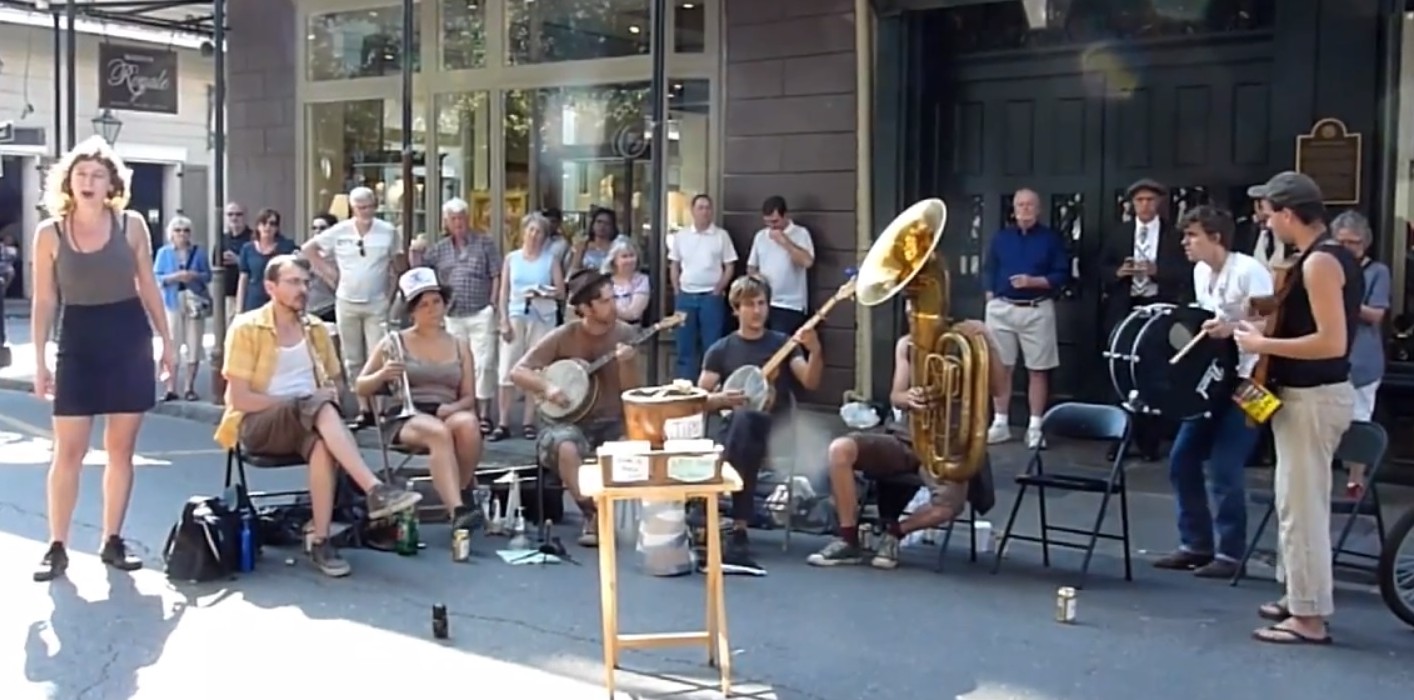
The wonderful young band Tuba Skinny, based in New Orleans, is setting us an example in this respect, as in so many others. Whenever there is sufficient space, they spread themselves out in front of their audience. Shaye Cohn, who gives the directions, sits where she can be seen by all her colleagues. The clarinet and the trombone occupy positions shoulder to shoulder with her because it is with them that she has to work closely to produce the band's wonderful polyphony. The tuba and banjo or guitar are in line so the audience has an unimpeded view of them. Every individual in the band can be seen and appreciated by the audience:
Get it?

Don't you agree that's a better way to present our music?
==========
Footnotes

Since I originally wrote the above article (in 2013), I have noticed a few more bands playing in the 'arc' formation. I'm very pleased about this. Let's get rid of the concept of a 'front line'!

My book Playing Traditional Jazz is available from Amazon.