Welcome, Visitor Number

Translate

Showing posts with label RaoulDuke504 - video-maker. Show all posts

1 February 2018

Post 594: DISENTANGLING 'TANGLED BLUES' (SHAYE COHN AND TUBA SKINNY)

An 18-bar vocal from Erika

I first heard Tangled Blues when Tuba Skinny performed it at The Louisiana Music Factory on 14 April 2015. It was a new composition by Shaye Cohn, with words by Erika Lewis.

Tangled Blues is a very pleasant tune, somewhat country-and-western in feel and played in the Key of F.

But something about it struck me as strange. You form the impression  that you are listening to one melody. But listen carefully and you find there are two separate tunes. Let's call them A and B. They have a lot in common. For example there are motifs such as this one that occur in both A and B (giving the piece that feeling of unity).
It occurs twice in A, played (I think) on the chord of F. It also occurs twice in B, but this time (I think) played on the Bb chord. So we begin to see what a clever 'tangle' Shaye has woven for us. Part A has a lyric and comprises 18 bars. How many tunes can you think of that consist of 18 bars (not counting tunes that are really 16 bars with a 2-bar tag, such as Sister Kate)? Can you think of any? Apart from Miss Otis Regrets by the wonderful Cole Porter, I can't. So Shaye has played a very clever trick here.

However, Part B is a conventional 32 bars but with no lyric.

Despite their similarity of 'feel', the two parts sound (to my ear, which may be misleading me) quite different in chord structure. It seems A starts with, and twice uses, the I - IV - V - I chord pattern whereas B starts on the V chord (dominant - C7th, followed of course by the tonic), of which it makes much use later.

The whole performance goes like this:

4-bar Introduction
18-bar A (Ensemble)
32-bar B (Cornet 16 + Ensemble 16)
18-bar A (Todd on Tuba playing the melody)
32-bar B (Clarinet 16 + ensemble 16 - trombone with melody)
18-bar A (the only occurrence of the vocal - sung by Erika)
32-bar B (Ensemble, cornet-led)

Total = 154 bars; performance time about 4 minutes 20 seconds.

What a clever, pretty and intricate tangle indeed! Well done, Shaye!
'Tangled Blues': Todd plays
the  18-bar melody.
You can watch a street performance filmed by RaoulDuke BY CLICKING HERE or digitalalexa's video (the performance at which I first heard the tune) BY CLICKING HERE.    

My friend Peter Petrovič, who lives in Maribor, Slovenia, enjoys the challenge of trying to work out tunes by ear. He sent me his attempt to decipher Tangled Blues; and I think he has done really well.


24 December 2017

Post 581: MAY AND SHAYE - 'THRILLER RAG'

Thriller was one of the rags composed by May Aufderheide. She wrote it in 1909. May was also the composer of 'Dusty Rag', which is still a favourite with our bands.


I think May would have greatly enjoyed hearing Tuba Skinny, in 2017, adding Thriller Rag to their repertoire. As so often, we have to thank the videomaker RaoulDuke504 for recording their performance for us. You can watch it BY CLICKING HERE.

I believe the sheet music starts with the instruction 'Not Fast', but Shaye Cohn chooses to ignore this and play the piece at a pretty quick tempo. I don't think May Aufderheide would have disapproved of the effect this achieves. Such a tempo certainly provides the basis for 'thrills'.

In fact, although the whole band plays well, I think this performance is in particular a tour de force by Shaye herself.

The four-bar Introduction (from 10 seconds into the video until 14 seconds) is possibly the most thrilling part of all. Shaye leaps to the high Ab and rapidly tumbles down through arpeggios on the Ab diminished chord.


The Thriller comprises two 16-bar themes. Tuba Skinny play through Theme A twice, during the second of which (at 34 seconds) Shaye introduces some interesting variations. When they come to Theme B (54 seconds), Shaye frequently plunges down to the Ab below the stave; and yet then leaps up two octaves to the Ab above the stave for more of those descending arpeggios (e.g., 1 minute 08 seconds). This is something very difficult to do on a cornet, especially at this speed. I am not even sure I have heard Shaye do such a thing before. It's a sign that she is at the height of her powers and full of confidence.

By the way, from all I have said, you may have inferred correctly that the band plays Thriller Rag in the key of Ab - the key in which May Aufderheide composed it. But some bands (certainly here in England) have taken to playing it in F, which is - in a sense - cheating but makes it a good deal easier on the lips!

Also notice how well Shaye directs the performance. In addition to making it clear which instruments are to take 16-bar solos, there are at least six other discreet signals:
2 mins 10 secs: All the 'front line' to join in.
3 mins 09 secs: Return to Theme A.
3 mins 29 secs: Switch to Theme B - finger pointing down:
3 mins 43 secs: Washboard to play the 'break'.
4 mins 03 secs: Front line to play the break.
4 mins 08 secs: Final chorus (leg extend signal).

13 November 2017

Post 567: THE GENEROUS MAKERS OF GREAT VIDEOS

If, like me, you spend many hours watching YouTube videos of traditional jazz bands playing in the USA - and particularly in New Orleans, you must have noticed that dozens of the videos have been put up by two video-making enthusiasts who use the code-names digitalalexa and RaoulDuke504And more recently James Sterling has also come on to the scene. And there others - such as Wild Bill and jazzbo43, who have captured many good New Orleans performances for us. We owe them a huge debt of gratitude; and I think the bands too must be grateful to these people for spreading their fame to many thousands throughout the world. 

A great experience I had in New Orleans during April 2015 was meeting two of these video-makers. They were enthusiastically filming at the French Quarter Festival.

RaoulDuke504 has the advantage of living near New Orleans. I met him while he was filming the Tuba Skinny performance at the Festival. Here he is:


I had the great privilege of shaking his hand and thanking him for the pleasure he has given me (and so many thousands of people) with his wonderful videos.

Digitalalexa is actually two people - husband Al and his wife Judy from New Jersey. They travelled down frequently to New Orleans and had a grand time filming their favourite bands. Al and Judy film the same performance from different angles and when they return home Al edits the two videos into one, trying to make the most of the best shots they have obtained between them. It was a great honour to meet Al and Judy several times at various events. Al told me his videos by 2015 had over three million 'hits'. It was through their videos that I (and hundreds of other fans) first discovered Tuba Skinny and some of the other great bands. So I am deeply grateful.

Here is Judy at The Louisiana Music Factory, where they were about to film a Tuba Skinny Concert.


And here at the same event is Al.


These wonderful modest people enjoy their relative anonymity. But I hope they won't mind my featuring them on this Blog and saying a Big Thank You to them on behalf of us all for bringing us such pleasure.

Good news is that Al and Judy produced the first video of Tuba Skinny to be viewed more than a million times: THIS ONE - CLICK ON TO WATCH IT.

By the way, Al and Judy also founded The 2015 French Quarter Festival and Tuba Skinny Appreciation Society. Al and Judy designed and then Judy embroidered a batch of these lovely souvenir bannerettes. They distributed them to several fans to wave during the Parade and they also gave some to the members of Tuba Skinny.
What terrific souvenirs. I treasure mine!

James Sterling lives in Florida and can get to New Orleans in five hours by car. In January 2015, he came upon a YouTube video of Tuba Skinny (probably one of digitalalexa's). He told me it changed his life for ever. (Exactly the same experience had happened to me a year or two earlier.) He said: 'I watched Tuba Skinny videos for 6 hours straight, finally stopping at 1am'. Since then, James has made the journey three or four times each year. In 2016, I had the pleasure of meeting James and his wife, too. Here he is in Frenchmen Street. Thank you, too, for all the good work, James!

10 September 2017

Post 546: SHAKE 'EM UP JAZZ BAND TRIUMPHS AGAIN!

Once again, those of us who live thousands of miles from New Orleans are indebted to my friend Randy, who makes videos under the name RaoulDuke504. Despite his busy and hard-working life as a chef, he managed to get across the Lake to attend the performance by the all-ladies Shake 'Em Up Jazz Band at the Ogden Museum of Southern Art on 7 September 2017. 
And what a performance it was! This band - which was formed initially just to give a demonstration at a girls' summer camp in 2016 - has continued in existence, flourished and is now one of the most exciting and best traditional jazz bands in the world.

Watch Randy's video of them playing Margie in this recent concert: CLICK HERE.

Yes, I know it's a simple 'standard' that all bands play. But what musicianship!

The three rhythm players have established a kind of 'alternative' gently-pulsating New Orleans-style background that really drives the music and keeps your feet tapping. They are unusual in having no drum kit, no tuba, no banjo, no piano. It's all done in this video by Albanie's guitar, Molly's string bass and Dizzy's subtle work on the washboard (listen to the way she uses her 'cymbal' on the offbeats in the final chorus). I should explain that Julie was out of town so Albanie joined the band. In one half of the concert, she played guitar and Molly the string bass; in the other half, they switched rôles. What versatile and brilliant musicians they are!

After a neat final-eight intro from Haruka, Albanie provides a lovely clear vocal at the start.

Then excitement gradually builds, first with a super solo chorus from Haruka, and next with one of amazing fluency from Chloe on clarinet, while the three rhythm ladies keep that gentle, hypnotic pulse going. Just listen to those notes in Chloe's improvisation. Jazz doesn't get any better than that. Then we hear one of Marla's specials - a chorus brilliantly demonstrating what she can achieve with the plunger mute - hugely creative. After this we have a most exciting chorus, with all three front-line ladies collectively improvising around the melody. How well they listen to each other!

After Albanie sings the vocal again, there is a final ensemble chorus that leaves you desperate to hear more from this band.

And yet the whole performance is achieved with restraint. Everyone is relaxed, comfortable and totally in control. There is no over-blowing, no excessive noise. The notes are allowed to do the work. What we have here are great musicians with a common purpose, working brilliantly as a team and expressing the soul of the music.

I could go on about the other videos from this performance.... But seek them out for yourselves. 'Savoy Blues' and 'Shake 'Em Up' are played in ways that will also take your breath away.

By the way, the cavernous acoustics in the Museum are notoriously bad. So Randy did really well to get close to the band and capture the sound in such high quality.

28 April 2017

Post 501: CALL ME BACK, PAL O' MINE

The morning started with a run through the new additions to YouTube from some of our favourite video-makers.

I soon had a very pleasant surprise. Louisiana-based RaoulDuke504 had filmed Maddy and Her Jazz Friends in the French Quarter on 27 April 2017, performing Call Me Back, Pal o' Mine. I do not think I had ever heard this song before, and certainly not played by a jazz band.
So it is yet another obscure tune from long ago. Maddy has a knack for unearthing really good ones. Remember Hold You Hand, Madam Khan, Baltimore and Buy Me a Zeppelin?

This tune, Call Me Back, Pal o' Mine, struck me as very pleasant indeed. It has a good melody and it feels as though it is based on familiar chord changes that should present no difficulty to jazzmen. So I hope very much that other bands will adopt it - with or without the vocal. You can watch Maddy's performance BY CLICKING HERE.

I immediately contacted that great benefactor of traditional jazz musicians the world over - Lasse Collin. He has made leadsheets for hundreds of tunes freely available to us on his website. I was so pleased that he also liked the tune and promised to produce a leadsheet for it without delay. A few hours later, he had completed the job, and he let me know that the result can be found at:
http://cjam.lassecollin.se/songs3/callmebackpalomine170428.html
Meanwhile, I had sought out the origin of the song and found that it was recorded in 1922, having been composed in 1921 by Harold Dixon, with words by Lawrence Perricone.

Maddy sings and plays it (in the key of Bb) in 4/4 time. But it seems it was composed as a WALTZ (as, indeed several of our 4/4 tunes originally were).

To hear a lovely but ancient piano roll recording of it (played in Ab) in lilting waltz time, CLICK HERE.

There is also an early Gennett waltz-tempo recording available BY CLICKING HERE.

In 1949, the song was recorded (this time in the key of F) by blues guitar legend Blind Willie McTell. You can hear it BY CLICKING HERE. My guess was that Maddy had probably learnt the song from this version; and indeed she has kindly confirmed this was so. In an email she kindly told me: 'Yes, I did learn it from the Blind Willie McTell recording which was on a compilation my dad listened to all the time when I was growing up.'

Conclusion: let's start playing this tune, with a big thank you to Maddy for reviving it, to Randy for filming it, and to Lasse for working out a leadsheet.

===================
Footnote:

Do not confuse this song with Dear Old Pal of Mine, composed during the First World War by Lieutenant Gitz Rice while he was serving in Belgium - though his song also went on to be famous at the time. If you seek it out on YouTube, you will find it is a quite different song from the one sung by Maddy.

31 January 2017

Post 472: 'CRUMPLED PAPERS' - MYSTERY SOLVED

A few years ago, a new tune appeared on the streets of New Orleans.

I heard that it had been used in the TV series Tremé, where it had been played by the most important band in the 21st-Century Revival of traditional jazz - Loose Marbles.

It is a tune I like and recommend, for several reasons. It is short (essentially a 12-bar theme), lively  and very catchy. It is in a minor key (D minor) and it's good to have a minor-key tune in our programmes occasionally. As it seems to use a very small number of chords (possibly only D minor, G minor and and A7th), it is also easy to improvise on.

It was called Crumpled Papers and I could find no reference to it in earlier jazz literature. So where had it come from? Who was the composer?

For a long time, that was an unsolved mystery. However, John Dixon has let me know it is a Michael Magro tune. John told me: Michael ‘wrote’ this, as in just came up with a nice simple melody for a basic 12-bar minor blues. We actually recorded this a couple years ago with him on clarinet, Marla on trumpet, Tyler on bass, Justin on snare drum, and Ben Polcer on piano. Not sure if the recording will ever see daylight though.

So the mystery is solved. Michael, as you probably know, founded Loose Marbles way back in September 2000 and he still runs that band in New Orleans today.
Michael Magro

Modest though its beginnings may have been, Crumpled Papers is a great little tune, given the way it lends itself to improvisations. Have a listen to it, as played by Tuba Skinny. There's a choice of videos:


For a slightly more pedestrian performance, but less affected by audience noise:


Thanks as ever to those two great video-makers digitalalexa and RaoulDuke504.

5 December 2015

Post 321: 'DUSTY RAG'

It was 23rd December 2015 and I started the day as usual by dealing with my large email jazz correspondence and then checking to see what was new on YouTube. I found that RaoulDuke504 - the great Louisiana-based film-maker - had just put up another video of Tuba Skinny playing a few days earlier in the French Quarter.

On the face of it, this video is nothing out of the ordinary. The tune is May Aufderheide's Dusty Rag (from 1908) in the sort of performance that the Tuba Skinny musicians probably regard as routine and unexceptional. They give a simple unpretentious interpretation, without special effects and complexities. What's more, there seems to have been a workman using an electric drill somewhere off-camera, so there are irritating occasional whirring noises in the background.

And yet, this is such an enjoyable performance that it reminds me why I consider the playing of Tuba Skinny to be streets ahead of most of the bands whose efforts I watch on YouTube.
Todd Burdick
It's not easy to put my finger on exactly what makes them so good. I think it's a mixture of the following. The drumming (by Robin Rapuzzi) is so intelligent, tasteful and unobtrusive. The string players are completely solid in supplying accurate harmonies and four-to-the-bar rhythmic support. Todd Burdick (tuba - though he plays a sousaphone on this occasion) as ever provides a bass line that is elegant, accurate and appropriate. The 'front line' (clarinet, cornet and trombone) listen to each other carefully: they interweave their musical lines and harmonies with subtlety and with a total absence of flashiness or exhibitionism. The emphasis is on teamwork: players support each other. (Note how even when the sousaphone has a little 16-bar 'solo', Barnabus gives gentle support on the trombone.) Also, the band takes care with setting a perfect tempo - and maintains it. Finally - and I think this is very important - there is no electronic amplification of any kind. Everyone plays acoustically. We can hear every instrument, and we can appreciate the various 'voices' and blending tones.

I hope you will share my pleasure if you watch the video by clicking here.

What makes other bands less good? They nearly always fail in one or more of the respects I have mentioned. The drumming is too loud or insensitive: one or more of the players is an exhibitionist; there is limited evidence of teamwork; amplification is allowed to unbalance the band and distort sounds,.... and so on.
Tuba Skinny at the end of 2015
On a related matter, I would like to quote from two emails I received. The first is from a gentleman who lives in Florida. He became a keen fan of Tuba Skinny after discovering the band early in 2015:

I have commented to others that Tuba Skinny is, in my humble opinion, the best trad jazz band in the world. Of course I haven't been exposed to every band in the world, but I haven't heard one better. Shaye forgoes what I call 'acrobatics' on the horn to play the actual music with her impeccable phrasing and reverence for the music. There is no show off in her, trying to prove how facile she is on the cornet like many players, who only do so to the detriment of the music.

And this one is from a gentleman in England:

I've just been listening to the 3 recordings on You Tube of Tuba Skinny playing Blue and Lonesome. All are good but the one that thrills me most is played on Royal Street 4/11/14 on Digitalalexa. Erika's singing and the instrumental work are in perfect sympathy. They caress the melody and play both individually and collectively in the best New Orleans tradition. How do they do it so well? I've now listened to several of the other New Orleans busking groups and there isn't one, including those involving some of the regular TS musicians, which comes within a mile of what they achieve. Wonderful, wonderful jazz . What a find.

25 November 2015

Post 308: 'THOUGHTS' (COMPOSED BY ROBIN RAPUZZI)

A lovely new tune to appear on YouTube is Thoughts, played by Tuba Skinny and composed by their percussionist Robin Rapuzzi. It is a tune of which he has every right to feel proud.

You can hear Tuba Skinny playing it by clicking here (with thanks to the excellent video-maker RaoulDuke504 for capturing the performance and alerting the world to it).

Thoughts is played wistfully, at a gentle tempo. In this video (click on) you can see them taking trouble to get the tempo just right before playing it.

When you first hear it, you can easily fall into the trap of thinking it has a standard 32-bar structure (A - A - B - A) because it begins like that and also it runs to 96 bars (measures) in total - which normally would suggest it's played through three times (3 x 32).

But listen carefully and you find it is much more complex. The initial tune seems to comprise 40 bars, not 32 (A - A - B - A - A).

The 'A' theme is of a pretty rocking and 'descending the ladder' type. Its first four bars sound to me like this:


and the 'B' theme seems to have a deliberate echo of 'Mood Indigo'. It begins:


But after these forty bars, something different happens. There is a 16-bar 'Interlude' (let's call it Theme 'C') which seems to me to be using the related minor key. It begins something like this:


By the end of that, we have completed 56 bars.

So, 40 bars to go? Presumably the Main Theme (A - A - B -  A - A ) to be played again?

Well, yes, but not quite. What we get is A - A - (a strange) B - B - A.

In these final 40 bars, the first sixteen (led by the clarinet) are indeed the same as the opening sixteen (Theme A twice). But then we have the first four bars only of the 'B' (Mood Indigo) theme followed by 4 leaping new bars of melody. Then the full 'B' (eight bars) again, but with a slightly different ending from the first time it was played.

88 bars completed. 8 to go. These 8 turn out to be a final run through of Theme 'A'.

So in total, the 8-bar theme 'A' has been played seven times. It lingers is your head and you will be humming it for the rest of the day.


Robin wrote this piece during the band's Summer 2015 tour. It was - as he puts it - at first planned as a tune for 'Squeaky Violin'! But, he says: 'Sure sounds a lot better when the band plays it'!

I had the great pleasure of meeting Robin at the French Quarter Festival in April 2015.We had a very enjoyable chat as he prepared his washboard (and his fingers) to go on stage.
I hope we shall hear more of Robin's compositions in the future.

22 November 2015

Post 302: OUR MUSIC GOES GLOBAL

A correspondent from Connecticut set me thinking. She said it is a wonderful thing that - thanks to YouTube - performances by the bands on Royal Street, New Orleans, can be enjoyed within hours by viewers all over the world. She said it's as if we are all attending a 'Global Concert'.

That's exactly how it is. I constantly receive e-mails from fans saying 'Have you seen this latest YouTube  video? It's terrific.' In my turn, I pass on such tips to other friends. So these performances become what journalists call 'Breaking News', spreading rapidly throughout the world.

The quality of much of the video work is first-class. A recent e-mailer told me that watching some of the videos is 'almost like being right there in the street'. We are all grateful, I'm sure, to the video-makers - those with the codenames digitalalexa, RaoulDuke504, jazzbo43, Dmitriy Prityikin, Wild Bill, guitarded71 and many more.

The musicianship is some of the best to be witnessed anywhere. So we must also be grateful to the musicians, who do not mind their performances being enjoyed free of charge throughout many different countries.
In its turn, however, YouTube is helping to spread the fame of these great bands. Correspondents often tell me they would never have heard of such bands as Tuba Skinny and The Smoking Time Jazz Club and The Shotgun Jazz Band, had it not been for YouTube. And many say they decided to take a vacation in New Orleans as a result of watching these videos.

Yes, how things have changed since the days when the best that fans could do was to save up for the latest 78 rpm record of Jelly Roll Morton or Louis Armstrong. We are indeed fortunate to enjoy the immediate aural and visual gratification that comes from living in the great technological age of Traditional Jazz Concert 'Breaking News'.
=================
FOOTNOTE
The book Enjoying Traditional Jazz, by Pops Coffee, is available from Amazon.

20 November 2015

Post 297: TUPELO - THE CHIEF EXECUTIVE

Today a treat for those of you who love both traditional jazz and dogs. It's a photo of Tupelo, the World's No. 1 Jazz Dog.
Photo courtesy of RaoulDuke504

This photo was sent to me today by the great video-maker codenamed RaoulDuke504. He says this is Tupelo in his favourite spot during the street performances.

Tupelo is of course Tuba Skinny's dog. We have seen him over the past five years strolling around among the band members during so many of their YouTube performances. He may appear not to take much notice of their playing but I assure you he is a keen critic and knows their entire repertoire of more than 250 tunes. There is no need for him to be demonstrative. He knows they are playing well and - like a great football coach - he says he can trust his team to 'give 110%' once they are on the pitch.

Here he is with Barnabus, on his way to supervise a street gig.
Photo courtesy of Bill Stock


For a video in which Tupelo plays a starring role, CLICK HERE. You will notice him - from 3 minutes 56 seconds - beating his foot in time with the music!

Robin Rapuzzi of Tuba Skinny has contributed this tail-piece:

Tupelo has been our band director since at least 2010. He's got his winter coat growing in and he's prepared to sing along any time Barnabus warms up on his trombone. He really does check our pitch. Sometimes our second manager, Lola, Todd's dog comes around to keep us in check too. Keep a look out for her.
=====================

FOOTNOTE: I wrote the above article four years ago. But I received in July 2019 the sad news that Tupelo had died.

25 October 2015

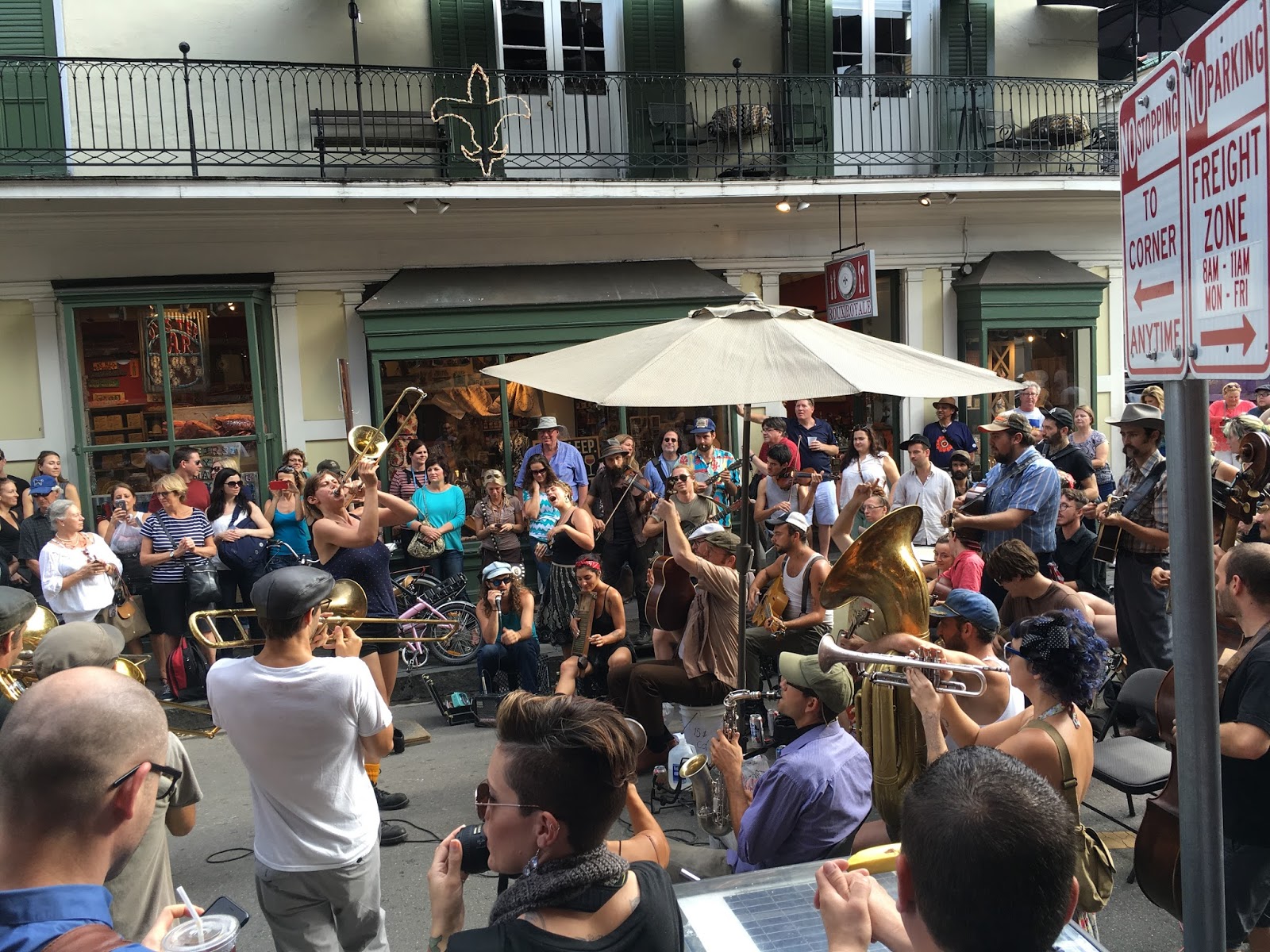
Post 282: A NEW ORLEANS STREET SCENE

What a street scene!
Photo courtesy of RaoulDuke504

Twenty-seven outstanding musicians playing traditional jazz together!

Where but New Orleans would you witness anything like this?

The occasion was 6 November 2015. The event was recorded for us by the excellent video-maker codenamed RaoulDuke504. He told me:

At one point, we counted four guitars, three banjos, two trumpets, five(!) trombones, a clarinet, two percussionists, three fiddlers, two accordions, three washboards, a harp player, and a jug blower, all playing at the same time!

All these fine young people had given their day to the good cause of raising money to help with the medical expenses of a popular 64-year-old jazz fan, a regular visitor to New Orleans, who had been brutally attacked and injured in the street.

If you would like to experience the atmosphere of the occasion by watching one of the videos (there are several on YouTube), please click here. How often have you heard a five-trombone chorus?! There's one at 5 minutes 26 seconds.

9 February 2015

Post 171: 'WHAT IF WE DO?' - CLARENCE WILLIAMS, KATHERINE HENDERSON; AND TUBA SKINNY

In the beginning there was a Columbia recording made in New York in 1929 by The Seven Gallon Jug Band of a 32-bar tune (without vocals) called What if I do?. Who wrote it? 'Clarence Williams and Johnson' (presumably James P. Johnson, unless someone can provide me with further information). The Seven Gallon Jug Band was one of the musical groups led by Clarence Williams.

Then in 1930 came the recording What if we do?, (same melody) sung by the niece of Clarence Williams - Katherine Henderson (sometimes spelt Catherine Henderson) - accompanied by Clarence Williams and his Orchestra.
What if we do? is sung very prettily at a gentle tempo and the whole performance runs for just over 3 minutes 20 seconds. Thanks to the kindness of Nico Fournier, you can enjoy it on YouTube. You will find it addictive:
As you will hear, after a short introduction, Katherine sings the 32-bar Chorus. It's a simple a-a-b-a structure typical of those times. There's a Georgia pattern chord structure in the 'a' sections. Harmonically the whole song is very similar to Five Foot Two and Please Don't Talk About Me. And like those songs, it has this familiar Middle Eight:
III7 |   III7  |  VI7  |  VI7  |   II7  |  II7  |  V7   |  V7

After the Chorus, Katherine Henderson sings the Verse (16 bars) before singing the Chorus again and, with that, the record ends. There are no instrumental interludes.

Katherine sings the song in the key of C, with which she is obviously comfortable.

I would not have known this song existed had it not been for its appearance in January 2015 as the latest addition to Tuba Skinny's impressive repertoire. It appeared on YouTube (thanks to the fine video-maker RaoulDuke 504):


Goodness knows how Tuba Skinny constantly find these long-lost gems and then revive them for our pleasure.

As you see, Tuba Skinny have chosen to play What If We Do? entirely as an instrumental number. They take it rather more quickly than Katherine Henderson and Clarence Williams. They also choose to change the key to Bb. And they omit the Verse. In this Tuba Skinny street version, the Chorus (32-bars) is simply played through four times (128 bars in total), with no introduction or coda - no frills, in fact. Barnabus gives a lusty performance on trombone and Todd takes the lead on the second half of the third chorus. It is a typical workmanlike Tuba Skinny performance - thoroughly enjoyable and a lesson to us all.