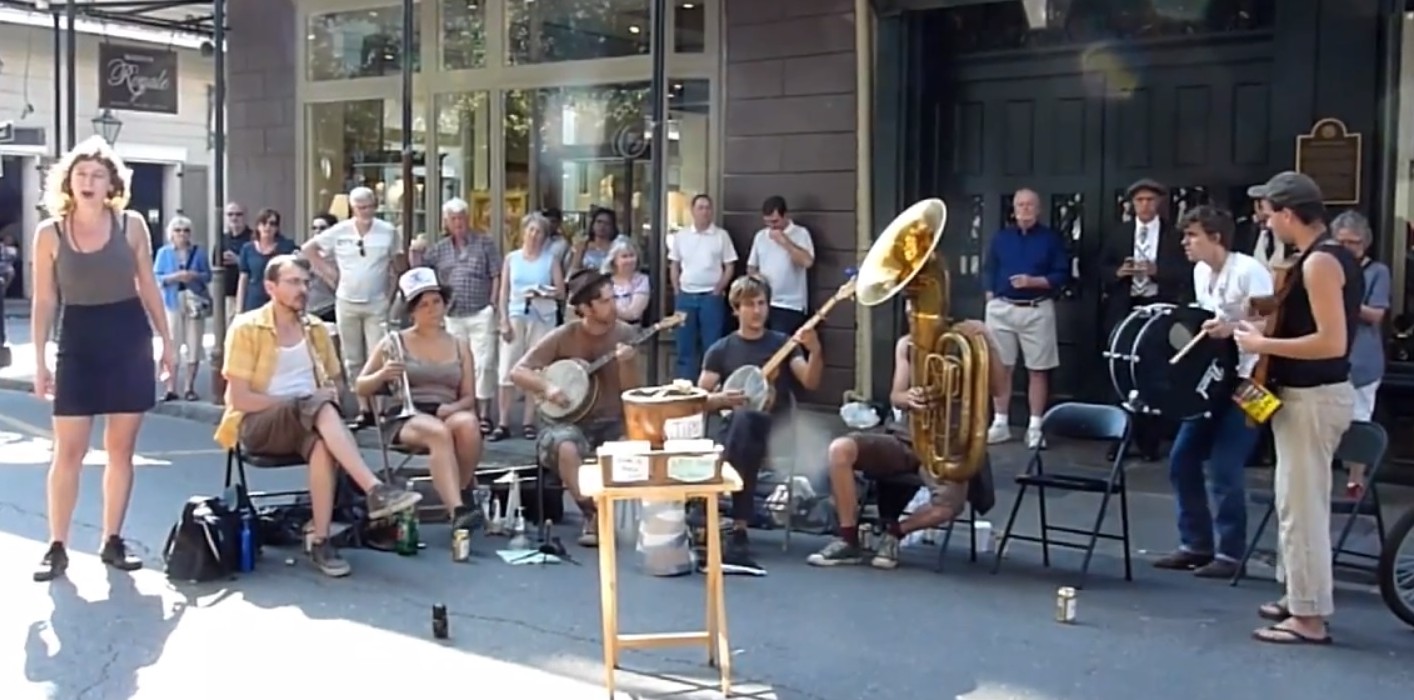
Obviously there are circumstances where musicians have no choice. If you play in a street parade, for example, you have to be on your feet. And some string bass players and sousaphone players claim to be more comfortable standing up. That's fair enough; though even some of them can and do sometimes benefit from using a chair or perching on a stool.
I have heard it said that trombonists need to play standing up to give 'freedom to their lungs'. I do not accept this argument. Classical orchestral trombonists - who are almost invariably seated - have no difficulty in producing a triple forte when required. And our best young trombonists today (such as Barnabus Jones) happily play sitting down.
As a general principle, I believe our musicians should be seated whenever possible. Why? Because you need to be comfortable and relaxed to contribute well in a traditional jazz ensemble. You are less likely to over-blow and more likely to listen carefully to your colleagues. The teamwork will be better.
I have written before about the layout of bands and recommended that the formation should be a semi-circle or arc rather than a 'front line' with other musicians behind it. Combine this with having everyone seated and you have the perfect formula for good teamwork and communication.
 |
| AN ARC: Perfect for relaxed playing and good communication within the band. |
But when we see a trumpet and trombone at the front of a stage, the instruments pointing directly over the heads of the audience, there is something inherently exhibitionist and aloof in the very posture. Unless the musicians are specially careful, it encourages playing that is too loud and it diverts their attention from where it should be - on how the band as a whole is sounding.
 |
| That's the way to do it! |
Look at photos of the great bands from the early days of our music. Clearly, they enjoyed being well supplied with chairs.


The evolution of the standing, pretentious 'front line' seems to have occurred later.
I am pleased to note that in recent years, even though the fashion for standing up still persists in many (mostly long-established) bands, the younger generation of fine traditional jazz musicians generally adopts a comfortable and relaxed seated posture and a formation that enables them to put teamwork first.
I am pleased to note that in recent years, even though the fashion for standing up still persists in many (mostly long-established) bands, the younger generation of fine traditional jazz musicians generally adopts a comfortable and relaxed seated posture and a formation that enables them to put teamwork first.