Welcome, Visitor Number

Translate

Showing posts with label Madeleine Reidy. Show all posts

25 May 2017

Post 510: 'BALTIMORE'

The song Baltimore first came to my attention when I watched a YouTube video (filmed by the excellent RaoulDuke504) of Madeleine Reidy (Maddy and Her Jazz Friends) singing it in Royal Street, New Orleans, in 2016.
You may find the performance:
BY CLICKING HERE.
I discovered it was a song composed in 1927 by the great Jimmy McHugh. The lyrics were by Danny Healy and Irving Kahal.

I also soon realized it was not specifically about Baltimore the great seaport city in Maryland. It's about a dance craze called 'The Baltimore' that originated there. It was maybe something like the Black Bottom or the Charleston, though I guess far less popular.

The song has a 16-bar Verse and a 32-bar (aaba) Chorus and, in the sheet music, is in the key of Eb. Maddy plays and sings it in F, starting with an instrumental Chorus  and saving the Verse until the start of her vocal.

According to the lyrics, 'The Baltimore' seemed to involve 'swayin' like an old see-saw'. Apparently you 'count the beat, you double it, then repeat and then you slide your feet right over the floor...' (instructions I would find impossible to follow!). There is plenty of good rhythmic punctuation of the melody, especially in the Middle Eight. 

I thought it would be a good tune to learn and that it would be very helpful to see the sheet music.

My friend Mikko Vaisala, who runs the Doctor Jazz band in Finland, also took a fancy to this tune. He pointed out to me that there are many performances of it available on YouTube. Try THIS ONE (click on), for example, where again it is played in F.

And for a very slickly-orchestrated early version from Frankie Trumbauer (with Bix on cornet) CLICK HERE.

Good news it that, thanks to the kindness of the Sheet Music Archivist at The University of Missouri, Mikko was able to obtain a copy of the original sheet music. So there's no excuse now for us not to play it. Many thanks, Mikko.

28 April 2017

Post 501: CALL ME BACK, PAL O' MINE

The morning started with a run through the new additions to YouTube from some of our favourite video-makers.

I soon had a very pleasant surprise. Louisiana-based RaoulDuke504 had filmed Maddy and Her Jazz Friends in the French Quarter on 27 April 2017, performing Call Me Back, Pal o' Mine. I do not think I had ever heard this song before, and certainly not played by a jazz band.
So it is yet another obscure tune from long ago. Maddy has a knack for unearthing really good ones. Remember Hold You Hand, Madam Khan, Baltimore and Buy Me a Zeppelin?

This tune, Call Me Back, Pal o' Mine, struck me as very pleasant indeed. It has a good melody and it feels as though it is based on familiar chord changes that should present no difficulty to jazzmen. So I hope very much that other bands will adopt it - with or without the vocal. You can watch Maddy's performance BY CLICKING HERE.

I immediately contacted that great benefactor of traditional jazz musicians the world over - Lasse Collin. He has made leadsheets for hundreds of tunes freely available to us on his website. I was so pleased that he also liked the tune and promised to produce a leadsheet for it without delay. A few hours later, he had completed the job, and he let me know that the result can be found at:
http://cjam.lassecollin.se/songs3/callmebackpalomine170428.html
Meanwhile, I had sought out the origin of the song and found that it was recorded in 1922, having been composed in 1921 by Harold Dixon, with words by Lawrence Perricone.

Maddy sings and plays it (in the key of Bb) in 4/4 time. But it seems it was composed as a WALTZ (as, indeed several of our 4/4 tunes originally were).

To hear a lovely but ancient piano roll recording of it (played in Ab) in lilting waltz time, CLICK HERE.

There is also an early Gennett waltz-tempo recording available BY CLICKING HERE.

In 1949, the song was recorded (this time in the key of F) by blues guitar legend Blind Willie McTell. You can hear it BY CLICKING HERE. My guess was that Maddy had probably learnt the song from this version; and indeed she has kindly confirmed this was so. In an email she kindly told me: 'Yes, I did learn it from the Blind Willie McTell recording which was on a compilation my dad listened to all the time when I was growing up.'

Conclusion: let's start playing this tune, with a big thank you to Maddy for reviving it, to Randy for filming it, and to Lasse for working out a leadsheet.

===================
Footnote:

Do not confuse this song with Dear Old Pal of Mine, composed during the First World War by Lieutenant Gitz Rice while he was serving in Belgium - though his song also went on to be famous at the time. If you seek it out on YouTube, you will find it is a quite different song from the one sung by Maddy.

12 August 2016

Post 426: THE BALKAN BRASS BAND INFLUENCE IN TRADITIONAL JAZZ

My American friend and frequent correspondent Phil is very keen on a band called The California Feetwarmers.
He has kept me informed about their Summer 2016 tour in the U.K., Germany and Switzerland. You can hear this band of very proficient musicians by clicking here, where they play slick arrangements of Aunt Hagar's Blues, San and Bill Bailey.

Phil tells me some of the players previously played as a 'Balkan brass band' and there is still a great influence of the disciplines of Balkan brass band music in their playing.

This set me thinking, because Balkan Brass Band Music is something about which I knew virtually nothing. So I spent a couple of hours reading about it. I discovered it seems to have arisen from the folk music mainly of Serbia, Macedonia and Bulgaria. Much of the music supports vigorous dancing. It has repetitive insistent melodies and very strong rhythms.

Picture a village square. We see a group of colourfully-dressed dancers in a circle, hands linked, dancing in a manner that involves fast-paced complicated foot movements while the upper bodies remain statuesque. They are accompanied by a sousaphone heavily stamping the first and third beats of the bars, an accordion playing rapid sequences of notes, a violin, trumpets and other horns, as well as sundry busy percussion instruments. The band plays with technical precision. The harmonies sound simple – largely involving the three main chords (but perhaps this is deceptive, since it seems likely also that they using some uncommon scales); and the melodies, mostly rapid, contain some acrobatic twists and turns. In some tunes, there are compound time signatures, notably 9/8 and 7/8.
A 'Balkan Brass Band' in New Orleans!
I learned that there are various song forms of which the two commonest are the Kolo and the Čoček. The Kolo is often a group dance as described above and sometimes in 9/8 rhythmic form. The Čoček may also be in 9/8 time.

To get an immediate feel for what Balkan brass band music at its brassiest sounds like, click here.

The Balkan influence has spread among some of the very best traditional jazz musicians of today. Think of Jenavieve Cooke. In her years of nomadic living, she picked up Balkan music at its source. In April 2016 she told me 'I'm a traditional Balkan music and dance freak!'

Years before she formed the famous Royal Street Winding Boys, Jenavieve founded in New Orleans a Balkan brass band called Backyard Belladonna.

And there's Ben Schenk (mainly playing clarinet), now in his 50s, who spent years evolving the kind of band that seemed just right for him. He ended up with The Panorama Jazz Band, which is quite capable of playing traditional jazz in familiar style, but also has in its programmes doses of influence from Balkan brass band music and Klezmer music, not to mention a considerable Caribbean element! Panorama has been a truly great band since Aurora Nealand (who, by the way, has toured in the Balkans) joined it. She - one of the world's greatest reed players - has a heart full of the joys of music of all cultures. She perfectly complements Ben's work. There are plenty of videos of the band on YouTube but I will mention this one, where you catch them in Big Band Mardi Gras format: CLICK HERE.

And think of Matt Schreiber. This fine accordion player and Balkan music specialist not only plays with Ben in the Panorama Jazz Band but also works in the specialist Mahala Trio (Balkan music in New Orleans). Try watching a video of him and his two colleagues by clicking here. It's not a brass band but it certainly gives novices such as myself a good insight into the nature of Balkan music.

And now we have The Wit's End Brass Band. They have produced a remarkable CD that you can find on Bandcamp.
The Wit's End Brass Band 2016.
It includes some familiar faces!
You must watch THIS VIDEO OF THEM. CLICK HERE TO VIEW.

I discovered there are very many 'Balkan Bands' all over the world, even in such unlikely places as England, Australia and the Netherlands. In the USA there are dozens of them, and Balkan Band Summer Camps are held on both the East and West Coasts. For a terrific Balkan SuperBand playing in our beloved Royal Street, New Orleans: CLICK HERE.
Balkan Brass Bands:
Above and Below
In spirit, instrumentation and rhythmic excitement, it seems to me this Balkan music has a lot in common with Klezmer music, which has also had a permeating influence on New Orleans jazz in the 21st Century. Add to these influences that of Caribbean calypso music – much associated in recent years with The Panorama Jazz Band and with Madeleine Reidy and later with The Rhythm Wizards in New Orleans and Wow! We observe some very interesting developments in the music we love.

25 October 2015

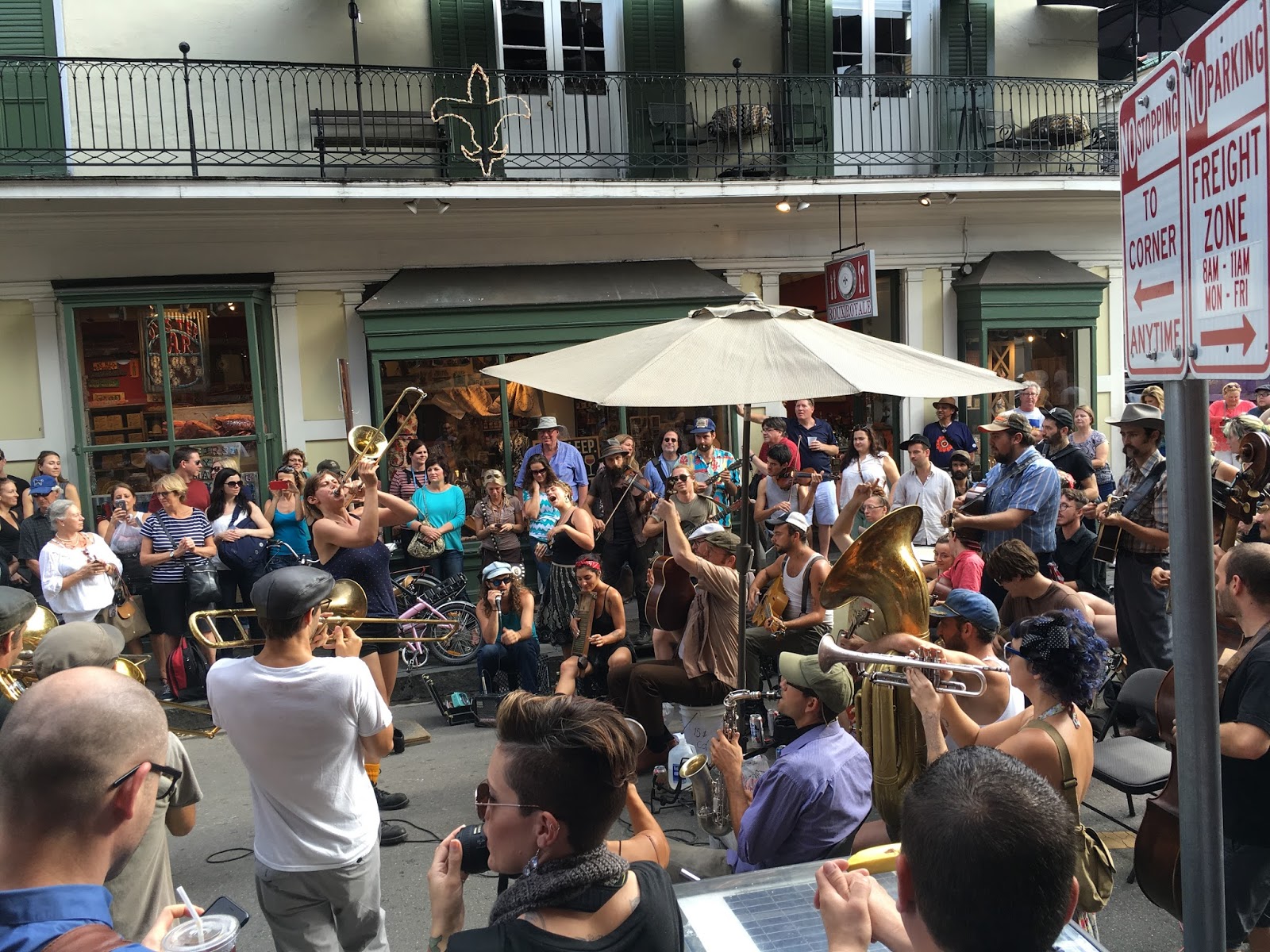
Post 282: A NEW ORLEANS STREET SCENE

What a street scene!
Photo courtesy of RaoulDuke504

Twenty-seven outstanding musicians playing traditional jazz together!

Where but New Orleans would you witness anything like this?

The occasion was 6 November 2015. The event was recorded for us by the excellent video-maker codenamed RaoulDuke504. He told me:

At one point, we counted four guitars, three banjos, two trumpets, five(!) trombones, a clarinet, two percussionists, three fiddlers, two accordions, three washboards, a harp player, and a jug blower, all playing at the same time!

All these fine young people had given their day to the good cause of raising money to help with the medical expenses of a popular 64-year-old jazz fan, a regular visitor to New Orleans, who had been brutally attacked and injured in the street.

If you would like to experience the atmosphere of the occasion by watching one of the videos (there are several on YouTube), please click here. How often have you heard a five-trombone chorus?! There's one at 5 minutes 26 seconds.

18 April 2013

Post 49: FROM CALYPSOS TO TRADITIONAL JAZZ

Hey, what's this?

Hold Your Hand Madam Khan, Buy Me a Zeppelin, History of Man, Seven Skeletons Found in the YardRoses of Caracas, Juliana - how is it that such tunes have entered the repertoire of the young street bands in New Orleans?

The all-ladies band, formed in 2016 and now called The Shake 'Em Up Jazz Band, has the calypso Shame and Scandal in the Family in its repertoire and recorded on its first Album.

It seems that someone on the traditional jazz scene in New Orleans has been deeply affected since early 2014 by Trinidadian calypsos from the 1930s.

Traditional jazz bands have long enjoyed playing an occasional tune with a Latin rhythm - for variety. In the standard repertoire, there are Creole Song and Eh La BasRum and Coca Cola and Mama Inez, for example; and the minor key section of St. Louis Blues and a few tunes such as Isle of Capri lend themselves to a Latin beat.

But we have recently seen on YouTube that the bands have revived long-forgotten 1930s calypso numbers. There was the Superband (with Madeleine Reidy on vocal) playing Hold Your Hand Madam KhanClick here to view. Great fun.

Madeleine has kindly let me know about a wonderful website/blog from which anyone can obtain inspiration and material. She told me: Here's a music blog I found recently with tons of awesome old calypso (and many other Caribbean genres) recordings uploaded for free:
http://auraljoy.blogspot.com . 

The site is indeed tremendous and I pass on Maddy's recommendation to you.

My theory is that Madeleine is the principal force behind this percolation of Caribbean music into the repertoires of today's young bands in New Orleans.

In fact, one of the groups in which she plays is called Maddie and Her Calypso Friends. They recorded Seven Skeletons Found in the Yard - a calypso originally recorded in 1938 by Lord Executor (Philip Garcia). Watch this video (click here). Madeleine clearly makes a speciality of calypsos and has also been seen, for example, singing Buy Me a Zeppelin - another great number. You can hear Maddie performing this calypso by clicking here. She has memorised the words of plenty of verses for these songs - no mean feat.

And since 2014 Maddie has led an exciting 12-piece band called Steamboat Calypso. Like the great calypso performers of the 1930s (Lord Invader and Roaring Lion, for example), Maddie has given her musicians wonderful stage names - such as Lord Patches, The Duke of Hammers, Porkchop and (Shaye Cohn, no less) The Duchess of Sound. Madeleine has plans for them to make a CD soon. You can find a few videos of the band on YouTube.

The Lionel Belasco tunes Juliana and Roses of Caracas have been heard on the streets of New Orleans, played by Tuba Skinny. And The Rhythm Wizards included History of Man as one of the twelve tracks on their March 2015 CD. More recently we had Tuba Skinny (at the time sharing three players with The Rhythm Wizards) also playing History of Man in the street:
Click here to view.

The history of the calypso over the last 250 years is very complex. Many influences went into its creation, and in its turn it has  spawned music in various sub-genres. If you want to study the history of calypsos in depth, there is plenty to get you started in Wikipedia. But if you are happy with a few over-simple essentials I can offer you some observations.

The origins of Afro-Caribbean calypsos can be found in the music sung by the slaves of French planters in the Eighteenth Century, especially in Trinidad.

The early music had characteristic rhythms and harmonies.

The language of the lyrics moved over the years from a form of French creole to a greater intermingling of English.

The words were frequently subversive - expressing political satire.

In 1912, on a visit to New York, Lovey's String Band (twelve musicians, including piano, bass, flute, violins, etc. - quite an 'orchestra') made the first recording of a calypso - five years before the first jazz recording! You can hear their performance by clicking here.  The Lovey String Band and the pianist-composer Lionel Belasco were important names in the recording of the music over the next few years. To my ear, those early recordings seem to use one or two simple repetitive smooth melodic themes, played (for example on violin or clarinet) against a busy rhythmic - almost ragtime - background.
Lovey's String Band
Try sampling another very early calypso recording - this one a piano-and-violin duet (Lionel Belasco and Cyril Monrose) - by clicking here.

Calypsos flourished in the 1920s and 1930s, when the genre became firmly established. Their subject-matter was wide-ranging, but continued to contain much critical comment on politics and society, sometimes under the guise of double entendre. Entrepreneurial talent scouts fitted some of the best performers up with impressive stage names and sent them from the West Indies to record and find fame in New York. Principal among them were Roaring Lion (Rafael de Leon), Attila the Hun (Raymond Quevedo), Lord Invader (Rupert Westmore Grant - who composed Rum and Coca-Cola), Lord Kitchener (Aldwyn Roberts), Lord Caresser (Rufus Callender) and Wilmoth 'King' Houdini (Frederick Wilmoth Hendricks).
Lord Caresser (Rufus Callender)
Words were often witty and delivered in rapid-fire style (sometimes extemporised), and there were internal rhymes. You can hear Raymond Quevedo and his band performing Coffee Coffee by clicking here. It is hard to imagine anybody not enjoying this!

Note how, in structure, this calypso has much in common with the New Orleans 'Creole' standards Eh La Bas and L'Autre Can Can (a.k.a. Creole Song). But this is unsurprising: they are derived from similar African roots.

Born as late as 1934, Lord Tanamo (Joseph Gordon) sustained the tradition. Listen to his amusing Taller Than You Are (written and played by himself): CLICK HERE. I have not yet heard a New Orleans band play this song, but I am sure one of them will soon get round to it!

From the 1950s, 'toned-down', commercialised calypsos were very much in vogue. For example, there was The Banana Boat Song, made famous by Harry Belafonte. There were several films exploiting the craze - notably Island in the Sun. The use of steel drums became commonplace. (Ironically, the steel drums have generally been manufactured in European countries, such as Sweden and Switzerland.)

There have been hundreds of calypsos recorded and dozens of distinguished performers - far more than my brief survey implies.

But, as the repertoire of the Trinidadian band Codallo's Top Hatters Orchestra has been revived in New Orleans, it is worth mentioning that band in particular. In the 1930s they recorded History of Man and Hold Your Hand Madam Khan. And it was Lord Caresser (Rufus Callender) who wrote Exploiter (a.k.a. Buy Me a Zeppelin).