You're planning a holiday in New Orleans? It will be your first time there? Great. You will love it.
The best way to get around in the French Quarter, where most of the jazz is to be heard, is on foot. The entire French Quarter is small - only about half a square mile in total. However, until you get used to it, be careful how you tread on those pavements (sidewalks), because - as at 2017 - there were still thousands of fractures and fragmentations awaiting repair.
My friend and keen video-maker James Sterling from Florida has visited New Orleans much more often than I have; and he has asked me to pass on his own recommendations. He says you should get out of the French Quarter occasionally, particularly by using the St. Charles Streetcar which will quickly take you to the Garden District, with its stately mansions, hotels and restaurants, as well as the fine Audubon Park and Zoo. Then there is Magazine Street. You can visit it while in the Garden District. It is lined with quirky shops, pubs and eateries and is just a five-block walk from the streetcar line. That is a very good tip - not one that many people would think of.
And James enjoyed the World War II Museum in the Warehouse District, just up-river from the French Quarter. In addition to the displays, it has a theatre with live revues of music from the WWII era.
James says he goes to New Orleans for the food as much as for the music. He says: 'There are too many excellent restaurants in NOLA to list but my favourite is Coquette on the corner of Magazine and Washington in the Garden District.' He also mentions Brennans for a great brunch, and Coop's Place, Johnny's Po-Boys, The Gumbo Shop, and The Central Grocery for excellent reasonably-priced food. Café Envie in Decatur Street is good for pastries, coffee and breakfasts.
For a place to stay, James likes the many bed-and-breakfast inns. He says: 'You will get a private room usually in an old mansion with personal service from the inn-keeper and will meet new friends around the breakfast table. For rooms at reasonable prices (for NOLA) I recommend The Richelieu, Hotel Provincial, LaMothe House, and The Frenchmen Hotel (get a room in the back away from the street noise).'
There are indeed plenty of hotels and other forms of accommodation. Imagine you stay at a hotel in Burgundy Street, somewhere near the junction with St. Ann Street. It will be a mere 5-minute walk to Preservation Hall, or 12 minutes to the Palm Court Jazz Café.
It will take you only a quarter hour to walk to Frenchmen Street, which is just beyond the French Quarter at its north-eastern edge; and there in the evenings (and some afternoons) you will find such great bars and clubs as the dba, The Maison and The Spotted Cat, where some wonderful bands regularly play.
From 11 a.m. daily, you will be able to hear great busking groups if you head to Royal Street (five minutes on foot from your hotel).
 |
| Buskers in Royal Street |
You will of course enjoy sampling all the other amazing things the French Quarter has to offer, including, as Jim says, plenty of fine eating places. You must have a stroll by the Mississippi – maybe heading down to the Riverwalk Shopping Mall, which I like very much. On the way to it, you could visit the Audubon Aquarium of the Americas. On another day, head left alongside the river to a different kind of shopping experience – the famous and massive French Market.
 |
| The French Market |
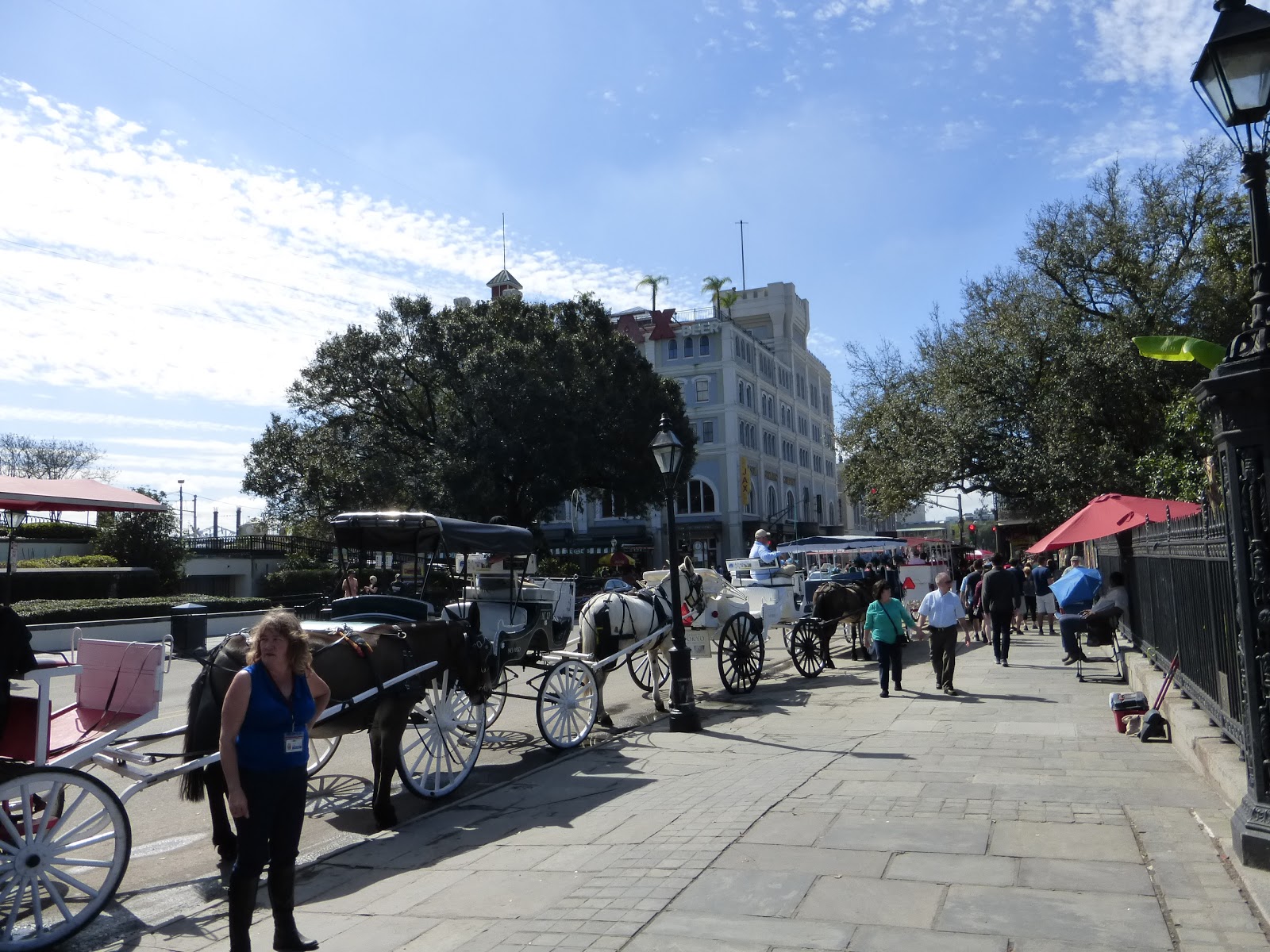
Of course you will dawdle among the artists in Jackson Square (where there is usually also some lively jazz busking).
And you may visit special events at The Mint, or take rides on the streetcars to the Garden District .
Or go to the huge City Park, or have a river trip on the Natchez. Or you might care to cross the River on the ferry to Algiers.
 |
| The Mississippi and New Orleans |
Maybe you will go on one of those 'Bayou' tours or a 'Cemetery' tour (easily bookable - you will see them widely advertised. James particularly recommends the Lafayette Cemetery just one block south of St. Charles Avenue). This is well worth doing on your first visit.
My advice would be to give the garish and vulgar Bourbon Street only a few minutes of your time. I suppose it's worth seeing, if only to convince yourself that such a street really exists. And you will hardly be able to avoid it, as it's right there in the centre of the French Quarter. But if you are a serious traditional jazz fan, there are far better places to be.
But please don't take me as authoritative. I live 4500 miles from New Orleans and have been to the City only seven times during the last 30 years, so (even with help from James) I don't claim to be an expert. I am simply giving you a few personal impressions that may be of some use.
On my first visit, when I was about 50 years old, I spent most evenings at Preservation Hall. I heard such players as Harold Dejan, Milton Batiste, Narvin Kimball, Percy Humphrey, Willie Humphrey, Danny Barker, Frank Demond, Kid Sheik Colar and the very young Greg Stafford. But in recent years I have spent my evenings in the bars and clubs of Frenchmen Street to catch the exciting new generation of great bands that have evolved in New Orleans since Hurricane Katrina.
A couple of further points:
1. Transport between the aerodrome and the City Centre (about 15 miles) is easy. There are plenty of taxis. And some hotels run shuttle services. Recently a taxi cost 40 dollars (including tip) for a single trip. But there is also a regular bus service (the Jefferson E.2 Transit) which is efficient and remarkably cheap (about a couple of dollars), which I have also used. Obviously get up-to-date timetables from the internet.
2. When is the best time to go? All the year round there is good jazz. However, bear this point in mind: in June, July and August it can be extremely hot – maybe too hot for comfort. Even some of the musicians make this the time of year when they head north and tour in cooler States, or fly to other continents to play at festivals. The French Quarter Festival (in April) is recommended as there is an organised programme with dozens of bands giving free concerts on temporary stages in many of the streets. However, bear in mind that the crowds can be huge and you may have the disappointment of not being able hear your favourite bands in the best possible conditions.
 |
| Jackson Square during the French Quarter Festival |
Also, unsurprisingly, hotel prices tend to be quite a bit higher during festivals. So you may prefer to go at a 'quieter' time when you will be able to spend your evenings in the clubs, hearing your favourite bands in conditions that are acoustically better and less crowded.