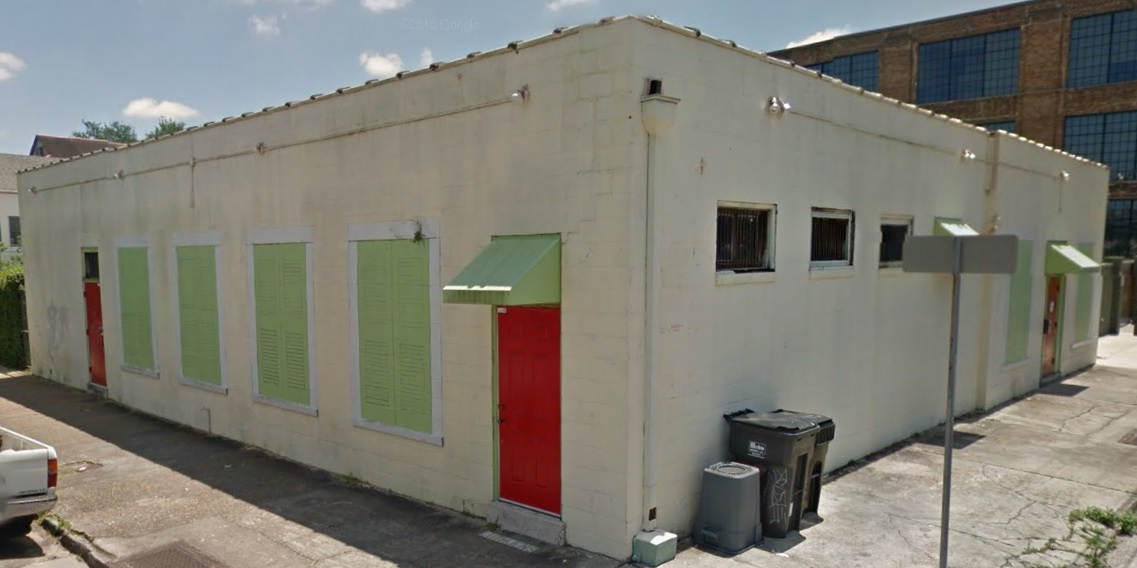
The original Luthjens Dance Hall
The location, among quiet tree-lined streets, was pleasant. It was about a mile north-east of the French Quarter.
How did the Hall get its name? It was established by Mrs. Clementine Luthjens, who was born in New Orleans in 1880. (Probably there was some German ancestry - at least on her husband's side: there had been plenty of migration of German people with the surname 'Luthjens' (or, more commonly 'Lutjens' without the 'h', I guess becoming 'Luthjens' in the USA).
She bought the humble, unpretentious building (previously a seafood restaurant) and set it up as a 'beer parlor and dance hall'. Steadfastly, she employed only the authentic old-style black jazzmen. She wanted the establishment to be family-friendly: she liked couples to bring the children. (However, it later acquired the nickname 'The Old Folks' Home': its patrons tended to be elderly white people.)
Informal dress was encouraged. Prices charged for drinks were reasonable. So it was the most economical venue in New Orleans if you wanted to hear the 'good ol'-fashioned' jazz; and tourists often sought it out. Dancing took place on Fridays, Saturdays and Sundays. On the other nights of the week, Luthjens was merely a kind of bistro, complete with a juke-box.
Many of the legendary musicians of the mid-Twentieth Century played there. Emile Barnes is believed to have led the first band. Later came such players as Big Eye Louis Nelson, George Lewis, Joseph Bourgeau, Alton Purnell, 'Slow Drag' Pavageau, Lawrence Marrero, Harrison Brazlee, Louis Gallaud, George Henderson, Alcide Landry, Ernest Rogers, Benny Turner, Peter Bocage, and Charlie Love; and in the final years the virtual 'house band' was that of De De and Billie Pierce.
The patrons liked the more stately forms of dancing and disapproved of 'jitterbugging'! The two-step, the one-step and the waltz were mostly in demand.
As you can see, it was quite a small building. So I imagine that - if you had a band and about 60 dancers in there - it would have felt crowded. The band was 'protected' from collisions with dancers by being placed at one end of the hall on a small bandstand two feet off the floor, (as at The Dew Drop Hall).
Sadly, the Luthjens Dance Hall in that photo burnt down in the early hours of Saturday, 30 January, 1960, with the loss of the lives of both Mrs. Clementine Luthjens (then aged 81) and her son Jules (aged 50), who were living in the back apartment of the premises. By that time, Mrs. Luthjens was a wheelchair-bound invalid. I wonder whether her son died while trying to save her: we shall never know. Perhaps it is not surprising that a fire - even in a one-storey building - could have had such dreadful consequences: it seems to have been a flimsy wooden structure, covered by tar-paper. Perhaps a smouldering cigarette end, left by a customer, caused the fire. Apparently smoking 'while dancing' was forbidden, but I suppose there was plenty of smoking by customers relaxing at tables.
Clementine's nephew Jerome Luthjens in 1961 opened a new Luthjens at 2300 Chartres (at the corner of Chartres and Marigny Streets - less than a mile from the original building). This was a more substantial brick-built hall, again of one storey, though with a flat roof. It was about half a mile nearer to the Mississippi, or - to put it another way - a mere 250 metres east of the present-day Frenchmen Street jazz bars, such as The Spotted Cat, The Three Muses, and The Maison. It too was in a pleasant, leafy area, among pretty houses - many of them of the 'Shotgun' type.
|