Welcome, Visitor Number

Translate

Showing posts with label Erika Lewis. Show all posts

22 February 2018

POST 601: 'ROCK ME'; AND A BEREAVEMENT

Here's a sad tale. In 1932, Nettie Dorsey, the wife of Thomas A. Dorsey,  died in childbirth; and two days later their new-born son died too.

In his grief, Thomas A. Dorsey composed Precious Lord, Take My Hand - a tune which remains popular with traditional jazz bands to this day.
Thomas Andrew Dorsey
Who was Dorsey? Not to be confused with Tommy Dorsey (1905 - 1956), the famous trombonist and band-leader, he was always known as Thomas A. Dorsey. He lived from 1899 to 1993.

Thomas A. Dorsey was already well-known at the time of his wife's death. He was an established blues pianist, band-leader and composer. He had performed as 'Georgia Tom'. He had a hit record in 1928 with It's Tight Like That. His band had accompanied Ma Rainey. He founded the first black gospel music publishing company. He was in later life to be considered the Father of Black Gospel Music. 

A gospel number for which he is also specially known is the 1937 composition Peace in the Valley.

But what prompts me to tell you all this is that I listened earlier today to Erika Lewis singing Rock Me on Tuba Skinny's first album - the album simply called 'Tuba Skinny' and issued in 2010. Rock Me was made famous when it was recorded by Sister Rosetta Tharpe in 1938; but the song was originally composed by Thomas A. Dorsey under the title Hide Me In Thy Bosom.

Rosetta sang it in the key of Bb; Tuba Skinny prefer Ab.

You can hear Rosetta's recording BY CLICKING HERE.

To hear Erika Lewis singing the song in the early days of Tuba Skinny, you should buy the album. But if you would like to see a live version, filmed as long ago as 2010, CLICK HERE.  At the time, Tuba Skinny was in its infancy and still had no reed player; but you can hear a wonderful little solo chorus from Shaye Cohn at 2 minutes 20 seconds  that foretells the greatness to come.

We have to thank the video-maker codenamed digitalalexa for recording this early performance.

I decided to try playing Rock Me on my keyboard and trumpet. What I then discovered is that it is a 32-bar tune (you could consider it as a 16-bar Verse with a 16-bar Chorus). Also, I found the first 16 bars have virtually the same simple chord progression as the second 16 bars. Moreover, all four sets of eight bars begin with The Magnolia Chord Progression [ I  -  I7  -  IV  -  IVm ].

The Magnolia Chord progression is found at the beginning of so many of the tunes we play. Other examples are:

After My Laughter Came Tears 
Mississippi River Blues 
Brown Skin Mamma 
Carolina Moon 
Cherry Red 
'Deed I Do 
Does Jesus Care? 
Girl of My Dreams 
If I Had You 
I'll See You in the Spring
I May Be Wrong But I Think You're Wonderful 
I'm Gonna Meet My Sweetie Now 
I'm Putting All My Eggs in One Basket 
In the Upper Garden 
I Want a Little Girl to Call My Own 
I Would Do Most Anything for You
Lonesome Road 
Louisiana Fairytale 
Magnolia's Wedding Day 
My Mother's Eyes 
Old Rocking Chair 
Red Sails in the Sunset
Rolling Round the World 
Show Me The Way To Go Home
Stevedore Stomp [final strain] 
When the Swallows Come Back to Capistrano
You Were Only Passing Time With Me

6 December 2017

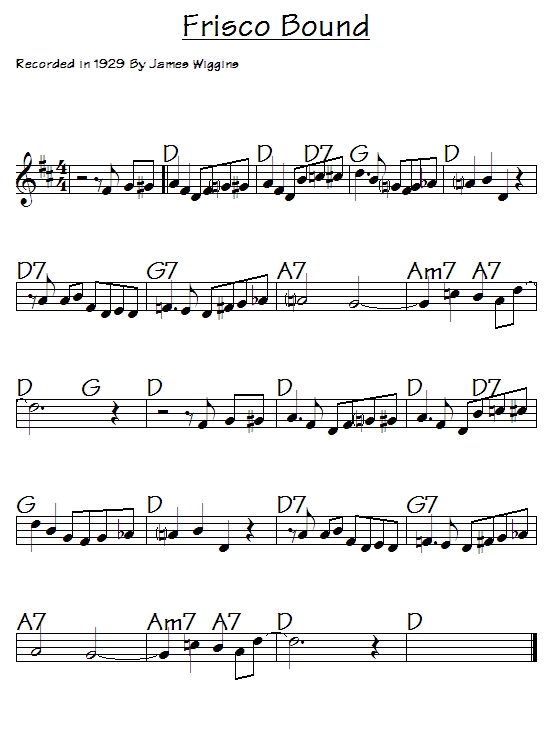
Post 575: MEMPHIS MINNIE, TUBA SKINNY AND 'FRISCO BOUND' - A TEN-BAR TUNE

Memphis Minnie was quite somebody. She could play the guitar and sing well. But she was also a composer of some fine early jazz tunes.

Her real name was Lizzie Douglas and she was born in the New Orleans suburb of Algiers in 1897. Her family later lived in Tennessee. As a child, she mastered the banjo and guitar. She took to busking in the Beale Street, Memphis, area when she was only a teenager, and she also toured with a circus. It was a hard life. She became a tough, street-wise young woman; and this toughness was reflected later in her singing and playing.

She married three times. Her second husband, Joe McCoy, was a fellow busker. They were talent-spotted and went on to make records for both Columbia and Vocalion.
It was at that time (when she was already more than 30 years old) that the publicists decided to call her 'Memphis Minnie' and the name stuck. (Similarly, her husband was given the name 'Kansas Joe'.) Between 1929 and 1934, they recorded about 30 songs, some of them more than once. After they divorced, she recorded many more, sometimes with Kansas Joe's brother and later with her third husband - Ernest Lawler ('Little Son Joe'). At this time she was mainly based in Chicago.


Minnie recorded more than 130 songs in total, several of them composed by herself. Among songs Minnie recorded that have influenced and been revived by the young New Orleans musicians of the 21st Century are: Bumble Bee, Frisco Town, I'm Goin' Back Home, Me and My Chauffeur, Ice Man, Tricks Ain't Walkin' No More, What's The Matter With the Mill?, New Dirty Dozen, and When the Levee Breaks. 


Minnie is known to have been the composer of the following songs that she recorded: Black Cat Blues, You Caught Me Wrong Again, Down in the Alley, Good Biscuits, Good Morning, Has Anyone Seen My Man?, Hoodoo Lady, I Hate To See The Sun Go Down, I'm a Bad Luck Woman, I've Been Treated Wrong, Ice Man, If You See My Rooster, Keep On Eating, Ma Rainey, Man You Won't Give Me No Money, My Baby Don't Want Me No More, My Butcher Man, My Strange Man, Nothin' In Rambling. Some of the other songs for which she became well known (such as Bumble Bee and  Me and My Chauffeur) were written by McCoy or Lawler.


You can hear Minnie and her third husband (the composer) performing Me and My Chauffeur
by clicking here.
And you can watch one of today's young traditional jazz bands performing the song by clicking here.

Memphis Minnie seems to have been the composer of Frisco Town (a ten-bar blues) in 1929.  She recorded it with her husband Kansas Joe the same year. Its title rapidly changed to Frisco Bound(This a quite different song from the Frisco Bound composed by Sam Powers in 1915.)

Still in 1929, a recording of Frisco Bound was made by James Wiggins and this increased its popularity.

This song also has recently been revived in its ten-bar form by Tuba Skinny:
Click Here.

How does it come to be a ten-bar blues? Well, if you look closely at its structure, you will see it is really a 12-bar blues, but with the first two bars omitted.

Two choruses here:


In another video of Tuba Skinny, the young musicians may be seen performing one of the 12-bar blues written by Minnie's second husband (Joe McCoy). The singer is Erika Lewis. Enjoy especially at 2 mins 20 seconds (and again later) the descending triplets played by the clarinettist (Craig Flory) in his 'solo' chorus. The song is called If You Take Me Back. You can watch it by clicking here.

By the way, my book about Tuba Skinny is now available. If you may be interested, go to the Amazon Website, click on 'Books', and type in 'Tuba Skinny and Shaye Cohn'.

22 May 2017

Post 509: FATS WALLER'S 'SQUEEZE ME'

Squeeze Me was composed and published in 1926. The composers were given as Fats Waller and Clarence Williams. Clarence was, of course, also the publisher. (Don't confuse this song with Just Squeeze Me - another good jazz tune. Just Squeeze Me was composed in 1941 by Ellington and Gaines.)


In the early days of Tuba Skinny, this great young band recorded and often performed Squeeze Me. The song really cried out for a lady singer (even though Fats Waller himself provided the vocal on one of his recordings); and Erika Lewis showed just how brilliant she is. Take her performance and compare it with the original sheet music. You find she keeps the words virtually to the letter, but her timing and varying of pitch illustrate well what a great instinct she has for jazz. She decorates the melody exquisitely; and her little touches of rubato are spine-tingling.

The Band plays the tune in Eb, to suit Erika's voice; and it sounds very good in that key, even though the original sheet music has it in G. Unlike some other bands, Tuba Skinny perform the whole piece - the 12-bar Verse as well as the 16-bar Chorus. They easily build some 2-bar breaks into the Chorus and they also make the most of the chromatic runs at the end of the Chorus.

You can watch Tuba Skinny perform the song BY CLICKING HERE. As so often we have to thank the generous video-maker codenamed RaoulDuke504 for making it available to us.

Here - for comparative purposes - is the sheet music from 1926:

10 May 2017

Post 505: 'MOTHER'S SON-IN-LAW'


I put up on YouTube a video of Tuba Skinny playing Mother's Son-in-Law at the 2015 French Quarter Festival. To watch it:
CLICK HERE.

You don't have to have a hanker
To be a broker or a banker.
No sir-ee, just simply be
My mother's son-in-law.
Needn't even think of trying
To be a mighty social lion
Sipping tea, if you will be
My mother's son-in-law.
Not got the least desire
To set the world on fire.
Just wish you'd make it proper
To call my old man 'poppa'.
You don't have to sing like Bledsoe*
And you can tell the world I said so.
Can't you see you've got to be
My mother's son-in-law?

(* Jules Bledsoe - a famous Afro-American singer and the original performer of Ol' Man River - was 36 years old at the time when My Mother's Son-in-Law was written.)

The song was composed by Alberta Nichols, who had studied piano at the Louisville Conservatory. The lyrics were written by her husband, Mann Holiner. As a partnership, they wrote over 100 songs, mainly for Broadway shows. Alberta died in 1957.

The song can be performed either as My Mother's Son-in-Law or Your Mother's Son-in-Law - according to the gender of the singer.

When they recorded it for their Garbage Man CD in 2011, Tuba Skinny played a vigorous version in which Kiowa Wells, their guitarist at the time, featured prominently. They played the song in keys that some Bb instrument players would consider tricky, starting with several choruses (including one vocal from Erika) in E minor and then switching to A minor for the finish - with Erika singing the words for the final part of the Chorus.

Watching again my video of Tuba Skinny playing the song at the French Quarter Festival in April 2015, I was struck first by the amazing energy and drive of the performance. But I then noticed it had moved on a bit since the 2011 recording. Obviously Kiowa was no longer with the band and greater prominence was given to all the other instruments, Shaye being especially busy. But more than that: I noticed that we now had not one key change, but TWO, each preceded by a 4-bar Bridge. The band started in G minor and then followed the 2011 structure by going into E minor (including a vocal) and ending (after Robin's solo) in A minor (with Erika singing in that key too). It's a truly invigorating performance.

I then checked out Billie Holiday's recording from 1933 (available on YouTube). Sure enough, her performance also went through the keys G minor, E minor and A minor - in that order. So I guess Tuba Skinny took their inspiration from that recording.

Also, although I have not been able to find the sheet music anywhere, I tried to pick the tune out by ear and put it in my little notebook. I chose a key (A minor) to suit myself.
By the way, my friend Tony Harris (guitarist) has introduced me to another song that has a similar mood and theme. It is called It's All Your Fault and was composed by Cindy Walker in 1941. Cindy was a good composer and deserves to be better known. This (click on) is a version worth listening to.

10 September 2016

Post 432: TUBA SKINNY - WORLD LEADERS

Let me tell you straight away that the young band Tuba Skinny, based in New Orleans, is currently considered by many people to be the best traditional jazz band playing anywhere in the world today. Judge for yourself by clicking on this video which was made in late 2016 and is to be commended for its fine sound and visual qualities. We have to thank the video-maker codenamed CANDCJ for making this treat available to us.

For me, the most exciting musical experience of the last seven years was discovering the band called Tuba Skinny.

After evolving since 2009, I think they reached their most effective line-up, as seen in this video:
CLICK HERE.

In 2010, a friend advised me to have a look at them on YouTube. The result: a revelation!

I learned from the Internet that Tuba Skinny was more or less half a dozen young musicians who had based themselves (though not born there) in New Orleans. They have been playing together for seven years and have recorded 7 CDs.
This super photo from the early days of
Tuba Skinny was taken in New Orleans by Greg Headley.
Although they have already appeared elsewhere in the USA, notably in New York, and also toured in several countries, including Mexico, Sweden, Australia, Switzerland, France, Italy and Spain, they spend half their year busking in the streets and playing in the clubs of New Orleans, their natural setting.

There, they appear content to live mainly on the income from busking. As far as I can tell, they seem to live cheaply, using bicycles for all transport needs. Yes, Erika even gets around with her bass drum on her bicycle. And here's Barnabus taking his trombone and Tupelo, the band's internationally-renowned dog (the group's Chief Executive!), to the next gig:
Dog and 'bone - as Bill Stock wittily says.
He kindly sent me the picture.
Tuba Skinny plays jazz in the style established in New Orleans and Chicago between 1900 and 1930. The musicians have built up a wide repertoire, mixing classics (especially blues) with more modern tunes, including original compositions. They have rescued from near-obscurity such 90-year-old gems as Muddy Water, Russian Rag, New Orleans BumpDeep Henderson, Chocolate Avenue, Frog HopVariety Stomp, Dear AlmanzoerHarlem's Araby and Minor Drag; and the Jabbo Smith forgotten classics from the 1920s - Michigander Blues and Sleepy Time Blues and A Jazz Battle. They have shown, with their fresh and original interpretations, how exciting these tunes can be.

How do they decide on their repertoire? In an interview, washboard-player Robin Rapuzzi explained: It's a group decision. It always is. Tuba Skinny is a miniature political system of majority rule. We discuss ideas with each other either on the street or over dinner. We have listening-parties throughout the year to discuss what we're interested in and where we want to go with our music. It's very organic. We're very fortunate to all be so interested in the same kind of music and to have met each other when and where we did and with a travelling itch and desire to busk.

The songs are played against a rock-steady ‘walking’ rhythm, with tuba, washboard, guitar or banjo laying down the foundation while the cornet, trombone and clarinet play the melody and frolic around it. For its first three years, the band had no reed player (except when a welcome guest sat in), so there was a distinctive brassy sound.

In the streets, there is no use of the electronic amplification that spoils so much music these days.

The performances are meticulously prepared. Although allowing plenty of room for improvisation, sophisticated head arrangements are used, with precision and admirable attention to detail. Great care is taken to get the tempo just right for the interpretation. There are mid-way key changes, and clear pre-planning of introductions and an understanding of when verses, bridges and codas will be played, around the repeating choruses. They support each other’s solo choruses with harmonising long notes and stop chords.

Tunes do not outstay their welcome: most are completed in about four minutes. Tuba Skinny avoids the dreary succession of uninspired solo choruses that we associate with many other traditional jazz bands. Usually, in a 32-bar chorus, two or more instruments take the lead for a few bars each.

The Band has a remarkable singer – Erika Lewis, originally from New York State's Hudson Valley. She has an amazingly strong and soulful voice, ideal for the blues. Her control of pitch and command of rubato are perfect. She has been compared with Bessie Smith (who must have been her inspiration) and in my opinion she equals the great Bessie in vocal ability. In street performances she needs no microphone. Since 2012, Erika has also taken to playing the bass drum, on which she sits as she sings and plays - further solidifying the band's rhythm section. Erika has said (Offbeat Magazine, September 2014), 'It just dawned on me one day that a bass drum was something that I could add and it would fit in. For the first year, I strapped it to my front, but I felt like a pregnant spider flailing around, standing up while everyone else was sitting down. So I said, I’m just going to sit down on it.'

There is a vocal in about 75% of the tunes played by the band, and these are mostly performed by Erika, though other members also contribute.

At the end of 2015, to the disappointment of her many fans, Erika moved away from New Orleans and therefore ceased appearing with the band in the New Orleans streets. But she announced that she would continue to appear with the band at festivals and on tours.

Tuba Skinny is a model collective enterprise, without a star or prima donna. But I must admit a special admiration of Shaye Cohn, the young lady who plays the cornet and generally directs the musical traffic.
As one who attempts to play the jazz cornet myself, I appreciate her technical virtuosity and amazing inventiveness. Using mutes with great skill, she produces a unique tone that perfectly encapsulates the blues feeling that is at the heart of so much of our music. She knows just when to 'bend' notes and she has a great instinct for bluesy notes in the right places. Her phrasing is impeccable. Shaye is not a showy player who produces lots of high and raucous notes, like so many trad band trumpeters. Her playing is busy, but in an unobtrusive way. Just listen to her extraordinarily inventive and subtle improvisations and don’t miss the way she provides brilliant delicate arabesques behind the solos of others (such as the trombone - which often takes the melody), and particularly behind the singer.

I have been told that, when she was just nine years old, Shaye was a member of The New England Conservatory Children's Chorus and sang solo on stage. This amazing lady from Boston is classically trained and, as YouTube demonstrates, also plays other instruments (especially the accordion, violin and piano - and even the spoons!) brilliantly. To judge from videos and recordings, Shaye is currently also one of the best traditional jazz piano-players on the New Orleans scene. She even does the delightful artwork for the band's CDs. Here's an example:
Some people are so talented!

I guess that other musicians in the group also have academic musical qualifications, but I have no information on this.

The guitarist when the band was formed was Kiowa Wells and he and the slim Todd Burdick (tuba - Mr. Tuba Skinny in person - originally from Chicago) were the founders of the band, building it up by inviting other fine musicians they met busking on the streets of New Orleans. They originally worked (circa 2007) in the band Loose Marbles, a kind of musical collective that still exists but that spawned several of the great bands based in New Orleans today. Todd and Kiowa are very skilful, sensitive and accurate players. You quickly notice from their first recordings how thoroughly they have learned their music, how meticulously they prepare and play. Todd originally played guitar and banjo (as he still does when required) and he is very good on those instruments. It must be a big help to be strong in your knowledge of chord sequences when laying a secure foundation on the tuba.
Todd and His Tuba
Kiowa occasionally sings; and he also contributes some fine guitar solo choruses. How clever these young people are! Listen carefully to the tuba in Tuba Skinny performances and notice how solid and accurate is the foundation Todd lays and how important this is to the special sound of the band.

It seems that Ryan Baer on banjo and guitar replaced Kiowa after a year or so. Ryan is extremely good, whether providing rhythmic support or delicate melodic solo choruses. He too is a fine singer.

And in recent months, other guitar and banjo players have been frequently used. Guitarist Max Bien-Kahn from Oregon, who has also frequently worked as the band's recording engineer, has provided a rock-solid rhythmic backing in many performances, and toured with the band. In 2014 such fine and well-known New Orleans street performers as Gregory Sherman and Jason Lawrence (and occasionally Scottie Swarers - 'Stalebread Scottie') played on banjo and guitar. Another fine player who appears frequently on tenor banjo is the Texan Westen Borghesi. To appreciate Westen's very skilful and sympathetic playing, listen carefully to his contribution throughout the band's CD called Pyramid StrutNo matter who plays, they all conform to the Tuba Skinny house style - laying down a very solid four-to-the-bar foundation. The combination of Todd Burdick on tuba and a guitar player (such as Max Bien-Kahn) provides a powerful 'engine' that drives the band along; and all the banjo players over the years have been brilliant at providing that rock-steady rhythm that our bands require. The banjoists are good at playing tremolos to add emphasis on stressed notes (as in Jazz Battle) or to add pretty decorations (to such tunes as Memphis Shake and Michigander Blues).

The ever-present trombonist (except when he headed off on a sailing cruise in early 2016!) is the versatile Barnabus Jones, who possesses a big sound and has mastered the tricks of Kid Ory, John Thomas, Honoré Dutrey and Fred Robinson - the trombonists who played with Louis Armstrong in the 1920s. Barnabus produces musical phrases that perfectly complement the melodic inventions of Shaye Cohn. The trombone and cornet blend magically.
Shaye and Barnabus
What is more, he too (from evidence I have seen) is also brilliant on other instruments - the banjo and the violin, which were his original instruments; and on occasion he shows himself to be no mean singer!
Barnabus and Shaye again -
what a great musical partnership!
All the Tuba Skinny instruments are easily portable. This is particularly helpful if you are a street band. They normally have no drum kit, for example. But they have a washboard player – Robin Rapuzzi from Seattle (though I'm proud to report his mother was born in England!). Normally, I am not keen on the washboard as a musical instrument: I have known a badly-played washboard to wreck a jazzband, especially when the player fails to keep a steady tempo. But Mr. Rapuzzi is a great driving force for the rhythm of this band, and fully underpins the music’s structures. He has fixed a few additional small percussive items to his washboard, so he can produce tricky crowd-pleasing solo choruses, with sound varied very imaginatively.

Although it's easier to play a washboard on the street than to lug around a full drum kit, Robin is in fact a drummer, and enjoys the full range of tones and colours that he can get from the drum kit, including the snare and Chinese tom-drum and Chinese-crash cymbal. He used a full drum kit when making the band's 7th CD; and at the end of 2015 he managed to start taking his full kit along to street busking - using a bicycle with a trailer - which he described as 'some kind of work out'!

On a few occasions (including the tour to Mexico), the wonderful washboard player Defne Incirlioglu has deputised for Robin.
There are other part-time members of this band – too numerous for me to track or mention. In their videos you may spot an occasional double bass, or violin, or a second trumpet. This is bound to happen with a street busking band. But I must tell you that a young lady called Alynda Lee Segarra (who now mostly works with her own band) used to play banjo and sing (very well). Here she is with Shaye and Barnabus.
But most of the fine young musicians of New Orleans have played in the band at some time or other. Here, for example, we see Albanie Falletta on guitar.
Ewan Bleach from the U.K. on clarinet and saxophone fitted in brilliantly for a year or so (Ewan is incidentally also a superb jazz pianist); and John Doyle on sax and clarinet is another fine player (reminiscent of Jimmy Noone) who settled well into the band during 2013 when they were playing some of their greatest music. These two are outstandingly good musicians. Just listen closely to their work in any of the videos and you will class them among the very best traditional jazz reedmen you have ever encountered.

Jonathan Doyle studied briefly at Depaul's School of Music in Chicago and has worked with several bands, including his own quintet. He now divides his time between Chicago, Austin and spells with Tuba Skinny - in New Orleans and touring abroad. He is also a composer of music for his bands.

(By the way, Jonathan Doyle and Westen Borghesi both play in the wonderful Thrift Set Orchestra in Austin, Texas. There are some videos of this group - well worth watching - on YouTube.)

In the Autumn of 2013, the clarinet and sax seat was briefly occupied by (among others) James Evans who is from Beaumaris, North Wales. James had spent the previous few years proving he is one of the very best clarinet players in the U.K. You can see him with Tuba Skinny in an absolutely cracking performance of Weary Blues:
CLICK HERE.

In 2014 and 2015, the reed player has usually been Craig Flory, from Seattle, but it seems that John Doyle is the principal reed player when available, especially for tours and festivals. At the end of 2015, Tomas Majcheski, the very fine player from The Smoking Time Jazz Club band, was regularly helping out on reeds.

Tuba Skinny dresses and presents itself in a laid-back, casual manner. The gents wear baseball caps and – on hot days – play in singlets and shorts, without shirts. The ladies have a penchant for short socks and flat shoes or trainers. So they have perfect looks for a New Orleans street band; and they tend to dress in just the same way for indoor gigs – bringing a breath of fresh air into what might otherwise be stuffy or formal venues. They seem to be modest, unassuming young people, having fun playing the music they love and scarcely aware of their own enormous talent.

But please let me beg you to try this band for yourself! There are over 300 examples of their work on YouTube.

Their line-up as at October 2015 was:
Shaye Cohn   Cornet
Barnabus Jones  Trombone
Erika Lewis   Bass Drum & Vocals
Todd Burdick  Tuba
John Doyle (or Craig Flory)   Clarinet and Sax
Jason Lawrence  Banjo & Vocals
Max Bien-Kahn - Guitar
Robin Rapuzzi  Washboard
A really exciting recent video - with a full band - is this: CLICK HERE.

Or you might care to go way back in time and start with this: CLICK HERE.

Here you can meet the band in a relaxed, undemanding, gentle-tempo 12-bar blues in the Key of C. The tune (made famous by Ma Rainey) is Hear Me Talkin’ To Ya. Unfortunately the camera does not catch much of Robin (washboard) but you have good examples of everything else, including brief solos from tuba and guitar.

Try the band here in its original formation in a quicker number. This song – Six Feet Down - was written by Erika Lewis, who is seen singing it: CLICK HERE.

The video illustrates much of what I have been saying (including – note – the skilful washboard playing) and you can identify all six of the original core members of Tuba Skinny.

And Garbage Man is a terrific, infectious, fun number. You can watch it (with Ewan and John on reeds) here: CLICK HERE.

To hear an example of Shaye Cohn's brilliance, listen to her solo that comes one minute and fifteen seconds into this next video. Quite apart from its technical virtuosity and fireworks, note its almost surreal inventiveness, especially in the first few bars: CLICK HERE.

To me it is so thrilling that YOUNG people are keeping alive the traditional jazz of New Orleans. I was there in 1998, and many of the great musicians of those pre-Katrina days have since passed on. But – thanks to groups like Tuba Skinny – their music has not disappeared with them.

Finally, listen to their wonderful and energetic performance of Minor DragCLICK HERE.

By the way, you can help support these wonderful young musicians by obtaining one or more of their CDs. You can buy or download the CDs online. You can pay with PayPal. It works even from other countries, as I have found. Start by going to their website and that tells you how to go about it:
http://tubaskinny.tk/

1 July 2016

Post 411: TUBA SKINNY - WHAT'S THE SECRET?

How do Tuba Skinny do it? How is it that this group of surprisingly young musicians – who met six years ago while busking on the streets of New Orleans, has become the greatest traditional jazz band in the world today?
Let me offer you twenty-one reasons.

1. They work very hard behind the scenes – researching and learning old material and devising ways of playing it with fresh vigour. And they are perfectionists. Look, for example, at their performances of Deep Henderson, a tricky multi-part rhythmic piece. While showing respect for the 1926 recording of this tune by King Oliver's Band, Tuba Skinny do not slavishly imitate: they show what they can do with their own resources. They have arranged the piece meticulously. And all members of the band have the arrangement firmly inside their heads. They know exactly who does what, and when. And they also know where they have a chance to cut loose for a few bars. Now watch other bands playing this tune. Almost invariably they are dependent on printed arrangements of the music on stands in front of them, and their performances sound far less exciting and more stilted.

2. Although Tuba Skinny could play the familiar worn-out tunes of every trad band's repertoire, their programmes mostly comprise exciting unfamiliar gems they have unearthed from the 1920s and 1930s (e.g. New Orleans Bump, You Can Have My Husband, Chocolate AvenueJackson StompDeep HendersonBanjorenoTreasures Untold, Russian Rag, Oriental Strut, Minor Drag, Michigander Blues, Harlem's Araby, Me and My Chauffeur, A Jazz Battle, Droppin' Shucks, Fourth Street Mess Around, Carpet Alley Breakdown). The almost-forgotten artists whose music they have revived include Lucille Bogan, Victoria Spivey, Memphis Minnie, Jabbo Smith, Georgia White, Skip James, Merline Johnson, Ma Rainey, Hattie Hart, The Memphis Jug Band, Blind Blake, Clara Smith, The Dixieland Jug Blowers, The Grinnell Giggers and The Mississippi Mud Steppers; and of course they also play tunes associated with the better-known, such as Bessie Smith, Fats Waller, Louis Armstrong and Jelly Roll Morton. They will surprise you by going to some unconventional sources for tunes they turn into exciting traditional jazz - sources such as Ray Charles and the 21st-century Australian original C. W. Stoneking.

3. All the musicians in the group have thoroughly mastered their instruments; and most of them can play more than one (e.g. cornet + piano + violin; tuba + banjo; trombone + banjo; banjo + harmonica + mandolin + guitar). This provides variety of sound and also the ability to 'substitute' if a regular player is unavailable.

4. They prefer collective improvisation to prima donna solos. Their teamwork is exceptional.

5. They have an outstandingly good singer (Erika Lewis). She has a soulful plaintive voice and great intonation. Her phrasing is perfect and she uses rubato very skilfully. Rather than stick to the familiar jazz standards, she has developed a rich repertoire of tunes rescued from obscurity (e.g. Tricks Ain't Walking, Crow Jane, How Do They Do It That Way?, Mississippi River BluesI'll See You in the SpringNeed a Little Sugar in my Bowl, You Let Me Down, Got a Man in the 'Bama MinesWhat's the Matter with the Mill?). Erika also doubles on bass drum.

6. Other members of Tuba Skinny are also very competent vocalists.

7. The Band does not use a conventional percussionist, with full drum kit. Instead, they have a washboard (and recently the bass drum). As a result, there is a clean sound to the rhythm. In many traditional jazz bands, the drumming has a smudging effect, filling every space and sometimes forcing other players to blow too loud. Listen to Tuba Skinny and you can hear clearly the part played by every single instrument: there is no need to over-blow; and there is none of the muddying effect you sometimes notice with other bands. The washboard player is superb is his energy and inventiveness and time-keeping (and I speak as one who used not to care much for washboards as musical instruments).
Erika and Robin
8. Tuba Skinny avoids the dreary succession of 32-bar 'solo' choruses from four or more instruments that we so often hear in traditional jazz performances. Usually, two or three players lead for a few bars each in covering a 32-bar theme. In the rare instances of complete solo choruses, Tuba Skinny musicians add colouring behind the soloist, either with musical phrases or by using stop chords or long notes.

9. Tuba Skinny always starts a tune well. They have devised an appropriate introduction for every one of their tunes.

10. The tuba player Todd Burdick provides a very solid base line for all tunes. It pays from time to time to focus on his contribution and admire its accuracy and solidity.

11. The trombonist Barnabus Jones has absorbed the skills and techniques of the great traditional jazz trombonists in the famous recordings of the 1920s. He and the cornet-player work particularly well together – listening carefully to each other and responding to each other's musical phrases. Recently-introduced reed players (one of them English, I'm pleased to say) proved just as skilful.

12. The band takes great care with the setting of tempos at the start of each tune. Once established, the tempo is maintained with metronomic accuracy. There is none of the speeding up or (worse) the wearying drag-back of tempo that you notice in other bands on YouTube. The combination of Todd Burdick on tuba and a guitar player (such as Max Bien-Kahn) provides a powerful 'engine' that drives the band along; and all the banjo players over the years have been brilliant at providing the rock-steady rhythms that our bands require. The banjoists are good at playing tremolos to add emphasis on stressed notes (as in Jazz Battle) or to add pretty decorations (to such tunes as Memphis Shake and Michigander Blues).

13. The Band is not afraid of key changes within tunes, sometimes because the tune is written that way, sometimes to play the tune in a key that suits the whole band and then in a key with which the singer is more comfortable (e.g. How Do They Do It That Way? and Delta Bound and Dangerous Blues) and sometimes just for the mischief of it. Have a listen to Cannonball. Notice what tricks they can play even with a 12-bar blues. Admire the Introduction, the Bridges and the Coda, and especially the three key changes!
Watch it by clicking here.

14. Tuba Skinny devises interesting endings for its tunes. Listen to their very neat codas.
Left to Right: Shaye, Barnabus and Erika.

15. The cornet player and (it seems) unofficial director of music, the amazing Shaye Cohn (who is also terrific on piano, violin and accordion - and she even plays the double bass in the country music group The Lonesome Doves), is never flashy in her playing. She has a Mozartian instinct for what works best: she contributes to ensembles in the same way that the viola contributes to the 'conversation' in Mozart's string quartets. She can 'bend' notes and knows instinctively when to use this trick to the best effect. Full of bluesy notes and demonstrating a very effective use of mutes (notably the plunger and the stone-lined cup), the fluent phrases and harmonies she produces are hugely more interesting and exciting than the raucous high-note solos that many traditional jazz trumpeters think the music requires.

16. The Band does not stick doggedly to instrumentation that involves a trumpet (or cornet) – clarinet - trombone front line for every tune. Sometimes, their music has elements of bluegrass or klezmer and this can involve a whole tune (e.g. Russian Rag, Jackson Stomp, Papa's Got Your Bath Water On) being played without cornet or trombone.

17. They don't mind including an occasional waltz in their programme – especially if the tune is beautiful (e.g. Treasures Untold, Sunset Waltz). These are played lovingly, allowing the melodies to speak for themselves.

18. The violin is sometimes used – both for melodic and rhythmic effects.

19. Members of the Band have (in a small way so far) composed tunes for their group to play (e.g. Salamanca Blues, Owl Call Blues - a hauntingly beautiful song, Broken-Hearted Blues, Thoughts, the authentically-1920s-sounding Nigel's DreamPyramid Strut - a potential classic of Mortonesque structure and complexity, Six Feet Down, the lovely Blue Chime Stomp and the craftily-composed Tangled Blues - with a highly unusual 18-bar theme). These pieces are fully up to the quality of the material from the 1920s that they love so much.

20. The Band is very skilful with 'breaks' – the element Jelly Roll Morton considered so important in jazz. If you don't know what I mean, I am referring to those phrases (typically two bars) where the whole band stops suddenly, except for one instrument – the clarinet, for example – leaving that player to invent a decorative musical phrase to fill the gap before the band picks up again. Tuba Skinny is particularly good at breaks: there never seems to be any doubt about which player will play the break, and all the players cut off together. (So many other bands fail in this matter. It is particularly irritating when – for example – a drummer plays right through a clarinetist's break.)

21. Just like a classical orchestra, they take trouble tuning up. See the start of this video:
CLICK HERE

Finally, as a demonstration of the above points, listen to the way the band interprets and performs Delta Bound on its CD. This is a straightforward 32-bar tune, with a structure of four sets of eight bars. Let's call these four sets A1, A2, B [the middle eight], A3. So how do they make Delta Bound specially interesting and different? Here's what they do:

  Introduction: In the key of D minor, the full band plays A2; then the trombone plays the melody for B; and then the full band plays A3 (total 24-bar introduction – unusual!)

  Song: A sudden switch to the key of G minor! Erika Lewis sings the 32-bar song once right through. In A1 and A2, she is solidly supported by the tuba, banjo and washboard. In B and A3, there is quiet decorative support first from the brass and then from the clarinet.

   Next time through: The clarinet improvises on A1 – 8 bars only - while the brass trio play long supporting notes, including crescendos! Then the clarinet improvises on A2. The cornet takes over, improvising the eight bars of B, with lovely tuba support; and then the trombone leads the final 8 bars of the song – A3.

   Approaching the End: the return of the singer; but Erika picks up the tune not at the beginning but rather at the middle eight – B, while the clarinet provides decorative background. Then the full band joins in for A3 with long-note harmonies.

   Coda: Suddenly we switch back to the opening key - D minor - just for the final eight bars! How cheeky is that? The full band plays A3 again as the coda, with a rallentando to round off.

What about that for an interpretation?

If you would like to hear this performance of Delta Bound, click on this link or paste it into your browser:
http://tubaskinny.bandcamp.com/track/delta-bound
Or you can watch them playing it on YouTube. But this performance was recorded long before the CD. There was no clarinet at the time, so the arrangement is slightly different:
http://www.youtube.com/watch?v=5u0uqoqfMEM

"I think what's unique about our group is that everyone is really dedicated to the music," said Erika Lewis in an interview. "That's the bottom line. How we measure success is all about how well we played."