Welcome, Visitor Number

Translate

Showing posts with label rehearsing. Show all posts

5 January 2018

Post 585: 'I KNOW NOTHING ABOUT MUSIC.' REALLY?

'He plays piano queer. He only plays by ear'. Those are the words describing the pianist 'Mister Brown' in the 1916 jazz song Down in Honky Tonky Town.
A very good English clarinet player once told me: 'I know nothing at all about music. I play by ear. That's all you need for jazz.'

But on another occasion I overheard him saying to a pianist, 'You played a D minor chord in the third bar. It should have been F diminished.'

So much for 'knowing nothing about music'!

That gentleman died five years ago, but I have met several other musicians who have also proudly claimed they can't read music and know nothing about it. Presumably they thought they were natural geniuses.

I have become sceptical about such claims.

I can recall only three gentlemen who obviously could not read music and played entirely 'by ear'. But they were very limited in what they could offer in traditional jazz bands and in their understanding of tune structures and conventions. I noticed they were unable to gain acceptance in any regular band and managed only to pick up occasional gigs as deputies.

Of course, the ear is an essential tool in the learning of tunes when - as often happens - you can't get hold of printed music. Play along a few times with a good clear recording. Use the pause button and write the tune down as you go along. You may even be able to work out the chord progression reasonably well. I am sure most jazz musicians have mastered dozens of tunes in this way. But you need to know what you are doing. You must have at least some rudimentary understanding of keys, note lengths, time signatures and tune structures. 

Many of the older generation of traditional jazz players depended very much on their ears in order to learn music, as they put it, 'closely enough for jazz'. But the younger generation is more academic in its approach to the repertoire. Some have studied both jazz and classical music at colleges. So they practise hard to memorise correctly the melodies, harmonies, structures, rhythmic patterns and grammar of the music. For an example of the finished product:
CLICK HERE.

=========
COMMENT RECEIVED FROM BARRIE MARSHALL:

I used to dep with a band that had a trumpet player who boasted he was an ear player and knew nothing at all about music. We were doing this gig in the back garden of a pub, we started a tune and on the first chorus the banjo player played a chord that was not right He played it again on the second chorus. Then when he played it on the third chorus the trumpet played turned to him and said, 'That should be a C7, not an F7!'

19 October 2017

Post 559: TAKING TRADITIONAL JAZZ PLAYING SERIOUSLY - 'GRANDPA'S SPELLS'

When many bands decide to add a new tune to their repertoire, somebody beats it in, and off they go.

The results are often slapdash, with spur-of-the-moment arrangements, and everyone hoping for the best.

Of course it sometimes happens, where the musicians are very talented and listen well to each other, that the result is quite good.

But that great young band in New Orleans - Tuba Skinny - has shown us in the last few years how you need to approach the music more seriously if you are to achieve results that are truly outstanding.

There is nothing slapdash in their approach. When they tackle a new tune, they begin with a clear vision of what they want to achieve. They have a unity of purpose. Every individual is focused on the agreed arrangements. There is no room for compromise. Only the best will do.
A good illustration of this is their 2014 performance in Italy of Jelly Roll Morton's Grandpa's Spells. You can find it at https://vimeo.com/101422951. On the face of it, this is just a merry busking session in a public square.

Yet note the meticulous care that has been taken to present the tune. It is never muddled, despite its complexity. Everybody knows who is to do what, and when. There is no need for printed music on stands in front of the musicians, as we find with many bands playing such a tricky piece. Everybody has taken the trouble to learn what he must do.

Obviously, the band must have studied the original recording by Jelly Roll Morton's Red Hot Peppers in detail, because they follow it closely.

The structure goes like this:

Both bands start in the key of C.

BOTH BANDS
INTRODUCTION
Four bars 'running up the ladder'

BOTH BANDS
THEME A
Featuring guitar breaks and then the cornet

BOTH BANDS
THEME B
Ensemble;
but with the break in bars 7 and 8 taken by the piano (Red Hot Peppers) and by the banjo (Tuba Skinny - not having a piano at the time)

THEME B second time
Clarinet leads throughout, including the break (Red Hot Peppers)
Clarinet leads but washboard takes the break (Tuba Skinny)

THEME B third time 
Trombone and string bass alternate the lead (Red Hot Peppers)
Trombone and Tuba alternate the lead (Tuba Skinny)

Without any need for a signal, there is then a seamless transition into the key of F (occurring at 1 minute 41 seconds into the Tuba Skinny video).

THEME C
BOTH BANDS
Melody (a firm statement stabbing out the notes of the chords) played by the cornet

THEME C second time
BOTH BANDS
Ensemble, featuring the clarinet on the flowing runs

THEME C third time
Taken as a piano solo (Red Hot Peppers) but as a Trombone solo (Tuba Skinny)

THEME C fourth time
Ensemble out-chorus (Red Hot Peppers)
Chorus led by Tuba (Tuba Skinny)

(The Red Hot Peppers version - under 3 minutes in total - ends at this point, but with a neat two-bar coda)

THEME C fifth time
Ensemble (Tuba Skinny - everyone swinging joyously)

THEME C sixth time
Ensemble (Tuba Skinny - again everyone swinging joyously). Simple end. No coda.

Note how nobody puts a foot wrong with the various two-bar breaks. Notice too how even Erika (whose main rôle is as vocalist) gets the bass drum beats exactly right - stopping at those moments when 'silent beats' are required. Notice how there is no need for signals from Shaye, though she gives the slightest indication (hardly required) at 2 minutes 35 seconds that Todd is leading the next chorus.

By the time when I videoed them playing the tune in Royal Street, New Orleans, three years later, (https://www.youtube.com/watch?v=IUICxSTjzPc), they had very slightly tweaked the arrangement, with minor alterations to the structures and playing of the breaks, for example. Have fun spotting the differences. They had added a Coda too.

Obviously, to get all that right, from memory, the members of the band have to put in plenty of hard work in the woodshed. Their dedication is an example to us all.

18 February 2016

Post 393: JAZZ IMPROVISING FOR BEGINNERS - TRY THIS

I receive many emails from readers who tell me they are in the early stages of trying to play traditional jazz. They ask whether I can help them.

Unfortunately, I am no great expert and certainly not a music teacher. I tell them there is quite a lot of help available on the internet (such as Lasse Collin's site and Charlie Porter's videos) and I have referred to these in several of my articles.

These emailers tell me they hope one day to play in a band but at present they are mastering their instruments, and learning tunes and chord progressions.

Maybe you should start by watching this excellent little video, which makes very clear how the trumpet, trombone and clarinet can improvise collectively:
CLICK HERE TO VIEW.

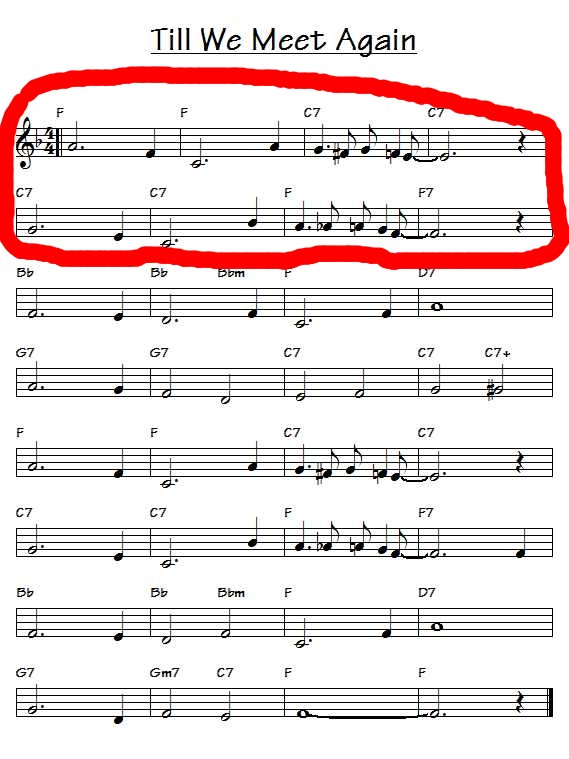
While I was listening recently to a performance of Till We Meet Again, it occurred to me that I could at least recommend this super tune to you as something on which to practise.

Why?

Well, for a start you can take it quite slowly. Next, it includes two essential basic chord progressions that will turn up in very many tunes, so you need to feel comfortable improvising over them.

First you need to look at what goes on in this tune. So let's consider it, in the key of F.

We discover that it is a 32-bar tune (the most common type of all) and it is structured ABAB (each letter representing eight bars).

So you have two 'A' sections that are pretty much identical. These eight bars (marked in red below) use one of the most common chord progressions:

I    I    V7    V7    V7    V7    I    I

This movement from the tonic chord to the dominant and then back is found in very many tunes.


The F7 in the eighth bar leads perfectly into the Bb chord of Bar 9.

The 'B' sections use The Sunshine Chord Progression (also used in dozens of tunes). I have written about The Sunshine Progression in several articles. For example, click here to read one. Every jazzer must get the The Sunshine Progression into his fingers - in a range of keys.

In the first use of this progression, Bars 15 and 16 hold on to the dominant 7th (C7) rather than resolve completely to the tonic. The purpose of this is to lead back to the melodic theme all over again in Bar 17.

But when we reach the final eight bars of Till We Meet Again (B for the second time) we find the full Sunshine Progression - ending on the tonic to round the tune off perfectly.

So here is the full chord chart (in F):
Now: how about improvising? A simple way of creating an improvisation is to use this chord chart [F   F  C7   etc.] and simply play notes from the relevant chords as you go along. Basic arpeggios to begin with. For a beginner, this is not easy. That is why it helps to work with a slow tune such as this: it gives you time to think.

Don't forget that if you are a Bb or Eb instrument, then the Concert key of F will become G for you (Bb instruments, i.e. most trumpets and clarinets) or D for you (Eb instruments).

To give you some idea how this improvising-on-the-chords business works, I put the tune into Band-in-the-Box and then let my computer play it while with my cornet I tried to play notes from the arpeggios of the chords. I mostly used notes above the melody, in order to avoid clashing with it. To watch my attempt - or play along yourself - CLICK HERE.
Till We Meet Again was composed in 1918 by Raymond Egan, with words by Richard Whiting.

...............................
FOOTNOTE
The book Playing Traditional Jazz by Pops Coffee is available from Amazon.

22 December 2015

Post 337: REHEARSING TRADITIONAL JAZZ; AND HEAD ARRANGEMENTS

I don't think our bands should over-rehearse. But it helps if they at least rehearse a little, have planning meetings and work out how to make the presentation of a tune more interesting.

Here's an example of how effective such preparatory work can be. The piece of music to be played is a 32-bar song in Eb, with a typical a - a - b - a structure.

At a planning meeting, the band comes up with the following head arrangement. They will play the Verse once (16-bar) and then work through the song five times:

(1) The 16-bar introduction in which the cornet (or trumpet), backed by the rhythm section, firmly establishes the key of Eb, running around arpeggios in bars 1 - 8 and 13 - 16, with a contrasting 'middle 4' on G minor for bars 9 - 12.

(2) The trombone takes the lead as the band plays through the 32-bar tune for the first time.

(3) Surprise: an abrupt key change to Bb! The full 32-bar tune is played a second time - in the new key - with a good deal of drama added by the cornet's use of 6ths, 9ths and flattened 3rds.

(4) The vocal. The full 32-bar song in the key of Bb. In the first half, the singer is supported by the rhythm section. Then there is gentle support from the cornet in the 'middle eight' (which is distinctly of the IV - I -  II7  - V7  pattern).

(5) The Band improvises on the complete song as we go through it for the fourth time, but with the tuba taking the lead in the final sixteen bars (while the front line provides quiet sustained chords through the Middle Eight).

(6) Drama again! We have suddenly reverted without any transitional warning to the original higher key - Eb! Our attention is grabbed immediately by the cornet energetically improvising over well-disciplined stop chords for the first 24 bars. The full ensemble joins in for a storming final 8 bars, all stopping abruptly on the third beat of the 32nd bar (a common but very effective coda-less way of ending a tune in traditional jazz).

Now isn't that likely to be a lot more interesting and exciting for both band and audience than the all-too-common procession of 32-bar 'solo choruses' all in the same key - the 'arrangement' used by so many bands?

If you would like to hear this very head arrangement at work - demonstrated by one of the world's finest bands - listen to Tuba Skinny playing How Do They Do It That Way? on their CD entitled Owl Call Blues.

There are also some YouTube videos of them playing this song. In these, at Shaye's direction, tiny amendments to the head arrangement (e.g. a two-bar coda) are sometimes applied. Click here to watch one.

Tuba Skinny picked up this tune from Victoria Spivey's 1929 recording with Red Allen and his Orchestra, which you may also find on YouTube. You will discover that most of the features I have listed (including the key changes) were present in that original recording. Tuba Skinny have based their head arrangement closely on that of the Spivey original and you can hear and see what a great 'head' arrangement it is whenever the band plays this tune: all members of Tuba Skinny are well drilled in the structure.

7 November 2015

Post 296: OUR MUSIC IS CHAMBER MUSIC?

I have been interested for more than thirty years in the presentation of acoustic performances by small music groups. I listen to and play in traditional jazz bands and I also attend chamber music concerts (especially those given by string quartets). So I am offering the following questions and my personal answers to them as food for thought.

What do chamber musicians and jazz musicians have in common?

They play one to a part and their music is not popular with the masses. Playing a type of music that does not attract large audiences, they do not make a fortune.


Why do we choose to be ‘unpopular’?

We take pride in being miniaturists. We like hearing music played acoustically. It is easier to appreciate details. The noise level is bearable. There are delicate textures. We better appreciate the drama of the music’s dialogue. The individual players - playing just one to a part - are more free to express themselves.

Does such a group need a leader?

Do not be too democratic. It is helpful to have a leader (or to take turns at being leader). It may help to have two leaders – one who manages bookings and one who 'directs the traffic' of the music.

Do we need to get on well together socially in order to make good music?

It helps, but is not essential. Musicians who do not get on well socially sometimes make wonderful music together. Conversely, musicians who get on well sometimes make a poor job of performing. 

How can we give a decent performance if we are just starting out and some of our players are inexperienced?

Choose repertoire within your capabilities. Then, however limited the players' abilities, aim to make the whole greater than the sum of the parts. This means not just playing the notes; it means concentrating on teamwork and interpretation.

Can we get away with practising alone, or should we often rehearse as a group?

Group rehearsals are essential for chamber music; and many jazz groups would be more worth listening to if they rehearsed together more often.

How can we ensure that practice brings improvement?

Do not use much time playing pieces you already know well. Seek new challenges; and focus on the mental as well as the physical. 

How do we get bookings?

The following methods may help - but not much: the Internet, Leaflets, Small Ads. Agents may be helpful but should be treated with caution. Being seen and heard (for example, busking in the street) is the best form of advertising: one performance leads to another. Next best is word-of-mouth. 

How should we dress when giving a concert?

For most venues, a group should look good and adopt a unifying style, even if this means some formality. Individuals have to forego personal preferences for the good of the group.

How can we win over our audience?

It is essential to keep in your mind that your listeners are giving you two hours of their precious time. So you owe it to them to communicate well. Look involved and interested. Smile. Speak to them: they love information. Your programme should be balanced and should match the needs of the audience. Don't be too esoteric and don't risk a built-in fidget ingredient. Welcome feedback and learn from it.

If we develop a good programme, can we be sure it will always work?

Don’t be surprised when you discover that no two audiences are the same. Every audience acquires its own collective mood. A piece of music that is received enthusiastically by one audience may fail completely with another. Also, you must never take seriously anyone's promise that all the seats will be sold!

Should we use microphones and amplification systems?

Wherever possible, play acoustically. Instruments carry surprisingly well, even in large halls.

Will a piece of music become stale if we play it often?

Staleness may set in eventually, but not for a very long time; and during that time, you play the piece better and better. Do not complain when asked to play a piece you have played a hundred times before. You must please the paying public. 

How should we relate to the people who help put on our concerts?

Support in every way the entrepreneurs, promoters and sponsors who give you opportunities to play, who publicize events and attract the audience. They rarely have much cash to play with.

Will the piano be in tune?

Expect pianos to be unsatisfactory even if they have allegedly been tuned recently. Regrettably, it is best to have your electronic keyboard in the car.

Should we make a CD?

If it gives you pleasure, fine; but you are unlikely to recoup the cost. Also, recording will highlight mechanical noises, coughs, unwanted resonances and especially errors; and a good balance will be hard to achieve. So think twice before making a CD. ‘Demo’ recordings should not be necessary and are unlikely to pay for themselves.

How should we arrange the performers at a public performance?

If you have enough space and not too many players, go for an ‘arc’. A well-known jazz musician friend of mine wrote this after first trying this arrangement: ‘The difference when playing in a semi-circle was amazing. I could hear every instrument, and see everyone. More importantly, I could see all signals. I feel that, where possible, it is a good formation for a 4/5 piece band. Also, the audience can see everyone too!’

10 March 2013

Post 10: JAZZ PRACTICE PRATTLE

How much should traditional jazz musicians practise?
Obviously, when you are in the early stages of mastering your instrument and learning tunes, a great deal of practice is needed. But after you reach an acceptable standard and play regularly in a band, do you really need to practise at home every day? If so, for how long?

I don’t think there is a ‘right’ answer. But let me pass on some observations.

Sometimes I come across musicians who consider themselves so clever that they have no need to practise. They arrive at a gig saying with pride, ‘This is the first time I’ve had this instrument out of its case since we last played here a month ago!'

In 1958, when the internationally-renowned Fodens Motors Brass Band was giving a concert in Hyde Park, London, I asked their principal cornet player Edward Gray how much he practised. This man was one of the very best cornet players in the world at the time. ‘Two hours every day,’ he answered. Yes, he still felt he needed that amount of practice in order to stay at the top.

And in New Orleans, I have learned from conversations with them that the great contemporary young traditional jazz musicians regard daily practice as very important. Even on days when he has to head off to two or three gigs, the trombonist Charlie Halloran always begins with a warm-up session at home. James Evans, one of the greatest reed players, told me he still works very hard at his playing in order to do well amidst so much competition. And Barrie Marshall told me: 'When I went to New Orleans some years ago, Orange Kellin was in town and had the flat above us. You could hear him playing every day, lots of scales and arpeggios'.

The Wihan String Quartet – one of the world’s greatest – told me that, whenever possible, they treat their practice like an office job: they assemble at 9am and work solidly on their quartets until lunchtime. After that, they are free to go to their separate activities and engagements, which include giving music lessons.

Like many trying to play traditional jazz, I am self-taught and I often wonder what I missed by not having a musical education. My guess is that those young people who studied music in colleges (such as many of the younger generation playing in New Orleans today) were taught how to make the best use of time spent in practice. They must have experienced coaching such as the rest of us can only imagine. I guess they were put through skilfully-designed drills, routines and exercises.

Most of us have to make do with what we can devise for ourselves and a few tips picked up along the way. Here are some pieces of advice that have been passed to me by good musicians:

(1) If you have trouble with a small segment of a tune, play it over and over again – just that segment – until you manage it comfortably. Come back to it the following day, and repeat.

(2) Do not practise continuously. Take short breaks between exertions.

(3) 'It’s not enough to practise something until you get it right. You must practise it until you never get it wrong.’ This comment was made by Erich Höbarth - one of the very best classical violinists in the world, whom I once had the pleasure of meeting.

(4) You may think you should spend half your time playing exercises (e.g. scales and arpeggios) and the other half working on tunes and improvisations. But one very fine classical pianist told me exercises can be boring and can discourage us from practising. She said you can find all the exercises you need within the music itself, if you select tunes that are sufficiently challenging.
------------
Having said all that, I must end with a confession: I find it very difficult to motivate myself to practise.