Welcome, Visitor Number

Translate

Showing posts with label 12-bar blues. Show all posts

2 January 2018

Post 584: 'RED MAN BLUES'; AND TRADITIONAL JAZZ TUNE STRUCTURES

Start with a standard 12-bar (12-measure) blues structure in Eb:

Eb | Eb | Eb | Eb7 | Ab | Ab | Eb | Eb | Bb7 | Bb7 | Eb | Eb

Now, just for fun, let us extend it to 16 bars by playing the two Bb7 bars three times:
Eb | Eb | Eb | Eb7 | Ab | Ab | Eb | Eb | Bb7 | Bb7 | Bb7  |  Bb7 | Bb7 | Bb7 | Eb | Eb

Now let's think about the melody. Over bars 7 and 8 (both Eb bars), let's have the band playing this motif in unison:
Next, over the six Bb7 bars, let's have the clarinet playing this pretty two-bar pattern three times:
The reason why I'm saying all this is that I have been listening to Armand Piron's Red Man Blues (composed in 1925); and the devices I have mentioned are exactly what he uses in the first theme of the piece.
Listen to Piron's Orchestra playing this tune: CLICK HERE; and note in particular the part from 15 seconds until 28 seconds. You will hear what I have been describing. (You can hear it again when it is repeated at 42 seconds and again at 2 minutes 06 seconds and 2 minutes 31 seconds.)

You will note that Red Man Blues has a second theme that actually uses a standard 12-bar blues structure. And the piece then has a kind of 'Interlude' 16-bar third theme featuring the clarinet. It provides contrast by being minor-key in mood (using plenty of Eb minor chords). After this it returns to Theme A in which those tricks I described occur again, leading up to the Coda.

I remember hearing bands in England occasionally playing Red Man Blues in the 1980s and 1990s but I don't recall hearing it played in recent years. I hope it has not dropped out of fashion. It is a very pleasant and pretty number. And it is an important and interesting part of our heritage.

2 November 2017

Post 564: THE 12-BAR BLUES AND 'OH, YOU BEAUTIFUL DOLL'

Everyone knows the CHORUS of Oh, You Beautiful Doll. But do you know the VERSE?

I was very interested to find that the VERSE is in fact a standard pattern 12-bar blues! In the sheet music, the 12 bars are played through twice in the key of Eb. Then there is a switch into the key of Ab and the familiar Chorus begins. (Of course, such transitions from the dominant to the tonic are very common in music, as one theme leads into another.)

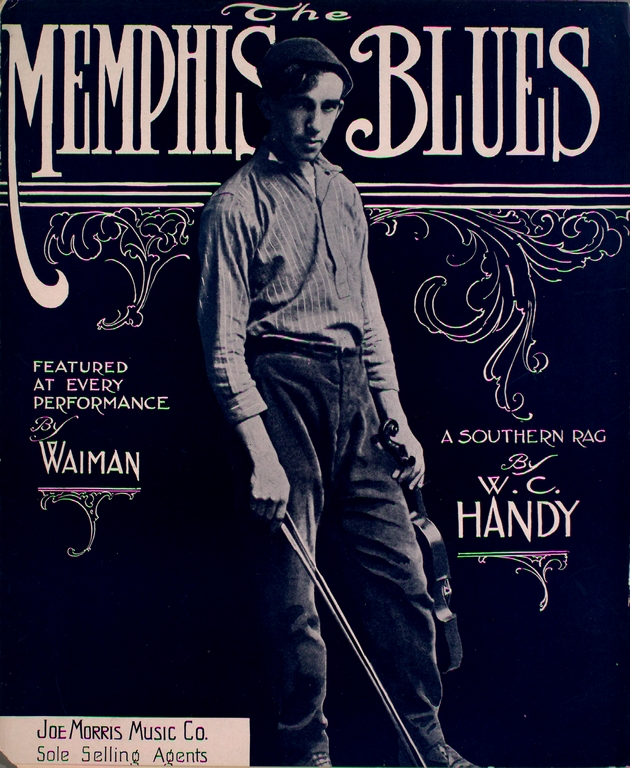
Nat D. Ayer (who also wrote the music for If You Were The Only Girl in the World) composed the piece in 1911 - yes, all that long ago. So I think this is a fine example of the way the 12-bar blues form was influencing popular music even during those very early years in the Twentieth Century when traditional jazz bands were beginning to emerge. Handy's pioneering Memphis Blues, also with the standard 12-bar main theme, had appeared just a year earlier.

And, as we all know, the 12-bar blues went on to be the basis of about a tenth of the tunes our bands have played in their performances ever since; and of course it became the basis of rock'n'roll.

Here, from the original sheet music, is the transition point where the 12-bar blues (VERSE) ends and the CHORUS begins.

5 October 2016

Post 434: WHAT ARE 'BLUES'?

A reader asked me to explain the type-names we come across in traditional jazz tune titles. 'What is the difference between a Drag and a Rag?' he asked. 'What exactly is a Stomp? How do you define Blues?'
Little did he know I am just as confused about these matters as he is. There is plenty to read on the subjects, both in books and on the internet; but agreed definitions are not easy to come by.

Worst of all is trying to define Blues. In the 1940s, the first 'Blues' I became aware of were the songs of Bessie Smith and her contemporaries. There were tunes such as Backwater Blues and Blue Spirit Blues. I was led to believe the Blues were mournful songs, expressing suffering or regrets, or at least wistfulness and nostalgia. The books I read suggested they had arisen from the chanting of African slaves and were structured on a familiar twelve-bar chord pattern (three four-bar blocks). They used a scale in which flattened thirds, fifths and sevenths were common.

But just think of the heritage of tunes with 'Blues' in the title today.

There are songs called 'Blues' that are really just run-of-the-mill pop music of ninety years ago (normally 32-bar structures). Think of Beer Garden Blues (a conventional 32 bars in AABA structure). Think of Tishomingo Blues, Sugar Blues (this one actually an 18-bar, including tag), Bye Bye BluesWild Man Blues, Rent Party Blues, and Davenport Blues.

When professional composers got to work on writing 'Blues', their inventiveness took them far beyond creating one mournful melody of 12 bars. You find Yellow Dog Blues, Savoy Blues, Riverside Blues, Perdido Street Blues, Royal Garden Blues, Jackass Blues, Aunt Hagar's Blues, Dippermouth Blues, Livery Stables Blues, Beale Street Blues, Canal Street Blues, St. Louis BluesWest End BluesTin Roof BluesChimes Blues - all having two or more (often very cheerful) 12-bar themes and in some cases further structuring, such as 'bridge' passages and key changes.
The early classic Crazy Blues has a long, continuous vocal that runs through three themes. Only the middle one comprises 12 bars; but you would hardly be aware of it.

There are tunes with a 12-bar theme but also a substantial and memorable verse that is played before it. Think of Memphis Blues.
There are plenty of 'Blues' that are lovely wistful compositions that do not include a 12-bar theme at all - Basin Street Blues, Melancholy BluesWabash Blues, Michigander BluesOwl Call BluesWinin' Boy Blues, Faraway Blues, for example.

Some tunes called 'Blues' have no 12-bar theme and nothing 'bluesy' about them, but are simply well-structured fun numbers. Think of Wolverine Blues, Blue Grass BluesDangerous Blues and Jazz Me Blues.
Sometimes the 12-bar blues structure turns up in unlikely places. For example, Mahogany Hall Stomp (yes - it's called a stomp) has a simple main second theme of 12 bars on which the musicians improvise. The same thing happens in She's Crying For Me, Copenhagen, and especially in The Chant, which sounds like a very tricky piece, even though there is a simple 12-bar section tucked away within it as a basis for improvisations.

And what about Tom Cat Blues? It actually sounds like the 12-bar song Nobody Knows The Way I Feel This Morning leading (usually with a change of key) into the 16-bar Winin' Boy Blues.

And consider Weary Blues. Band-leaders often tell you it is not a blues and it is certainly not weary. In fact the first two themes are 12-bar structures, though they whip along in such a way that you would hardly notice. Then, with a change of key, you are into the pulsating familiar 16-bar theme on which sparkling improvisations are possible.

So: what kind of tune may be called a 'Blues'? As John Gore, my favourite school-teacher, used to say to us pupils in his Latin class 70 years ago: 'Tot homines, quot sententiae' [There are as many opinions as there are people]. He was quoting Terence, the Roman dramatist who lived 22 centuries ago.

5 August 2016

Post 423: 'WORKING MAN BLUES'

In 1923 the 37-year-old cornet-playing band-leader Joe 'King' Oliver and his 25-year-old pianist Lil Hardin (who had a music diploma from Fisk University, Nashville, and who later became Mrs. Louis Armstrong) composed Working Man Blues - sometimes written as Workingman's Blues.

At the time, King Oliver's Creole Jazz Band had a residency at Lincoln Gardens, 459, East 31st Street, Chicago - not far from the Lake. (As far as I can tell, there is today a glass office block on the site.) The band made a recording of Working Man Blues for the Gennett label in Richmond, Indiana, on 3 October 1923. You may listen to it BY CLICKING HERE.

It's a really good piece for the repertoire of our bands and easy to master. 


As you see, there are just three short and simple sections. The first (A) is only a 12-bar blues, using a pretty riff. The second (B) is a 16-bar theme using The Four-Leaf Clover chord progression. (You can read about that progression BY CLICKING HERE.)

Section (B) is structured to include three opportunities for 2-bar breaks. Johnny Dodds makes the most of those in that 1923 recording.

The third 'theme' (C) involves free-style improvising over another 12-bar blues structure, but this time allowing a 'break' in bars 7 and 8. Oliver's band had the clarinet, cornet and trombone (Honoré Dutrey) respectively taking these breaks.

The tune is rounded off by a neat 2-bar CODA.

Some bands today, unlike Oliver himself, make more of Themes (A) and (B), staying on them for longer, or even dropping Theme (C) altogether.

Oliver chooses to devote the whole of the second half of the performance to three choruses of Theme (C).

He was constrained by the limited amount of time for which a 78 rpm record could play. Bands today are freed from such constraint and - with more choruses - tend to make the tune last much longer. However, as I have said elsewhere, a short performance can often be more effective than a longer one (especially if the musicians have nothing special to 'say'). For me, Oliver's original recorded version feels just right.

On the choice of key, some bands today play the piece in F. It sounds fine in that key and is perhaps for some musicians a little easier than Lil Hardin and Oliver's choice of Ab.

To watch a clear and reverential performance of Working Man Blues by a much later band (The Peruna Jazzmen) CLICK HERE.

===========
The book Playing Traditional Jazz by Pops Coffee is available from Amazon.

10 December 2015

Post 328: EIGHT-BAR BLUES?

Blind Blake (1896 - 1934)
The 12-bar blues is, of course, one of the staple components of traditional jazz. No concert is complete without one. Audiences seem to love them, especially if some (e.g. Squishin' Bees or Shake That Thing) are played at rock-n'roll tempos.

Yet many musicians I have spoken to are not so keen. They find the 12-bar blues too formulaic, too repetitive. They notice they are playing virtually the same solo in several different blues. They want different challenges and more variety. So they prefer to include no more than two 12-bar blues in a concert.

Many tunes called 'blues', of course, do NOT fall into the 12-bar structure, so musicians object less to playing them. Tishimingo Blues is a good example, with a pleasant harmonic progression: its Chorus comprises 32 bars. (It also happens to have a 12-bar Verse - but that is hardly ever played.)

Wild Man Blues is another very appealing number - but it also comprises 32 bars.

Basin Street Blues is very popular but it is not a 12-bar: it uses a 16-bar theme, based on The Georgia Progression.
Atlanta Blues, Michigander BluesBig House Blues, Jazz Me Blues, Wolverine Blues, Winin' Boy Blues, Wabash Blues and Faraway Blues are all very appealing to play because they have good melodies and (in some cases) challenging structures. But not one of them is a 12-bar blues.
And then there are some famous blues that DO incorporate 12-bar themes but are so interestingly composed, with multi-part structures (possibly including a change of key or a section in a minor key) that everybody enjoys playing them. Examples are Royal Garden Blues, St. Louis Blues, Riverside Blues, Savoy Blues, Yellow Dog Blues and Beale Street Blues.

But here's an idea for adding a bit of interest to a routine performance of a 12-bar blues. Play Too Tight Blues, as performed by 'Blind' Arthur Blake (the great guitarist) in 1929. Too Tight Blues is actually an EIGHT-Bar Blues, the melody and chord progression of which are very easy to pick up. When you play it (with or without vocals), you can do what Blind Blake does: throw in some choruses of improvised 12-bars, using the standard 12-bar chord progression. Then you have some variety. You can pick it up from Blind Blake with the help of YouTube:  CLICK HERE.

15 October 2015

Post 275: 'PYRAMID STRUT'

Tuba Skinny's fifth CD - Pyramid Strut - is available for digital download direct to your computer. And Tuba Skinny's sixth CD - Owl Call Blues - is also now on sale.

All you need to do to download Pyramid Strut is this. Go to
https://tubaskinny.bandcamp.com/album/pyramid-strut

and follow the instructions. You can pay for it easily (e.g. by PayPal) even if you do not live in the USA. You can even listen on line before you buy.

This CD was recorded in Tasmania during the band's Australian tour in 2013 and in my opinion is their best. It has excellent sound quality and of course the technical standard the musicians had reached by 2013 was so high that this CD is truly outstanding.

Talking about it, washboard-player Robin Rapuzzi said: Recording 'Pyramid Strut' was far different from any recording experience I think any of us will ever have again, as the space in which we recorded was very beautiful and sacred. A man named Chris Townsend had us over to his home outside of Hobart in the middle of Virgin Tassie Forest. He welcomed us and let us camp out on his property in some old fruit-picker shacks as well as recorded the album in its entirety. It was a pleasure to work with him and get to know his style. Normally we just record our music at home with blankets hung on the wall or a mattress leaned up against a corner to act as a sound barrier. I'm sure the sheer beauty of jungle around influenced us, as well as having the time and space to do it.  Often when we record, we don't give ourselves that much time to get the job done and it can feel rushed. In Tassie, we recorded I think it was over 20 tracks the first day and a similar amount the following day. Recording on that property allowed us to discuss a lot of everything and everyone's own ideas about the album.

15 tracks were eventually used on the CD, including such gems as Alligator Crawl, Deep Henderson and Big Chief Battleaxe. The polished, disciplined performances are stunning. There is also some terrific singing from Erika in such numbers as Slow Drivin' Moan (in a great arrangement making good use of Barnabus's trombone) and in Lonesome Drag, for which she wrote the lyrics. Here's the full list:

Big Chief Battle Axe
Lonesome Drag
Freight Train Blues (Lorraine Walton composition from 1938)
Pyramid Strut
I Got The Cryin' Blues
Cold Morning Shout
Hesitation Blues
Skid Dat De Dat
Mean Blue Spirits
You've Got To Give Me Some
Sweet Lovin' Old Soul
Alligator Crawl
Blood Thirsty Blues
Deep Henderson
Slow Drivin' Moan

May I draw your attention especially to the eponymous Pyramid Strut, an amazing composition by Shaye Cohn, who also plays a prominent part in its performance? This is a complex Mortonesque piece. In fact it's in the spirit of such tunes as Red Hot Peppers Stomp, recorded by Morton and His Red Hot Peppers in 1928.

Pyramid Strut is a tune of ithnographic complexity. It begins in the Key of Eb. It has a 4-bar Introduction which in other contexts could be mistaken for the final four bars of a tune. It runs down the scale of Eb in the third bar and so establishes the key. Then we have a first theme consisting of 24 bars and played twice. Bars 1, 5 and 21 contain a distinctive little phrase (a minim each on A and Bb) which give this theme a special character. But its other notable feature is that Bars 17 to 20 inclusive are played as 'Breaks' (exactly what Morton would have approved of). The first time this theme is played, the cornet takes the lead and also the breaks; the second time the clarinet.

Then the tune moves immediately and energetically into a second theme. This consists of 12 bars on the basic 12-bar blues chord pattern. As you may know, it was also a common practice in the 1920s to slot a 12-bar blues theme into the middle of structured compositions. (Think of The Chant and Copenhagen, for example.) Shaye's 12-bar theme is played through twice - first vigorously stated by the cornet and secondly with the full ensemble. We are still in the key of Eb.

Straight into the third theme we then go; and we find ourselves now in the key of Ab. What we have here is a 16-bar theme and this too is played twice. But what a tricky theme! In each set of 16 bars, bars 1 and 2, bars 3 and 4, bars 9 and 10 and bars 11 and 12 are taken as Breaks! That gives you four breaks in 16 bars - twice; so eight breaks in all. On the recording, the eight breaks are taken respectively by cornet, clarinet, trombone, tuba, cornet, cornet, cornet and cornet.

This is followed by an attractive 8-bar Bridge passage, which is extraordinary because it teasingly plays around (if my ear serves me correctly) on the F minor arpeggio. But the Bridge ends by running down through the Eb7 chord which of course leads us back beautifully into Ab. This will remain the key of the fourth (and final) theme.

This fourth theme consists of 16 bars  on a simple chord sequence. It is played three times. The clarinet leads us through it the first time, playing a tricky melody almost entirely of semi-quavers. Next, the banjo and tuba take the lead (a nice touch) in the second 16-bar chorus. Finally the whole band joins in for a climactic ensemble improvising over the 16 bars. And there's one more (Mortonesque) cheeky surprise: in a brief coda, those two minims from the opening theme bring the piece to an end, rounding it off perfectly. But this time (because the key has changed to Ab) they are played on the notes D and Eb.

Wow! I feel exhausted simply writing about it. Listen carefully to this piece. You will love it. Admire the discipline, the tightness of the playing and the technique of all seven players. You are witnessing what will come to be seen as one of the masterpieces of recorded jazz history.

What a girl Shaye Cohn is! (By the way, she even did the extraordinarily detailed and painstaking artwork on the CD cover - see top of this post.)
By the way, also note especially Shaye's busy playing on Big Chief Battleaxe. She can take a simple theme and create so much out of it, whether soloing or supporting the other players.

Aren't we lucky to be able - all over the world - to enjoy the fruits of her marvellous composing, arranging and playing?

12 October 2015

Post 272: 'NEW ORLEANS HULA' AND 'THE GIRLS GO CRAZY'


Sadly, the great jazz clarinet-player Monty Sunshine died on 30 November 2010. He was born in London, England, in 1928. I enjoyed his recordings over fifty or more years and had the pleasure of being in the audience at some of his concerts.

One of his recordings was of New Orleans Hula, a tune of which I was only vaguely aware.

However, listening to it again recently, I noticed that it is virtually identical to another old jazz classic - The Girls Go Crazy.

And if you are interested in jazz chord progressions, as I am, here's a curiosity for you. Take a standard twelve-bar blues chord sequence, for example (in the Key of C):

  C | C | C | C7 | F | F | C | C | G7 | G7 | C | C

(This was the basis of so much rock 'n' roll and all that followed.)

Then chop off the first four bars, leaving you with a sequence of eight bars:

 F | F | C | C | G7 | G7 | C | C

And what do you have?

None other than the chord sequence for New Orleans Hula and The Girls Go Crazy.

It also happens to work for the chorus of the spiritual It is No Secret - except that you have to go through the sequence twice to make up the 16 bars. And it works for the Chorus of Redwing and of Down By The Riverside.

If you don't know these tunes, I am sure you can find them easily on the internetThey are fun to play.

13 June 2015

Post 221: 'SATURDAY NIGHT FUNCTION'

One of the leaders in whose band I 'dep' has taken a fancy to Saturday Night Function - the Duke Ellington tune. He wants to add it to his band's repertoire.

I remember that Ken Colyer made an impressive recording of it long ago.

I have listened to it and note that it's essentially a 16-bar tune with some lovelier-than-usual harmonies. It's a useful tune because you can play it at slow-to-medium tempo, thereby creating a contrast with some of the quick numbers we all love to play.

This is how I've worked it out and this is how I shall try to play it, unless anyone supplies me with a more accurate version.


I'm not certain about the Ebdim in Bar 12, though it sounds like a strong possibility. An alternative could be B major or B major 7th. What do you think?

(Insertion: Henry - banjo from Germany - has just told me it should be B7. I think he's right.)

In some performances on record, free-style solos on a straightforward 12-bar blues progression are played after the above, before returning to the 16-bar theme to finish.

What exactly was a 'Saturday Night Function'? Most probably it was a means of paying the rent. You invited people to buy tickets for a Saturday-night party at your house; and the admission charges covered the cost of your rent.

There's another Duke Ellington tune with the same sociological background - Rent Party Blues.

11 June 2015

Post 218: THE 12-BAR BLUES STRUCTURE AND 'SHAKE THAT THING'

In case you need help with mastering that most quintessential of jazz tune structures - the Twelve-Bar Blues - here is a tune that uses the chord progression in its least sophisticated form.
This is 'Shake That Thing' - well worth having in your repertoire. It was written by 'Papa' Charlie Jackson in 1926.
Born in 1885, Jackson was unusual in creating 'blues' that were
played faster and were more humorous than most.
Play 'Shake That Thing' at a moderately fast speed and if possible have someone singing the words. They are good fun.

There are various sets of possible words. In one of them the first two verses can go something like this:

Down in Georgia there's a dance that's new,
Ain't nothin' to it, it's easy to do.
You gotta shake that thing. [Shake that thing.]
I'm growin' tired of tellin' ya,
You gotta shake that thing.

The old folks are doin' it, the young folks too,
The old folks tell the young folks what they gotta do.
They gotta shake that thing. [Shake that thing.]
Growing' tired of tellin' ya:
You gotta shake that thing.

You can click on this video to see and hear how effective it can be:
http://www.youtube.com/watch?v=CPhbe6RwABI

And here's a curiosity - the only 13-BAR blues I can think of. It occurs as the Interlude in Blind Boy Fuller's Untrue Blues. This is essentially an eight-bar tune, but he has two guitar links of 13 bars, which seemed to be based on the 12-bar blues, but with Bar 10 repeated. When Tuba Skinny revived this tune in 2014, they scrupulously followed the original and kept the 13-bar section.

29 May 2015

Post 216: A VERY SPECIAL PERFORMANCE - 'ALMOST AFRAID TO LOVE'

Tuba Skinny has given us a mind-boggling performance that serves as a lesson to us all. We have to thank the generous and prolific film-maker codenamed digitalalexa for making it available to us on YouTube. (I will give you the Link to it shortly.)

am speaking about Almost Afraid to Love. This is a song I had never heard of. But banjo-player Stan Cummings of Sacramento kindly informed me it was composed by Ann Turner in 1938 and made famous at that time by the great blues singer Georgia White.
Georgia White
On the face of it, no performance could be simpler. It's just seven choruses of a 12-bar blues in C - 84 bars of music in all.

But the way it is interpreted is exemplary - demonstrating all that is great about traditional jazz at its best. Just listen.

Chorus 1: Against a solid foundation provided by the tuba, washboard, guitar and bass drum, the cornet introduces us to the tune; but the music is like a conversation between three old friends. Using her cup mute, Shaye makes the sad statements and Barnabus (trombone) and Ewan (clarinet) respond sympathetically to everything the cornet says.

Chorus 2: Erika begins to sing, telling the story with an uncluttered accompaniment. What a solid foundation Todd gives (as usual) on the tuba!

Chorus 3: Erika completes the story - with Shaye providing tasteful background colouring, using the cup mute.

Chorus 4: Ensemble. Both the cornet and trombone are muted now. This is another chorus sounding like a conversation between three old friends. It reminds me of the string quartets of Haydn and Mozart. Some of the phrases are exquisite - such as Shaye's phrase responding to the trombone at 1 min. 49secs.
[I think this must be one of Shaye's favourite phrases - you hear it frequently in her playing.]

Chorus 5: The 'conversation' continues; with Evan making assertive statements on his clarinet, while the cornet and trombone reply 'Yes, we know. It's a shame. You're so right!'

Chorus 6: Erika resumes the song.

Chorus 7: Erika completes the song, but with the others performing like the Greek Chorus from Oedipus Rex - commenting sympathetically on the events of the story. It is outstandingly good four-part interplay with the singer. And as the performance comes to an end, there's one more surprise in store. Shaye picks up her 'jam funnel' mute for a strong conclusive effect in the final two bars, descending a C minor arpeggio.

There is nothing strenuous or over-loud or showy or raucous about this performance. There are no screaming high notes. The playing gives the illusion of being totally relaxed, simple and effortless. But the apparent simplicity conceals art of the highest order.

15 April 2015

Post 201: MA RAINEY'S 'DREAM BLUES'


It was in 2013 that I was introduced to Ma Rainey's lovely tune Dream Blues. Ma Rainey recorded it (accompanied by the Pruitt Twins) in Chicago in 1924. I believe Ma Rainey herself wrote it that year. You can hear it on YouTube:
Click here.
Ma Rainey sings it in Bb but I have transposed the blues to Eb for my (slightly simplified) version.
It is a conventional 12-bar blues, except for the way it uses the mediant where we might expect the tonic. Note, for example, how the melody ends on G, and not on Eb, as we might expect.

Ma Rainey - sometimes known as The Mother of the Blues - was one of the first great blues recording artists. She came from Georgia in the USA and she died in 1959.

29 March 2015

Post 192: 'SALAMANCA BLUES'

A reader asked me who composed Salamanca Blues, which can be heard on Tuba Skinny's 2012 CD 'Rag Band'.

Shaye  (Photo courtesy of an Australian correspondent)
Well, it was composed by none other than Shaye Cohn. As performed on the CD, it is a short, unpretentious, medium-tempo, charming and melodic piece, without a vocal. The whole thing is over in less than three minutes and it comprises just 76 bars (measures), which are made up of six segments:

1. 12-bar simple blues in F, firmly stated as a trombone solo by Barnabus Jones.

2. 16-bar soaring theme in F, just as firmly stated on Shaye's cornet - starting on the high F. There is some lovely tremolo support from the banjo and the harmonies are beautiful.

3. A key change! With no modulation, the full ensemble is straight and decisively led by the cornet into a 12-bar blues in Ab.

4. A second 12-bar ensemble in Ab.

5. Another 12-bar in Ab, this time stated by the banjo with (from Jonathan Doyle's clarinet) some cascading sweetness over a Db chord and also a two-bar solo 'break' - the only break in the 76 bars.

6. A final 12-bar ensemble blues chorus, again firmly started by Shaye on the high F - turning the chord into an Ab6. But, with a slight rallentando, all is brought to a calm neat ending.

Why did Shaye call her composition Salamanca Blues? I don't know. My first guess was that it was named for Salamanca in Spain. Tuba Skinny have visited that country. But there is also a 'Salamanca Market' in Hobart, Tasmania. Maybe the band busked in that market some time before 2012, but I have no evidence of a trip to Tasmania before 2013. A friend has suggested - very plausibly - that it was inspired by the small city called Salamanca in the Southern Tier region of New York. He reminded me that the band played shows in that general region at about the time when the tune was composed.

That excellent video-maker codenamed TheWsm0 filmed the band reviving the tune in 2018, during the French Quarter Festival in New Orleans:
CLICK HERE.
Why not buy the CD, which also contains such treats as Jackson Stomp, Banjoreno and Russian Rag?