Welcome, Visitor Number

Translate

Showing posts with label rhythm section. Show all posts

5 March 2018

Post 604: HOW KINGSLEY AMIS DESCRIBED TRADITIONAL JAZZ

Over the years, I have jotted down interesting and insightful remarks I have come across concerning traditional jazz. I would like to share some of them with you.

Ken Colyer (one of the most important English traditional jazz musicians of the second half of the Twentieth Century):
Take it easy. Keep it down. Give plenty of light and shade.

Ben Marshall (banjo-player) writing in The Ken Colyer Trust Newsletter, December 1992:
...the whole band acting like a rhythm section, concentration on ensemble work, seeking the inner rhythms, dynamics, swing, lift, energy, passion, all the things we talked of for hours on end.

From Ken Colyer: A Musician for All Seasons, by Malcolm Robinson, Spring 1990 (in Jazz Beat):

Through the months that followed, Ken learned and developed his playing, and achieved his still unmatched understanding of the subtle dynamics and harmonies of the beautiful New Orleans music: the easy tempos, the relaxation, the emphasis on ensemble with no one instrument ever dominating, the solos growing out of the ensemble, the rolling beat with the trumpet always riding the 4/4 bass figure, gently pushing then pulling back like a surfer; all to create the feeling of tension, relaxed heat and bounteous emotion that New Orleans jazz fans understand so well.


From a book about Preservation Hall:

....music in the African tradition - circumlocution rather than exact definition...

Narvin Kimball:
In those days, players had to learn to 'sleep fast'.

Kingsley Amis (in The Times, March 1991):
Rhythm was what made you tap your feet in time to the stuff, and you certainly did that if you were not actually dancing to it. If alone, or in the right company, you gave little yells of enjoyment and encouragement, as some of the listeners do to this day. With a four-man rhythm section, piano to drums, pounding out their four-to-the-bar in a contentedly unliberated fashion, and the wind instruments often avoiding the actual beat but never ignoring it, nobody who was not worse than deaf could fail to respond to the driving pulse. Of course, it was more a metrical pulse, and real rhythmic interest and diversity lay in what those other instruments, aptly called the melody instruments, were playing. And melody, which comes first and last in jazz, as in any self-respecting music, is in another sense the heart of this.
To reproduce the tune, the air, to do no more than embellish it, was likely to be thought inadequate except in slow ballads. Effectively the aim was an alternative tune, a counter-melody, or a disconnected series of them, sometimes in scraps rather than flowing, improvisatory in manner, delivered here in a solo passage, there divided among two or three, dry and harsh rather than limpid in tone, often distorted in pitch, its points of tension arranged across the steady underlying beat. When successful, the result was exciting and absorbing in a way otherwise unknown, intense but abstract, encouraging no mood or thought beyond itself, satisfying.

Benny Green:
It would seem that there is in the make-up of a jazz musician a strong instinct of defiance of authority and contempt of humbug which has always seemed to me one of the most attractive features in the jazz world. I have seen so many bubbles of pretension pricked by every grade of humour from epigram to obscenity that I am now convinced that the jazz musician is one of the most beautiful creatures on the planet.

An Irish fiddler speaking on BBC2 on 23 February 1991:
The great thing about traditional music is that it has no shelf life. There is no sell-by date.

4 May 2017

Post 503: THE MAKING OF 'SNAG IT'

On 17 September 1926 King Oliver took his Jazz Band into the Chicago Studio to record his composition Snag It. Two takes of the tune survive. Both are available on YouTube.

VERSION ONE: This strikes me as the weaker version, but it has some interesting features (a Chorus led by the tuba; and a 2-bar Coda) that were not on the better version. Also, there is no vocal. My guess is that Oliver would not have been too happy with his own playing (some superfluous notes in the Introduction; and the now-famous four-bar break taken a  shade too hastily) and that he would have considered the final two choruses less tidy than on VERSION TWO.

VERSION TWO: This is better played overall. In structure, the main differences are that it drops the tuba solo chorus and substitutes a vocal chorus. There is also some vocal commenting (which I could have done without) over the final two choruses. Also, Version Two drops the Coda.

Both versions, however, were well crafted, using pretty much the same scheme (the 8-bar Introduction followed by seven 12-bar blues choruses, all in Eb). Oliver had clearly given the piece a lot of thought. It was to have that striking dramatic eight-bar Introduction and then an ensemble first chorus before a second chorus in which the trombone would take the lead against a gentle long-note accompaniment. He would begin the fifth chorus on his cornet with the four-bar break which has since become the one thing in the recording that everybody remembers. The final two choruses would be based on a pleasant riff (played gently by the reeds, with a counter-melody from the cornet and steady soft accompaniment).

But what I have deliberately not mentioned so far is something that strikes me as one of the most interesting features - the rhythmic accompaniment to the third chorus. The clarinet plays the melody, supported by a repeated two-bar rhythmic pattern that goes like this:| 


If that seems hard to follow, listen to it at 1 minute 14 seconds into this YouTube version: https://www.youtube.com/watch?v=y6fkstiMAbc

This inventive, unusual rhythmic pattern is, for me, one of the best things in 'Snag It'. I think it is something we could all attempt (not only when playing this tune) as it would give badly-needed variety to our rhythmic accompaniments.

It is quite tricky to get the drums, guitar or banjo, bass and piano all hitting this rhythm precisely together. It may need practice. But it is well worth the effort.

Listen again to the full King Oliver recording and see what you think.

30 March 2015

Post 194: 'CLIMAX RAG' PLAYED BY SHOTGUN

Have you seen this video of Marla Dixon's Shotgun Jazz Band? They are playing Climax Rag, written by James Scott 100 years ago. We are all indebted to the videomaker codenamed bljl1223 for making this available to us on YouTube.
Haruka Kikuchi
It has so much to offer:

1. sensational playing and teamwork;

2. super breaks;

3. a stomping and precise rhythm section (John, Tyler and Justin);

4. James Evans and Haruka (having recently settled in with this band) really enjoying themselves and playing some amazing unrestrained stuff;

5. a 'quiet' chorus;

6. a front-line-only chorus;

7. a super raw final chorus;

8. a fun coda;

9. twelve variations on the final Chorus with a range of entertaining and interesting treatments;

10. Marla's dynamic leadership throughout.

The whole performance is driven along by the pulsating poom-poom-poom-poom rhythmic pattern (rather than um-chook-um-chook) that I personally find thrilling and entirely appropriate to this type of tune.

Try for yourself. Set your feet tapping by

7 March 2015

Post 183: CHORUSES AGAINST OFF-BEAT STOP CHORDS

I wish there was more variety of treatments of choruses in the performances of our bands. There are many ways of making 'solo' choruses more interesting. The use of long held notes (as backing) is one. Another is the use of stop chords (for example, the rest of the band - apart from the soloist - playing just the first two beats of each bar).

One of my favourites is the use of OFFBEAT stop chords. In other words, the soloist plays fluently over all four beats of the bar, while the rest of the band plays only the second and fourth beats.

Similarly, you can have the full rhythm section playing a chorus of offbeats only while the melody instruments all continue to play normally. That is very effective.

Like all good things, the device should be used sparingly. For example, in a 32-bar chorus, one instrument could play 16 bars against offbeat stop chords, with another taking over for the remaining 16 bars accompanied by conventional rhythm section backing.

The use of offbeat stop chords impresses audiences and indeed it does not always come easily to the musicians. In particular, the soloist must not let himself or herself be thrown by the unusual rhythm. It takes practice. When taking a solo against offbeat backing, it's best to hit the first note of the bar firmly, at least at the start, to establish clearly where it actually is!

The offbeat stratagem is not at all new. It is an authentic part of the New Orleans tradition.

You can hear Louis Dumaine demonstrating it well with his Jazzola Eight in 1927. Louis himself plays a chorus of Pretty Audrey against such a rhythmic background.
Notice what happens at 1 minute 15 seconds into the recording. Louis plays a full fast 32 bars against stop chords. It is an exciting effect.

In the same year, the great Sam Morgan Band made recordings in New Orleans. Notice what happens in the band's recording of Mobile Stomp.
At 1 minute 28 seconds, for the third chorus, the rhythm section switches to a stop chord offbeat rhythm, against which the reeds continue to improvise prettily over the full bars.

Let us all try more of these variations. Of course, the best bands already do.
for a clever variant in which the front line (cornet, trombone and reeds) plays the stop chords while the banjo takes the solo. Note what happens at 1 minute 37 seconds. What about that as an example to us all?

6 March 2013

Post 6: GET RID OF THE FRONT LINE!

I don't know who started the fashion way back in the mid-20th Century for having a 'front line' of clarinet, trumpet and trombone and a 'back line' rhythm section with such instruments as percussion, banjo and bass. Maybe it was the George Lewis band.
The set-up thrusts the front line into the limelight and prevents the audience from seeing and appreciating the other musicians. The players at the back often complain that they can't clearly hear those at the front. Also, this formation makes it difficult for signals to be passed between the musicians (for example - who is going to 'take the solo' in the next chorus). A front-line player who is the band-leader frequently has to turn round in the middle of a tune to signal or speak to colleagues.

I know there are some cramped venues where such a set-up is hard to avoid. But I have often thought it would be better for both the band and the audience if the musicians arranged themselves in an arc or semi-circular formation, in the same way as string quartets and quintets do in the classical music world. The players would all be able to see and hear each other and the audiences would see all the players.

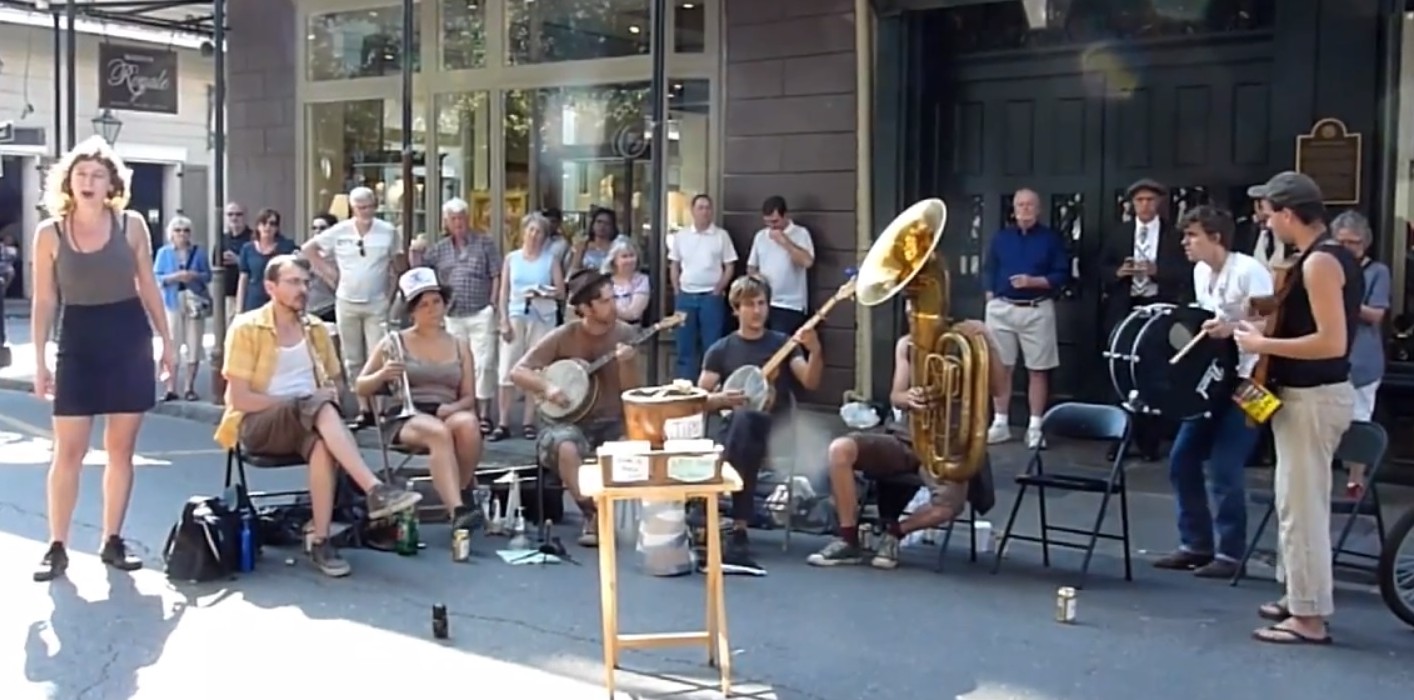
The wonderful young band Tuba Skinny, based in New Orleans, is setting us an example in this respect, as in so many others. Whenever there is sufficient space, they spread themselves out in front of their audience. Shaye Cohn, who gives the directions, sits where she can be seen by all her colleagues. The clarinet and the trombone occupy positions shoulder to shoulder with her because it is with them that she has to work closely to produce the band's wonderful polyphony. The tuba and banjo or guitar are in line so the audience has an unimpeded view of them. Every individual in the band can be seen and appreciated by the audience:
Get it?

Don't you agree that's a better way to present our music?
==========
Footnotes

Since I originally wrote the above article (in 2013), I have noticed a few more bands playing in the 'arc' formation. I'm very pleased about this. Let's get rid of the concept of a 'front line'!

My book Playing Traditional Jazz is available from Amazon.