Welcome, Visitor Number

Translate

Showing posts with label Tuba Skinny. Show all posts

2 December 2019

Post 612: CRAIG FLORY'S 'MINOR FRET'

What a wonderful and complex composition Craig Flory’s ‘Minor Fret’ is. Through-composed, it is possibly the most striking and challenging piece Tuba Skinny ever set itself to learn by heart. 
Beginning (in recent performances) with a single beat played on the washboard, the rest of the first bar has the band holding an E flat minor chord, followed by four (in earlier performances two) more bars of Introduction, establishing the key by firmly laying down that chord on every beat.

This is followed by a 12-bar blues theme in E flat minor, led by Craig on clarinet, with Shaye playing a pretty counter-melody in bars 2 and 4. Then Shaye herself leads the way through the 12-bar blues theme, this time with Barnabus playing the counter-melody.

Now something extraordinary happens: the rug is pulled from under us! There is a startling switch up by just one semi-tone to the key of E minor! The acid E minor chord is hammered out over eight bars, during which Craig plays that counter-melody again – but in the new key. The eight bars end with a heavily-struck B flat 7th chord, which leads us cleverly back into the principal key of E flat minor.

We now have the 12-bar blues in E flat minor again, but usually with the trombone (Barnabus) taking the lead in the final eight of those bars.

Now those final eight themselves become the pattern for a new theme: we have this little theme, played three (in some performances four) times and usually led respectively by the cornet, the clarinet, the tuba and (against offbeats) the guitar. This eight-bar theme uses the chord structure of the final eight bars of the 12-bar blues in E flat minor.

The last of these mini-solos ends on a crashing B 7th chord, taking us for a second time into that wailing Interlude of eight bars in E minor, again including the counter-melody and ending on a sustained B flat 7th chord, which of course takes us neatly back into the key of E flat minor for another run-through of the twelve-bar blues theme and a lingering drop on the final E flat minor chord. Wow!

You can hear Tuba Skinny play this piece in its mature form, after some months of gestation and tweaking, in this video filmed by my good friend James Sterling:
https://www.youtube.com/watch?v=RNDWAJvhN_4

Post 611: RECOMMENDED GREAT TRADITIONAL JAZZ VIDEOS

I leave you some recommendations for videos of traditional jazz bands active in recent years. If you have not seen these videos before, I hope you will enjoy them. If you have seen them, I am sure you will enjoy watching them again!

First, for a relaxed, moving, unpretentious but beautifully-played performance, showing just how perfect a musical form traditional jazz can be, try Whenever You're Lonesome, Just Telephone Me played by members of The Shotgun Jazz Band. The video runs for about five minutes:

For an example of a great jazz band playing one of the very complex tunes from our repertoire - Deep Henderson - watch Tuba Skinny in this next video. It runs for a little over three minutes. Notice how all members of the band, working from memory rather than printed arrangements, play wonderfully as an ensemble through all three sections of this challenging piece, not to mention taking in their stride a change of key and linking passages:


Now, for some passionate 'no frills' traditional jazz, coupled with brilliant musicianship and generating great excitement, I would like to offer you a performance of Royal Garden Blues that I myself had the privilege of filming. This one runs for under five minutes:


Next, I offer you a performance of a good old jazz standard - Savoy Blues - played by The Shake 'Em Up Jazz Band. This video runs for a little under five minutes. I recommend it because it shows what happens when six outstanding musicians come together and - with great respect for each other - play wonderfully as a team, just as our bands should. This performance too is unpretentious and yet you will hardly find a better rendition of this piece anywhere:


Finally, if you have time to sit back for a full half hour and watch six outstanding musicians play a varied programme ranging from storming stuff such as Climax Rag to the tender Love Songs of the Nile, may I urge you to watch this video? You will also hear such tunes as Oriental Man, Yearning, Mobile Stomp and I Can't Escape From You. As one observer said, 'It's the kind of music that makes you cry with joy!' Click on it here:


In my opinion, this is the best 'half-hour live concert' video to have appeared in several years.

1 December 2019

Post 610: TUBA SKINNY RE-CREATING GEMS FROM THE PAST

I have been hugely impressed in recent months - as I'm sure most fans have - by the meticulous care Tuba Skinny take whenever they select a forgotten or near-forgotten recording from the 1920s and decide to add it to their repertoire. Though they have to adapt the piece to suit their own resources, talents and instrumentation, they keep closely to the spirit of the original, often including the order of events, the structure of the piece and even sometimes the exact notes originally played in two-bar breaks.

Take, for example, their rifacimento of Got No Blues - Lil Hardin's composition recorded by the Hot Five. Have a look at this performance, kindly filmed by James Sterling:

I love the sensible way Shaye tackles Louis' two-bar cornet break at 32 seconds. And note the key-changing subtleties: on the Hot Five original, a banjo interlude craftily slides us from the key of Eb to the key of F. In Tuba Skinny's performance, hear Jason do exactly the same (54 seconds to 1 minute 05 seconds). Later, just as Louis plays a succession of notes to transpose the piece back into Eb before handing the next solo on to clarinet-player Johnny Dodds, so Shaye plays a similar pattern of notes (1 minute 48 seconds to 1 minute 54 seconds) to return the tune to Eb and so hands it on to Craig in that key.

These things don't just happen. They require hours of preparation, coordination and practice. Then, when the tune is ready for public performance, every player knows exactly what is happening and what he is required to do, and when.

Next, consider I Got The Cryin' Blues. It was composed by Sara Martin and Tom Johnson, and recorded in September 1924 by Sara Martin and her Jug Band. Here's their version of it played by Tuba Skinny:
As you can hear, it has an 8-bar Verse (played just once) and a 16-bar Chorus. But here's the interesting thing: the Chorus is sometimes played with the addition of a two-bar tag! You can hear Erika sing the tag at 2 mins. 21 secs. You can hear Shaye play it at 1 min. 41 secs; and again right at the end, before the Coda. And guess what? Tuba Skinny have followed the structure of the original Sara Martin recording and have punctiliously placed the Tags exactly where Sara and her Band played them. Of course the whole Band knows exactly when they are coming. Nobody makes a mistake. That's a further illustration of the meticulous care  the band takes in its preparation of tunes for our entertainment.

And consider how they recreate King Oliver's 1929 recording of Too Late, which was composed by Dave Nelson and Oliver himself. Click on this performance:
This is a 32-bar tune with a simple chord progression. With Rhadamanthine scrupulosity, Tuba Skinny begin with the extraordinary 'speeding up fanfare' Introduction of Oliver's recording. Then they follow the equally extraordinary example set by Oliver of dropping the key from Eb to C for one Chorus only - the second. Even Oliver's two-bar breaks are scrupulously respected. Shaye herself faithfully copies (at 3 mins. 53 secs.) the break that occurs in Bars 15 and 16 of the 32. To do this, she has to play the highest note I have heard her play anywhere in a YouTube video. She is not one of those soulless players who like to show off by playing lots of high notes all the time, but in this moment she proves she can hit such a note when she wants to be faithful to the original recording.

Cushion Foot Stomp has proved very popular with audiences. Here is a Tuba Skinny performance of this piece:
Although Tuba Skinny sensibly do not include the scat vocal to be heard on the original Clarence Williams recording from 1927, the Coda and Shaye's 'decorations' (exactly as cornet-player Ed Allen provided on the original recording) illustrate well the band's attention to detail when they set about producing a rifacimento of a classic recording from the past.

For the benefit of anyone who may have difficulty following the ichnography of jazz classics from the 1920s, here's the lay-out of this one. You will note that it has three themes, like many of the jazz classics of that era.

Tuba Skinny follow Clarence Williams, by playing the piece in the key of Eb.
(1) EIGHT-BAR INTRODUCTION : 28 seconds - 38 seconds.
(2) THEME A (standard 12-bar) : 39 secs. - 54 secs. Craig leading with the main melody.
(3) THEME B (24 bars) : Todd leading, with Shaye 'decorating' : 55 secs. - 1 min. 27 secs.
(4) THEME B (24 bars) : Craig leading, with Shaye 'decorating’ : 1 min. 28 secs - 1 min. 59 secs.
(5) THEME A (the 12-bar again) : 2 mins. 00 secs. - 2 mins. 16 secs.
(6) BRIDGE (4 bars, leading into THEME C): 2 mins. 17 secs. - 2 min. 21 secs.
(7) THEME C [Classically known as the TRIO. This is the Main Theme on which the piece settles, and is used as the basis for improvised solos. It consists of 16 bars, always with a ‘break’ on Bars 7 and 8] : Taken by Barnabus, and indeed with the ‘break’ : 2 mins. 22 secs. – 2 mins. 43 secs. (You can hear his ‘break’ at 2 mins. 30 secs. - 2 mins. 32 secs.)
(8) THEME C : Taken by Craig and including the ‘break’ - 2 mins. 44 secs. – 3 mins. 04 secs.
(9) THEME C : Taken by Shaye and including the ‘break’ - 3 mins. 05 secs. – 3 mins. 26 secs.
(10) THEME C : Taken by Jason and including the ‘break’ - 3 mins. 27 secs. – 3 mins. 47 secs.
(11) THEME C : Taken by Todd and including the ‘break’ - 3 mins. 48 secs. – 4 mins. 08 secs.
(12) THEME C : Taken by Robin and including the ‘break’ - 4 mins. 09 secs. – 4 mins. 29 secs.
(13) THEME C : Taken by the full ensemble but with collective ‘break’ on signal from Shaye - 4 mins. 30 secs. – 4 mins. 50 secs.
(14) CODA (4 bars) : Initiated by Robin – 4 mins. 51 secs – 4 mins. 59 secs.

Finally, have a listen to Tuba Skinny's re-creation of Kiss Me Sweet:
This song was composed by Steve J. Lewis and Armand J. Piron in 1923. Like Piron, Tuba Skinny play it in the key of C; and they play the 16-bar Verse only once. Also like Piron they take Bars 7 and 8 of the 20-bar Chorus as a 'break'. You can hear Todd play it at 1 min 14 secs and 3 mins 45 secs, Barnabus at 1 min 52 secs, Craig at 2 mins 29 secs, Max at 3 mins 08 secs and Robin at 4 mins 22 secs. There is an amusing Coda in the Piron recording which - surprisingly - Tuba Skinny omit, though they have a lovely rallentando ending instead.

The interesting rhythmic backing to Craig's solo is the kind of thing Tuba Skinny devise and execute so well, as is the way Craig and Shaye play harmonies behind Barnabus's solo chorus.

Though Tuba Skinny choose not to have a vocal, there are words to this tune. For the words of the Chorus, go to Piron's original recording: https://www.youtube.com/watch?v=K7HuZNF77IQ - or if you would like to hear the words of the Verse as well as the Chorus, go to the King Oliver recording (he plays it in the key of G):https://www.youtube.com/watch?v=PJTecT7DHOQ

20-bar Choruses are unusual, though there was a fashion for them at the time. Think of After You've Gone, What Do You Want to Make Those Eyes At Me For?, Oh You Beautiful Doll, The Darktown Strutters Ball, Drop That Sack, Hard-Hearted Hannah, You've Got the Right Key but the Wrong Keyhole and Life is Just a Bowl of Cherries, for example.

One final bit of tedious analysis: when it's Shaye's turn to play the 20-bar Chorus as a solo (2 mins 55 secs), she plays the first six bars and then gives the next two (the break) to Max; she then plays Bars 9 to 12 and leaves the remaining eight to Max. This is a typical Tuba Skinny stratagem - and a lesson to us all in how to make the music interesting.

Almost all Tuba Skinny performances are masterclasses for the rest of the world's traditional jazz bands. There. You will be relieved to hear I've finished and will now go and have a cup of coffee.

9 March 2018

Post 606: TUBA SKINNY'S CD 'SOME KIND-A-SHAKE'

Tuba Skinny’s latest CD, released in April 2019 and entitled ‘Some Kind-a-Shake’, contains 14 tracks and is remarkable for four reasons.

First, it was recorded at The Living Room Studio in New Orleans. This is a former church, a spacious wooden building, now equipped with a huge range of technical equipment and offering excellent acoustics. So the CD is possibly the most ‘professional-sounding’ of all Tuba Skinny’s recordings.

Second, the band on this occasion comprised ten players, including two reeds. The result is an unusually full-bodied sound.

Third, to an even greater degree than before, most of the tunes are highly orchestrated with slick, ingenious arrangements. Little is left to chance.

Finally, two of the tunes were composed by participating musicians. The title track, ‘Some Kind-a-Shake’, written by Shaye Cohn in 2018, is a riffy number with well-drilled backing and rhythmic effects, a 16-bar fluent ‘verse’ interlude, and an amusing link and coda in which various instruments play one at a time in an eight-note arpeggio! And Ewan Bleach’s ‘Berlin Rag’, composed in 2016, is craftily scored, with an intriguing structure that seems to dance teasingly around the key of D minor.

'Saturday Night Function’ is a highlight, with five 12-bar solos, including two particularly tasteful by Craig on clarinet and Todd on sousaphone, sandwiched between single statements of Ellington and Bigard's 16-bar theme. The unusual rhythmic pattern backing Ewan’s solo is typical of the attention to detail that permeates this CD. You hear the same kind of thing behind Craig’s solo in ‘Ballin’ The Jack’.

Erika sings Fats Waller’s ‘Squeeze Me’, which she also performed on the band’s album ‘Rag Band’. The earlier recording was made before a live audience at The Spotted Cat, so this new version is much cleaner in sound, but the arrangement and key (Eb) are pretty much the same. The strings – in the familiar chromatic descents - and Ewan’s alto saxophone provide lovely support.

Erika also duets with Greg on the Memphis Minnie song ‘I’m Going Back Home’ (in the unusual key of A) and on ‘Wee Midnight Hours’ - based on ‘Midnight Hour Blues’ originally recorded in 1932 by Leroy Carr. Both these are established favourites with fans of Tuba Skinny.

Greg gently sings the 8-bar Blind Blake song ‘You Gonna Quit Me’, followed by a pleasant solo from Barnabus, and some exquisite teamwork choruses.

The up-tempo ‘Ballin’ The Jack’ has Craig shining on baritone sax and Ewan playing a clarinet chorus against stop beats; and there is a vigorous ‘Jubilee Stomp’, with lively work from Craig and plenty of tricky links and breaks perfectly executed.

'Echo in the Dark’ and ‘Stealing Love’ are gentle, melodic pieces, with the lead shared around and sweet combined work from the reeds. 'Too Late’ keeps closely to the spirit of the 1929 original by Dave Nelson and King Oliver, even with Rhadamanthine scrupulosity including the drop from Eb to C for just one chorus.

Many bands play May Aufderheide’s ‘Thriller Rag’ in F; but Tuba Skinny go for the more challenging Ab, in an exciting up-tempo version.

Shaye Cohn’s own playing seems to have reached an even greater peak in the last couple of years. Whether beautifully melodic in ‘Echo in the Dark’ or rapidly and energetically creative in ‘Deep Minor Rhythm Stomp’ (a super tune for dancers), she is always exciting to hear. 'Echo in the Dark' is the tune in which Shaye reaches the second highest note (concert Bb) we have ever heard her play on record. She is not merely showing off technique, as many players do, but is required to play it as part of the melody. There's an amusingly tense moment when she approaches it for the final time near the end of the track: we keep our fingers crossed for her and she pulls it off - with only the tiniest hint of a struggle!

There is superb, neat, complementary playing and soloing throughout by Barnabus, Robin and Todd, and by the strings - with quite a few finger-picking solos.

In total, then, this a well produced CD, with a wide range of contrasting tunes demonstrating the dazzling standard the band has reached ten years after its formation.

The artwork as usual is by Shaye.

22 February 2018

POST 601: 'ROCK ME'; AND A BEREAVEMENT

Here's a sad tale. In 1932, Nettie Dorsey, the wife of Thomas A. Dorsey,  died in childbirth; and two days later their new-born son died too.

In his grief, Thomas A. Dorsey composed Precious Lord, Take My Hand - a tune which remains popular with traditional jazz bands to this day.
Thomas Andrew Dorsey
Who was Dorsey? Not to be confused with Tommy Dorsey (1905 - 1956), the famous trombonist and band-leader, he was always known as Thomas A. Dorsey. He lived from 1899 to 1993.

Thomas A. Dorsey was already well-known at the time of his wife's death. He was an established blues pianist, band-leader and composer. He had performed as 'Georgia Tom'. He had a hit record in 1928 with It's Tight Like That. His band had accompanied Ma Rainey. He founded the first black gospel music publishing company. He was in later life to be considered the Father of Black Gospel Music. 

A gospel number for which he is also specially known is the 1937 composition Peace in the Valley.

But what prompts me to tell you all this is that I listened earlier today to Erika Lewis singing Rock Me on Tuba Skinny's first album - the album simply called 'Tuba Skinny' and issued in 2010. Rock Me was made famous when it was recorded by Sister Rosetta Tharpe in 1938; but the song was originally composed by Thomas A. Dorsey under the title Hide Me In Thy Bosom.

Rosetta sang it in the key of Bb; Tuba Skinny prefer Ab.

You can hear Rosetta's recording BY CLICKING HERE.

To hear Erika Lewis singing the song in the early days of Tuba Skinny, you should buy the album. But if you would like to see a live version, filmed as long ago as 2010, CLICK HERE.  At the time, Tuba Skinny was in its infancy and still had no reed player; but you can hear a wonderful little solo chorus from Shaye Cohn at 2 minutes 20 seconds  that foretells the greatness to come.

We have to thank the video-maker codenamed digitalalexa for recording this early performance.

I decided to try playing Rock Me on my keyboard and trumpet. What I then discovered is that it is a 32-bar tune (you could consider it as a 16-bar Verse with a 16-bar Chorus). Also, I found the first 16 bars have virtually the same simple chord progression as the second 16 bars. Moreover, all four sets of eight bars begin with The Magnolia Chord Progression [ I  -  I7  -  IV  -  IVm ].

The Magnolia Chord progression is found at the beginning of so many of the tunes we play. Other examples are:

After My Laughter Came Tears 
Mississippi River Blues 
Brown Skin Mamma 
Carolina Moon 
Cherry Red 
'Deed I Do 
Does Jesus Care? 
Girl of My Dreams 
If I Had You 
I'll See You in the Spring
I May Be Wrong But I Think You're Wonderful 
I'm Gonna Meet My Sweetie Now 
I'm Putting All My Eggs in One Basket 
In the Upper Garden 
I Want a Little Girl to Call My Own 
I Would Do Most Anything for You
Lonesome Road 
Louisiana Fairytale 
Magnolia's Wedding Day 
My Mother's Eyes 
Old Rocking Chair 
Red Sails in the Sunset
Rolling Round the World 
Show Me The Way To Go Home
Stevedore Stomp [final strain] 
When the Swallows Come Back to Capistrano
You Were Only Passing Time With Me

8 February 2018

Post 597 : MIDDLE EIGHT JAZZ ANXIETIES

The band-leader announced that we would play I Get The Blues When It Rains.

The clarinet-player leaned across to me and quietly said, 'Just remind me how the Middle Eight goes.'

I hummed the tune and soon had to stop. 'Hey, wait a minute!' I said. 'I Get The Blues When It Rains doesn't have a Middle Eight. It's a 16 plus 16.'

'Ah yes. Got it!' he replied. And away we went, with no problems playing the tune.

But the incident reminded me that Middle Eights can cause problems and anxiety.

In case you don't know what I'm talking about, let me tell you most of our standard tunes are written in a 32-bar form. Sometimes (as in I Get The Blues When It Rains) the structure could be described as A1 (16 bars) + A2 (16 bars), in which A1 and A2 are very similar, beginning in identical ways for the first few bars.

But a huge number of the 32-bar tunes are structured in 8-bar segments, of which the first (A1), second (A2) and fourth (A3) are almost identical, while the third (B1) is something quite different. This 'B' section is called the Middle Eight (even though it does not come in the very middle); and it is sometimes called the Bridge or the Release.

(Incidentally I'm reminded of a very old joke. Two jazz musicians walked past a newspaper hoarding on which were the words Indiana Bridge Disaster. 'That's funny,' said one of them. 'I didn't think there was a bridge in Indiana.')

Although there are some stock patterns for Middle Eights (making it easy to improvise), there are also a few tunes that defy conventions. In these cases, you have to learn the Middle Eight the hard way and keep it in your head with regular practice.

All musicians have trouble with Middle Eights occasionally. I have even heard some of the 'big names' being flummoxed at this part of their improvisation.

Examples of tunes needing practice and care with the Middle Eight are I'm Putting All My Eggs in One Basket, RosettaBlue Moon, You Took Advantage of Me, Have You Met Miss Jones?, Polka Dots and MoonbeamsYearning, Wrap Your Troubles in Dreams, Do You Know What it Means to Miss New Orleans?, and C'est Si Bon. Although very few bands play them, Body and Soul and When Smoke Gets in Your Eyes need care, too.
In more complex multi-part tunes, you may find several themes, each of which has a challenging Middle Eight. Think of Deep Henderson, which contains three themes with Middle Eights that have to be thoroughly mastered. The Middle Eight of the final theme is a real thriller (arpeggios descending over unlikely chords). But Shaye Cohn, Barnabus Jones and Jonathan Doyle make it sound easy at 1 minute 53 seconds in this video:

1 February 2018

Post 594: DISENTANGLING 'TANGLED BLUES' (SHAYE COHN AND TUBA SKINNY)

An 18-bar vocal from Erika

I first heard Tangled Blues when Tuba Skinny performed it at The Louisiana Music Factory on 14 April 2015. It was a new composition by Shaye Cohn, with words by Erika Lewis.

Tangled Blues is a very pleasant tune, somewhat country-and-western in feel and played in the Key of F.

But something about it struck me as strange. You form the impression  that you are listening to one melody. But listen carefully and you find there are two separate tunes. Let's call them A and B. They have a lot in common. For example there are motifs such as this one that occur in both A and B (giving the piece that feeling of unity).
It occurs twice in A, played (I think) on the chord of F. It also occurs twice in B, but this time (I think) played on the Bb chord. So we begin to see what a clever 'tangle' Shaye has woven for us. Part A has a lyric and comprises 18 bars. How many tunes can you think of that consist of 18 bars (not counting tunes that are really 16 bars with a 2-bar tag, such as Sister Kate)? Can you think of any? Apart from Miss Otis Regrets by the wonderful Cole Porter, I can't. So Shaye has played a very clever trick here.

However, Part B is a conventional 32 bars but with no lyric.

Despite their similarity of 'feel', the two parts sound (to my ear, which may be misleading me) quite different in chord structure. It seems A starts with, and twice uses, the I - IV - V - I chord pattern whereas B starts on the V chord (dominant - C7th, followed of course by the tonic), of which it makes much use later.

The whole performance goes like this:

4-bar Introduction
18-bar A (Ensemble)
32-bar B (Cornet 16 + Ensemble 16)
18-bar A (Todd on Tuba playing the melody)
32-bar B (Clarinet 16 + ensemble 16 - trombone with melody)
18-bar A (the only occurrence of the vocal - sung by Erika)
32-bar B (Ensemble, cornet-led)

Total = 154 bars; performance time about 4 minutes 20 seconds.

What a clever, pretty and intricate tangle indeed! Well done, Shaye!
'Tangled Blues': Todd plays
the  18-bar melody.
You can watch a street performance filmed by RaoulDuke BY CLICKING HERE or digitalalexa's video (the performance at which I first heard the tune) BY CLICKING HERE.    

My friend Peter Petrovič, who lives in Maribor, Slovenia, enjoys the challenge of trying to work out tunes by ear. He sent me his attempt to decipher Tangled Blues; and I think he has done really well.


25 January 2018

Post 591: 'DREAMING THE HOURS AWAY' AND WILLIAM DULMAGE

Though history has not treated his memory kindly, William E. Dulmage was an important figure in American music during the first half of the Twentieth Century.

Born in 1883, he became a musician, composer and music publisher. He grew up in Michigan and spent much of his life there. His parents ensured that he had a good music education and he found employment in a large store in Detroit - the Grinnell Brothers Music House. Grinnell sold pianos of their own manufacture and these were considered some of the best at the time. William Dulmage worked there for 22 years, rising to become manager of the Band and Orchestral Department. In his spare time he played in the band and orchestra run by George and William Finzel in Detroit. It was not a jazz band but it played for dances in Detroit and for boat trips on the nearby Lake St. Clare.

In 1930 he moved on to an executive post with the Wurlitzer Company, well before its decline, and he worked there for twelve years.

During all this time, William was composing. Early on there were his patriotic World War One songs. Later there were soundtracks for films and television shows. He wrote Tigers on Parade as the theme song for the local baseball team. Two of his hits were Tenderly Think of Me and When It's Night Time in Nevada


In his final years, Dulmage ran a music store of his own, with the help of his wife and son.

William died in 1953.

Why am I telling you all this? Because one of Dulmage's songs was called Dreaming The Hours Away and, since 2015, it has been very successfully revived by traditional jazz bands, notably Tuba Skinny.

What a fine song it is! It has a 16-bar Verse, using plenty of minor chords, and a repeated pattern in two-bar phrases. The words for the first phrases are: 'When evening comes along....The night bird sings his song....It makes me sad and blue.... Because he sings of you...'.

Then there is a beautifully-phrased 32-bar Chorus (with a 16+16 structure). The words of the first 16 are: 'Dreaming....the lonesome hours away... Longing... for you all through the day...and in the twilight.... beneath the starlight...thoughts of you...make me blue...'.

But the words are not important. When the Clarence Williams Jazz Kings recorded the tune in 1928 - the year after Dulmage composed it - they chose not to have a vocal at all. You can hear the seven-piece band playing the song BY CLICKING HERE.

This enterprising arrangement makes the most of the opportunities for 'breaks' in Bars 15 and 16 of the Chorus. But it begins with a 4-bar Introduction, followed (at 09 seconds) by 16 bars distinctively led by the clarinet and freely based on the first 16 bars of the Chorus. This is followed (at 28 seconds) by the final 16 bars of the Chorus by the full band, powerfully led by the cornet. Then it's back (at 46 seconds) to the Verse (which is played only once in the entire recording), played much 'as written' by Dulmage, with syncopations stressed by the whole band.

At 1 minute 05 seconds, we embark on the next run through the 32-bar Chorus, but the first sixteen are led by Ed Allen's muted cornet, unsupported by trombone or reeds. From bar 16 (1 minute 22 seconds), the alto-sax of Coleman Hawkins takes over the lead, backed for his first eight bars by tricky rhythmic pattern played by the rest of the band - notably banjo, brass bass and piano. At the end of the Chorus (1 minute 42 seconds), the trombonist Ed Cuffee takes the lead in another Chorus, and is immediately backed by a delightful little riff from the reeds, until the unmuted cornet (at 2 minutes 10 seconds) takes the lead back for the final eight bars. Then, to finish, we have a complete Chorus with the whole band freewheeling - excitingly improvising but without loss of control.

It's not surprising that this tune and arrangement appealed to Tuba Skinny. They must have worked hard at mastering this number for their own very slick public performances. Here's one - filmed by my friend James Sterling: CLICK HERE.

Note how strongly they have been influenced by the 1928 recording. They use the same Introduction and then copy the idea of having a clarinet take the first 16 bars of the first chorus and the cornet leading the second 16 bars. Then (at 45 seconds), like Clarence Williams, they play the Verse. Like him, they will play it only once. At 1 minute 06 seconds, we embark on the next run through the 32-bar Chorus, but the first sixteen are led by Shaye Cohn's cornet, unsupported by trombone or reeds. From bar 16 (1 minute 26 seconds), the clarinet takes over the lead, backed for his first eight bars by those same tricky rhythmic patterns played by the rest of the band.

At the end of the Chorus (1 minute 46 seconds), the trombonist Charlie Halloran takes the lead in another Chorus, and is backed from time to time by that Clarence Williams delightful little riff from the clarinet and cornet. Then, to finish, we have a complete Chorus with the whole band excitingly improvising. Both bands play the tune entirely in the key of Ab.

Interesting, isn't it, to note how closely, despite their slightly different instrumentation, Tuba Skinny have respected the structure of the original recording?

20 January 2018

Post 590: 'SAVOY BLUES' - TWO MAGNIFICENT CONTRASTING PERFORMANCES

May I draw to your attention two recent and magnificent performances of Savoy Blues? They are both available for you to watch and hear on YouTube.

Savoy Blues is one of the best-known tunes in the traditional jazz repertoire. It is played by almost all of our bands. Created by the great pioneering trombonist Edward 'Kid' Ory (1886 - 1973), it is played throughout in the key of F and has opportunities for 12-bar blues improvisations at its centre. But it also has popular riffing patterns at the beginning and end. These have become conventional parts of the structure. The exciting riffs are old friends to anybody who listens regularly to traditional jazz. Because the trombone usually has such a prominent part, the tune is often regarded as a trombone feature. Most bands playing Savoy Blues stick closely to the original Ory structure.

The first performance on YouTube, by the Shake 'Em Up Jazz Band, adheres to these conventions. The video may be enjoyed BY CLICKING HERE.

The ladies begin with the famous 16-bar introduction with its striking notes at the end (30 seconds to 32 seconds). This is followed by the famous riff of 12 bars where once again the final two bars are usually accentuated (52 seconds to 54 seconds). After this comes a four-bar 'bridge' (two bars played twice) acting as a lead-in to the series of 12-bar blues solos. 


In this Shake 'Em Up performance, the first solo is taken by Chloe Feoranzo on the clarinet. Chloe by the way plays a Buffet E11 clarinet with a Vandoren M13 Lyre mouthpiece. She begins with a laid-back chorus and then plays two more in which her improvisations become increasingly fiery. Chloe is followed by Marla on the trumpet. She also takes three choruses, demonstrating some very fine work with the plunger mute. Note how Haruka Kikuchi and Chloe back her up with a gentle riff in the third chorus (2 minutes 56 seconds to 3 minutes 12). 

It is usual in Savoy Blues for the final solo to be taken by the trombone. That is what happens here. The great Haruka Kikuchi, who has told us it was Kid Ory who inspired her to become a traditional jazz trombonist, plays very much in his manner. She takes just two choruses, with Marla and Chloe backing her up prettily in the second. As is the convention in Savoy Blues, the trombone solo ends with a glissando rising over two bars (3 minutes 57 seconds to 4 minutes 01 in this video). This glissando is one of the most treasured and exciting moments for traditional jazz audiences (as indeed it obviously is for the cheering audience here!).

The glissando takes us into the final two 12-bar riffing choruses. The Shake 'Em Up ladies then finish with a neat two-bar trombone-led coda. 

Throughout this performance, notice the superbly metronomic, empathetic and gentle rhythmic footfall provided in the background by Albanie, Molly and Dizzy. 

What a magnificent performance of Savoy Blues this is! Here we have six of our greatest musicians each individually demonstrating wonderful skills and yet playing brilliantly as a team. It is hard to imagine a better performance of Savoy Blues in its conventional form.

Now let us turn to the slightly more recent performance by Tuba Skinny. You can watch the video BY CLICKING HERE.

This is equally magnificent and yet the tune is reinterpreted in Tuba Skinny's distinctive way. Editing of the usual rituals has taken place and the tune is given a new delicacy. There is no question of its being a 'trombone feature'; and the 12-bar riffs that usually bring the tune to an end are replaced by a repeat of the riffs from the beginning.
Sure enough, Tuba Skinny begin with the usual 16-bar riffing introduction but with less accentuation on the famous final two bars than we normally hear (from 32 seconds to 35 seconds). Then, sticking for the moment to the usual pattern, they follow with the 12-bar riff but again quite deliberately tone down the final two bars (54 seconds to 55 seconds). 

This is followed by the usual four-bar link to the solo choruses. It is played gently by Barnabus. 

As with the Shake 'Em Up version, soloing now begins. First we have Craig playing two choruses on the clarinet, in the second of which he is very neatly and gently backed up by Shaye and Barnabus (1 minute 26 seconds to 1 minute 42).

We then have an extraordinary conversational two choruses in which Barnabus on trombone and Shaye on cornet 'trade twos' in a most exquisite manner (1 minute 47 seconds to 2 minutes 30). For me, this is the highlight of the performance and it demonstrates so well why thousands of us all over the world consider the musical partnership and mutual understanding of Shaye and Barnabus to be among the best in traditional jazz anywhere. 

After this we have a single 12-bar chorus from the strings. 

Now, in a total break from the Savoy Blues conventions we do not have a final chorus from the trombone and we do not have the famous glissando up to the 12-bar riffs that normally bring the tune to an end. In contrast, the trombone solo and those riffs are dropped altogether and we have Todd (at 2 minutes 52 seconds) taking the lead just for 12 bars while the others repeat the 12-bar riff that had been played before the solo choruses. 

Finally, Tuba Skinny choose to go right back to the beginning (with Shaye tapping her hand on the head at 3 minutes 13 to remind them to do this). So they end by playing the 16-bar introduction and the 12-bar riff that always follows it yet again, giving us an unusual and surprising ending, which incidentally they finish in a gentle manner with a little rallentando.

In addition to the musicians I have named, note the usual brilliance and solidity of the Tuba Skinny rhythm section and the subtleties of Robin's playing on his percussion instruments.

So this too is a magnificent performance, cleverly thought out, with superb teamwork and some lovely touches demonstrating traditional jazz at its best. 

I hope you will enjoy these videos as much as I have. And I must add that both were uploaded by RaoulDuke504. I think we owe this generous gentleman a major international award for all the pleasure he has spread over the world with his videos in the last few years. Thank you, RaoulDuke504!

1 January 2018

Post 583: 'BERLIN RAGS'


I was intrigued by 'Berlin Rags', a video put up by James Sterling (24 February 2018). If you haven't yet seen it, click here:


Even by Tuba Skinny standards, it is an extraordinary piece of music. It was obviously thoroughly composed (mainly using the key of D minor) and arranged from start to finish, with none of the usual opportunities for improvised 'solos'. Notice the two bars from Barnabus and one from Todd at about 52 seconds, which seem to make a highly-unusual 3-bar 'bridge'. These bars are clearly part of the arrangement. Similarly, at about 1 minute 35 seconds, without any signal from Shaye, the strings switch to playing off-beats and the whole band takes the volume down briefly. Then you have those Justin tremolos - several of them, starting at about 1 min 58 - again obviously part of the composition. There’s Robin’s use of the cymbal starting at 1 minute 43 – four times in all, I think, and again later, all obviously pre-planned. Then there's the three silent beats from the entire rhythm section at 2 mins 42: things like that don't just happen. Finally, there is the very special and unusual ending. The structure of the piece is unconventional; and although it uses familiar chords, there are surprises in the progressions as well as in the melody.
So where did it all come from? Do you know? I did not. All I could tell was that it was NOT the 'Berlin Rag' that was composed by Bernie Pearl.

Well, Robin has kindly let me know it was composed in 2016 by Ewan Bleach - who of course had been a member of Tuba Skinny for a while. Well done, Ewan! And thanks, Robin. Ewan composed it for the band Frog and Henry and they (without a trombone - unlike Tuba Skinny) recorded it in 2016 on their CD (it's the very first track):


Over the years, there have been close links between Tuba Skinny and Frog and Henry. I believe there have been four musicians who have played a great deal in both bands. When Tuba Skinny took on 'Berlin Rags', they had to find a role for the trombone. Robin told me also that his cymbal markings were purely an idea he had stuck with, though he changes them from time to time.

At the top of this article  you can see the poster produced to go with this tune. Frog and Henry Music have very kindly sent it to me.

-------------------


My friend Jonathan Graham, who is one of England's best traditional jazz musicians (on both guitar and trumpet), sent me this comment, which I think is spot on:-

I concur – lovely piece, brilliant arrangement and beautifully played. No room for error anywhere with those chord progressions. The chord players look like they may be reading (I would want to) but the front line seem, as you suggest, to have memorised it – this is particularly impressive when listening to how many note-precise parts the trombone player has to include. All very reminiscent in style and process to the legendary Morton Red Hot Peppers.

6 December 2017

Post 575: MEMPHIS MINNIE, TUBA SKINNY AND 'FRISCO BOUND' - A TEN-BAR TUNE

Memphis Minnie was quite somebody. She could play the guitar and sing well. But she was also a composer of some fine early jazz tunes.

Her real name was Lizzie Douglas and she was born in the New Orleans suburb of Algiers in 1897. Her family later lived in Tennessee. As a child, she mastered the banjo and guitar. She took to busking in the Beale Street, Memphis, area when she was only a teenager, and she also toured with a circus. It was a hard life. She became a tough, street-wise young woman; and this toughness was reflected later in her singing and playing.

She married three times. Her second husband, Joe McCoy, was a fellow busker. They were talent-spotted and went on to make records for both Columbia and Vocalion.
It was at that time (when she was already more than 30 years old) that the publicists decided to call her 'Memphis Minnie' and the name stuck. (Similarly, her husband was given the name 'Kansas Joe'.) Between 1929 and 1934, they recorded about 30 songs, some of them more than once. After they divorced, she recorded many more, sometimes with Kansas Joe's brother and later with her third husband - Ernest Lawler ('Little Son Joe'). At this time she was mainly based in Chicago.


Minnie recorded more than 130 songs in total, several of them composed by herself. Among songs Minnie recorded that have influenced and been revived by the young New Orleans musicians of the 21st Century are: Bumble Bee, Frisco Town, I'm Goin' Back Home, Me and My Chauffeur, Ice Man, Tricks Ain't Walkin' No More, What's The Matter With the Mill?, New Dirty Dozen, and When the Levee Breaks. 


Minnie is known to have been the composer of the following songs that she recorded: Black Cat Blues, You Caught Me Wrong Again, Down in the Alley, Good Biscuits, Good Morning, Has Anyone Seen My Man?, Hoodoo Lady, I Hate To See The Sun Go Down, I'm a Bad Luck Woman, I've Been Treated Wrong, Ice Man, If You See My Rooster, Keep On Eating, Ma Rainey, Man You Won't Give Me No Money, My Baby Don't Want Me No More, My Butcher Man, My Strange Man, Nothin' In Rambling. Some of the other songs for which she became well known (such as Bumble Bee and  Me and My Chauffeur) were written by McCoy or Lawler.


You can hear Minnie and her third husband (the composer) performing Me and My Chauffeur
by clicking here.
And you can watch one of today's young traditional jazz bands performing the song by clicking here.

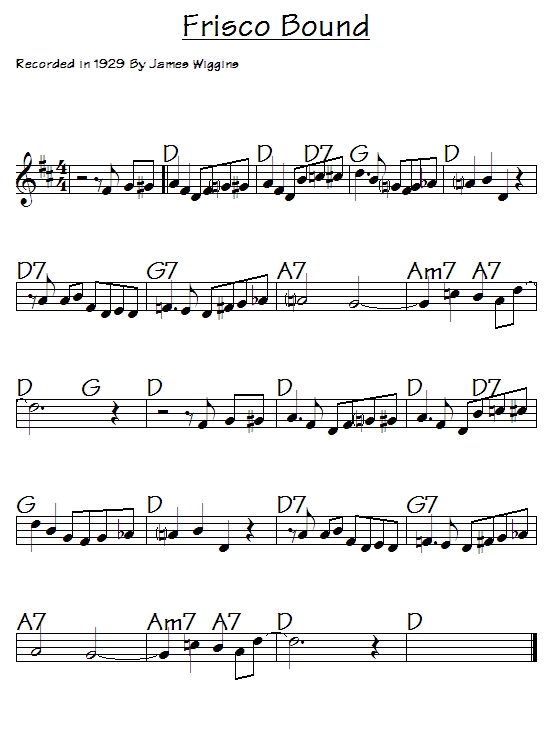
Memphis Minnie seems to have been the composer of Frisco Town (a ten-bar blues) in 1929.  She recorded it with her husband Kansas Joe the same year. Its title rapidly changed to Frisco Bound(This a quite different song from the Frisco Bound composed by Sam Powers in 1915.)

Still in 1929, a recording of Frisco Bound was made by James Wiggins and this increased its popularity.

This song also has recently been revived in its ten-bar form by Tuba Skinny:
Click Here.

How does it come to be a ten-bar blues? Well, if you look closely at its structure, you will see it is really a 12-bar blues, but with the first two bars omitted.

Two choruses here:


In another video of Tuba Skinny, the young musicians may be seen performing one of the 12-bar blues written by Minnie's second husband (Joe McCoy). The singer is Erika Lewis. Enjoy especially at 2 mins 20 seconds (and again later) the descending triplets played by the clarinettist (Craig Flory) in his 'solo' chorus. The song is called If You Take Me Back. You can watch it by clicking here.

By the way, my book about Tuba Skinny is now available. If you may be interested, go to the Amazon Website, click on 'Books', and type in 'Tuba Skinny and Shaye Cohn'.