Welcome, Visitor Number

Translate

Showing posts with label learning to play traditional jazz. Show all posts

19 October 2017

Post 559: TAKING TRADITIONAL JAZZ PLAYING SERIOUSLY - 'GRANDPA'S SPELLS'

When many bands decide to add a new tune to their repertoire, somebody beats it in, and off they go.

The results are often slapdash, with spur-of-the-moment arrangements, and everyone hoping for the best.

Of course it sometimes happens, where the musicians are very talented and listen well to each other, that the result is quite good.

But that great young band in New Orleans - Tuba Skinny - has shown us in the last few years how you need to approach the music more seriously if you are to achieve results that are truly outstanding.

There is nothing slapdash in their approach. When they tackle a new tune, they begin with a clear vision of what they want to achieve. They have a unity of purpose. Every individual is focused on the agreed arrangements. There is no room for compromise. Only the best will do.
A good illustration of this is their 2014 performance in Italy of Jelly Roll Morton's Grandpa's Spells. You can find it at https://vimeo.com/101422951. On the face of it, this is just a merry busking session in a public square.

Yet note the meticulous care that has been taken to present the tune. It is never muddled, despite its complexity. Everybody knows who is to do what, and when. There is no need for printed music on stands in front of the musicians, as we find with many bands playing such a tricky piece. Everybody has taken the trouble to learn what he must do.

Obviously, the band must have studied the original recording by Jelly Roll Morton's Red Hot Peppers in detail, because they follow it closely.

The structure goes like this:

Both bands start in the key of C.

BOTH BANDS
INTRODUCTION
Four bars 'running up the ladder'

BOTH BANDS
THEME A
Featuring guitar breaks and then the cornet

BOTH BANDS
THEME B
Ensemble;
but with the break in bars 7 and 8 taken by the piano (Red Hot Peppers) and by the banjo (Tuba Skinny - not having a piano at the time)

THEME B second time
Clarinet leads throughout, including the break (Red Hot Peppers)
Clarinet leads but washboard takes the break (Tuba Skinny)

THEME B third time 
Trombone and string bass alternate the lead (Red Hot Peppers)
Trombone and Tuba alternate the lead (Tuba Skinny)

Without any need for a signal, there is then a seamless transition into the key of F (occurring at 1 minute 41 seconds into the Tuba Skinny video).

THEME C
BOTH BANDS
Melody (a firm statement stabbing out the notes of the chords) played by the cornet

THEME C second time
BOTH BANDS
Ensemble, featuring the clarinet on the flowing runs

THEME C third time
Taken as a piano solo (Red Hot Peppers) but as a Trombone solo (Tuba Skinny)

THEME C fourth time
Ensemble out-chorus (Red Hot Peppers)
Chorus led by Tuba (Tuba Skinny)

(The Red Hot Peppers version - under 3 minutes in total - ends at this point, but with a neat two-bar coda)

THEME C fifth time
Ensemble (Tuba Skinny - everyone swinging joyously)

THEME C sixth time
Ensemble (Tuba Skinny - again everyone swinging joyously). Simple end. No coda.

Note how nobody puts a foot wrong with the various two-bar breaks. Notice too how even Erika (whose main rôle is as vocalist) gets the bass drum beats exactly right - stopping at those moments when 'silent beats' are required. Notice how there is no need for signals from Shaye, though she gives the slightest indication (hardly required) at 2 minutes 35 seconds that Todd is leading the next chorus.

By the time when I videoed them playing the tune in Royal Street, New Orleans, three years later, (https://www.youtube.com/watch?v=IUICxSTjzPc), they had very slightly tweaked the arrangement, with minor alterations to the structures and playing of the breaks, for example. Have fun spotting the differences. They had added a Coda too.

Obviously, to get all that right, from memory, the members of the band have to put in plenty of hard work in the woodshed. Their dedication is an example to us all.

15 June 2017

Post 517: BEGINNERS' FAKE BOOK

I have written before about the value of fake books (sometimes called 'busker's books') to traditional jazz musicians, especially in the early stages of mastering your craft.

But beware. Some fake books - though crammed with tunes - are not as helpful as you may expect. They contain very few tunes the traditional jazz musician is likely to play.

But you can find less pretentious books that provide the leadsheets (words, notes and chords) of quite a few essential tunes. Such is 101 Pub Favourites for Buskers. Pub favourites tend to be in most cases traditional jazz favourites too; and they are often among the simplest tunes you need to master.
So from this book, for example, you can learn such tunes as After the Ball, You Always Hurt the One You Love,  Ain't She Sweet, Bill Bailey, On a Slow Boat to China, Nobody's Sweetheart Now, I'm Gonna Sit Right Down and Write Myself a Letter, I Can't Give You Anything But Love, and so on. Here, for example, is On The Sunny Side of the Street - as you can see, very clear and easy to learn from. AND it even includes the Verse (which many musicians don't know).
I bought this book way back in 1986, would you believe, when I was at the stage of getting started and trying to play a few simple tunes in a group formed by three friends. It was produced by Wise Publications. There were several others in the '101' series.

I doubted whether these books were still on sale three decades later. But a quick internet search showed me that you can easily still order a new copy for about £18 (i.e., U.K. price) or you may obtain a used copy much more cheaply.
==========
By the way, if you may be interested in reading my e-Book called 'Playing Traditional Jazz', which is for jazz players and would-be jazzers, click here:
https://www.amazon.com/dp/B01MS38JVI
This will let you sample-read a few pages.

28 November 2016

Post 450: JAZZ TUNES - WHERE CAN I FIND THE SHEET MUSIC?

I often receive emails from people who ask me whether I can help them by providing music, usually for particular tunes that have taken their fancy. More often than not, I am unable to do so.

I was also approached after a performance by a young man in the audience who said he was learning the trumpet and asked whether he could 'borrow the music for a few days' so that he could learn the tunes our jazz band had just played. Unfortunately, I could not oblige: the 'music' was in our heads and not on paper.

So, if you are learning to play a musical instrument and want eventually to be in a traditional jazz band, where can you get the music? 

Unfortunately, it is virtually impossible these days to go into a music shop and buy off the shelf a dixieland band arrangement of, say, Maple Leaf Rag, or sheet music for Steamboat Stomp.

So picking tunes up from old recordings by ear is one solution. And it is a method we occasionally resort to.


But if you hunt on the Internet, you can find some sites that will help you. In particular I recommend the site of that fine, generous, Swedish musician Lasse Collin:
If you use Lasse's materials, you will have enough to keep your band going for years. He provides clear lead sheets, giving the melody line and the chords in a simple form. That's just what you and your band need.

Another possibility is to buy buskers' books (fake books). These also provide collections of lead sheets.
Second-hand copies of these are cheaply available on Internet auctions. But be careful to buy those that contain tunes that will definitely be of use in traditional jazz. Many fake books - despite their bulk - contain very little that will be of use to you.

15 November 2016

Post 445: MEETING DAVID JELLEMA, JAZZ CORNET PLAYER

I first noticed and admired the cornet player David Jellema in 2014, when on YouTube I discovered videos of The Thrift Set Orchestra, which is based in Austin, Texas. David was playing some fine music in the company of other outstanding musicians - among them, Albanie Falletta, Westen Borghesi and Jonathan Doyle. If you don't know this group, you may sample one of their performances BY CLICKING HERE.

But I didn't meet David until 20 October 2016 when, during a very brief visit to New Orleans, I literally bumped into him. I pushed open the door to the Yuki Izakaya Bar in Frenchmen Street, and David was immediately on the other side. He was guesting in Haruka Kikuchi's Band.

During the interval, David kindly and generously joined me for a very interesting chat.


In particular we discussed how he goes about mastering tunes and improvising upon them. He felt that, although it is obviously crucial to know the tune's melody and its chords, it becomes more important to internalize those elements (relegating them to the subconscious through repetition and practice - to the point where you would be able to play the song even in an unfamiliar key). With the music thus internalized, the conscious mind can be free to engage with the immediate demands of the performance in the present, i.e., listening and responding to the other musicians, making split-second choices within a solo, etc.

Beyond mastering the scales and arpeggios of chord shapes and inversions in all keys, David said, what is most important in developing jazz improvisational language, style, and a personal voice is to study many masters (by copious listening, transcribing, and copying their solos and licks) in order to let their influence percolate into your playing as you mature into your own voice.   The music you most love will help inform and shape your first steps towards developing your own improvisational style. In his own case, he said the most important master had been Bix Beiderbecke.

I was not surprised. In his fluency, creativity, attack, tone and technique, David's playing always reminds me of Bix.

But here's something astonishing. David plays a cornet that is over 120 years old; and he still gets a beautiful tone from it. The cornet is an 1893 English Besson, a vintage 'Prototype' (serial number 48XXX). David knows that F. Besson was at the time located at 198, Euston Road, London; and that the instruments were distributed in the USA by Carl Fischer of New York. David bought this cornet from an antique store in Annapolis, Maryland, in the 1990s. As the US Naval Academy is based in Annapolis, David surmises that the instrument may originally have been played by someone in the Navy band.

After a few years, David passed the cornet on to his friend Dave Sager, a jazz trombone player in the DC area. Mr. Sager spent a deal of money in having it brought back to a pristine condition. Since about 2011, it has been back in the hands of David Jellema:


and from the other side:


But David has four other very special cornets, including a Conn from the 1890s. I hope - with David's help - to write an article about them for publication early in 2017.

I remember hearing the late great British jazz trumpet-player Humphrey Lyttelton say that some instruments (such as Stradivari violins) improve with age but that brass instruments begin to deteriorate from the first time they are played and go on getting worse.

Well, David's cornets seem to discredit that theory. Or perhaps it is simply that they really knew how to make solid and enduring brass instruments in the Victorian Age.

11 October 2016

Post 436: YOUR LOCAL BAND NEEDS YOU!

The world of traditional jazz desperately needs more musicians - especially young ones. I have written on this subject before (about three years ago) and hundreds of people read the article, so it seems to be a topic worth considering again.

Would you consider playing in a traditional jazz band? How should you go about it?
You must start by reaching a reasonable level of technical proficiency on your chosen instrument. If you are a complete beginner, you will need lessons to get you started, mainly to set you up with good habits. I would recommend finding a qualified professional music teacher rather than someone who happens to play traditional jazz. (Players do not necessarily make good teachers.) Make sure you learn about scales, keys, chords and arpeggios and it will help if you learn to read music, at least at a basic level. After that, practice will be your main pursuit.
If you are already a competent musician, it does not follow that you will move easily into traditional jazz. Good piano soloists sometimes find it hard to adapt to their rôle in a band. Teamwork is the key to success in traditional jazz and players of the piano, guitar and banjo have to accept that for most of the time their job is simply to lay down the correct chords, firmly and clearly, rather than display virtuoso skills.

The one exception may be highly-skilled double bass players. If they are willing to adjust to the style and hardly use the bow at all, they can contribute extremely well with nothing more to guide them than the band's chord book. I remember how, during the 1950s, there were some double bass players, members of the symphony orchestras based in London, who would finish a concert with their orchestra and then head to a jazz club where they would join a traditional jazz jam session. It was easy enough for them to jump from Handel to Handy and from Mozart to Morton.

Becoming good enough to perform traditional jazz in public doesn't mean passing lots of exams. But be warned: it can take hundreds of hours of hard work in the woodshed.

You should start early on learning some tunes from the traditional jazz repertoire - easy ones to begin with. Laissez Les Bons Temps Rouler is a particularly good and easy one as it is fun but uses very few notes and virtually only two alternating chords.

Soon you could try Algiers StrutTin Roof BluesWhen The Saints Go Marching InCareless LoveDown By The Riverside, and Lily of the Valley.
There are plenty of sources of printed music, such as busker's books. But an excellent site you should consult is Lasse Collin's, where there's enough to keep you going for years: CLICK HERE TO VIEW.

And here's an important tip: when you first learn a tune, make sure you learn it accurately. If you get into a habit of playing a phrase or a sequence of chords wrongly, it is very hard to unlearn them later, after the tune has become embedded in your brain and fingers.

Develop an understanding of and fluency in different keys. Those most commonly (but by no means exclusively) needed in traditional jazz are Bb, Eb and F. Next most common are Ab and C.

Listen to lots of traditional jazz - especially noting the part played by your chosen instrument - to get a feel for what is required. Use the wonderful resource of YouTube. When you are ready, try playing some tunes along with bands on YouTube. That's almost as good as 'sitting in'.

A similar idea is to play along with backing tracks. Some of these are also freely available on YouTube. This will give you a great chance to assess your progress because, if you are confident and not discordant with a backing track, the chances are you will fit in with a jazz band.

Link up with other musicians. Maybe you can form a band in your town, starting with a nucleus as a trio or quartet. Meet regularly in one of your houses to rehearse and expand your repertoire.

How do you find these musicians? Put the word around among all your friends and acquaintances. Chat in the local music shop. Advertise in the local newspaper. See whether anybody in a social group is interested (e.g. in England, the U3A). There may be a regional website on which you can seek (free of charge) other musicians.

Listen to live traditional jazz bands and talk to the musicians: they are very good sources of information about both learners and established players in the area and may be able to put you in touch with people who could join your group.

For information on which bands are playing where, there is probably a regular publication you can consult. For example, here in England we have the monthly Jazz Guide - available in clubs and from bands and also by post if you pay the very reasonable subscription (payments by PayPal are accepted). You should be able to see a sample page and full information by clicking HERE.

And specifically for the North-West of England, a gentleman called Fred Burnett altruistically runs a website giving full bulletins concerning jazz in his region: click here.

When you feel ready, begin to practise more challenging and more complex tunes: there are hundreds in the repertoire.

Unless you are a born genius, you will need to learn the standard chords and also practise improvising your way though common chord progressions. In particular, work on the Circle of Fifths and The Sunshine Sequence and the basic 12-bar Blues Sequence as these will be useful in hundreds of jazz tunes. If you don't know what I mean, look at the blog posts in which I have written about them.

Are you worried about improvising? Watch Charlie Porter's excellent videos. For an example CLICK HERE.

When your group is good enough at fifteen or so tunes, start playing gigs! You can give your band a name and offer yourselves for free to a local pub or residential home and get your band officially launched.

Also, when you have built up confidence by playing along with YouTube, ask whether you may sit in for a couple of tunes with an existing band. Most bands are so keen to keep the music alive that they readily give opportunities to anyone who shares that mission.

Make sure you give your telephone number and email address to everyone who may be able to help you in the future - especially band-leaders. It may be worth having some business cards printed.

Band-leaders and agents keep lists of musicians within a radius of seventy miles. You never know when you may receive a call to deputise for a musician who is ill or on holiday.

Eventually you may succeed in obtaining a place in a reputable well-established band. There is a rapid turn-over of personnel and a need for new blood, especially these days when many elderly musicians are hanging up their trumpets and clarinets.

Most of today's traditional jazz musicians have gone through the stages I have described above, except that in their day they did not have the enormous benefit of YouTube and such sites as Lasse Collin's to help with learning and training. In years gone by, players had to listen to records and later to cassettes in order to pick up tunes by ear and learn from the masters.

18 February 2016

Post 393: JAZZ IMPROVISING FOR BEGINNERS - TRY THIS

I receive many emails from readers who tell me they are in the early stages of trying to play traditional jazz. They ask whether I can help them.

Unfortunately, I am no great expert and certainly not a music teacher. I tell them there is quite a lot of help available on the internet (such as Lasse Collin's site and Charlie Porter's videos) and I have referred to these in several of my articles.

These emailers tell me they hope one day to play in a band but at present they are mastering their instruments, and learning tunes and chord progressions.

Maybe you should start by watching this excellent little video, which makes very clear how the trumpet, trombone and clarinet can improvise collectively:
CLICK HERE TO VIEW.

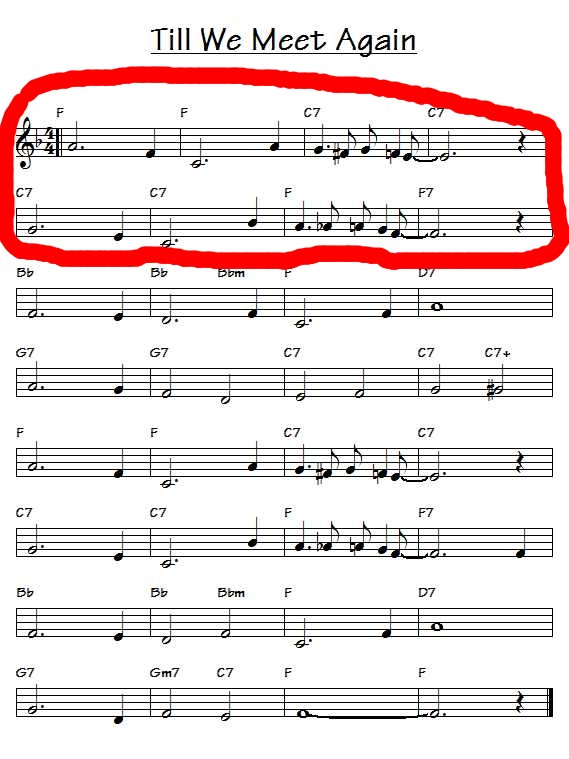
While I was listening recently to a performance of Till We Meet Again, it occurred to me that I could at least recommend this super tune to you as something on which to practise.

Why?

Well, for a start you can take it quite slowly. Next, it includes two essential basic chord progressions that will turn up in very many tunes, so you need to feel comfortable improvising over them.

First you need to look at what goes on in this tune. So let's consider it, in the key of F.

We discover that it is a 32-bar tune (the most common type of all) and it is structured ABAB (each letter representing eight bars).

So you have two 'A' sections that are pretty much identical. These eight bars (marked in red below) use one of the most common chord progressions:

I    I    V7    V7    V7    V7    I    I

This movement from the tonic chord to the dominant and then back is found in very many tunes.


The F7 in the eighth bar leads perfectly into the Bb chord of Bar 9.

The 'B' sections use The Sunshine Chord Progression (also used in dozens of tunes). I have written about The Sunshine Progression in several articles. For example, click here to read one. Every jazzer must get the The Sunshine Progression into his fingers - in a range of keys.

In the first use of this progression, Bars 15 and 16 hold on to the dominant 7th (C7) rather than resolve completely to the tonic. The purpose of this is to lead back to the melodic theme all over again in Bar 17.

But when we reach the final eight bars of Till We Meet Again (B for the second time) we find the full Sunshine Progression - ending on the tonic to round the tune off perfectly.

So here is the full chord chart (in F):
Now: how about improvising? A simple way of creating an improvisation is to use this chord chart [F   F  C7   etc.] and simply play notes from the relevant chords as you go along. Basic arpeggios to begin with. For a beginner, this is not easy. That is why it helps to work with a slow tune such as this: it gives you time to think.

Don't forget that if you are a Bb or Eb instrument, then the Concert key of F will become G for you (Bb instruments, i.e. most trumpets and clarinets) or D for you (Eb instruments).

To give you some idea how this improvising-on-the-chords business works, I put the tune into Band-in-the-Box and then let my computer play it while with my cornet I tried to play notes from the arpeggios of the chords. I mostly used notes above the melody, in order to avoid clashing with it. To watch my attempt - or play along yourself - CLICK HERE.
Till We Meet Again was composed in 1918 by Raymond Egan, with words by Richard Whiting.

...............................
FOOTNOTE
The book Playing Traditional Jazz by Pops Coffee is available from Amazon.

8 February 2016

Post 383: 'PUT ON YOUR OLD GREY BONNET'

Put On Your Old Grey Bonnet was composed as long ago as 1909 by Percy Weinrich and Stanley Murphy. It's one of those 'Good Ol' Good Ones' that has truly stood the test of time. It is still popular with the traditional jazz bands of today.

However, versions of this tune by jazz bands on YouTube are mostly disappointing and they nearly all omit the excellent trotting verse. When I was in New Orleans in April 2016, I heard one of the best bands giving an exhilarating performance that included the Verse. Sadly, I was not videoing at the time.

But there is a historic (non-jazz) recording that is interesting to study: you get the full works, plus the lyrics: Click here to listen. In this version, the Verse is in G; the Chorus in C.

It's a super number for any band but I would specially recommend it to learners because - if you play the Verse as well as the Chorus - you have two good tunes for the price of one. Also, it is fairly easy to play and improvise on.

The Verse (32-bars structured AABA) uses the simple I-II-V-I chord progression (known as The Four Leaf Clover Progression) for the three 'A' sections. And the Middle Eight is basic too: II7-V-II7-V-VI7-II7-V7-V7.

The song changes to the related key (in effect, dominant to tonic) for the Chorus. This is the part on which musicians improvise. There are only sixteen bars and the Progression is straightforward (Think The Apple Tree Progression [I-IV-I] and The Four Leaf Clover Progression again).

Here is the tune. This is shown with the Chorus in Concert Bb - the key generally used in traditional jazz because it is the most comfortable for players.

19 December 2015

Post 333: REHEARSAL AS PERFORMANCE - INSTANT JAZZ!

How do those big street groups in New Orleans (sometimes 15 players or more) produce such good music in their 'superjams' even when some members of the band don't even know the tune a few moments before they play it?

Answer: they learn mighty fast!

We are given an insight into this process on YouTube by the great video-maker digitalalexa.

In less than forty seconds at the start of this video, a banjo player picks a tune - Who Walks In When I Walk Out, gives the others an outline of the chord sequence ('G minor... B.... Breaks on Bb...' etc.) and how they will tackle it; and off they go. No problem. Enjoy it


And there's another delightful Blues in F video from this same performance - one in which Erika Lewis gets a couple of babies interested in playing the mini-piano. Watch it
by clicking here. See them even take a chorus at 4 mins. 10 secs.!

By the way, if you would like to play Who Walks In yourself, here it is:


7 November 2015

Post 296: OUR MUSIC IS CHAMBER MUSIC?

I have been interested for more than thirty years in the presentation of acoustic performances by small music groups. I listen to and play in traditional jazz bands and I also attend chamber music concerts (especially those given by string quartets). So I am offering the following questions and my personal answers to them as food for thought.

What do chamber musicians and jazz musicians have in common?

They play one to a part and their music is not popular with the masses. Playing a type of music that does not attract large audiences, they do not make a fortune.


Why do we choose to be ‘unpopular’?

We take pride in being miniaturists. We like hearing music played acoustically. It is easier to appreciate details. The noise level is bearable. There are delicate textures. We better appreciate the drama of the music’s dialogue. The individual players - playing just one to a part - are more free to express themselves.

Does such a group need a leader?

Do not be too democratic. It is helpful to have a leader (or to take turns at being leader). It may help to have two leaders – one who manages bookings and one who 'directs the traffic' of the music.

Do we need to get on well together socially in order to make good music?

It helps, but is not essential. Musicians who do not get on well socially sometimes make wonderful music together. Conversely, musicians who get on well sometimes make a poor job of performing. 

How can we give a decent performance if we are just starting out and some of our players are inexperienced?

Choose repertoire within your capabilities. Then, however limited the players' abilities, aim to make the whole greater than the sum of the parts. This means not just playing the notes; it means concentrating on teamwork and interpretation.

Can we get away with practising alone, or should we often rehearse as a group?

Group rehearsals are essential for chamber music; and many jazz groups would be more worth listening to if they rehearsed together more often.

How can we ensure that practice brings improvement?

Do not use much time playing pieces you already know well. Seek new challenges; and focus on the mental as well as the physical. 

How do we get bookings?

The following methods may help - but not much: the Internet, Leaflets, Small Ads. Agents may be helpful but should be treated with caution. Being seen and heard (for example, busking in the street) is the best form of advertising: one performance leads to another. Next best is word-of-mouth. 

How should we dress when giving a concert?

For most venues, a group should look good and adopt a unifying style, even if this means some formality. Individuals have to forego personal preferences for the good of the group.

How can we win over our audience?

It is essential to keep in your mind that your listeners are giving you two hours of their precious time. So you owe it to them to communicate well. Look involved and interested. Smile. Speak to them: they love information. Your programme should be balanced and should match the needs of the audience. Don't be too esoteric and don't risk a built-in fidget ingredient. Welcome feedback and learn from it.

If we develop a good programme, can we be sure it will always work?

Don’t be surprised when you discover that no two audiences are the same. Every audience acquires its own collective mood. A piece of music that is received enthusiastically by one audience may fail completely with another. Also, you must never take seriously anyone's promise that all the seats will be sold!

Should we use microphones and amplification systems?

Wherever possible, play acoustically. Instruments carry surprisingly well, even in large halls.

Will a piece of music become stale if we play it often?

Staleness may set in eventually, but not for a very long time; and during that time, you play the piece better and better. Do not complain when asked to play a piece you have played a hundred times before. You must please the paying public. 

How should we relate to the people who help put on our concerts?

Support in every way the entrepreneurs, promoters and sponsors who give you opportunities to play, who publicize events and attract the audience. They rarely have much cash to play with.

Will the piano be in tune?

Expect pianos to be unsatisfactory even if they have allegedly been tuned recently. Regrettably, it is best to have your electronic keyboard in the car.

Should we make a CD?

If it gives you pleasure, fine; but you are unlikely to recoup the cost. Also, recording will highlight mechanical noises, coughs, unwanted resonances and especially errors; and a good balance will be hard to achieve. So think twice before making a CD. ‘Demo’ recordings should not be necessary and are unlikely to pay for themselves.

How should we arrange the performers at a public performance?

If you have enough space and not too many players, go for an ‘arc’. A well-known jazz musician friend of mine wrote this after first trying this arrangement: ‘The difference when playing in a semi-circle was amazing. I could hear every instrument, and see everyone. More importantly, I could see all signals. I feel that, where possible, it is a good formation for a 4/5 piece band. Also, the audience can see everyone too!’

19 October 2015

Post 279: HISTORY OF WISBECH, CAMBRIDGESHIRE

I was born in London in the 1930s and spent the first 22 years of my life there. I well remember sleeping in the Anderson Shelter at the bottom of the garden during the World War II bombing and doodlebug raids.

But I later lived for almost 40 years in Wisbech. It was there, at the age of about 45, that I started to take an interest in traditional jazz and began a long, slow struggle to master jazz playing on the trumpet. I was encouraged along the way by many good musicians, most of whom sadly have since died. They helped me to learn and they allowed me to sit in with their bands.

The early stages involved building up some strength in the lips and also learning by heart (from sheet music or records) as many tunes as I could. My playing was pretty basic; and it was a long time before I began to understand the importance of chords and to study them and their sequences.

One of the musicians who helped me in those early days was Gerry Birch (sousaphone) who had a music shop in Norfolk at the time and who is today still playing in bands in Kent. Another was Sean Moyses. He was still at school in Wisbech and was already a great banjo player. Sean formed his first little group The Symphonic Hot Five, with me on cornet.
Sean's Mum was on Percussion and Vocals
Today, of course, Sean is one of the great internationally-renowned jazz stars.

As I developed, I played in The Nene Valley Stompers (a six-piece operating mainly in Norfolk). This band was fairly active in the early 1990s.

Later, I moved to Nottingham, where I now live very happily in my old age and where I have been accepted in the local traditional jazz scene, with various opportunities to play or deputise in the region's bands.

But just in case you may be interested to learn a little about Wisbech, where I spent all those years, I will tell you about the town's history. (This has nothing to do with jazz, so stop reading this article now if it's unlikely to interest you.)

Wisbech Town Centre, 2002
Wisbech is a small market town in Cambridgeshire,  England. It is situated 100 miles north of London.
When you look into the subject, the study of Wisbech’s past quickly becomes intriguing. The ancient buildings have a fascinating (and sometimes unfathomable) history. The rise and fall first of the port and then of the railway make absorbing stories. Everywhere, there are curiosities. Even local street names are fossilized history: Gaol Street with no gaol; Station Road with no station; a ‘School Lane’ that leads to no school; Octagon Drive with no Octagon; Turnpike Close with no Turnpike; ‘Oil Mill Lane’ with no Oil Mill; and ‘Roman Bank’ – a road alongside the river, presumably where possibly the Romans strengthened defences against flooding.

How did Wisbech get its name? Nobody knows for sure. Certainly, BECK in Anglo-Saxon meant 'stream', and there is not far to the east of Wisbech a River Ouse and a little further a River Wissey. The Ouse or Wissey or both, with their tributaries, flowed into the wide estuary of the sea which a thousand years ago came right up to Wisbech. So 'Ouse Beck' or 'Wisse Beck' became 'Wis - bech'? Possibly.

The river today running through Wisbech is actually called the Nene. It once split into two at Wisbech, one section heading south (to Outwell and then west to Whittlesey and Peterborough) and the other – the medieval ‘Great River of Wisbech’ - heading west (directly to Peterborough, where the two courses met up again). In the late Twentieth Century, the division of the river running south (known locally for hundreds of years as the ‘Well Stream’) was been filled in from Wisbech to Outwell and a road built over part of it at the Wisbech end.
You have to picture the region round Wisbech long ago as flat and swampy, containing goodness knows how many waterways - all of them from time to time obstructed by silt and sand while trying to escape to the nearby sea. By about 1300, the Ouse and the Wissey, with their courses increasingly blocked, found those new outlets several miles east of Wisbech: the Wissey now runs into the Ouse, which itself enters the sea at King’s Lynn. This - and the construction of Morton's Leam - left the southern branch of the river out of Wisbech much drier. That is the reason why it was eventually filled in during the Twentieth Century. Morton's Leam (cut from Guyhirn to Peterborough between 1479 and 1486 under instructions from Bishop Morton) is an important ‘drain’ running roughly parallel to the present River Nene.

Today, of course, the whole expanse of flat land is drained. Very far around Wisbech, you can hardly travel anywhere for more than a mile without crossing a man-made dike (narrow canal).


Wisbech was four miles from the North Sea until about 1300. The silt has left it eleven miles from the coastline today. So the River Nene now heads almost due south from the sea ('The Wash') about eleven miles to Wisbech, where it forks off to the west and eventually reaches Peterborough and Oundle.


The first reference to the town appears in a Charter attributed to the Saxon King Wullfere in the year 664. The Charter is not generally accepted as genuine; but in or about the year 1000 the Saxons Oswy and Leoflede gave the Township to the Monastery of Ely (Ely with its magnificent cathedral is 22 miles away) by a document of recognised authenticity.


There have been several bridges over the River Nene. There was a stone bridge in 1758 but it had a high camber. In November 1852, it was weakened by flood damage which also carried away part of the Nene Quay. The stone bridge was replaced by an iron bridge, twenty yards west of it. This existed from 1857 until 1931, when it was replaced by the present concrete bridge (constructed alongside the site of the iron bridge). With increasing traffic, a second bridge became essential and this (the Freedom Bridge) was built in 1971. Between the present two bridges, on both sides of the river, are seventeenth- and eighteenth-century warehouses which were so important in the days of sailing ships, when as many as forty ships could be unloading at any one time. These warehouses have mostly been refurbished recently as flats.


The authorities in recent years have tried to revive interest in the river by developing a marina, or yacht harbour, north-east of the Freedom Bridge. Typically, one sees about twenty private boats moored there.

The position of Wisbech at the outfall of the fen rivers was of paramount importance. At some time before 1086, William the Conqueror had a castle built in Wisbech to command the entrance from the sea to the fens. The castle was held and garrisoned by the Crown, and was visited by King John in 1216, a year after the Magna Carta was extorted from him by the Barons. He was pursuing his lightning march through the country at the head of his mercenary forces, burning, ravaging and destroying with terrible ferocity. On 16 September, he was at Lynn; two days later, he set out for the north, passing the night in Wisbech Castle on his way. But he attempted to travel across the wetland swamp without waiting for the ebb tide and thus lost his army, his baggage train, his treasure, and (so it was said) the crown. He reached Sleaford on 14 October with his surviving followers, was stricken down by dysentery and died two days later.

By the way, there are now some delightful videos on YouTube about the history of Wisbech - especially the Castle and the the old railway line that used to run to Upwell. I recommend them. You could start with this one:

http://www.youtube.com/watch?v=ickWlkfYcrc

A great advantage Wisbech gained from its position was that it became a port through which ships could sail to Ely, Peterborough, Cambridge and other inland centres, laden with merchandise and heavy goods, at a time when roads, so far as they existed at all, were only too often mere tracks, dangerous in summer and almost impassable in winter. The network of fen waterways made it possible for ships and boats to pass with facility in every direction.

When the fen rivers found a fresh outfall at Lynn, that town gained at the expense of Wisbech; but despite this, the silt that ruined the town's port also brought benefits: the great quantities of silt and sand brought up by the tides spread themselves over the lands on either side of the river. The valuable silt farms for which the countryside is noted owe their existence to this event. Ultimately Wisbech became an important market town.


At the Norman Conquest, the population of Wisbech was small, but it carried on an important fishing industry. Boats brought back herring, codling and other fish, much of which was salted down for winter use; but of still more importance were the eel fisheries. (‘Ely’ comes from ‘Eel island’.) The manors of Wisbech, like the other manors within the Isle of Ely, were in the hands of the Monastery of Ely.Th
e oldest Wisbech building still in existence today is St. Peter's Church, which was built, according to tradition, in the year 1111. No traces of an earlier Church on the same site have been found.
What is now known as the Old Market (North of the river) was in ancient times the only market place of Wisbech; but, after the building of the Castle (South of the river), houses and shops appear to have sprung up in the neighbourhood beneath the shelter of its walls; and a new market place was established – and is still the town’s main ‘Market Place’ (featured in the photos at the start of this post).

It would naturally follow that St. Peter’s Church should be built adjoining the Castle moat, where it now stands. It was built at a time when church builders planned on an ample scale but it was not very long before it was found inadequate, partly, no doubt, owing to the growth of population. The chancel was first lengthened and widened after which much of the splendid Norman arcading in the north aisle was taken down for the purpose of extension; but further building at that time was abandoned, and the remaining Norman pillars thereby obtained a reprieve and are now the subject of general admiration.

The Church is remarkable for its double nave, covered by a single high-pitched roof and ceiling. It contains some exceptionally fine monuments, and on the chancel floor the effigy of Sir Thomas de Braunstone, Knight, Constable of Wisbech Castle, 1401. This brass is one of the largest in England.

The imposing old vicarage of this church, having been replaced by a modern house, has become municipal offices. It is the place where people now go to pay their council tax or to register births and deaths.

One of the treasures of the Wisbech Corporation is a manuscript containing the records of the Guild of Holy Trinity. There were several guilds in Wisbech at different times, some of them indeed of earlier date than the one mentioned; but the guild in question was destined to have a decisive influence upon the history of the town. The guild was founded in 1379, and from the very first it received wide support including that of the principal townspeople, and, indeed, the support of a number of the chief inhabitants of the surrounding district. Primarily religious in its conception, it also helped to relieve the guild brethren in poverty, sickness or infirmity, or for loss of goods by fire, robbery or floods. The guild hall was in Ship Lane, as it was then known, approximately on the site now occupied by the Empire Theatre. In quite early days, the Guild established and maintained a school, the precursor of the Wisbech Grammar School. In 1547 all guilds, fraternities and charities (with a few exceptions) were suppressed by Act of Parliament, their valuable work for so long continued was brought to an abrupt ending, and their endowments vested in the Crown.

There was, however, a remarkable sequel. Supported by the Bishop of Ely, the inhabitants petitioned for the vesting of the lands in the leading townsmen, and 616 acres were accordingly handed over upon terms which were undoubtedly moderate, namely the payment of £260 10s. 10d.

On receipt of this sum, the Crown granted the property to the inhabitants, and elevated the town into a corporation on 1 June 1549, with a common seal and the right to hold lands. The possession of these lands, and the steadily rising income which they brought in as rentals, placed the finances of the Corporation on a solid basis and enabled them to go ahead without being unduly hampered by pecuniary difficulties.

The government of the town was thereafter to be exercised by ‘Ten Men’ to be elected by the inhabitants; and provision was made for one schoolmaster who was to be paid £12 and 8 shillings a year. The ten men also had control of the town's port. There was no mention of a Mayor in the Charter; but the 'Bailiff' became the Mayor as from 1835; 'Aldermen' and 'Councillors' at the same time replaced 'Capital Burgesses'.

A further charter was granted in 1611 by James I, extending the scope of the first one.

For about a hundred years after the great flood of 1236 the Castle seems to have been held by the Crown and subsequently by the Crown and the Prior of Ely jointly; and about the middle of the Fourteenth Century it was granted to the Bishop of Ely. Bishop's courts were held there and felons incarcerated. The Castle fell into disrepair in the Fifteenth Century. Under Elizabeth I, it was used as a prison for about 35 Roman Catholic recusants; and over a period of 40 years, there were several escapes.

The Bishops held the Castle until the Civil War, when it was seized by Parliament and sold by them to John Thurloe, Secretary to the Council of State, and head of Oliver Cromwell's secret service. Thurloe demolished the Castle and replaced it with a fine building after the style of Inigo Jones, which he completed just in time for it to be forfeited to the Bishop of Ely upon the Restoration of Charles II.

The house was sold to Joseph Medworth of Bermondsey, London, in 1793 for £2305. Whatever remained of the original castle (apart from some interesting underground tunnels, which can still be visited to this day), had by now been destroyed; and Medworth erected a fine Georgian house there in 1816 - the house which is still known as 'Wisbech Castle' and which is occasionally used for filming purposes. 'David Copperfield', for BBC television in the 1990s, is an example. It was Joseph Medworth who also developed the Georgian ‘Crescent’ round the castle – just inside where the medieval moat must have been.

Museum Square and the latest 'Wisbech Castle'.
Near the Castle is a narrow passageway called Love Lane. It contains five one-storey almshouses (now renovated), provided in 1813 by Joseph Medworth, who had himself once been a Wisbech charity boy.

Wisbech Market Place – the one which developed outside the wall of the castle - has been in operation since the Twelfth Century. There was long ago a Shire Hall on the Market Place. By 1492, there were 115 tenants of the Bishop living around the Market. Saturday Markets (still held today) are known to have existed at that time.


A local priest complained in his diary that a 'noisy and riotous crowd' had misbehaved at some festivity in the Market Place, with 'the inevitable overthrow of all modesty and good morale among both sexes in the lower walk of society'. (I recall that in the 1990s, the young thieves and vandals smashed randomly-chosen shop fronts on Saturday nights - week after week after week. Shopkeepers were being driven out and several shops were boarded up and abandoned.)


Three thousand people attended a feast in the Market Place in 1814 to celebrate peace after the Flanders War (this was before Waterloo).


Wisbech is perhaps unusual in having TWO market places. While the Market Place on the south side is rectangular and large, that on the north side is relatively small with a shape vaguely triangular. Amazingly, this was already referred to as the ‘Old Market’ as early as 1221, in a deed now in the British Museum. The Old Market is now mainly used for car parking. The fine Georgian buildings around it testify to the golden days of the river trade.


One of the attractive buildings alongside the Old Market was the Octagon Church. I know it only from photographs. I am told it decayed and became dangerous. It was closed for ever in 1946 and later pulled down and replaced by a bank. Built in 1831, this building - styled on the Octagon of Ely Cathedral - was used as a chapel of ease.


Hundreds of lives were lost in and around Wisbech during the Great Flood of 1236. And in 1613, floods turned Wisbech into an island. Other notable floods have been in 1308, 1316,1327,1334, 1337, 1570 and 1571. Much of the English coastline was damaged by great floods in 1953 and again in 1978. On both occasions, the area near Wisbech Docks (temporarily) suffered badly.


The river never freezes in modern times; but it used to. In 1763, there was a skating race along the river from Wisbech to Whittlesey. The winner completed the course in 46 minutes at an average speed of 15 miles an hour. The River Nene today is about thirty yards wide where it flows through Wisbech; hence the need for bridges. However, in 1751, it was so silted up that people were able to get across on foot and vessels had to unload much closer to the Sea. Straightening and embanking improved matters over the next fifty years.

In bygone times, when Fenlanders suffered badly from the swampy conditions and contracted rheumatic and respiratory diseases, they would combat fevers by smoking cannabis - the dried leaves of the hemp plant - which at the time grew profusely.

Fen people objected to the drainage schemes of the Sixteenth and Seventeenth Centuries because they knew the population of wildfowl would be reduced. Wildfowling was a big industry. So Fenmen would not help with digging the many drains, dikes and canals with which the region is now criss-crossed. The work was done by gangs of Dutchmen and prisoners of war.


The best year ever for the Port of Wisbech was 1847, when 167,442 tons of cargo were recorded. By 1910, the figure had fallen to 89,333 tons, but this still involved 594 vessels. Today, it is unusual if more than one of two cargo ships dock each week.

Richard Young (1809 - 1871) was Wisbech's leading ship owner. He had 43 ships. His speciality was shipping coal from Sunderland to Wisbech. (Wisbech’s other major shipping import was timber from the Baltic.) He had a magnificent house (the three-storey Osborne House) built for himself near the river. Young was the Mayor of Wisbech between 1858 and 1862. Later, he became a Member of Parliament (but for South Cambridgeshire, not Wisbech). His pride and joy was a ship called 'Lady Alice Lambton'. It was used on 9 August 1853 to take 800 people on a day trip to the mouth of the Humber.


The population of Wisbech is estimated to have been 2000 in 1700. The Census of 1801 shows the figure by then to have risen to 4710. The coming of the railways to Wisbech in 1847 (incidentally doing great damage to the trade of Wisbech Port) had a striking effect on population increase. The creation of railway stations led to the development of many new roads and dwellings, usually near the stations themselves. In 1861, there were 9272 inhabitants and by 1931 the figure was 12006. The population of Wisbech today is about 20,000. As a shopping centre, the town serves twice that number, because it is visited regularly by the inhabitants of the many surrounding villages in Fenland, Cambridgeshire and also neighbouring Lincolnshire and Norfolk.


By 1848, Wisbech had two railway stations. The main station on the South Brink connected with March Town, and so to Cambridge and London. The other station became known as Wisbech East and connected with King's Lynn.

1866 brought another station, this one in Harecroft Road, on the north side of the river, about a mile from the town centre. Trains from here went cross-country in a westerly direction, serving a number of villages.


In 1884, the Great Eastern Railway opened a branch line known as the 'Steam Tramway'. As you may have seen if you watched the video I recommended, it ran from Wisbech alongside the Well Stream already mentioned, to the village of Upwell (seven miles south of Wisbech). I believe it was this line that inspired the local vicar and author Rev. Awdry to produce his 'Thomas the Tank Engine' series of children's books. Passengers were carried on this line until 1928 but it could not make a profit. One of the original coaches is now in the Cambridge Museum of Technology. I remember the last vestiges of the line but they have all been taken up now and much of the former rail track land (still quite distinctive in places) has been built on.

So at one time, there were four passenger railway lines running out of Wisbech. Now the town has none, though the old tracks that linked it to March still exist. Branch lines which used to feed the villages around Wisbech have all gone, though I always find it moving to see evidence of them - pubs with such names as 'The Locomotive', or Station Road, or old gates that were obviously part of railway crossings. Just occasionally, you come across a signal box that has been converted to some other purpose, but most have been pulled down.

Even in the days before the railway, it was reasonably easy to travel to London, which is about 100 miles south of Wisbech. In the 1770s, for example, you could go in the mail coach which left daily at 4pm. The fare was twenty-five shillings (inside) or half-price outside. Or you could travel in the stage coach which operated on three days of the week (eighteen shillings inside; nine shillings outside).

The pioneer photographer Samuel Smith (1802 - 1892) lived on the outskirts of Wisbech, in the village (or rather suburb) called Leverington. Just a decade after the invention of photography, he set up as a photographer in Wisbech. One hundred and ninety of his negatives are in the Wisbech Museum. The importance of his work was not fully recognized until an exhibition of it was given in London in 1973. A book of his photographs has been published, showing many daily scenes in Wisbech one hundred and fifty years ago. In those days, long exposures (fifteen minutes!) were needed, so he had to persuade people to keep very still while they posed. Often he would set the exposure going and then walk round to get into the picture himself. Usually, with his street scenes, the roads look completely empty. This is because people would walk past and not be seen for long enough to be picked up by the camera! Here is such a picture from 1857.
Smith was also a collector of shells, coins, insects and geological specimens. He did much work for Wisbech Museum in its early days, even making cases and arranging displays.

Wisbech has had a Post Office since 1793. The first was in Upper Hill Street. In 1851 it moved to Cornhill. There is a Samuel Smith photo of Mr. Goward, the Post Master, standing outside this office in 1854. In 1887, the Post Office moved to its present site in a pseudo-Gothic building, near the river and facing the Clarkson Memorial. There has been a telephone service in Wisbech since 1898.

A curious thing happened to the local economy in 1823. Wisbech Corporation was forced to make massive financial cutbacks. (How history repeats itself!) They made a plan to reduce the number of street lights from 237 to 37 and also to make several watchmen and 'scavengers' redundant. We do not know whether the plan was thoroughly carried out.

The history of formal education in Wisbech is interesting and exemplifies the developments that occurred in country towns throughout England before the great Education Acts of the Nineteenth Century.

But before going back further, I must give one detail of personal interest to me. During the Second World War, the boys from The Stationers' Company's School in North London were temporarily evacuated to Wisbech and educated there. I missed this experience, as I became a pupil at The Stationers' Company's School a little later.

We have some figures for Wisbech's early school rolls. In 1710, Wisbech had 50 boys and 40 girls attending its two schools. There were also some 'dame' schools. By 1798, there were 250 boys being taught reading, writing, arithmetic and catechism, while 30 girls were receiving lessons in reading, sewing, knitting and - yes - catechism. In those days, a child attended such a school for just three years.

There were other schools. The Unitarian School in Deadman's Lane was established in 1803 and took up to 240 boys.

The girls' school was at the junction of Lower Hill Street and Nene Quay: 'Lower Hill Street School' was opened in 1814. After 1874, it also accepted infants. This school closed in 1928.

The boys' school was rebuilt in 1874 (as 'St. Peter's School') on the north side of Stermyn Street. Its premises are now occupied by an estate agency.

There was a Boys' British School, opened in 1803. It became an infants' school in 1840, when the 'boys' were moved to Victoria Road. Then in 1879 it became the School for Art, Science and Technology (a forerunner of the Isle College of Further Education which later occupied a large campus half a mile outside the town centre). In 1947 the little School's use changed again when it became part of the Wisbech Library. Today it is the box office section of the Angles Theatre.

On the south side of Norwich Road, about half a mile from the town centre, there was a small 'Lecture Hall' (an inscription saying so was still to be seen over its entrance in the 1970s, when it had long been part of a shop.

The original Wisbech Grammar School (a building with stepped gables) is in Hill Street and operated as a school between 1549 and 1898. Today it is a social club.

Like so many other institutions, the old Grammar School owed much of its existence to the generosity of one philanthropist. In this case, it was John Crane, an apothecary, who left much property to the town in 1651, some of it to provide a salary for the Master of the Grammar School. As late as 1837, the Master was still receiving £20 per annum from this bequest. Originally, the school had been set up by the Guild of the Holy Trinity in the Sixteenth Century. Land for it was acquired in Hill Street in 1549. There was a projecting wing at the back for supplementary use as a meeting place for the burgesses, so it doubled at the time as a Town Hall.

Regarding windmills, the remains of one (in Lynn Road) were converted into an unusual home in approximately 1980. Another windmill (Neal's Windmill - long gone) was in Hill Street.

Like most places, Wisbech suffered frequently from the Plague. Particularly bad outbreaks are believed to have occurred in the 1580s, one of them killing 140 residents. A 'pesthouse' was set up on the north-western outskirts of the town.

In the cholera epidemic of 1849, there were 66 deaths in Wisbech. Because of this and the outbreak in 1854, water supplies and sewerage were massively improved. A special extension to the town centre's graveyard had been opened in 1832, mainly to accommodate cholera victims. This little patch of green is today treated as a very small park. (I taught my daughter to ride her bike there in the 1960s.) There was once a chapel on the site but that has gone. The only evidence left of the site's former use comprises two tombstones - both without legible markings and both within rosebeds.

If you head north-west from Wisbech Town Centre, you reach in less than a mile (and after crossing the River Nene) an interesting, small disused and overgrown cemetery. It was known as the Leverington Road Cemetery and was opened in 1835. It is currently hidden away behind the Asda Store. It had a chapel designed by William Adams in the Doric style. From the fragment that remains of the chapel, it seems to have been unusually magnificent. On the crumbling tombstones, one can discern such family names as Hotson, Lankfer and Dawbarn (still very common in the area) and it is said that the photographer Samuel Smith was buried there.

In the Sixteenth Century, there were disputes between the inhabitants of Wisbech and those of March (a small town 10 miles to the south) over whose sheep and cattle could graze on the common land between. This resulted in fights, malicious killings of animals, and rebukes from the Bishop of Ely. A similar dispute between Wisbech and Long Sutton (a few miles to the north) had occurred in the Fifteenth Century.

There was a gallows on the river bank, a little below Horseshoe Terrace, so presumably public executions were carried out. A gaol, which existed from 1846 until 1878, had 43 cells. Gaol Road is still there.

A local newspaper - 'The Fenland Advertiser' (founded 1845, though as ‘The Wisbech Advertiser') - had its headquarters in Union Street. As we can see from Smith’s photos taken in 1858, the name 'Gardiner' was right across the top of the shop. John Gardiner was proprietor and editor of the paper. Gardiner's son and successor, F.J. Gardiner, in 1898 wrote a book called 'A History of Wisbech'.

The town has been well served by newspapers. The early 21st Century rival to 'The Fenland Advertiser' is 'The Wisbech Standard', which was founded in 1868. Other titles (now gone) were 'The Lynn and Wisbech Packet' (founded 1800), 'The Wisbech Observer' (of 1813), 'The Star in the East' (1836), 'The Wisbech Gazette' (1837) and 'The Telegram' (1877). 'The Wisbech Standard' now operates from a small office in the Market Place but not many years ago it had larger premises in Hill Street and (even earlier, as I have seen from old photos) it was on the Nene Quay, in premises now occupied by Grounds Estate Agents.

A few houses in the area are very old. For example, No. 97 Norfolk Street (very close to the town centre) is dated 1701 and has the remains of a Dutch gable. No. 29, Market Place (now a shop), conceals a medieval vaulted cellar, believed to have religious origins. In Hill Street, there is an unusual shop: it is strangely long and ostensibly impractical. This is because it used to be the Fire Station! A new Fire Station was built half a mile outside the town centre in the 1980s.

Norwich Road, which stretches for about a mile away from the town centre in the general direction of Norwich, was originally Marshland Road. It developed as a pleasant suburb from the end of the Eighteenth Century. The earliest known house (now white cottages) dates from 1793. Alas, this road is hardly a pleasant suburb today.

William Godwin grew up in Wisbech. His father was John Godwin, minister of the Unitarian Chapel (believed to have been situated in what is now Hill Street) from 1748 until 1758. Godwin himself (1756 - 1836) wrote 'Political Justice' and 'Caleb Williams'. He married the philosopher and writer Mary Wollstonecraft: their daughter Mary married Shelley and is best-known as the author of 'Frankenstein', though she also wrote other novels considered better.

Octavia Hill (1838-1912) was born in 1838 at 7, South Brink, a house overlooking the river (and now refurbished as a museum in her honour). She was (while inspired by Ruskin and working in London) a housing reformer, a philanthropist and a founder of the National Trust.

But the most famous native of Wisbech was Thomas Clarkson (1760 - 1846), educated at Wisbech Grammar School (where his father was the master), a researcher, writer and campaigner who devoted his life to the abolition of slavery. A splendid 70-foot limestone memorial to him (incorporating his statue) - erected by public subscription in 1880 - stands just south of the River Nene, at the entrance to the Town Centre. It was designed by Sir G. Gilbert Scott and is in Fifteenth-Century Gothic style.

Where the Clarkson Memorial now stands, there was a building called the 'Butter Market' or 'Butter Cross'. It was built in 1801. It had an upper storey supported by open arches. Magistrates held court there; and it also served for a time as the Customs House. The building was removed at the time of the bridge development in 1856.

People today think of Wisbech as an agricultural and fruit-growing region but in fact, fruit growing (mainly apples and strawberries at the beginning of the Twenty-First Century) was introduced by immigrants from Kent only in the Nineteenth Century. Mr. H.H. Bath in about 1850 employed 1000 fruit-pickers in the season at his 600-acre orchards.

It is hard to believe today that Wisbech was - in the 1850s - the second busiest corn market in England (Wakefield was the first). Having at the time both the port and a railway station must have been important in this respect.

In the early Nineteenth Century, land could be bought for between 15 shillings and 40 shillings an acre: the best-drained fetched the highest prices. In 1837, you could rent a labourer's cottage at the edge of the Horse Fair (now the Bus Station and part of the town centre's shopping area) for £6 per annum, or a better-class house in The Crescent for £28 and 10 shillings.

The streets of Wisbech were not paved until 1810. Street cleaning dates only from 1721. Early street lamps were powered by whale oil.

Law was maintained (until 1836) by paid watchmen. Their superintendents carried a cutlass, a pistol and a lantern. In 1836, a Wisbech Police Force (of eight men) was established. By 1900, there were ten policemen. The original Police Station and Sessions House still exists on the South Brink but has in recent years been used the local authority for various purposes. A modern police station is now situated next to the Freedom Bridge.

Jane Stuart, said to have been an illegitimate daughter of James II, sought refuge in Wisbech after her father's downfall. She earned a living as a worsted spinner and became a Quaker. She is believed to have been buried in the grounds of the Friends' Meeting House - one of the fine buildings on the North Brink.

Peckover House (now administered by the National Trust) is Wisbech's most famous and most visited building. Constructed in 1722 (with its low wings added in 1878), it stands picturesquely facing the River Nene from the North Brink. The house is a splendid, elegant example from the period but today it is the two-acre Victorian-style walled garden that attracts most tourists. It is rich in specimens and interestingly laid out. There is one of the largest maidenhair tress in the country. Three orange trees in the conservatory fruit regularly.

The Peckovers were a Quaker banking family who had a great influence on the history of Wisbech. Peckover House was bought by them in the Nineteenth Century.

Near Peckover House and designed by Algernon Peckover is the Friends’ Meeting House (mentioned above) of 1854.

Further along the North Brink are other houses designed by the Peckovers. These feature curiosities popular with the Victorians: crow-stepped gables, mock Tudor chimneys, fish-scale tiles, hexagonal slates, for example. Two of the houses on the Brink have little towers – gazebos – alongside them, viewing points from which the ladies used to watch the shipping.
Fine properties overlooking the River Nene.
Harecroft House (1844) – further along the North Brink – was built by Algernon Peckover in the style of an Italian villa for his son Alexander. In 1904, the building became the Girls’ High School and is now part of Wisbech Grammar School. The Grammar School became a private, fee-paying school in the final quarter of the Twentieth Century, when its governors declined to let it become part of the state's 'comprehensive' education system. So its pupils today tend to come from wealthy families, some of them bussed in from twenty miles away.

Houses, warehouses and cottages accreted along the Brinks beside the River Nene over hundreds of years. Before planning laws were as strict as they are today, architects did not have to think much about relative aesthetic effects. The result is the current higgledy-piggledy picturesqueness. In fact, an extraordinary harmony is achieved: each building is different but they blend together. Many types of architectural detail are visible, for example urns, friezes, pilasters and columns. Such details may not be considered necessary today but they enrich the historic landscape of Wisbech and help make parts of it very attractive.

Those splendid Georgian fronts of the North Brink are deceptive. There were houses in those places in Tudor times. What happened was that the Georgians 'did up' those Tudor houses, in particular giving them the attractive facades. There stands between two of them an ancient warehouse probably belonging to one of the original Tudor houses but not renovated in Georgian times. It continued to be used as a warehouse or storage space right up to the present day. I have been told it was once used as a sailmaker's premises.

Along the North Brink, not everybody before 1800 built their properties to front on to the river. There are some other such warehouses (and houses) which are built sideways on to it or whose fronts face away from the river.

Everyone knows that in England there used to be a Window Tax. This meant that householders had to pay a tax based on the numbers of windows in their home. Most owners therefore bricked up some of their windows in order to reduce the amount of window tax. This crazy tax was repealed in 1851. However, all over England, you still see thousands of buildings with some window spaces bricked up before that time. Sometimes the bricked-up windows have later been painted to look like windows! There are plenty of them in Wisbech and they include several on the North Brink.

The famous Georgian Crescent was laid out from 1793 until 1816, forming a circle round where the site of the medieval castle walls once stood. The first part to be developed was York Row, a short road that leads from the river to the Crescent. Nos. 6-8 York Row are known to have been there in the 1600s. Similarly, No. 7-9 York Row (believed to have been built by Thurloe for his sons in 1658) is a preserved gabled house of some standing.

On the opposite side of the Crescent is Castle Lodge, facing the Museum. It incorporates a balcony of diagonally set corbels taken from Thurloe's 'Castle'. (A corbel is a block of projecting stone, supporting something on its horizontal top surface.)

The present Westgate (a moderate-sized Co-Op department store including a bank and a restaurant) stands on the site of the United Methodist Church, which was built in 1862. The road is still called 'Little Church Street'.

There was a playhouse in Wisbech (at North End) in 1792. Evidence of this is a map in the Wisbech Museum. However, the better-known little Angles Theatre was built in 1793, the year in which Louis XVI was beheaded. The famous actor Macready played there in 1836. Cobbett addressed an audience of 220 there in April 1830. The last theatrical performance in the Nineteenth Century was in 1847. The building became a Wesleyan Methodist Church and later a little school and later still a Spiritualist Church. But in the 1970s some young enthusiasts, headed by my immensely-talented old friend Mike James (who has long since left the area), set about restoring and re-opening the place as The Angles Theatre. It has been in operation as a performance centre ever since, greatly helped by grants from authorities and funding councils.

In 1793, John Baxter left £1220 for the benefit of the disabled church-going poor. This was known as 'Baxter's Charity'. In 1837 there were 18 recipients. Baxter's tomb is one of the most sumptuous in Wisbech. It is in the town centre graveyard of St. Peter’s Church.

Another charitable resident was Mrs. Judith Mayer, who left £1900 in her will of 1811 to provide for a Mrs. Mayer's Asylum - a two-storey grey-brick building, which she envisaged as a kind of hospital for the infirm. The courts insisted on making it an ordinary almshouse taking five inmates. It was built in 1815, south of Stermyn Street, alongside the division of the river which at the time ran south from the Nene Quay.

Adjoining Mrs. Mayer's at a right angle were Stermyn's Almshouses - four houses built in 1614, thanks to a bequest of £100 by Mrs. Jacomin Stermyn. These were replaced by two-room almshouses in 1813.

In addition, a Dr. Henry Hawkins in 1631 had left £300 for the establishment of almshouses. Six were built and they were used from 1632 until 1835, when they were demolished. The Corporation built six double almshouses in King's Walk to replace them. There are now apartment flats on the site.

South-east of the present Norfolk Street / Norwich Road junction - that is to say alongside where there once was the south-flowing river, a timber market was situated. Goods were unloaded from the river. The timber market stalls and booths stood where the shops of Norfolk Street are today.

The eastern extremity of Wisbech – one and a half miles from the town centre - is known as Walsoken (the ‘Wal-’ in the name probably refers to what was once the sea wall). That was where I lived for 30 years. In 1933, portions of Walsoken which had been within the county of Norfolk were transferred for administrative purposes to Wisbech. Today, the whole of the eastern side of Wisbech is so built up that Walsoken is hardly seen in any sense as separate from the town.

Wisbech's famous brewery, situated on the North Brink of the River Nene, about a mile west of the town centre, was established in 1795. It was a conversion of an oil mill and granary. It changed hands a number of times and was bought in 1877 by John Elgood. The brewery is still run by the Elgood family.

There used to be another brewery - Boucher's - on the site by the river where Wisbech Police Station now stands! A Samuel Smith photo from 1854 shows it clearly, with the Workhouse in the distance.

When I first lived in Wisbech (1968), the town had a small and cosy library. As explained above, it was substantially what is now The Angles Theatre. But a Methodist Chapel - dating from 1803 - in the Crescent was pulled down and a modern larger library established there. (There are stories that in 1786 early Methodists were pelted with mud when trying to preach in the Market Place.) This modern library – though commendable in what it offers the public - is out-of-sympathy with its Georgian surroundings.

Round the corner from the present library stands Wisbech Museum. It was designed as such by George Buckler and built in 1846-7 at a cost of £2405. Being on the site of the ancient castle's moat, its foundations have tended to sink a little, but it is still a very good museum by small country town standards. Its greatest treasure is the original Dickens manuscript of 'Great Expectations', which was bequeathed to the Museum by Mr. S. H. Townshend.

Some of the pubs and inns of the area date back a very long time. The timber-frames of the New Inn (Union Street) were constructed in about 1500. The Rose and Crown Hotel (still occasionally used as a film set), at the northern end of the Market Place, has a two-storey outbuilding dating from 1601. The Hotel is mainly a seventeenth-century building, with a Regency facade. There is an impressive eighteenth-century staircase.

The Town Hall in use today was built (by Medworth) after the 1810 Improvement Act (which had far-reaching effects - for example it forced the corporation to have all roads paved). It is situated on a site previously occupied by The Nag's Head Inn on the north side of the river, but immediately across the bridge from the town centre. The lower storey, originally with open arches, was intended as a corn exchange but was hardly used as such. Today it has been turned into a room that may be hired for meetings and events. The Council Chamber is on the first floor.

There is in Hill Street a Working Men's Club provided by the Peckover family and dating from 1891. It has a distinctive clock tower which rises high above the roofs near the Bus Station and contains a carillon which still plays tunes on the hour). In 1898 the 'Wisbech Working Men's Club and Institute' was the most financially successful of all English working men's clubs, with nearly £6000 in investments. Known as Alfred House, it had a gymnasium and a library.

In the Lynn Road (so named because it points the way to King's Lynn), a Workhouse was erected soon after the passing of the 1835 Poor Law Act. With twin turrets, it was designed to resemble from the outside an Elizabethan stately home. It catered for 22 parishes and could accommodate 600 people. Each inmate was supported at 31 pence per week. The building included shoemakers' and tailors' workshops, schoolrooms, dormitories and two 'hospitals'. It was called 'The Union Workhouse'. It became known later as the Clarkson Hospital. Later still, it became part of an agricultural processing factory.

It had replaced the old workhouse, built 1720-22, which looked like a row of four terraced houses and was subdivided into other premises in 1835, including the Customs House (transferred from the Butter Cross) and an ale merchant's shop. This former workhouse stood near the river (Albion Place) where the Department of Health and Social Security Office stands today.

In that eighteenth-century workhouse, 80 people were accommodated: they were employed making garments from wool, together with some brewing and baking. In the 1820s, the Workhouse Master was personally making quite a lot of money. Net profits were about £180 per annum. Before there were workhouses, the Corporation was required to find ways of putting the poor profitably to work.

On the south side of the Lynn Road, half a mile from the town centre, is Wisbech Park, kindly and imaginatively created in 1869 on land bought for £2400 from the Ecclesiastical Commission. It contains lawns, tennis courts, flower beds, walkways and a bandstand in which I sometimes had the pleasure of performing during summer concerts.
Audience at a jazz band concert in which I took part, round the bandstand in Wisbech Park.
There was once a White Cross standing at the junction of North Brink and Chapel Road. Today there is a conspicuously bare space on the pavement where it used to be. In 1585, Wisbech was divided into ten wards for administrative purposes. One of them was White Cross Ward. There are said to be remains of the White Cross in the grounds of Peckover House, about 120 yards from where it stood.


I am told that local dialect words include botty (over-particular, as in 'a botty woman'), flimmocky (fussy), lummox (a clumsy person) and scraunched (grazed or cut). Yet, despite living many years in Wisbech, I do not think I heard any of them, except 'lummox': that word is used frequently by an acquaintance of mine but he comes from Ipswich, not Wisbech.


FOOTNOTES

I am delighted to add these contributions. The first is from my old friend Ian Brakewell, the second from Tuba Skinny fan Chris Rule and the third from Paul in Germany:


Just wanted to say how much Julie and I have enjoyed reading your Short History of Wisbech. It was absolutely engrossing and although it told us many things that we knew already, there were an awful lot of things that had quite escaped us. You must have absorbed a lot of fascinating detail about the town in the years you lived there.


Our own feelings for the town remain ambivalent; we visit once or twice a year ………………  and on a sunny Saturday evening in July the Crescent, The Market Place, St Peter’s Church and Gardens can look magical. There is a peace and tranquillity there that seeps through your bones and reminds me of what life must have been like before motor cars.

On the other hand there is still plenty that dismays me: the never-ending succession of pound shops, an atmosphere of run-down seediness, the menacing characters standing on street corners………..; all of these things still make me thankful to have moved away.

Of famous persons I can add two more. I discovered recently that William Hazlitt’s father, also called William, was a Unitarian Minister who was posted to various parts of the country. He got married in Wisbech in 1766, twelve years before William (the writer) was born. His wife was the daughter of a local ironmonger, but of her name and family I know nothing.


Remember too that Lilian Ream (Julie’s great-great-great aunt) had her photographic studio and business, Crescent Studios, in Wisbech. A commemorative booklet was produced by Cambridgeshire County Council displaying some of her famous pictures of people and places in and around the town. A particular favourite of mine, which I’m sure you will have seen, is of the children in the sweet shop on Elizabeth Terrace. I believe the photographic collection is still housed in Wisbech Library…………….

Hi Ivan,
Fascinating to read your blog about Wisbech. My own bit of fen is considerably South of there, but I too am an exile from the Fens. My father always said that it was originally "Ousebech" or something similar. Certainly that was the exit point for the Ouse for a long time.

If the Wisbech and Upwell tramway was not the inspiration for Thomas the Tank Engine it certainly was for Toby the Tram engine although the only engine of that type I ever saw was on the quayside at Yarmouth. The
line survived on "Coal in, Fruit and Flowers out" for a lot longer than the passenger service, and was one of the earlier lines to be desilised.

I remember the "Friends Meeting House", having been taken there occasionally by my parents. The Peckovers were a Quaker family.

It seems to me that there ought to be a connection between large rivers that have to be embanked and Jazz, but I can't think what it could be. There certainly seems to be between trains and some tunes played by jazz bands.
Regards,
Chris


I just stumbled over your website and your history of Wisbech. I was born there back in 1959 and spent my first ten years in Wisbech before moving away to Germany in 1969. I´m really thankful for all the historic details you have gathered. They brought back lots of memories and a lot of new knowledge. I vividly remember going to Hunstanton by train in the early 60´s. Later, I went to St. Augustine´s Primary School on Lynn Road and then later to Norwich Road School. My childhood was mainly in the 1960´s, my Mum´s kitchen radio always buzzing on "Radio 2" with all the hits of the day. (Later, that inspired me to play the electric guitar.) I´m 63  now, and sadly, my last visit to Wisbech about 8 years ago was a bit disappointing and things had not changed for the better. They all seemed a 
pretty unfriendly lot. But still, I have lots of fond memories.
Best wishes from Germany and all the best, Paul.