Welcome, Visitor Number

Translate

Showing posts with label Buddy Bolden. Show all posts

12 December 2015

Post 331: 'ST. LOUIS TICKLE' AND 'BUDDY BOLDEN'S BLUES'

The famous Buddy Bolden's Blues is played occasionally by most traditional jazz bands. It's the one beginning with the words 'I thought I heard Buddy Bolden say You're nasty, you're dirty, take it away....'.

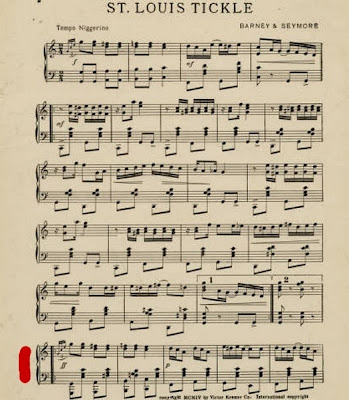
I'm not the first person to notice that the tune of Buddy Bolden's Blues is in fact the second theme in the composition St. Louis Tickle.

St. Louis Tickle was composed in about 1904 (when Buddy Bolden was a star on the New Orleans music scene).
The composers were named on the original sheet music as 'Barney and Seymore' (elsewhere 'Seymour'). But it is probable that these names were a pseudonym for Theron Catlan Bennett (1879 - 1937) - who became a well-known composer, music publisher (in Chicago) and music-shop owner (in Denver).

Having examined the sheet music, which is a well-structured through-composed early rag, I assumed that Bolden's Band 'lifted' the second theme from this composition, put words to it and made it their own.

However, internet sources claim the tune was composed by Bolden himself. Or that it was composed by the trombone player in his band - Willie Cornish - or at least that Cornish put the words to it. If Bolden's Band composed it, the composer of St. Louis Tickle must have lifted it from them.

But he did not live in New Orleans, so would he even have heard it in those days before mass media? And why would a composer of his obvious talent need to steal an idea for a theme? And how do we account for his distinctively 'raggy' rhythms and notes in Bars 7 and 8 and Bars 14, 15, and 16? They are more subtle and complex than the simplified version used in the song.

My theory would have been that Bolden's band lifted and adapted the tune from St. Louis TickleBut we are confidently assured by the experts that Bennett stole the tune from Bolden and sneaked the melody into his composition.

Whatever the truth, Buddy Bolden's Blues exists and you can hear many performances of it on YouTube, notably a very relaxed, soulful one by the late Pat Halcox:
And you can hear a lovely, tasteful version of St. Louis Tickle played (in 2015) by some of our favourite New Orleans-based musicians BY CLICKING HERE. This is a most delightful performance. May I urge you to watch it? Listen out for the 'Buddy Bolden' theme at 55 seconds.

Elsewhere, you can hear St. Louis Tickle performed by various artists, for example the California Feetwarmers. Note the Bolden theme, starting at 30 seconds into the film.
Finally, here's the original 1904 sheet music. I have marked in RED where the Bolden theme begins. It runs just for the repeated 16 bars. Then the composition moves into its next theme.
16 May 2015

Post 213: THE ORIGINS OF TRADITIONAL JAZZ

John McCusker

A most interesting experience while I was in New Orleans in April 2015 was being taken on a conducted tour of the immediate neighbourhood, with John McCusker as guide.

A graduate of Loyola University, New Orleans, John was for thirty years a regional photo-journalist with the Times-Picayune newspaper. He achieved distinction in that work - especially through his coverage of Hurricane Katrina.

John is a knowledgeable, lively and well-prepared speaker. He has spent years researching the origins of jazz in New Orleans. The fruits of much of John's research are to be found in his book Creole Trombone: Kid Ory and the Early Years of Jazz (University of Mississippi Press, 2012).

His findings are convincing because he supports them so well with evidence - such as reports from contemporary newspapers. He is also very proud of being a New Orleans citizen and he loves the early jazz music.

John reminded us of the usual 'myths' and said there may be grains of truth in them, but that essentially they were misleading and should be dispelled.

For example, he had found that all these myths were only partially true:

1. Musicians acquired instruments 'left over' by bands after the Civil War and somehow taught themselves to play. McCusker asks: Why should they do that? There were plenty of new and second-hand musical instruments available cheaply in shops; and there was a strong tradition of young people - black and white - having music lessons in those days. Music shops were a Big Thing in the days when people made their own entertainment, long before television and computers and iPhones. Here's an example, from Canal Street, New Orleans.
2. Lots of the early jazz players used to play in the bordellos of Storyville until it was closed down in 1917. (McCusker asks: Why would you want to waste time with musicians in a bordello? Only a few of the more fancy establishments booked musicians. There were plenty of other places - such as Lakeside - for musicians to find employment.)

3. After the closure of Storyville, the musicians went 'up the river' to Chicago. (McCusker says: Only a tiny proportion of the New Orleans musicians moved north. Most stayed in New Orleans and continued to work there. In any case, if you go 'up river', it doesn't lead to Chicago!)

What Mr. McCusker wanted to impress upon us was that there was a very strong musical tradition in New Orleans. We have to remember there was no TV, no radio and no cinema. At the time, a musical instrument was a 'must have' in most households, just as a computer is today. It was very common to find a mandolin or violin in the home (an interview with the early New Orleans musician Johnny Wiggs confirmed this). And there could well be a concertina, a piano or a harmonium.
Plenty of people made a living teaching youngsters to play musical instruments - piano, string, brass, reeds and so on. Music-making in the home and in public places was commonplace. In some homes, a family band would develop.

John especially impressed upon us the importance of opera in the lives of the citizens. People loved it. There were three well-attended opera houses, so everyone knew the tunes from Verdi, Offenbach, Bizet, Reyer, Von Flotow, Massenet, Meyerbeer and Gounod.  What an inspiration to early jazz musicians and composers they must have been!

Here is the Eagle Saloon, where Buddy Bolden and the other early jazz pioneers played. It has languished for years in a state of disrepair, though there is now strong local pressure to have it restored and used again as a venue for music.
John McCusker told us the Minstrel Shows and Vaudeville - both well attended in the theatres of New Orleans - were of huge importance (usually underestimated) in the early development of jazz. Likewise the 'society orchestras' (made up of trained sight-reading musicians) influenced the approach of such early New Orleans jazz musicians as Kid Ory.
A sad sight: the tumbledown building
behind the scaffolding used to be a theatre
in which at one time you could watch a vaudeville show
or hear Buddy Bolden play.
Of special significance was the craze for syncopated piano music (ragtime), brass band marches and especially the Blues with its genesis in the depths of African culture. The early jazz musicians also worked at a golden time in popular music, when so many of the hit songs were easy to adapt to a 'jazzy' presentation. 

Of course, he told us about Buddy Bolden and took us to some of the places where he used to play. We saw his house and the houses (or sites) where other early jazz stars lived - Nick La Rocca's house, for example. He told us about the early life of Louis Armstrong and he impressed upon us the importance of Edward 'Kid' Ory both as a developer of jazz in the early days and as the man who first recognised the talent of the teenager Louis and then set him on his way by booking him for gigs. Ory - who ran his own band in New Orleans from 1907 - also employed such musicians as Johhny Dodds, King Oliver and Sidney Bechet.
John McCusker also emphasised the importance of brass bands. Such bands became possible only in the mid-Nineteenth Century, after the invention of valved brass instruments (which made all notes of the scales obtainable). In the USA, as in England, there was a massive development of the brass band movement from about 1850 onwards. In England, it eventually became formalised, with national contests, and rules about the numbers of each type of instrument. But in Louisiana matters were more free-style. There were some small and medium-sized bands (undoubtedly forerunners of later jazz bands.
In such small, informal groupings, it would be easy for a player or two to set a fashion for 'jazzing up' a tune.) 
Statues on the edge of 'Congo Square',
in Louis Armstrong Park.
Right from the early days, when the famous benevolent societies operated around New Orleans (they provided mutual help at times of hardship), these social clubs had their own bands; and the bands played at members' funerals.

We tend to think of 'jazz funerals' as a twentieth-century invention. But they are really just a continuation of brass band funerals from long before. John McCusker quoted from a newspaper report of 1857 in which mention was made of the brass band accompanying the coffin.

John took us to various sites including 'Congo Square'. This area had been allocated to the black slaves as a place where on Sundays they were allowed to congregate, play their music and dance. The exciting African dances and the rhythms of their music appealed to all kinds of visitors and onlookers. In these, too, we find a huge influence in the early development of jazz. These Sunday events died out but the Square was used for brass band concerts at the end of the Nineteenth Century.
Congo Square in 2015 -
preserved as a historic landmark.
Frieze in Congo Square:
An attempt to imagine the scene about 180 years ago.
My regular blog-reading friend Phil in the USA told me there is a super video made by John McCusker which enables YOU too to go on his conducted tour. May I strongly recommend that you have a look? Watch it by clicking here.

John McCusker still feels deeply hurt about the lack of support New Orleans received during Hurricane Katrina and the floods, which killed 1000 people in the immediate vicinity. I could sense that his emotions were still raw on this subject ten years after it happened. He took us to a point from which we could see over many square miles of parishes north-east of the City, all of which (he told us) had been flooded to a depth of 15 feet.
With better engineering, it need never have happened. With quicker response from administrators and politicians, the consequent suffering could have been alleviated.

But please may I also recommend that you listen to a talk by John McCusker? If you're interested in the earliest days of New Orleans jazz, I think you will find this truly informative:
CLICK HERE TO WATCH IT.

25 April 2013

Post 56: THE EARLY DAYS; AND THE ABUNDANCE OF GOOD SONGS

Historians have given many reasons why jazz developed in New Orleans when it did. There were so many influences and so many sources of inspiration.
But one reason that is often overlooked is that there were so many tunes available at the time that lent themselves conveniently to interpretation in a 'jazzy' way. I sometimes wonder whether early jazz would have developed without the abundance of good suitable popular music at the time.

It was the age when you made your own musical entertainment in the home or you went to the music halls to find it. The early jazz bands had hundreds of tunes to choose from. Most have been long forgotten but just think about this: you could still today make up a good traditional jazz programme entirely from well-known tunes written more than 100 years ago.
Already by the early 1900s, such songs as these were available to the bands:
Beautiful Dreamer
After the Ball
You've Been a Good Old Wagon But You Done Broke Down
A Hot Time in Old Town
Way Down Upon the Swannee River
Ciribiribin
Smoky Mokes
Whistling Rufus
At a Georgia Camp Meeting
Maple Leaf Rag
My Wild Irish Rose
You Tell Me Your Dream
Creole Belle
Hiawatha
High Society
Indiana
Bill Bailey
The Entertainer
In the Sweet Bye and Bye
Oh Didn't He Ramble
Under the Bamboo Tree
Ida, Sweet as Apple Cider
Meet Me In St. Louis


And in the next ten years these were among the hundreds composed:

My Gal Sal

In the Shade of the Old Apple Tree

Redwing
Down in Jungle Town
Dusty Rag
Shine on Harvest Moon
Ace in the Hole
Meet Me Tonight in Dreamland
Put on Your Old Grey Bonnet
That's a Plenty
I Wonder Who's Kissing Her Now
Chinatown
Down By the Old Mill Stream
Some of these days
Silver Bell
Washington and Lee Swing
I Want a Girl Just like the Girl
Alexander's Ragtime Band
Oh You Beautiful Doll
Ballin' The Jack
Curse of an Aching Heart
You Made Me Love You
Down Among The Sheltering Palms
If I Had You
St Louis Blues
Twelfth Street Rag
When You Wore a Tulip
Yellow Dog Blues
Blame it on the Blues
Georgia Grind
Hesitating Blues
Memories
Paper Doll
When I Leave the World Behind

No wonder those early players - Buddy Bolden, Kid Ory and the like - could put on an entertaining programme for dancers. Such a thing would not be possible today. It's hard to think of much pop music of the last thirty years that lends itself readily to traditional jazz treatment.