 |
| W. C. Handy's house in Memphis. |
Friend and video-maker James Sterling filmed The Shotgun Jazz Band playing W. C. Handy's Ole Miss Rag at The Spotted Cat in New Orleans. It is a remarkable performance, not least because of the 'authentic' interpretation of this tune that Marla Dixon and her colleagues offer us.
Numerous tunes over the decades have become altered, simplified or corrupted, so that jazz bands playing the tunes today can offer various versions - and they are all accepted as 'correct'.
When we play Ole Miss Rag, we usually treat it as having just two simple themes. I am sure you know them. The first starts with these four bars:
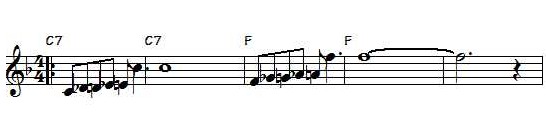
This theme comprises 16 bars (played twice to make 32), though there is usually a 'tag' stretching them to 20 bars as they lead into the second theme, which is also played in F. Its first four bars are:

And bands stick on that second theme for their improvisations. That's all there is to it!
At least, that's how hundreds of bands play this piece, including (I admit) bands in which I have played.
But we are all WRONG! Marla and her team have given us a version that is faithful and authentic in sticking to what Handy wrote - and what he himself played. Listen to a wonderful historic recording of Handy's own band playing the piece in 1917:
At least, that's how hundreds of bands play this piece, including (I admit) bands in which I have played.
But we are all WRONG! Marla and her team have given us a version that is faithful and authentic in sticking to what Handy wrote - and what he himself played. Listen to a wonderful historic recording of Handy's own band playing the piece in 1917:
Notice how it has a well-composed Introduction and also a substantial middle theme of 32 bars. We have dropped both of those features from our performances. What's more, it changes key from F to Bb for the final theme (correctly known as the 'Trio'). Today's bands have forgotten this key change.
Now watch and listen to The Shotgun's version:
Note how from 23 seconds until 1 minute 03 seconds the band is playing the middle section that the rest of us omit. And note how, for the final theme (the 'Trio') at 1 minute 23 seconds they correctly switch into the key of Bb, while the rest of us incorrectly stay in F.
In 'Comments' beneath the video, Shotgun member John Dixon has said All the credit to Twerk, James and Boeddinghaus for transcribing the original W. C. Handy version - what may best be described as the beautiful mess. There's so many little weird and anachronistic parts to the original that it's no wonder it's gone through changes.
This shows us what a lot of hard work is done behind the scenes in order for the top traditional jazz bands of today to be able to present us with performances such as this. The Shotgun Band included this tune in this 'correct' version on their CD (entitled Stepping on The Gas) early in 2017 and David Boeddinghaus is to be heard playing piano on that.
Well done, Shotgun. A lesson to us all.
In 'Comments' beneath the video, Shotgun member John Dixon has said All the credit to Twerk, James and Boeddinghaus for transcribing the original W. C. Handy version - what may best be described as the beautiful mess. There's so many little weird and anachronistic parts to the original that it's no wonder it's gone through changes.
This shows us what a lot of hard work is done behind the scenes in order for the top traditional jazz bands of today to be able to present us with performances such as this. The Shotgun Band included this tune in this 'correct' version on their CD (entitled Stepping on The Gas) early in 2017 and David Boeddinghaus is to be heard playing piano on that.
Well done, Shotgun. A lesson to us all.
Here's what Handy actually wrote.

Then comes the theme most bands have dropped.

And on the bottom half of the final page comes the 'second theme' we all know and play - though most of us fail the key change test.

By the way, the Ole Miss of the title was the train that used to run from Memphis to New Orleans.

It's just occurred to me that I enjoyed that very journey by rail on 18 October 2016, though Amtrak had some new rolling stock since Handy's time. Here we were - boarding the double-decker train at Memphis Station at 6am:


