Welcome, Visitor Number

Translate

Showing posts with label Clarence Williams. Show all posts

25 January 2018

Post 591: 'DREAMING THE HOURS AWAY' AND WILLIAM DULMAGE

Though history has not treated his memory kindly, William E. Dulmage was an important figure in American music during the first half of the Twentieth Century.

Born in 1883, he became a musician, composer and music publisher. He grew up in Michigan and spent much of his life there. His parents ensured that he had a good music education and he found employment in a large store in Detroit - the Grinnell Brothers Music House. Grinnell sold pianos of their own manufacture and these were considered some of the best at the time. William Dulmage worked there for 22 years, rising to become manager of the Band and Orchestral Department. In his spare time he played in the band and orchestra run by George and William Finzel in Detroit. It was not a jazz band but it played for dances in Detroit and for boat trips on the nearby Lake St. Clare.

In 1930 he moved on to an executive post with the Wurlitzer Company, well before its decline, and he worked there for twelve years.

During all this time, William was composing. Early on there were his patriotic World War One songs. Later there were soundtracks for films and television shows. He wrote Tigers on Parade as the theme song for the local baseball team. Two of his hits were Tenderly Think of Me and When It's Night Time in Nevada


In his final years, Dulmage ran a music store of his own, with the help of his wife and son.

William died in 1953.

Why am I telling you all this? Because one of Dulmage's songs was called Dreaming The Hours Away and, since 2015, it has been very successfully revived by traditional jazz bands, notably Tuba Skinny.

What a fine song it is! It has a 16-bar Verse, using plenty of minor chords, and a repeated pattern in two-bar phrases. The words for the first phrases are: 'When evening comes along....The night bird sings his song....It makes me sad and blue.... Because he sings of you...'.

Then there is a beautifully-phrased 32-bar Chorus (with a 16+16 structure). The words of the first 16 are: 'Dreaming....the lonesome hours away... Longing... for you all through the day...and in the twilight.... beneath the starlight...thoughts of you...make me blue...'.

But the words are not important. When the Clarence Williams Jazz Kings recorded the tune in 1928 - the year after Dulmage composed it - they chose not to have a vocal at all. You can hear the seven-piece band playing the song BY CLICKING HERE.

This enterprising arrangement makes the most of the opportunities for 'breaks' in Bars 15 and 16 of the Chorus. But it begins with a 4-bar Introduction, followed (at 09 seconds) by 16 bars distinctively led by the clarinet and freely based on the first 16 bars of the Chorus. This is followed (at 28 seconds) by the final 16 bars of the Chorus by the full band, powerfully led by the cornet. Then it's back (at 46 seconds) to the Verse (which is played only once in the entire recording), played much 'as written' by Dulmage, with syncopations stressed by the whole band.

At 1 minute 05 seconds, we embark on the next run through the 32-bar Chorus, but the first sixteen are led by Ed Allen's muted cornet, unsupported by trombone or reeds. From bar 16 (1 minute 22 seconds), the alto-sax of Coleman Hawkins takes over the lead, backed for his first eight bars by tricky rhythmic pattern played by the rest of the band - notably banjo, brass bass and piano. At the end of the Chorus (1 minute 42 seconds), the trombonist Ed Cuffee takes the lead in another Chorus, and is immediately backed by a delightful little riff from the reeds, until the unmuted cornet (at 2 minutes 10 seconds) takes the lead back for the final eight bars. Then, to finish, we have a complete Chorus with the whole band freewheeling - excitingly improvising but without loss of control.

It's not surprising that this tune and arrangement appealed to Tuba Skinny. They must have worked hard at mastering this number for their own very slick public performances. Here's one - filmed by my friend James Sterling: CLICK HERE.

Note how strongly they have been influenced by the 1928 recording. They use the same Introduction and then copy the idea of having a clarinet take the first 16 bars of the first chorus and the cornet leading the second 16 bars. Then (at 45 seconds), like Clarence Williams, they play the Verse. Like him, they will play it only once. At 1 minute 06 seconds, we embark on the next run through the 32-bar Chorus, but the first sixteen are led by Shaye Cohn's cornet, unsupported by trombone or reeds. From bar 16 (1 minute 26 seconds), the clarinet takes over the lead, backed for his first eight bars by those same tricky rhythmic patterns played by the rest of the band.

At the end of the Chorus (1 minute 46 seconds), the trombonist Charlie Halloran takes the lead in another Chorus, and is backed from time to time by that Clarence Williams delightful little riff from the clarinet and cornet. Then, to finish, we have a complete Chorus with the whole band excitingly improvising. Both bands play the tune entirely in the key of Ab.

Interesting, isn't it, to note how closely, despite their slightly different instrumentation, Tuba Skinny have respected the structure of the original recording?

24 June 2017

Post 520: WHERE IS DECATUR STREET? IN NEW ORLEANS?

Have you heard Decatur Street Blues? I expect you have. If not, you can enjoy a lively 1922 performance of it made by Leonia Williams and Her Dixie Band BY CLICKING HERE.

Leonie was a native of New Orleans and her 'Dixie Band' comprised five musicians, - Phil Napoleon on trumpet, Frank Signorelli on piano, Miff Mole on trombone, Johnny Costello on clarinet, and Jack Roth on drums.

The song was composed in 1922 by Tausha 'Tosh' A. Hammed and Clarence Williams, with words by Mercedes Gilbert.

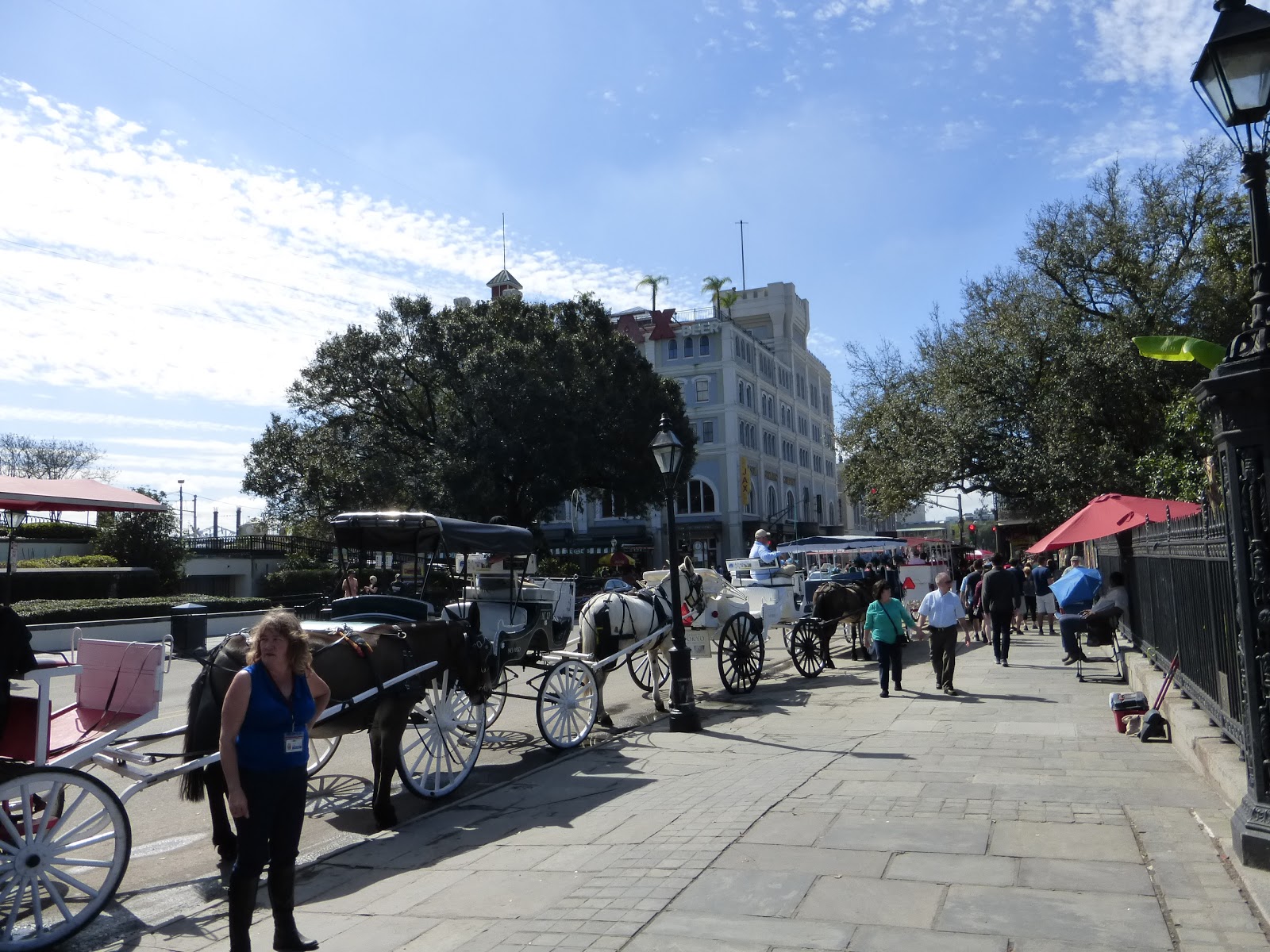
I thought until today that the title of the song referred to Decatur Street in New Orleans. (By the way, they pronounce it Di - CAYY - ter, with the stress on the second syllable.) This is one of the favourite roads of every visitor to the French Quarter - this road, in fact:
But today, giving close attention to the words of the song, I found it's actually Decatur Street in Atlanta, Georgia! We're even told to hear a gentleman called Eddie Heywood 'whip those ivories' down 'at eighty-one'. This would be the Atlanta jazz pianist Eddie Heywood, whose son - also called Eddie Heywood - became even more famous and ran a sextet in the 1940s.

I guess the scene has changed beyond recognition since Eddie played there.
Decatur Street, Atlanta - today.

22 May 2017

Post 509: FATS WALLER'S 'SQUEEZE ME'

Squeeze Me was composed and published in 1926. The composers were given as Fats Waller and Clarence Williams. Clarence was, of course, also the publisher. (Don't confuse this song with Just Squeeze Me - another good jazz tune. Just Squeeze Me was composed in 1941 by Ellington and Gaines.)


In the early days of Tuba Skinny, this great young band recorded and often performed Squeeze Me. The song really cried out for a lady singer (even though Fats Waller himself provided the vocal on one of his recordings); and Erika Lewis showed just how brilliant she is. Take her performance and compare it with the original sheet music. You find she keeps the words virtually to the letter, but her timing and varying of pitch illustrate well what a great instinct she has for jazz. She decorates the melody exquisitely; and her little touches of rubato are spine-tingling.

The Band plays the tune in Eb, to suit Erika's voice; and it sounds very good in that key, even though the original sheet music has it in G. Unlike some other bands, Tuba Skinny perform the whole piece - the 12-bar Verse as well as the 16-bar Chorus. They easily build some 2-bar breaks into the Chorus and they also make the most of the chromatic runs at the end of the Chorus.

You can watch Tuba Skinny perform the song BY CLICKING HERE. As so often we have to thank the generous video-maker codenamed RaoulDuke504 for making it available to us.

Here - for comparative purposes - is the sheet music from 1926:

13 January 2016

Post 364: TUBA SKINNY AND 'BEER GARDEN BLUES'

Be honest. Had you ever heard of Beer Garden Blues before Tuba Skinny unearthed it and started performing it in 2015? I certainly had not.

Robin Rapuzzi told me it is a tune the band now particularly enjoys.

The music was written in 1933 by Lewis Raymond and Clarence Williams; and lyrics were contributed by Walter Bishop.

It is normally played in the key of F, but making great use of the related key of D minor. In fact, a distinctive characteristic of the song is its strong minor flavour - in both Verse and Chorus.

The Verse comprises 16 bars. The Chorus has a 32-bar A-A-B-A structure.

You can hear the original Clarence Williams recording by clicking here. Surprisingly, the band omits the Verse but works its way through the Chorus five times (thus playing 5 x 32 = 160 bars in total). Much use is made of breaks, especially on Bars 23 and 24 of every Chorus; and the third Chorus is led by the washboard, with the others providing punctuation.

Clearly, Williams treated his own music very freely when he came to perform it. And Tuba Skinny do the same, making great use of the rhythms and the harmonies, but with slightly less than scrupulous respect for the original melody. Click here for a performance by them: they play through the Chorus six times [no Verse] on lines very similar to those of the Williams recording. Beer Garden Blues as originally written (with acknowledgement for the help provided by my American correspondent Larry Smith) is believed to have gone like this:

9 February 2015

Post 171: 'WHAT IF WE DO?' - CLARENCE WILLIAMS, KATHERINE HENDERSON; AND TUBA SKINNY

In the beginning there was a Columbia recording made in New York in 1929 by The Seven Gallon Jug Band of a 32-bar tune (without vocals) called What if I do?. Who wrote it? 'Clarence Williams and Johnson' (presumably James P. Johnson, unless someone can provide me with further information). The Seven Gallon Jug Band was one of the musical groups led by Clarence Williams.

Then in 1930 came the recording What if we do?, (same melody) sung by the niece of Clarence Williams - Katherine Henderson (sometimes spelt Catherine Henderson) - accompanied by Clarence Williams and his Orchestra.
What if we do? is sung very prettily at a gentle tempo and the whole performance runs for just over 3 minutes 20 seconds. Thanks to the kindness of Nico Fournier, you can enjoy it on YouTube. You will find it addictive:
As you will hear, after a short introduction, Katherine sings the 32-bar Chorus. It's a simple a-a-b-a structure typical of those times. There's a Georgia pattern chord structure in the 'a' sections. Harmonically the whole song is very similar to Five Foot Two and Please Don't Talk About Me. And like those songs, it has this familiar Middle Eight:
III7 |   III7  |  VI7  |  VI7  |   II7  |  II7  |  V7   |  V7

After the Chorus, Katherine Henderson sings the Verse (16 bars) before singing the Chorus again and, with that, the record ends. There are no instrumental interludes.

Katherine sings the song in the key of C, with which she is obviously comfortable.

I would not have known this song existed had it not been for its appearance in January 2015 as the latest addition to Tuba Skinny's impressive repertoire. It appeared on YouTube (thanks to the fine video-maker RaoulDuke 504):


Goodness knows how Tuba Skinny constantly find these long-lost gems and then revive them for our pleasure.

As you see, Tuba Skinny have chosen to play What If We Do? entirely as an instrumental number. They take it rather more quickly than Katherine Henderson and Clarence Williams. They also choose to change the key to Bb. And they omit the Verse. In this Tuba Skinny street version, the Chorus (32-bars) is simply played through four times (128 bars in total), with no introduction or coda - no frills, in fact. Barnabus gives a lusty performance on trombone and Todd takes the lead on the second half of the third chorus. It is a typical workmanlike Tuba Skinny performance - thoroughly enjoyable and a lesson to us all.

11 January 2014

Post 112: 'CUSHION FOOT STOMP'

What a good little number 'Cushion Foot Stomp' is!

It's not difficult to master, but it is fun to play, holds quite a lot of interest for both band and audience, and lends itself to effective improvisations on easy chord sequences.


It was the pianist / music entrepreneur Clarence Williams who composed the piece (with Agnes Castleton adding words) in 1927. And he recorded it in New York in April that year. Playing as his Washboard Five, he used the following from his pool of many musicians: Ed Allen on cornet, Buster Bailey on clarinet, Cyrus St. Clair on brass bass, Floyd Casey on washboard and himself on piano. You can listen to that famous recording  BY CLICKING HERE.

The tune is played in Eb, though some later bands modulate into Ab for the final theme.


It opens with an 8-bar Introduction of ladder-climbing semi-tones.

Then comes Theme A (very simple because it uses a standard 12-bar blues chord sequence). The pretty little triplet riffs are best played on a clarinet, with a (muted) cornet backing in the even-numbered bars.


This is followed by Theme B which consists of 24 bars. The chord sequence is again virtually the standard blues changes, but spread (by doubling all bars) over the 24 bars. This theme has a stately melody best played on a trombone or tuba or a clarinet in its chalumeau register, with other instruments (e.g., a muted cornet again) providing some pretty decoration.


Usually Theme B is played twice before Theme A is repeated.


Then there is a 4-bar Bridge leading into Theme C. This offers a very simple riffy 16 bars (8 + 8) using one of the most familiar of all chord sequences, known to jazzers as the Salty Dog Chord Progression: VI7 | II7 | V7 | I. It lends itself to a Break on Bars 7 and 8.


Bands tend to stick on this theme with various improvisations. When they have had enough, they go into the 4-bar Coda, which (unusually) begins with 3 bars played by the washboard alone, with the full band joining in on the final bar.


So: there's plenty of fun to be had.


And if you would like to hear a version with the full vocal, try the one recorded by Sara Martin. It's on YouTube.
At the piano: Clarence Williams

Over the years, many of our bands have recorded this tune and you can find plenty of performances on YouTube.

One of the latest is the version by Tuba Skinny, who took the tune up in 2018. They stick closely to the pattern of the Clarence Williams original, though they play it at a very slightly slower tempo. Their performance is available BY CLICKING HERE.
===========================

4 May 2013

Post 65: 'CHOCOLATE AVENUE'

Yet another obscure old tune has been unearthed by Tuba Skinny. We have to thank the band for reviving it after almost 90 years and for giving us such a delightful interpretation. We must also thank - as so often - the great video-maker codenamed RaoulDuke504 for being there to film it for us and for identifying it.

The tune (previously unknown to me - and probably to you too) is Chocolate Avenue - one of the forgotten numbers recorded and allegedly composed by the prolific Clarence Williams (though, according to some, Williams purloined it from Herman Blount [aka Sun Ra]).

It is a conventionally-structured 32-bar tune [ A   -  A  -  B  - A ] in Eb. The only harmonic 'surprise' is the second half of the fourth bar in the A sections,  where the harmony appears to be Eb minor where the ear would expect Eb major.

Tuba Skinny play the tune gently, four times through, without any Introduction.

Note especially the third time, where the responsibility for leading the melody is shared among the instruments, including the sousaphone and banjo, and where the cornet, clarinet and trombone play harmonising long notes during the Middle Eight.

Although this performance is a joy, it is spoiled by a dimwit in the audience just out of camera shot who after the middle of the Second Chorus keeps blowing some kind of whistle - probably one of those little wooden 'bird-whistles'. This is the kind of annoying thing that happens when a band plays in the public street. It is irritating, so I hope another opportunity will arise for RaoulDuke504 to get a 'clean' sound when this tune is played again by Tuba Skinny.

22 March 2013

Post 22: 'NEED A LTTLE SUGAR IN MY BOWL'; AND THE RESEARCHER DICK BAKER

Click on THIS VIDEO. It is concise (only 30 bars in total) and therefore simple for musicians to learn and memorise. It has a good, strong, easily-singable melody and a very pleasant down-the-ladder harmonic progression (plus The Sunshine Chord Sequence at the end). Bars 7 and 8 of the Chorus can be played as a 'Break' - to be taken either by a singer or by a member of the band; and Bars 17 and 18 of the Chorus are an appealing 'Tag'. For all these reasons, I Need A Little Sugar In My Bowl is a very good tune for jazz bands to have in their repertoire.

I have written before about the amazing Dick Baker who has spent decades researching the origins and histories of tunes played by traditional jazz bands. He now has information about nearly 4000 tunes on his website, which runs to over 400 pages of closely-typed information: CLICK HERE; and then go to Stomp Off Records Project.

Dick has been tracing the origins of I Need A Little Sugar In My Bowl, the song made famous by Bessie Smith and - more recently - brilliantly revived by Tuba Skinny and their fine singer Erika Lewis.


Dick sent me an email:

Ivan, In my quest to update and improve the Stomp Off index, I went hunting for this on a trip to the Library of Congress in January. The composers were actually Dally Small, Clarence Williams and J. Tim Brymn, and the filed copyright was "I Want a Little Sugar in My Bowl." The original lead sheet, possibly in Clarence Williams's handwriting, is attached. The copyright as printed in the book reads I need a little sugar in my bowl words and melody by C. Williams, Dally Small and J. T. Brymn. © 1 c. Jan. 14, 1932; E unp. 50141; Clarence Williams music pub. co., inc., New York. The record label, alas, screwed things up a bit. The initial "I" was dropped (but it's common for record companies to shorten, streamline, or otherwise change titles for their labels), but the composer credit on the Columbia 14634-D label is Williams, Byrne [or poss. Byrns] and Small. There WAS a composer named W. A. D. "Danny" Small, but this evidently isn't that guy.

Here is the leadsheet Dick discovered. What is interesting about it? It is dated (rubber stamp) '1932'. The composers are given as stated by Dick. The tune is set in the key of Ab, with a melody line and no chords for the Chorus and a melody line and a few hints at chords for the Verse. The Verse has 16 bars. The Chorus has 18 bars (really 16 bars plus a two-bar tag).

The 16-bar Verse is typical of its time - not specially interesting melodically, simple and with a repeated phrase, and ending with a dominant 7th to lead into the Chorus.

What I find strange is that Bessie Smith recorded it (in a musically very good version) in 1931; and yet the copyright manuscript (not such good music - especially the Verse) is dated 1932. I would have expected it to be the other way round.

Bessie Smith sang a shorter (12-bar) verse which is better than the 16-bar Verse in the manuscript.

Turning to the Chorus, Bessie's version is very close to the manuscript version of the melody.

Bessie, by the way, sang the song in the key of F, though the manuscript is in Ab.

When Tuba Skinny recorded the song (on their first CD, in May 2009), they based their performance on the Bessie Smith version, including the 12-bar Verse and using the key of F.

Here are the lyrics Dick Baker discovered. Bessie Smith kept close to the first three lines of the Verse, but scrapped the remaining three, replacing them with one line (thereby reducing the Verse to 12 bars). With regard to the Chorus, Bessie pretty well kept the words as in the manuscript, though she slightly amended a couple of phrases.
Bessie then went on to sing a second Chorus (not typed into the manuscript above). This second Chorus was based on the first, but with cruder metaphors.

I'm pleased Tuba Skinny's version omits Bessie's second Chorus altogether. Erika Lewis sings the Verse and first Chorus only, following Bessie Smith but with a little toning down of the language, conveying a mood rather than archness. And Tuba Skinny abbreviates the title even further to Need a Little Sugar.

Writers of jazz history books in the past used to snigger like schoolboys at the 'innuendos' in the lyrics of songs performed by the likes of Bessie Smith, Victoria Spivey and Lucille Bogan.  (In England, we had the songs of George Formby: their 'cheekiness' was fashionable at one time.) But we live in an age when people are neither amused nor shocked by the metaphors used; and today there is little appetite for this kind of verbal humour.

So, regardless of the lyrics, let us value this tune for its conveying of mood, its conciseness, its simplicity, its strong melody, its harmonic progression, its 'Break' and its 'Tag'.

Long before I received the photocopy of the manuscript above from Dick Baker, I did my best to pick the tune out by ear. This is the 'Need a Little Sugar' leadsheet that I came up with (as in the recordings: 12-bar verse and an 18-bar chorus). It's good enough for me.


==============
Footnote

My three books about traditional jazz are available from Amazon.