Welcome, Visitor Number

Translate

Showing posts with label how to learn the jazz tunes. Show all posts

15 June 2017

Post 517: BEGINNERS' FAKE BOOK

I have written before about the value of fake books (sometimes called 'busker's books') to traditional jazz musicians, especially in the early stages of mastering your craft.

But beware. Some fake books - though crammed with tunes - are not as helpful as you may expect. They contain very few tunes the traditional jazz musician is likely to play.

But you can find less pretentious books that provide the leadsheets (words, notes and chords) of quite a few essential tunes. Such is 101 Pub Favourites for Buskers. Pub favourites tend to be in most cases traditional jazz favourites too; and they are often among the simplest tunes you need to master.
So from this book, for example, you can learn such tunes as After the Ball, You Always Hurt the One You Love,  Ain't She Sweet, Bill Bailey, On a Slow Boat to China, Nobody's Sweetheart Now, I'm Gonna Sit Right Down and Write Myself a Letter, I Can't Give You Anything But Love, and so on. Here, for example, is On The Sunny Side of the Street - as you can see, very clear and easy to learn from. AND it even includes the Verse (which many musicians don't know).
I bought this book way back in 1986, would you believe, when I was at the stage of getting started and trying to play a few simple tunes in a group formed by three friends. It was produced by Wise Publications. There were several others in the '101' series.

I doubted whether these books were still on sale three decades later. But a quick internet search showed me that you can easily still order a new copy for about £18 (i.e., U.K. price) or you may obtain a used copy much more cheaply.
==========
By the way, if you may be interested in reading my e-Book called 'Playing Traditional Jazz', which is for jazz players and would-be jazzers, click here:
https://www.amazon.com/dp/B01MS38JVI
This will let you sample-read a few pages.

28 November 2016

Post 450: JAZZ TUNES - WHERE CAN I FIND THE SHEET MUSIC?

I often receive emails from people who ask me whether I can help them by providing music, usually for particular tunes that have taken their fancy. More often than not, I am unable to do so.

I was also approached after a performance by a young man in the audience who said he was learning the trumpet and asked whether he could 'borrow the music for a few days' so that he could learn the tunes our jazz band had just played. Unfortunately, I could not oblige: the 'music' was in our heads and not on paper.

So, if you are learning to play a musical instrument and want eventually to be in a traditional jazz band, where can you get the music? 

Unfortunately, it is virtually impossible these days to go into a music shop and buy off the shelf a dixieland band arrangement of, say, Maple Leaf Rag, or sheet music for Steamboat Stomp.

So picking tunes up from old recordings by ear is one solution. And it is a method we occasionally resort to.


But if you hunt on the Internet, you can find some sites that will help you. In particular I recommend the site of that fine, generous, Swedish musician Lasse Collin:
If you use Lasse's materials, you will have enough to keep your band going for years. He provides clear lead sheets, giving the melody line and the chords in a simple form. That's just what you and your band need.

Another possibility is to buy buskers' books (fake books). These also provide collections of lead sheets.
Second-hand copies of these are cheaply available on Internet auctions. But be careful to buy those that contain tunes that will definitely be of use in traditional jazz. Many fake books - despite their bulk - contain very little that will be of use to you.

15 November 2016

Post 445: MEETING DAVID JELLEMA, JAZZ CORNET PLAYER

I first noticed and admired the cornet player David Jellema in 2014, when on YouTube I discovered videos of The Thrift Set Orchestra, which is based in Austin, Texas. David was playing some fine music in the company of other outstanding musicians - among them, Albanie Falletta, Westen Borghesi and Jonathan Doyle. If you don't know this group, you may sample one of their performances BY CLICKING HERE.

But I didn't meet David until 20 October 2016 when, during a very brief visit to New Orleans, I literally bumped into him. I pushed open the door to the Yuki Izakaya Bar in Frenchmen Street, and David was immediately on the other side. He was guesting in Haruka Kikuchi's Band.

During the interval, David kindly and generously joined me for a very interesting chat.


In particular we discussed how he goes about mastering tunes and improvising upon them. He felt that, although it is obviously crucial to know the tune's melody and its chords, it becomes more important to internalize those elements (relegating them to the subconscious through repetition and practice - to the point where you would be able to play the song even in an unfamiliar key). With the music thus internalized, the conscious mind can be free to engage with the immediate demands of the performance in the present, i.e., listening and responding to the other musicians, making split-second choices within a solo, etc.

Beyond mastering the scales and arpeggios of chord shapes and inversions in all keys, David said, what is most important in developing jazz improvisational language, style, and a personal voice is to study many masters (by copious listening, transcribing, and copying their solos and licks) in order to let their influence percolate into your playing as you mature into your own voice.   The music you most love will help inform and shape your first steps towards developing your own improvisational style. In his own case, he said the most important master had been Bix Beiderbecke.

I was not surprised. In his fluency, creativity, attack, tone and technique, David's playing always reminds me of Bix.

But here's something astonishing. David plays a cornet that is over 120 years old; and he still gets a beautiful tone from it. The cornet is an 1893 English Besson, a vintage 'Prototype' (serial number 48XXX). David knows that F. Besson was at the time located at 198, Euston Road, London; and that the instruments were distributed in the USA by Carl Fischer of New York. David bought this cornet from an antique store in Annapolis, Maryland, in the 1990s. As the US Naval Academy is based in Annapolis, David surmises that the instrument may originally have been played by someone in the Navy band.

After a few years, David passed the cornet on to his friend Dave Sager, a jazz trombone player in the DC area. Mr. Sager spent a deal of money in having it brought back to a pristine condition. Since about 2011, it has been back in the hands of David Jellema:


and from the other side:


But David has four other very special cornets, including a Conn from the 1890s. I hope - with David's help - to write an article about them for publication early in 2017.

I remember hearing the late great British jazz trumpet-player Humphrey Lyttelton say that some instruments (such as Stradivari violins) improve with age but that brass instruments begin to deteriorate from the first time they are played and go on getting worse.

Well, David's cornets seem to discredit that theory. Or perhaps it is simply that they really knew how to make solid and enduring brass instruments in the Victorian Age.

6 June 2016

Post 401: DOTS IN FILOFAXES - 'MAMA'S GONE; GOODBYE'

When I want to learn a tune on my keyboard or cornet, I begin by getting the dots and chords as accurately as possible into my mini filofax collection.
Occasionally, I manage to find the music in a busker's book or somewhere on the internet; but often I have to work out the tune as well as I can by myself.

The appearance of my filofax pages is rough-and-ready but they can be very helpful as an aide-mémoire at some future date.

Below is an example of the results - in this case with Piron and Bocage's famous Mama's Gone, Goodbye. You can hear their very sweet original band recording (from 1923) by clicking here.

18 February 2016

Post 393: JAZZ IMPROVISING FOR BEGINNERS - TRY THIS

I receive many emails from readers who tell me they are in the early stages of trying to play traditional jazz. They ask whether I can help them.

Unfortunately, I am no great expert and certainly not a music teacher. I tell them there is quite a lot of help available on the internet (such as Lasse Collin's site and Charlie Porter's videos) and I have referred to these in several of my articles.

These emailers tell me they hope one day to play in a band but at present they are mastering their instruments, and learning tunes and chord progressions.

Maybe you should start by watching this excellent little video, which makes very clear how the trumpet, trombone and clarinet can improvise collectively:
CLICK HERE TO VIEW.

While I was listening recently to a performance of Till We Meet Again, it occurred to me that I could at least recommend this super tune to you as something on which to practise.

Why?

Well, for a start you can take it quite slowly. Next, it includes two essential basic chord progressions that will turn up in very many tunes, so you need to feel comfortable improvising over them.

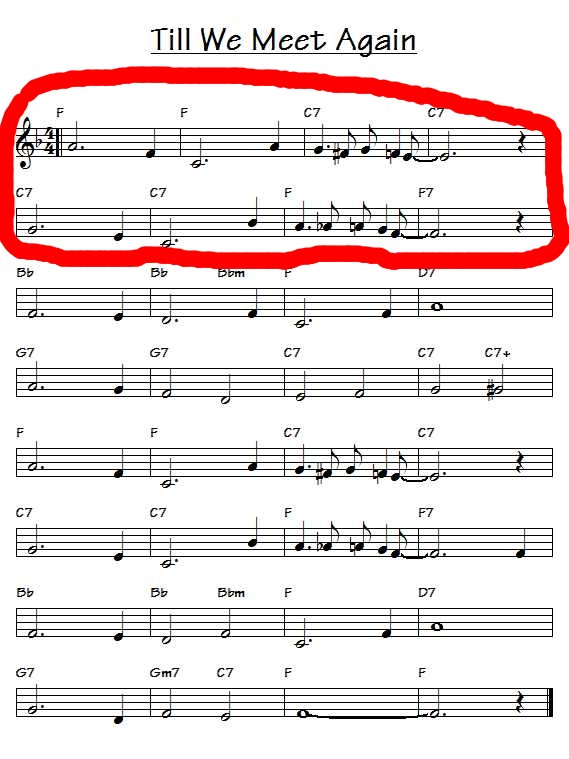
First you need to look at what goes on in this tune. So let's consider it, in the key of F.

We discover that it is a 32-bar tune (the most common type of all) and it is structured ABAB (each letter representing eight bars).

So you have two 'A' sections that are pretty much identical. These eight bars (marked in red below) use one of the most common chord progressions:

I    I    V7    V7    V7    V7    I    I

This movement from the tonic chord to the dominant and then back is found in very many tunes.


The F7 in the eighth bar leads perfectly into the Bb chord of Bar 9.

The 'B' sections use The Sunshine Chord Progression (also used in dozens of tunes). I have written about The Sunshine Progression in several articles. For example, click here to read one. Every jazzer must get the The Sunshine Progression into his fingers - in a range of keys.

In the first use of this progression, Bars 15 and 16 hold on to the dominant 7th (C7) rather than resolve completely to the tonic. The purpose of this is to lead back to the melodic theme all over again in Bar 17.

But when we reach the final eight bars of Till We Meet Again (B for the second time) we find the full Sunshine Progression - ending on the tonic to round the tune off perfectly.

So here is the full chord chart (in F):
Now: how about improvising? A simple way of creating an improvisation is to use this chord chart [F   F  C7   etc.] and simply play notes from the relevant chords as you go along. Basic arpeggios to begin with. For a beginner, this is not easy. That is why it helps to work with a slow tune such as this: it gives you time to think.

Don't forget that if you are a Bb or Eb instrument, then the Concert key of F will become G for you (Bb instruments, i.e. most trumpets and clarinets) or D for you (Eb instruments).

To give you some idea how this improvising-on-the-chords business works, I put the tune into Band-in-the-Box and then let my computer play it while with my cornet I tried to play notes from the arpeggios of the chords. I mostly used notes above the melody, in order to avoid clashing with it. To watch my attempt - or play along yourself - CLICK HERE.
Till We Meet Again was composed in 1918 by Raymond Egan, with words by Richard Whiting.

...............................
FOOTNOTE
The book Playing Traditional Jazz by Pops Coffee is available from Amazon.

26 May 2013

Post 87: BUSKERS' BOOKS AND FAKE BOOKS


I was playing in a traditional jazz band in a Cambridgeshire pub when a young man in the audience told me he was a trumpet player and wanted to learn to play traditional jazz. Could I please lend him 'the music'?

Unfortunately, it's not that simple. The 'music' has to be inside your head. It takes months to build up a repertoire and much of your learning may have to come from picking tunes up by ear, as many of the old-time tunes are virtually unobtainable in sheet music form.

But a good starting tactic is to buy some busker's books (also called fake books).
They do not contain piano-type music, with two staves. They simply give you what is known as a lead-sheet - the melody line and the chord sequence.
That's all you and your band should need. Provided that you are all working to the same melody and chord pattern, you can improvise to your heart's content and also work out - if you like - a 'head arrangement' (i.e. a plan for who will do what, and when).

Of course, these books have their limitations. They sometimes leave out the Verse of a song, giving you only the Chorus. That's all right if you want to play only the Chorus; but it's irritating if you want to include the Verse, to provide some contrast or variety.

And with more complex old tunes (such as rags with three or more themes), it is annoying if the fake book gives only one theme and omits the rest.

Another warning: there are so many busker's books on the market. Do not waste money on chunky books that claim to contain 500 or 1000 tunes if there are not more than four or five tunes in them that you will ever be likely to play with a traditional jazz band. There are many such books available. Don't be fooled by the bulk.

Over many years, I have built up a bunch of fake books. They can be quite expensive when new; but I have noticed recently that plenty of them are available on internet auctions, so you should now be able to pick some up cheaply. Simply type 'Buskers' Books' or 'Fake Books' into your search.

After that, there are also resources on the internet where you can freely download the music for some of the rarer old jazz tunes.

For an example of dozens of tunes generously provided by a very remarkable Swedish gentleman - a musician and artist named Lasse Collin - go to this website:
  http://cjam.lassecollin.se/

It is also possible - if you search - to find downloadable books of tunes, sometimes generously provided by particular bands.

Also be warned that, when you come to play a tune with other players, you may find the band uses a version with slightly different chords or melody notes from those in your fakebook. They may even use a different key. So be prepared to adapt.
============

27 April 2013

Post 58: 'FIDGETY FEET'


Yes, it seems crazy, but I carry the whole of Fidgety Feet around on just 21 square inches of paper.


I keep it, together with hundreds of other tunes written out in this way, in a set of easily portable mini-filofaxes. I am very keen on filofaxes both as little works of art and as effective methods of storage and record-keeping.


Fidgety Feet (with its alternative title War Cloud) was recorded at a romping speed by The Original Dixieland Jazz Band in 1918. Composer credits were given to the band's members Nick LaRocca and Larry Shields.


I like to take a filofax full of tunes with me on bus and train journeys, so that I can browse through them and brush away some of the rust that develops in the brain if you go several months without playing a particular number.