Welcome, Visitor Number

Translate

Showing posts with label The Shotgun Jazz Band. Show all posts

2 December 2019

Post 611: RECOMMENDED GREAT TRADITIONAL JAZZ VIDEOS

I leave you some recommendations for videos of traditional jazz bands active in recent years. If you have not seen these videos before, I hope you will enjoy them. If you have seen them, I am sure you will enjoy watching them again!

First, for a relaxed, moving, unpretentious but beautifully-played performance, showing just how perfect a musical form traditional jazz can be, try Whenever You're Lonesome, Just Telephone Me played by members of The Shotgun Jazz Band. The video runs for about five minutes:

For an example of a great jazz band playing one of the very complex tunes from our repertoire - Deep Henderson - watch Tuba Skinny in this next video. It runs for a little over three minutes. Notice how all members of the band, working from memory rather than printed arrangements, play wonderfully as an ensemble through all three sections of this challenging piece, not to mention taking in their stride a change of key and linking passages:


Now, for some passionate 'no frills' traditional jazz, coupled with brilliant musicianship and generating great excitement, I would like to offer you a performance of Royal Garden Blues that I myself had the privilege of filming. This one runs for under five minutes:


Next, I offer you a performance of a good old jazz standard - Savoy Blues - played by The Shake 'Em Up Jazz Band. This video runs for a little under five minutes. I recommend it because it shows what happens when six outstanding musicians come together and - with great respect for each other - play wonderfully as a team, just as our bands should. This performance too is unpretentious and yet you will hardly find a better rendition of this piece anywhere:


Finally, if you have time to sit back for a full half hour and watch six outstanding musicians play a varied programme ranging from storming stuff such as Climax Rag to the tender Love Songs of the Nile, may I urge you to watch this video? You will also hear such tunes as Oriental Man, Yearning, Mobile Stomp and I Can't Escape From You. As one observer said, 'It's the kind of music that makes you cry with joy!' Click on it here:


In my opinion, this is the best 'half-hour live concert' video to have appeared in several years.

25 February 2018

Post 602: MAKING TRADITIONAL JAZZ VIDEOS

I feel hugely privileged to have lived to an age when - sitting at my computer here in Nottingham, U.K. -  I am able to click a button and watch wonderful traditional jazz performances from all around the world. We have to be deeply grateful to all the generous and hard-working video-makers who provide us with these treats.

Some of them have high-quality equipment. They use two or more cameras and have a separate sound-recording apparatus.

If it had not been for video-makers such as those codenamed digitalalexa and RaoulDuke504, I might never have discovered the wonderful traditional jazz being played by relatively young musicians in New Orleans since Hurricane Katrina. Their videos convinced me that I had to get to New Orleans to see and hear for myself.

Good news is that digitalalexa (Al and his wife Judy) produced the first video of Tuba Skinny to be viewed more than a million times: THIS ONE - CLICK ON TO WATCH IT.

When I decided to try to make some videos, I bought a simple small camera from the cheaper end of the Panasonic Lumix range. It is intended mainly for taking still photographs but, like most cameras these days, it has a built-in microphone and the facility to record videos. It also has a useful 'zoom' feature.

Once you have made a video, it is easy to load it on to such a site as YouTube, thereby making it available to viewers all over the world. You have merely to follow the simple instructions on the screen.

I have had only four or five opportunities to video truly outstanding jazz bands. But I have made a number of videos and put them on YouTube. My favourite - the one with which I am most pleased - shows The Shotgun Jazz Band at The Spotted Cat Club (New Orleans) playing Royal Garden Blues when I was there for the French Quarter Festival in April 2015. The band was on absolutely cracking form and I was able to film from the side, very near the band, so I obtained some pleasing close-up shots of Haruka, Marla, James, John and Twerk.

If you have not yet seen that video, you can watch it BY CLICKING HERE.

I hope you will enjoy it as much as I still do.

I must also mention James Sterling, who discovered the music a few months after I did. Living in Florida, he has been able to travel to New Orleans far more often than I have, and he has uploaded some fine videos.

If you haven't yet explored what's up there on YouTube, you should start by looking at the offerings of the three video-makers I have mentioned.

17 January 2018

Post 589: THE DEW DROP HALL - THE OLDEST SURVIVING VENUE

I have written about the Dew Drop Hall before. But it is such an important building in the history of traditional jazz that - for the benefit of newcomers - I think it is worth writing about again.
The Dew Drop Hall
April 2015
For me the ambition to see The Dew Drop Hall started when I read that Marla Dixon's Shotgun Jazz Band played there on 7th November, 2014. That was what prompted me to find out more about this important jazz venue. It must have been a great thrill for Marla and her team to play in this very spot, among the spirits of so many of the Greats who performed there one hundred years earlier.

So let me tell you about this truly legendary old building that is one of the most important venues in the history of traditional jazz. It's the oldest surviving building in the world in which jazz was played in the earliest years of its development; and traditional jazz is again being played there today. I'm referring to the The Dew Drop Dance and Social Hall, which is situated at 430 Lamarque Street in Old Mandeville, Louisiana.
A great thrill for me was finally setting foot in The Dew Drop Hall in April 2015, when I was in New Orleans for the French Quarter Festival.

The story of the Hall begins on 5 May 1885, when local African Americans created The Dew Drop Social and Benevolent Association - aiming to provide help to the sick and the needy.

The Association built the hall from cypress timber nine years later - and opened it in 1895. Its foundations were simple brick piers (a wise choice for flood protection at the time). The pier at the front on the left still bears the original inscription (now barely legible).
It commemorates the founding of the Dew Drop Social and Benevolent Society No. 2 of Mandeville on May 5th, 1885, and the construction of the building in 1895, along with the names of the building committee.

Thwalls were covered with weather-boards at the front, and batten on the sides and rear; and they were originally painted green. The carpenters created the large wooden double-door at the front gable end, and a smaller door on the right at the back. There was an open beam ceiling. It was essentially a one-room structure, available for meetings, celebrations, vaudeville, dances and so on. It became the centre of social life.
The dais (mainly used as a bandstand) at the far end was typical of the time - with a wooden banister front opening in two places for the steps. The original dais was small (the part behind the banister on the left) but it was later extended to what we see in the picture above. The hall was built without electricity - or plumbing - or even glass: the 'windows' were simply openings measuring 6 feet high by 4 feet wide. They were normally covered by wooden shutters. These windows must have helped keep the band and audience cool on humid evenings.

Lamarque Street is to this day a quiet sparsely-populated, leafy, narrow road.

But where exactly is it? Answer: about 35 miles north of The French Quarter in New Orleans. It's where I've put the red dot at the centre top of this Google Map, very close to the north shore of Lake Pontchartrain.


From the earliest days, musicians started to cross the lake by steamboat to play for Saturday night dances in the Hall.
There were three landing-places for the boats on the shoreline - from east to west the Camellia Landing (destroyed by fire in 1912), the St. Tammany Pier (destroyed by fire in 1926), and the Lewisburg Landing (at the Lewis Plantation). The bands brought plenty of fans with them: Mandeville was considered a fashionable resort. It had several bands playing in various venues, including pavilions, the hotels and local park.

Pretty well all the famous early jazz musicians played at The Dew Drop Hall. Buddy Petit, Bunk Johnson, Kid Ory, Tommy Ladnier, Louis Armstrong, Papa Celestin, Sam Morgan, Chester Zardis and George Lewis were among them. Local man Isidore Fritz - according to such witnesses as George Lewis one of the best jazz clarinet players of all time - was a regular there, leading The Independence Band, which was hugely popular. He had Tommy Ladnier on trumpet and Edmond Hall on clarinet. Isidore's two brothers also played. What a pity the band was never recorded (or even photographed, it seems). Fritz was unwilling to cross the Lake to play in New Orleans. Why? Because he was doing very nicely in Mandeville and also had a family building business there. Fritz died in 1940.

Lillian, the wife of banjo-player Buddy Manaday (of Buddy Petit's Band) later recalled that white people as well as black attended and they all got along well together. Petit's Band, by the way, played at many venues in the  region - including at Bogalusa, Pensacola and Moss Point.

By the 1920s and 1930s, the Hall was a major centre for jazz concerts. Wooden benches provided limited and basic seating for about 100 people.

But - how sad! - as fashions and customs changed, the young were no longer interested, the Dew Drop Association ceased to exist and the Hall was virtually abandoned in the mid-1940s. This state of affairs continued for about half a century.

What amazing luck that nobody knocked the building down! All the other similar dance halls of its era were demolished or changed hands and acquired new uses or (like The Sons and Daughters Hall - also in Mandeville, on Lake Shore Drive) burned down.

The overgrown plot was bought at auction in 1993 by Jacqueline 'Jinx' Vidrine. She might have been expected to demolish the building and erect a modern house there; but she was a jazz enthusiast and knew what she was doing. She cleared the plot and investigated the building. She even found an old upright piano inside.
Jacqueline dreamed of re-opening the Hall as a jazz venue or museum. After some years, she managed to get the local Parks Service interested. By 1999, a first concert was possible! Mayor Eddie Price and the Mandeville Council recognised the importance of the property and bought the plot of land from Jacqueline. She herself donated the Hall to the community. Funds had been raised, including donations from the English. 

There had been a plan to transport the Hall to a site in Louis Armstrong Park, New Orleans. But the Mayor of Mandeville was easily convinced that the Hall should stay where it was. In 2001 the Hall was placed on the National Register of Historic Places. The 'official' re-opening was on 5 May, 2002. In 2006, two members of the Mandeville City Council led a campaign to create The Friends of Dew Drop - a non-profit organisation. There had to be a little refurbishment (at a cost of about 25,000 dollars), but they ensured it was entirely sympathetic with the original design of the Hall. Here is how the Hall looked in Lamarque Street when I visited. Note the (inevitably moss-covered) tree in front of it.
Concerts featuring the best of local musicians are now put on fortnightly in the Spring and Autumn. There are string bands, jug bands and various similar groups as well as traditional jazz bands.

The band performing when I was there included the great Gregg Stafford and Michael White and the outstanding young bass player Tyler Thomson.
There was even a brolly parade.
Just inside the entrance door
I'm thrilled to say that 'Jinx' is still very much involved in helping with activities at the Hall. She was there and I had the honour of being introduced to her.
Jacqueline Vidrine -
the driving force in preserving the Hall
If you go to The Dew Drop, you have a choice between standing, or arriving early to secure one of those wooden seats, or (bringing your picnic chairs) listening from outside to the wonderful music drifting through the large open windows (three on each side). Good Louisiana food is usually on sale outside the Hall, as it was in the earliest days.

The Shotgun Jazz Band
performing there in 2014
By the way, you may care to watch a video I made about The Dew Drop:
CLICK HERE.
Three days after the Gregg Stafford concert, the great Tuba Skinny played at The Dew Drop Hall. A video showing one of the tunes they played can be seen by clicking on here.


And for a much more recent video of Tuba Skinny playing at the Hall, CLICK HERE. The tune is the wonderful Deep Bayou Moan, composed by Shaye Cohn.

You can sample an entire album (19 tunes) recorded in The Dew Drop Hall during a live concert on 18 March 2017 BY CLICKING HERE. 
========================
Just in case you may be interested to know which tunes were played when I was there for the Gregg Stafford concert in April 2015, the programme was:
SET ONE
Hindustan
We Shall Walk Through The Streets of the City
Bye Bye Blackbird
Redwing
Fidgety Feet
Careless Love
Golden Leaf Strut (final strain of 'Milneberg Joys')
SET TWO
Panama Rag
When You're Smiling
Burgundy Street Blues (Michael White feature)
You Always Hurt The One You Love
Blueberry Hill
SET THREE
Baby Won't You Please Come Home
Creole Love Call
Just a Little While To Stay Here
What a Friend We Have in Jesus
When The Saints Go Marching In

Long may The Dew Drop continue!

31 October 2017

Post 563: 'OVER IN THE GLORYLAND' - FROM SAM MORGAN TO MARLA DIXON

Over in the Gloryland is one of the most famous tunes in our repertoire. It is a spiritual and is said to have been written by James Acuff and Emmett Dean in 1905. The reason why we all play it today is that we have been influenced by the recording of it made by the great Sam Morgan Band in 1927.

You can hear that recording:

The song has a Verse of 16 Bars (often sung with words beginning 'If you get to heaven before I do,...') and then a Chorus of 24 bars (usually beginning 'Over in the Gloryland,....').

I used to play this song with a band that went through Verse and Chorus every time. This felt right to me because the Verse is like a declamation by one person and then the Chorus is a chance for other people to join in.

However, guesting with another band, I found their tactic was to play the Verse only once and then stick on the Chorus - over and over. I was not very happy with this, as the effect is so limited and repetitive, harmonically as well as melodically.

So I checked the original Sam Morgan recording. He plays: Verse → Chorus → Chorus → Verse → Chorus → Verse → Chorus. In other words, the Chorus four times and the Verse three times. This works well and provides variety.
I decided also to check out the storming version from March 2015, when The Shotgun Jazz Band got together with Tuba Skinny. You can enjoy this memorable and historic performance
This runs for almost seven and a half minutes, and yet it is always exciting, even though it is a tune some musicians don't enjoy playing. They complain that its melody is so repetitive and that it uses essentially only the three most common chords.

But these two great bands show what can be fashioned from such simple material.

You will find they play Verse → Chorus every time.

That's good enough for me. So that's how I think we should all play it.

Specifically, here's what they do:
Verse (ensemble) → Chorus (ensemble) → Verse (vocal) → Chorus (vocal) →Verse (trombones) → Chorus (trombones) → Verse (reeds) → Chorus (reeds) → Verse (percussion) → Chorus (percussion) → Verse (piano) → Chorus (piano) → Verse (basses) → Chorus (basses) → Verse (vocal) → Chorus (vocal) → Verse (ensemble) → Chorus (ensemble).

By the way, if you need a lead-sheet for this song, you may find one on the site of the great and generous Lasse Collin:

4 October 2017

Post 554: THE MAGIC OF THE SONG 'YEARNING' BY JOSEPH BURKE AND BENNY DAVIS

We had just finished playing Yearning - the 1924 tune by Joseph Burke and Benny Davis. My good friend Al Harris, the string bass player, said: 'I love that tune. There's something really gorgeous about the Middle Eight.'

How right Al was! The tune is a standard aaba in structure. The 'a' sections are simple, catchy and, of course, repetitive. But that 'b' section - the middle eight - really does take the breath away. Quite apart from its emotional melody, can you think of any other middle eight in which the central four bars are based on the VII7 chord? The only one I can think of is Am I Blue?

This very unusual Middle Eight is:

IIIm     IIIm    VII7   VII7   VII7   VII7   IIIm   V7

Lasse Collin, the great benefactor of jazz musicians the world over, has produced on his website [ http://cjam.lassecollin.se/ ] this excellent lead-sheet of the song. We must be grateful that Lasse includes even the Verse, which is all too rarely played:


You can hear a lovely relaxed performance of this tune played in 1961 by the great Jim Robinson band, including Slow Drag and George Guesnon, by CLICKING HERE.

Or, for a fine performance by one of the best bands in the world today, go to 27 minutes 18 seconds into this video. Better still, sit back and enjoy the entire video. It is one of the finest traditional jazz concerts of recent years: CLICK ON HERE TO WATCH IT.

19 September 2017

Post 549: THANK YOU, STEPHEN FOSTER

I suppose most of us play Stephen Foster songs from time to time. They are among the oldest tunes in our repertoire. Foster wrote over 200 songs - an amazing output, considering that he died at the age of only 37, and that he was largely self-taught in musical theory and instrument playing.

I am particularly fond of Beautiful Dreamer (1864) and Way Down Upon the Swanee River (1851; also known as Old Folks at Home) and I get to play them quite a lot. It is always a poignant thought that Stephen died only a few days after composing Beautiful Dreamer. He did not live to see it published and probably never heard it played by a professional musician.

Foster's tunes may seem somewhat basic, compared with the rags that were added to our repertoire fifty years later. But I believe they should not be under-estimated. He was absolutely brilliant at producing a good melody within everybody's vocal range and with enough repeated phrases to make it easy to learn. His tunes also used very simple chord progressions that made the tunes a doddle to play in those nineteenth-century homesteads, where families had to make their own entertainment and where everybody aspired to own a piano or harmonium or fiddle or accordion or banjo. Also he tended to write 32-bar tunes, using the a-a-b-a structure (four eight-bar blocks) which was to become the standard in popular songs for decades.

And all those features make his tunes very pleasant and straightforward for us to play. Have you noticed how effectively The Shotgun Jazz Band (with Tyler Thomson singing) has been playing My Old Kentucky Home in recent months?

Here's how the wonderful and generous Lasse Collin has made Beautiful Dreamer available to us on his website[ http://cjam.lassecollin.se/ ]:


You see what I mean about the simple lines of the melody and the exceptionally simple chord sequence? But it is a gem of a tune to play. And audiences still love it.

Footnote added later: I noticed that on 6 November 2017 a video was downloaded on to YouTube by RaoulDuke504 in which Tuba Skinny are seen (for the first time?) playing Beautiful Dreamer. So I'm very pleased that they too have added this song to their repertoire.

7 September 2017

Post 545: SHOCK AT THE JAZZ CLUB!

Recently, I attended a traditional jazz concert at one of the best and longest-established jazz clubs in England. It was in the outskirts of London, far from my home, and I had never been there before.

The club meets once a week in a very fine arts centre for evenings of entertainment by visiting bands. It has a large car park. The auditorium has plentiful and comfortable seating. There is a bar selling food, and drinks hot and cold. The stage is ready-equipped with a tuned piano and a splendid PA system, so the bands are well provided for.

I was most impressed by the enthusiasm, hard work and friendliness of the six committee-member volunteers who run the club.

As with so many of these clubs in England, the volunteers were elderly and had become very knowledgeable about traditional jazz because it had been one of their main interests for several decades. The audience too consisted entirely of elderly people.

Having arrived early, I was able to chat with most of the volunteers. Like others running such clubs all over the country, they were concerned that membership numbers were steadily falling. At present they had just enough regular attenders to keep the club running. But a few had died in the recent past. The gentleman who booked the bands doubted whether the club would still be in existence five years from now.

As usual, we all regretted that the younger generation in England seemed to be taking little interest in this kind of music; and that there were very few young musicians to be found in English traditional jazz bands.

A couple of them told me they spend a lot of time watching traditional jazz videos on YouTube; and they mentioned the bands (all British) that they liked to watch. I was amazed they didn’t mention the videos coming out of New Orleans or Tokyo.

It turned out that these jazz club committee members – such knowledgeable fans – were completely unaware of the resurgence of traditional jazz being played right now to the highest levels by young people in the streets, bars and clubs of New Orleans.

Of course, I told them about the New Orleans scene, and recommended that they should start watching those videos.

But this experience left me thinking. If these people, who have loved traditional jazz since the 1960s, are unaware of what is happening in New Orleans, possibly there may even be some readers of this blog who also need to make the discovery.

So, just in case you need a prompt, try these two videos. Click on to view:


6 July 2017

Post 524: THE SHOTGUN JAZZ BAND; AND THE GOLDEN AGE

We are certainly living in a Golden Age of traditional jazz. Although most of us can't get to New Orleans or the few other places in the world where top-quality music is constantly being played, the wonders of YouTube assure us that it exists all right.

Only a few days ago, blog readers urged me to watch the recent 54-minute video of The Loose Marbles:
https://www.youtube.com/watch?v=9EFAhHT9AEE&t=17s
It was sensationally good and gave me huge pleasure.

Now, readers have told me also to watch the video of similar length which shows The Shotgun Jazz Band playing at the same event (The Abita Springs Buskers Festival, 2016):
https://www.youtube.com/watch?v=jvoau6EoMxI

Both of these videos were professionally made by Radio Station WWOZ; and the sound quality is excellent. We have to thank Alice Glick for uploading them.

Whereas The Loose Marbles performed on the day with ten musicians, The Shotgun Jazz Band uses its core five (three of them also in The Loose Marbles video, of course).
Yet again, The Shotgun Band gives us all a lesson in how traditional jazz - at the highest levels of performance - should be played. John Dixon is one of the very best banjo players to be heard anywhere - absolutely solid and reliable. In combination with Tyler Thomson (the world's best string bass player in this genre), he underpins everything this band plays with perfect chords and a perfect pulse. Note Tyler's solo chorus in China Boy (beginning at 45 minutes 36 seconds).

James Evans (reeds), Marla Dixon (trumpet and vocals) and Charlie Halloran (trombone) have all reached the very top of their profession. But they are not just outstanding individual musicians; they demonstrate great teamwork, supporting each other in a hundred subtle ways.

At 30 minutes 30 seconds, you can hear an exemplary performance of The Original Dixieland One-Step.

A little incidental treat is that Chloe Feoranzo joins in on Uptown Bumps.

And note throughout the video the varied and wonderful effects Marla can achieve with mutes. 

Dip into this video anywhere. You will discover music that brings tears of joy to your eyes.

I hope you watch it all. Don't make excuses.

But if you really can't spare more than a minute or so right now, at least watch the beginning of Breeze (10 minutes 20 seconds to 11 minutes 30 seconds) to be reminded of what beauty a great band can find in even the simplest material.

19 April 2017

Post 498: 'OLE MISS RAG' PLAYED PROPERLY!

W. C. Handy's house in Memphis.
Friend and video-maker James Sterling filmed The Shotgun Jazz Band playing W. C. Handy's Ole Miss Rag at The Spotted Cat in New Orleans. It is a remarkable performance, not least because of the 'authentic' interpretation of this tune that Marla Dixon and her colleagues offer us.

Numerous tunes over the decades have become altered, simplified or corrupted, so that jazz bands playing the tunes today can offer various versions - and they are all accepted as 'correct'.

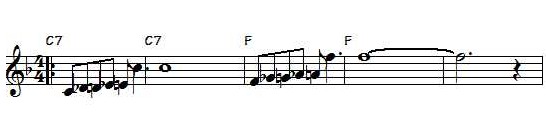
When we play Ole Miss Rag, we usually treat it as having just two simple themes. I am sure you know them. The first starts with these four bars:
This theme comprises 16 bars (played twice to make 32), though there is usually a 'tag' stretching them to 20 bars as they lead into the second theme, which is also played in F. Its first four bars are:


And bands stick on that second theme for their improvisations. That's all there is to it!

At least, that's how hundreds of bands play this piece, including (I admit) bands in which I have played.

But we are all WRONG! Marla and her team have given us a version that is faithful and authentic in sticking to what Handy wrote - and what he himself played. Listen to a wonderful historic recording of Handy's own band playing the piece in 1917:

Notice how it has a well-composed Introduction and also a substantial middle theme of 32 bars. We have dropped both of those features from our performances. What's more, it changes key from F to Bb for the final theme (correctly known as the 'Trio'). Today's bands have forgotten this key change.

Now watch and listen to The Shotgun's version:
Note how from 23 seconds until 1 minute 03 seconds the band is playing the middle section that the rest of us omit. And note how, for the final theme (the 'Trio') at 1 minute 23 seconds they correctly switch into the key of Bb, while the rest of us incorrectly stay in F.

In 'Comments' beneath the video, Shotgun member John Dixon has said All the credit to Twerk, James and Boeddinghaus for transcribing the original W. C. Handy version - what may best be described as the beautiful mess. There's so many little weird and anachronistic parts to the original that it's no wonder it's gone through changes.

This shows us what a lot of hard work is done behind the scenes in order for the top traditional jazz bands of today to be able to present us with performances such as this. The Shotgun Band included this tune in this 'correct' version on their CD (entitled Stepping on The Gas) early in 2017 and David Boeddinghaus is to be heard playing piano on that.

Well done, Shotgun. A lesson to us all.

Here's what Handy actually wrote.
Then comes the theme most bands have dropped.
And on the bottom half of the final page comes the 'second theme' we all know and play - though most of us fail the key change test.
By the way, the Ole Miss of the title was the train that used to run from Memphis to New Orleans.
It's just occurred to me that I enjoyed that very journey by rail on 18 October 2016, though Amtrak had some new rolling stock since Handy's time. Here we were - boarding the double-decker train at Memphis Station at 6am:

5 January 2017

Post 463: NEW SHOTGUN ALBUM! WHAT A TREAT! 'STEPPIN' ON THE GAS'

What a treat to start 2017!

On New Year's Day Marla and John Dixon's Shotgun Jazz Band released their latest Album, entitled Stepping On The Gas.

It was recorded, like their previous one, at the former Luthjens' Dance Hall. The acoustics were again terrific. Every instrument can be clearly heard. Basically, a six-piece band was used. This was the regular five - Marla Dixon on vocals and trumpet, John Dixon on banjo, James Evans (reeds), Charlie Halloran (trombone) and Tyler Thomson on string bass - plus David Boeddinghaus on piano. But on six tracks they became a 'Big Band' by adding Ben Polcer on trumpet and Tom Fischer on reeds.

I believe the combination of John Dixon on banjo and Tyler Thomson on string bass is just about the greatest in the world for driving along the raw style of New Orleans jazz in rock-steady four-to-the-bar form, and they are well complemented here by the totally dependable David Boeddinghaus. As for James Evans, he is now established as one of the greatest reed-players to be heard anywhere. He has that wonderful artist's knack of making everything sound relaxed, even though he always plays in a hugely creative and technically brilliant manner. And fans of the trombonist Charlie Halloran will particularly enjoy his lusty contributions on such numbers as Smiles, My Old Kentucky Home, She's Crying for Me, and Old Miss Rag. He adds so much to the gutsy, gritty qualities of which the band is proud. Marla, of course, is a gem - great as a band-leader, one of the best trumpet-players and always passionate and distinctive in her singing. She seems to me to know virtually every tune in the book and to have memorised the words of hundreds of songs.

This recording is specially exciting because, in terms of personnel, width of repertoire and quality of the arrangements, it is the most ambitious Album the band has made.

I often complain that bands spin out tunes for seven or eight minutes, even when nobody is dancing. They seem to think almost every member of the band must solo on at least one 32-bar chorus. Such performances can be so dreary. It would be better to keep tunes brief (as they were on the great recordings of the 1920s).

On this Album, The Shotgun Jazz Band seems to have adopted exactly that philosophy. Eight of the tunes are completed in under three minutes. And only three tracks run for over four minutes. This also allows for a goodly number and variety of tunes on the Album: there are 18 in all. 

As the title suggests, much of the Album is inspired by the work of the Sam Morgan band, whose recording of Stepping on the Gas (1927) is closely imitated by the Shotgun, right through to the neat Coda. The Sam Morgan band used two reeds and two trumpets. I guess that is why the Dixons added the extra two instruments for this track. Their 'Big Band' is used to good effect on this tune, as well as on She's Crying for Me, Down by the Riverside and Old Miss Rag.

Throughout the Album, notice the use of neat, intelligent head arrangements usually showing great respect for the original recordings. For example, White Ghost Shivers (for me the most interesting discovery) closely follows the original recording made in the 1920s by The New Orleans Owls. It is a romping number which, to my ear, appears to begin with a spooky theme in C minor, followed by a 16-bar theme in E flat and a further 16-bar theme in A flat – both the latter allowing for plenty of little breaks. There is a great Coda, just as on the original 1920s recording.

She's Crying for Me - also played by the 'Big Band' - is similarly close to the original 1925 New Orleans Rhythm Kings version composed by Santo Pecora. Essentially in A flat, it is complete with the two key changes taking it into and then out of F for a 12-bar blues interlude.

With some of the tunes, you feel immediately as if you were at The Spotted Cat, with Marla's regular band of five or six musicians in cracking form. This is especially true of Smiles, The Curse of An Aching Heart, Pretend, Whenever Your Lonesome, and My Old Kentucky Home. On this last number, Tyler is the singer: it has become one of his party pieces.

There are some interesting performances of obscure numbers. For example, Rose of Bombay is a tune I had not heard before. Apparently it was recorded in 1923 on an Edison Cylinder by Rudy Wiedoeft's Californians. It is a pleasant leisurely number with a Verse followed by a 32-bar Chorus somewhat reminiscent of Hindustan: it uses plenty of minims and semi-breves.

Then there is Guilty – not the song of that name recorded in the 1930s by such singers as Billie Holiday and Al Bowlly - but rather one written and recorded in 1974 by Randy Newman. Marla sings it, accompanied by John on the banjo for a whole two minutes before the full band joins in.

In Breeze and Moonlight Bay the band plays the Verses as well as the Choruses! I bet there were not many of us who knew these Verses.

Marla Dixon
Marla also sings I Hate a Man Like You; and the entire Album begins in a surprisingly simple, tasteful way with Gulf Coast Blues, the 1923 composition by Clarence Williams, recorded by Bessie Smith, which Marla sings mostly with accompaniment by David on piano - very much on the lines of the original, with David taking the Clarence Williams rôle.

Another interesting vocal is How Am I To Know?, sung by James Evans. Apparently it comes from a 1920s film called 'Dynamite' and was composed by Jack King with lyrics by Dorothy Parker, no less! 

The old pop tune Pretend You're Happy When You're Blue, composed by Lew Douglas, Cliff Parman, Frank LaVere and Dan Belloc, is very pleasantly performed, with a vocal from Marla. Why did it take so many people to compose it?! (I believe it was actually Lew Douglas who did most of the work.) After the final vocal, the Shotgun round it off (as also in My Old Kentucky Home) from the Middle Eight - a tactic we should all adopt from time to time.

Charlie takes the lead very movingly on the oldest composition on the Album - Deep River, which is the final track and very effectively winds down the concert. What a beautiful way to bring the Album to an end!

Finally, I must make a special point about Old Miss Rag. The Shotgun Jazz Band plays the tune correctly - having studiously gone right back to the original sheet music. There are three themes, two of which are in F, with the final theme in Bb. THIS is how we should all be playing it! But I'm afraid most bands these days offer a slipshod version in which we play just the first and third themes - and both in the key of F.

W.C. Handy would be disappointed with us. But he would be thrilled to hear the authentic version offered here by the Shotgun.

But now you need to know how to obtain the Album. The simplest way is on line. I found that it downloads in less than half a minute. The wonders of technology! Here's where to go:
https://shotgunjazzband.bandcamp.com/