Welcome, Visitor Number

Translate

Showing posts with label improvising. Show all posts

5 March 2018

Post 604: HOW KINGSLEY AMIS DESCRIBED TRADITIONAL JAZZ

Over the years, I have jotted down interesting and insightful remarks I have come across concerning traditional jazz. I would like to share some of them with you.

Ken Colyer (one of the most important English traditional jazz musicians of the second half of the Twentieth Century):
Take it easy. Keep it down. Give plenty of light and shade.

Ben Marshall (banjo-player) writing in The Ken Colyer Trust Newsletter, December 1992:
...the whole band acting like a rhythm section, concentration on ensemble work, seeking the inner rhythms, dynamics, swing, lift, energy, passion, all the things we talked of for hours on end.

From Ken Colyer: A Musician for All Seasons, by Malcolm Robinson, Spring 1990 (in Jazz Beat):

Through the months that followed, Ken learned and developed his playing, and achieved his still unmatched understanding of the subtle dynamics and harmonies of the beautiful New Orleans music: the easy tempos, the relaxation, the emphasis on ensemble with no one instrument ever dominating, the solos growing out of the ensemble, the rolling beat with the trumpet always riding the 4/4 bass figure, gently pushing then pulling back like a surfer; all to create the feeling of tension, relaxed heat and bounteous emotion that New Orleans jazz fans understand so well.


From a book about Preservation Hall:

....music in the African tradition - circumlocution rather than exact definition...

Narvin Kimball:
In those days, players had to learn to 'sleep fast'.

Kingsley Amis (in The Times, March 1991):
Rhythm was what made you tap your feet in time to the stuff, and you certainly did that if you were not actually dancing to it. If alone, or in the right company, you gave little yells of enjoyment and encouragement, as some of the listeners do to this day. With a four-man rhythm section, piano to drums, pounding out their four-to-the-bar in a contentedly unliberated fashion, and the wind instruments often avoiding the actual beat but never ignoring it, nobody who was not worse than deaf could fail to respond to the driving pulse. Of course, it was more a metrical pulse, and real rhythmic interest and diversity lay in what those other instruments, aptly called the melody instruments, were playing. And melody, which comes first and last in jazz, as in any self-respecting music, is in another sense the heart of this.
To reproduce the tune, the air, to do no more than embellish it, was likely to be thought inadequate except in slow ballads. Effectively the aim was an alternative tune, a counter-melody, or a disconnected series of them, sometimes in scraps rather than flowing, improvisatory in manner, delivered here in a solo passage, there divided among two or three, dry and harsh rather than limpid in tone, often distorted in pitch, its points of tension arranged across the steady underlying beat. When successful, the result was exciting and absorbing in a way otherwise unknown, intense but abstract, encouraging no mood or thought beyond itself, satisfying.

Benny Green:
It would seem that there is in the make-up of a jazz musician a strong instinct of defiance of authority and contempt of humbug which has always seemed to me one of the most attractive features in the jazz world. I have seen so many bubbles of pretension pricked by every grade of humour from epigram to obscenity that I am now convinced that the jazz musician is one of the most beautiful creatures on the planet.

An Irish fiddler speaking on BBC2 on 23 February 1991:
The great thing about traditional music is that it has no shelf life. There is no sell-by date.

26 January 2018

Post 592: A MUSICAL TEST PIECE - 'LAURA'

I was thinking about the tune Laura, composed by David Raskin in 1945. To my mind, this is a most beautiful piece of music; and yet I find it difficult to play and virtually impossible to improvise on.
David Raskin
Although, like thousands of other songs, it has a 32-bar structure, Laura is based on an extraordinary and complex chord progression. It runs through far more chords than the typical traditional jazz band tune. In fact, I think it uses 17 different chords. And the melody notes are sometimes on the ninth note of the chord.

There is on YouTube a brief video of Raskin himself playing the tune. Listen. Watch his hands. Note the rich succession of chords. CLICK HERE TO VIEW IT.

It struck me that this would make a very good test piece for a traditional jazz musician. I would be very impressed by anybody who - without using a chord book or the printed music - could play a decent full 32-bar improvisation on this tune.

One of my friends is a very fine English guitarist of the younger generation (by which I mean he is under 60!). He is booked frequently to play at festivals. So I asked him whether - without referring to a chord book - he could play Laura, complete with an improvised chorus. He responded first with a twinkle of the eye, because he knew exactly what a challenge I was setting. But he picked up his guitar and immediately played a couple of perfect, magical choruses, just for my personal entertainment. He had clearly passed the test. I was mightily impressed and felt privileged to hear it.

I have written about Laura before - in a post which you can read BY CLICKING HERE.

10 October 2017

Post 556: 'MEET ME IN ST. LOUIS' - A TUNE WORTH PLAYING

It struck me recently that a very good tune to play is Meet Me in St. Louis, Louis. Why?

First, it is a good melody but is rarely heard these days. With or without a vocal, it is a great tune to include in a programme.

Next, if you examine its structure - particularly the chord progression - you will find it is very simple, and therefore a good one for learners to master. And it trains you in so much that will be the basis for more difficult tunes as you progress in your studies.

For example, it is a 32-bar tune, with an AABA structure. You will discover that about 80% of all the traditional jazz tunes we play are based on such a structure.

The Middle Eight uses the chord progression:
III7  -  III7 - VI7  - VI7 - II7  - II7  - V7  - V7.

It is essential to become fluent in improvising over this progression because dozens of our tunes use it for the Middle Eight (sometimes with very slight variations).

The 'A' sections also use essential, basic chord progressions, all beginning with three bars on the tonic chord (I).

So beginners would do very well to practise improvising over this tune. It is an archetype for so much of the music you will have to learn to play in a traditional jazz band. If you can succeed with this tune, you are launched on your career as a jazzman.

I was surprised to discover that this song is well over 100 years old. It was composed in 1904. The music is by Kerry Mills, who also contributed such tunes as At a Georgia Camp Meeting, Whistling Rufus and Redwing to the repertoire that our bands still play. The words are by Andrew Sterling, who collaborated with several well-known composers over a number of years. (He also wrote the words for Wait Till The Sun Shines, Nellie, for example.)

In original performance, it had seven narrative verses (interesting in the context of their time), each followed by the Chorus. But generally it's best these days to forget the verses and work with the very fine Chorus. Here's my attempt to write it out. I hope this helps someone. By the way, it was originally composed - like several of the tunes we play - in waltz time (3/4) but it works very well as a typical jazz number in 4/4.

Finally, here, as a matter of interest, is how the beginning of the first verse looks in the original sheet music:

18 February 2016

Post 393: JAZZ IMPROVISING FOR BEGINNERS - TRY THIS

I receive many emails from readers who tell me they are in the early stages of trying to play traditional jazz. They ask whether I can help them.

Unfortunately, I am no great expert and certainly not a music teacher. I tell them there is quite a lot of help available on the internet (such as Lasse Collin's site and Charlie Porter's videos) and I have referred to these in several of my articles.

These emailers tell me they hope one day to play in a band but at present they are mastering their instruments, and learning tunes and chord progressions.

Maybe you should start by watching this excellent little video, which makes very clear how the trumpet, trombone and clarinet can improvise collectively:
CLICK HERE TO VIEW.

While I was listening recently to a performance of Till We Meet Again, it occurred to me that I could at least recommend this super tune to you as something on which to practise.

Why?

Well, for a start you can take it quite slowly. Next, it includes two essential basic chord progressions that will turn up in very many tunes, so you need to feel comfortable improvising over them.

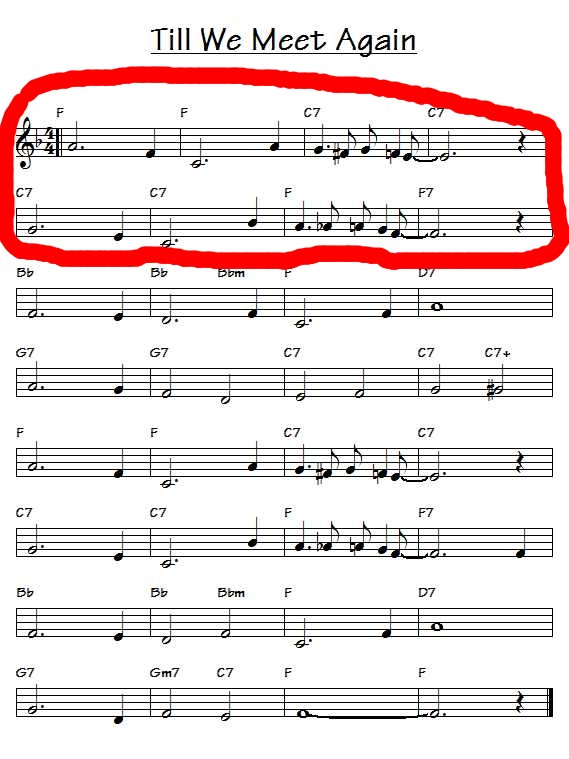
First you need to look at what goes on in this tune. So let's consider it, in the key of F.

We discover that it is a 32-bar tune (the most common type of all) and it is structured ABAB (each letter representing eight bars).

So you have two 'A' sections that are pretty much identical. These eight bars (marked in red below) use one of the most common chord progressions:

I    I    V7    V7    V7    V7    I    I

This movement from the tonic chord to the dominant and then back is found in very many tunes.


The F7 in the eighth bar leads perfectly into the Bb chord of Bar 9.

The 'B' sections use The Sunshine Chord Progression (also used in dozens of tunes). I have written about The Sunshine Progression in several articles. For example, click here to read one. Every jazzer must get the The Sunshine Progression into his fingers - in a range of keys.

In the first use of this progression, Bars 15 and 16 hold on to the dominant 7th (C7) rather than resolve completely to the tonic. The purpose of this is to lead back to the melodic theme all over again in Bar 17.

But when we reach the final eight bars of Till We Meet Again (B for the second time) we find the full Sunshine Progression - ending on the tonic to round the tune off perfectly.

So here is the full chord chart (in F):
Now: how about improvising? A simple way of creating an improvisation is to use this chord chart [F   F  C7   etc.] and simply play notes from the relevant chords as you go along. Basic arpeggios to begin with. For a beginner, this is not easy. That is why it helps to work with a slow tune such as this: it gives you time to think.

Don't forget that if you are a Bb or Eb instrument, then the Concert key of F will become G for you (Bb instruments, i.e. most trumpets and clarinets) or D for you (Eb instruments).

To give you some idea how this improvising-on-the-chords business works, I put the tune into Band-in-the-Box and then let my computer play it while with my cornet I tried to play notes from the arpeggios of the chords. I mostly used notes above the melody, in order to avoid clashing with it. To watch my attempt - or play along yourself - CLICK HERE.
Till We Meet Again was composed in 1918 by Raymond Egan, with words by Richard Whiting.

...............................
FOOTNOTE
The book Playing Traditional Jazz by Pops Coffee is available from Amazon.

9 February 2016

Post 384: 'THAT'S A PLENTY'

When we are fortunate enough to come across the original piano sheet music for one of our tunes from many decades ago, it is interesting to compare the composer's intentions with the way in which our bands now perform the work.

Usually, we find tricky musical phrases (easy enough for a pianist's fingers) have been modified and 'simplified' to make them playable on a trumpet. Sometimes we find that whole sections of the piece have been dropped.

That's A Plenty was composed by Lew Pollack as a 'Rag or One-Step' way back in 1914. It was stirring as a piano piece. Looking at the original sheet music, we notice it was composed in 2/4 time. Our jazz bands of course play it as 4/4, with all of Lew's quavers treated a crotchets. But the bands stick with his keys: F for the bulk of the piece, going into Bb for the Trio.


As you can see, he opened with a four-bar Introduction. Today, pretty well all bands have dropped this, starting straight away with the Section I have labelled as A. We keep fairly close to his original melody in Section A, though we tend to put in some more rhythmic alternatives and a few more notes, rather than his steady succession of quavers. As in the original, we play the repeat (making 32 bars on A in total).

We then move on to Section B (involving those triplets). Again, we follow Lew Pollack in playing this Section with the repeat (so 32 bars in all). But I think none of us can claim that we actually play more than 60% of the notes Mr. Pollack wrote for Section B. Particularly in Bars 5 - 8, we have devised our own simplification. (Some bands, by the way, leave out Section B [and what I have called Section C] altogether.)


After Section B, most bands go back to Section A, playing it through again (but without the repeat) in much the same way as they did the first time. As you can see above, however, Mr. Pollack made it much more decorative this time round (the part I have marked as Section C) with those leaping triplets in the pianist's right-hand that no trumpet player could possibly play.

We then come to the change of key and the part originally called the 'Trio'. I am labelling it as D.


This is a 16-bar Theme and it also happens to be the part of the composition which our traditional jazz bands use for their improvised solos, of which several are usually offered. It is an easy chord sequence on which to improvise - The Jada Progression, about which I have written in this article - click on to read.  Maybe this explains why bands like to play That's A Plenty: it sounds impressively clever and complicated but in fact the 'soloing' is easy!

Mr. Pollack then has a Section I have labelled E. Again, it is unplayable on the trumpet. But we have kept the spirit of it, turning it into what we call the Bridge (and playing in a kind of Fanfare format, on Pollack's chords) before going back to D for the soloing.
We also follow the composer in the way we end the piece. Essentially, we repeat the melody of D. I have labelled it F (=D2) above. Pollack's markings show he wants it to be played in a slow, stately fashion (marked Grandioso); and he prepares for this with a crescendo and a slowing of tempo in the preceding two bars. There's no reason why our jazz bands should not also give it this slow, special treatment in a final chorus. That would be quite effective. But I have not heard a band do this.

However, on the whole, I think it is remarkable how well our bands have treated Mr. Pollack's music. We still frequently play That's A Plenty; and we adhere to the spirit and structure of the original piece. In fact we even play most of the notes as intended!

Unfortunately, there do not seem to be many good videos on YouTube of 21st-Century musicians playing this tune. You could try one I filmed of The Shotgun Jazz Band (as a quintet in this case) playing it very well at The Spotted Cat in New Orleans in April 2016: click on here to view it.

Many bands play it too fast; and in some videos the sound quality is poor. However, you might also like this one - click on to view. One of the players is Gordon Au (trumpet). I have admired his playing for a long time.

10 January 2016

Post 350: TRY FLOATING ON THE 9th

Something to learn when you are mastering the art of improvisation is that playing the 9th above a chord can be very effective.
Assume that the chord for a couple of bars is C7th. This means the notes in the chord are:
  C  -  E  -  G  -  Bb.

While the rest of the band sustains this chord, try playing the D above it, in effect turning the chord into a 9th. It can be quite exciting. It gives a pleasant sensation of 'floating' above the chord. 

For a simple example on YouTube, 
CLICK HERE

and notice how (at 36 seconds until 38 seconds) Shaye on the cornet plays a series of Ds above the chord of C7th. It is one of her favourite devices, though she probably does it so instinctively that I doubt whether she herself is aware of it. In other performances, you will find her holding the 9th as one long continuous note.

When improvising, try occasionally playing a D above a C chord, an E above a D chord, a G above an F chord, a C above a Bb chord, etc.

You will also frequently come across moments in songs where the composers themselves use the 9th as the melody note. Here's a simple example. Think of the song from 1930 'I'm Confessing That I Love You'. It begins with the words 'I'm confessin' that I love you. Tell me do you love me too?'

That word 'too' is the 9th of the chord in the harmony at that point. If the song is being played in the key of F (as it usually is), the chord is D7th (D     F#   A    C) but the melody note is E.

You can hear the effect in your head, can't you?

3 October 2015

Post 268: THE SAME 'IMPROVISATION' TIME AND AGAIN!

A reader from Essex, England, sent me this interesting comment:

I learnt from your blog that many tunes share the same chord progression e.g. the Sweet Sue Progression, which makes life easier for the rhythm section. But then I thought that perhaps this applies to the clarinet and the trombone parts as well. Could it be that a clarinet player has learnt after many hours of practice a standard part for a chord progression that fits many songs or put another way, if you played through all the tunes listed under the Sweet Sue Progression would the clarinet player play the same thing each time (obviously with variations to fit the particular tune)?

..............I know that some very talented musicians could make up something different every time but there must be lesser mortals who learn a set piece and always play that way.

The reader is right.

I'm sure there are great players who do not depend on learning and repeating pet phrases. But it is possible (and tempting) to use the same sequence of notes in several different tunes, if they fit.

I know a clarinettist who plays exactly the same notes in ensembles and exactly the same 'solo' choruses at every performance. Audiences don't notice, but I have heard his fellow musicians complain that what he offers is not really jazz and that playing-by-rote prevents him from contributing to the special excitement generated when instruments feed off each other and respond to what the other is saying.

However, even the very best traditional jazz players have developed a number of pet phrases (known as 'licks') that occur frequently in their playing over familiar chord sequences.

3 September 2015

Post 258: SHAYE COHN'S MOZARTIAN QUALITIES

I have said before that Shaye Cohn's playing reminds me of Mozart. In particular, it makes me think of the viola part in Mozart's string quartets.
Here's why. Mozart's quartets are like lively interesting well-informed conversations between four intelligent and sympathetic friends. If you study the viola's rôle in a Mozart string quartet, what do you discover? 
Extract from a Mozart String Quartet
 - highlighting the Viola's rôle.
The viola sometimes takes the lead (playing the melody, you could say) but more often you find it responding, commenting cleverly and perceptively on the remarks of the others, coming up with surprising original thoughts, sparkling and witty, or sad, sympathetic and pensive as the occasion demands. It can play very quickly, producing a lot of notes rapidly when there is something exciting to say. But the viola does not show off or attempt to dominate. It both compliments and complements the contributions of the other instruments.
Mozart (1756 - 1791)
Shaye's playing in any jazz ensemble is exactly like that. She is not a showy player. Not from her will you hear those screaming, raucous, high-note 32-bar solo choruses to which so many traditional jazz trumpeters resort (though she easily plays notes such as A5 [SPN] when the melody requires - as in Variety Stomp and Dallas Rag). One of my readers emailed me to say he watches her solos 'with anticipation. What comes next? Her playing is so unpredictable'. I know exactly what he means. The rest of us can play corny cliché-ridden improvisations but Shaye seems effortlessly to come up with phrases that are magical and stunning in their originality.

She is so energetic in her playing and her thinking. One of my regular correspondents - Lou in the USA - has twice sent me emails in praise of Shaye; and they are worth quoting:
I couldn't agree with you more. I find myself more and more separating her horn from the rest of the piece. I've discovered that she has a very versatile tongue. One just knows that she doesn't have to think about what's coming next for her. She may think ahead for the arrangement, but her playing just flows naturally. I can hear the little notes she drops here and there that she just has to do because they belong. 
and:
I marvel at her stamina in numbers like 'Weary Blues'. She just blows her heart out, all in such a matter of fact way.
think Lou is absolutely right.

Shaye produces a unique tone that perfectly encapsulates the blues feeling that is at the heart of so much of our music. Listen closely to her busy fluent phrases, often muted and in the background, interwoven brilliantly into the polyphony of her band's wonderful music. That's why I am reminded of the viola in Mozart's string quartets.

Shaye has an instinctive understanding of rhythmic possibilities, subtle and surprising harmonies and progressions, even when improvising at high speed. She can 'bend' notes to great effect and in exactly the right places.

She always works hard to encourage great teamwork from the band, not just to display her own skills. Her playing takes account of (and usually directs) all that is going on around her.

Bearing in mind that she is not only brilliant on the cornet but is also one of the very best on the piano and violin (and is an arranger and a formidable composer - just think of Pyramid Strut and Tangled Blues, for example), I have to say I have not come across a traditional jazz musician who impresses me more than Shaye. She is simply the best.

12 April 2015

Post 198: REPERTOIRE AND PLAYLISTS

King Richard III and His Jazz Band
Recent painting by my friend Peter Bunney

http://www.peterbunney.com/gallery/
My 'Kenny Ball' post about repertoires and playlists attracted several interesting responses. I had wondered what policy a band should adopt. Here are the two extremes.

Policy 1
Master a small number of tunes (let's say 40) really well. Aim at smooth, accurate, polished performances. Even some of the 'improvised solos' could be virtually repeated from performance to performance. You will be playing on automatic pilot. Always stick to a playlist selected from these 40, obviously while trying to match the tunes to the occasion and to provide variety of tempos, keys, etc.

Policy 2
Aim to have a repertoire that runs to, say, 200 tunes, with some dropping out and new ones coming in all the time. Seek constantly to add new tunes to your repertoire. Be bold and experimental.  In performance, live dangerously. Have a fresh playlist for every gig - not allowing any tunes to become 'stale'.

Those are, as I say, two EXTREMES. I doubt whether any of us would adopt either of those policies exactly as I have stated them. However, in my experience most bands are closer to Policy 1 than Policy 2.

With their permission, I offer you below a selection from the comments I have received. I think these gentlemen offer us a thoughtful, interesting and common-sense approach.
=======================
FROM BOB ANDERSEN
Hi Ivan,

For my band, the Uptown Rhythm Makers (www.facebook.com/URMjazz) I always tailor the playlist to the event we're playing. And, I introduce 2 or 3 new tunes every month so we don't get into the trad jazz band rut of playing the same tunes over and over. Some turn out to be keepers, some not. And, that way, there's more to choose from when making a playlist for a performance. Makes it easier to spread the vocals around, change tempos/moods from tune to tune, and not play in the same key over and over.


Bob Andersen

-------------------------------------------------------

FROM RICHARD BOSWELL
In my bands there are 2 schools of thought: one is that it is better to have a couple of dozen tunes that we can pitch up with and play on auto pilot – reasonably well; the other is that we should always tailor the playlist to the venue and introduce new tunes as deemed appropriate.

I tend to hold with the former as I would always prefer to turn in a passable performance – after all, we are all just part-time players, not professionals.

Having said that, I don’t follow the strict edict that the trumpet player must always lead with the melody. When I dep with other bands, they often have tunes that I don’t know or may have learnt in a different key (a couple of examples – I play Bourbon Street in F, some play it in Ab; I like Muskrat Ramble in Bb, others play that also in Ab). So I say to the rest of the band: 'Does anyone know the melody? If so take the lead and I will harmonise.' – It doesn’t always have to be the trumpet; it's often nice to have someone else at the front.

It is also the case that in my band I will sometimes throw in a new tune at a rehearsal and the guys are quite happy to play along if the melody is clear and the chords follow a reasonably standard pattern. But like you, if it seems difficult we drop it quickly but also if it seems just plain boring! Have you found that sometimes you hear a tune on the radio, CD or YouTube and think it would be great to play – but then when you try it, it just doesn’t seem to work? That is quite common for us. I think in most cases it is because they need a good vocalist. Some tunes just don’t work as instrumental numbers.We’ve got a repertoire of about 85 numbers but still end up playing the same hard core of a dozen or so.

The other thought is that I used to love going to see Kenny Ball in concert. What an inspiration. Great trumpet player, fun band, always a good performance. But I noticed that the band would have a concert repertoire that they would repeat at each gig that year, in much the same order, with pretty much the same solos. Perhaps it was because he had famous recordings that people expected to hear – but some (not me) would argue that perhaps this wasn’t “proper” jazz because it wasn’t on-the-spot improvisation. Then again, once you’ve learnt the tune, is it ever spontaneous again?
--------------------------


FROM RICHARD LUND

First of all, thanks for this blog!
I'm a Jazz musician who has played one version of Traditional Jazz or another for over 20 years, but until recently nowhere near a level you could call professional, so the information you collect here is very informative and useful to me!
About your latest post:
To me, there's a place for both kinds of playing, pre-arranged and improvised.
In the beginnings of Jazz recordings, most bands would rehearse songs in a very specific way and have the arrangements and solos pre-determined with only very little variation (recording time and material was expensive, I guess, and you wanted the record buyers to get you at your best).
So technically, you could call this "Traditional" - except that back then (as far as I know), it was only used for recording.
Another good place for pre-arranged music is in Jazz Orchestras where you have multiple brass and reed instruments that play harmonic lines, e.g. some of King Oliver's later orchestras or Duke Ellington. This style is something I love hearing because of the wonderful sounds of multiple reeds harmonizing together.Howwever, what I personally consider Traditional Jazz is MOSTLY improvised and NEVER exactly the same - even the melody undergoes slight variations every time it is played. True, there are certain things you do always play the same - like a clarinet playing harmony over parts of the melody. There's things that simply work best this way. But as a musician, I'd say you can still be open to changing it if you realize that you just came up with something even better.
I have to say that I write this from a somewhat unusual situation. I play clarinet and have the Traditional style down well enough that people have commented on it. However, I lack repertoire. When sitting in with good bands, I may know only 10-20% of the songs they are playing, and I have to learn the harmonies of the song on the fly. So no, you will not likely hear me play the same thing ever again in such situations :-)When I was in a teenage Dixieland band, our saxophone player would play nearly the exact same solo (or at least the beginning of it) every time to a particular song. Granted, it was a great melody he had come up with, and we liked to have fun with him about him using that line again to the point where we'd all sing it along with him :-)
I know a professional musician in New Orleans who plays 6-7 hours every night in the same location. I have noticed that when he plays by himself with two or three guys in the rhythm section, he has to play a certain style and include some more modern show tunes to keep the audience interested. However, add a few more horns, and he livens up and will start playing the good stuff! And once the energy of the entire band gets going that way, he can play all sorts of other things that he couldn't play just by himself.
So, in summary, there's a place for pre-arranged music in Jazz no doubt. However, I am not quite certain about your description of Kenny Ball's band. If I were to play in a band that a year later was playing everything exactly as before, note by note, I'd be missing a lot and would probably not be happy playing in that band any more.
In Jazz, I need the freedom to express myself as I am in the moment. As much as I like the Jazz orchestra sound, it does not give me that freedom, so the improvised Jazz style will always be my personal favorite and my passion.
Richard Lund
-------------------------------
FROM JOHN (Banjo and Band-leader)
Hi Ivan,
We have a basic to do list of about 50 tunes, which we can play immediately, when constructing a program. We also introduce two new tunes at each practice. We also reserve  one chorus in each tune, in the practice, where everyone, apart from the chord player(s) has a go at improvising on the chords. Sometime chaotic, but more often very interesting, and sometimes leading to something we will keep and feature in a program.
In tunes like "Black and Blue" this can be extended into two or more choruses, as it is a lovely tune. Other choruses follow the more traditional pattern, with chords, background melody, and one person improvising over the top.
Best wishes,


John
------------------------------------------------
FROM RALPH (Banjo)
Thanks for this.  It's very good stuff.  I particularly picked up on Richard Lund's implied observation that the recordings we avidly listen don't necessarily reflect the way the great traditional jazz bands from the early 20th century normally played.  It comes down to what we as amateurs want to play now.  Do I want to copy exactly a performance I particularly like, or am I inspired by great playing and want to play better myself but in my own way?  And how do I feel about how I want other musicians that I play with or listen to?  I tend to be "inspired but individual"  rather than "tribute", but do find myself judging a bass player on whether he can play "Big Noise from Winetka" as a duet with the drummer - simply because at the age of 15  I witnessed Vic Barton and Johnny Richardson perform this in Moorends for a tanner. I suspect all musicians have conflicting inner driving forces. Mine are dominated by my skill level, which is low, so for me to try and emulate, say, Johnny St Cyr, Cynthia Sayer, or Don Vappie, would be over-reaching myself and absolutely disastrous.  This is why I live dangerously by playing a wide variety of tunes rather than mastering a few. I really envy the numerous amateurs who are skilful enough to choose.

Ralph

19 February 2015

Post 173: USE THOSE 6THS AND 9THS

Introducing flattened thirds and sevenths adds colour and excitement to a tune; but it's also interesting to throw sixths and ninths into your improvisations.

Listen to a great creative player such as Shaye Cohn and note how frequently she gives a lot of emphasis to 6ths and 9ths - especially at the start of one of the final choruses, when she is still finding fresh approaches. For example, a tune may begin with two bars firmly on the C major chord but you may find Shaye decisively hitting several 'A's (the 6th). Or in a tune beginning with the D major chord, she will deliberately and firmly go for the 'E' above the chord, making a 9th.

Composers have been well aware of the effect gained by making the sixth or the ninth the melody note at a particular point, too.

Think, for example, of You're The Cream in My Coffee played in the key of C. You find many of the melody notes are D played above a C major chord, or A played above a G chord.

Or take There'll Be Some Changes Made played in the key of C. What do you find? Lots of Bs above the A chord, and plenty of Es above the D chord. 

Another is If I Had You: Think of it in the key of Bb. Numerous times in this song, you find (yes - in the composed melody) a C being played above a Bb chord. You find a G being played above an F7th chord. And you find Cs being played above Eb chords.

I'm Crazy 'Bout My Baby is another. Its Middle Eight is unusual, its special effect being achieved by the fact that the melody notes are so often the 6ths or the 9th of the chords.

Effective, isn't it?
===============
Reader Barrie adds:
Hi Ivan,
I agree with your statement about using a 6th and a 9th. I use the 6th a lot, a very useful note. At times it can be sustained over several chords. I mainly use the 9th on the fourth bar of a 12 bar blues. It works well.

21 January 2015

Post 160: MIDDLE EIGHT OF 'MY BLUE HEAVEN'

Sometimes you come across a standard 32-bar tune in which the 'Middle Eight' follows a slightly uncommon pattern. I have noticed this can easily flummox jazz musicians - even very good ones  occasionally.

My Blue Heaven is a case in point. If you take it in the Key of Eb, then the Middle Eight - in simple terms - is:

one bar of Ab
one bar of C7th
two bars of F minor
two bars of Bb7th
one bar of Eb/Edim
one bar of Fm7/Bb7

The progression from the Ab chord to the C7th (it's the Georgia Progression) defies the usual 'circle of fifths' and that is what presents the challenge. So you have to be careful when improvising on this kind of tune and give it some thought while practising. This is the kind of improvisation that might result.
The music for My Blue Heaven was composed by the great Walter Donaldson in 1927.

He also wrote the music for - among others - My Little Bimbo, Oh Baby, Oh Sister Ain't That Hot, 'Taint No Sin To Take Off Your Skin, That Certain Party, Yes Sir That's My Baby, At Sundown, You're Driving Me Crazy, Carolina in the Morning, I Wonder Where My Baby is Tonight, Love Me Or Leave Me, Making Whoopee, and My Baby Just Cares for Me.

What a massive contribution to our music! Maybe one of these days I shall be able to persuade a band to give a concert entirely of Donaldson compositions.

Walter Donaldson was a New Yorker. He died in 1947 at the age of only 54.