Welcome, Visitor Number

Translate

Showing posts with label Street music in New Orleans. Show all posts

15 December 2017

Post 578: YES MA'AM ARE BACK

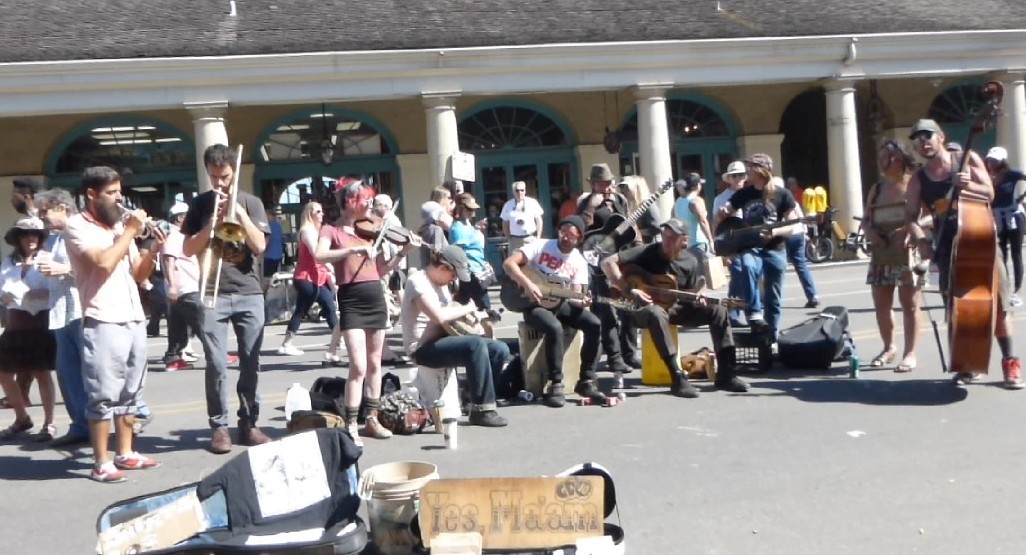
Watch this performance from December 2017 of the New Orleans busking string band Yes Ma'am.


I find it utterly compelling, so full of variety and brilliant musicianship. After the gently stated start, note the changes of tempo, the attention to dynamics, the brilliant little solos, Matt's footwork. It will give you some idea of what this group - and especially its founder and leader Matt Constanza - have achieved in the eight years since he formed the band.

But let me go back.

During my April 2016 visit to New Orleans, I was thrilled at last to hear the string band Yes Ma'am. I had admired their work on YouTube for several years but unfortunately did not come across them when I previously visited New Orleans in 2015.

However, in Royal Street on 7 April 2016, I bumped into my friend Randy (the great video-maker codenamed RaoulDuke504 - he who also filmed the video I have recommended above) and he gave me a tip-off that Yes Ma'am were playing at that moment at The French Market. I hurried over and sure enough there they were.

What a dazzling performance! I can assure you they are even more exciting in person than when seen on YouTube. Each musician individually is a virtuoso. The finger-work on some of the solo choruses was mind-boggling. The songs were witty; and the control of 'breaks' and rhythm (sometimes doubling-up) was so clever and effective. You can't help having a big smile on your face and you can't stop your feet tapping when Yes Ma'am are playing.
Elena Dorn has been with Yes Ma'am since
the early days. She plays the violin beautifully
and her subtle improvisations perfectly complement
the textures of the other instruments.
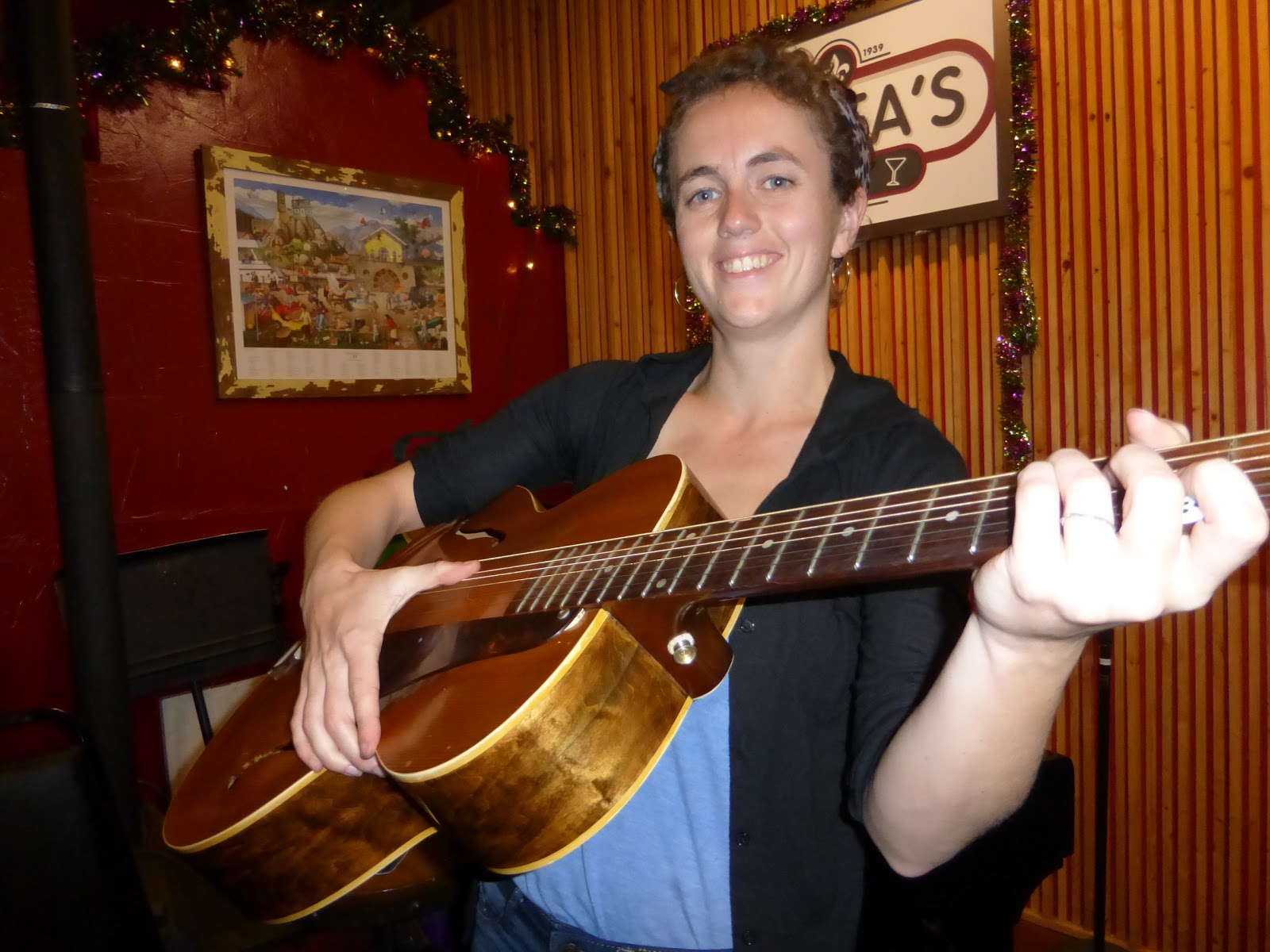
At the break, I was fortunate enough to have a chat with the leader - Matt Costanza. On YouTube, Matt (like Yes Ma'am in general) has always given me the impression of being very laid-back, devil-may-care, unconventional and bohemian in life-style. Well, maybe some of that is true. But I have to report that the man I met that day was also deadly serious about his music, modest, very articulate, extremely hard-working and also kind and generous in talking with me. He allowed me to take this photo.
I thanked Matt for the pleasure his band had given to YouTube viewers all over the world. I told him I was amazed at his own brilliance and versatility: he sits at the centre of the band, playing the guitar with great vigour and lustily singing, while simultaneously providing percussion: with his feet he plays a 'drum' and a tambourine and a bell! In the course of a performance he uses a huge amount of energy.

He very modestly said he did not consider himself a great player. In his opinion, the rest of the band were the technically-gifted players and he was privileged to have them working with him.

Well, there you have the recipé for a perfect team: a leader who is a dedicated, tireless, directing presence surrounded by other musicians whom he respects and encourages to display their skills.

Those Yes Ma'am songs tend to be tricky in structure. Think of the sudden tempo changes. How does the band get to perform them so slickly? And where do the songs come from?

Matt's answers were surprising. He told me he himself now composes about 90% of the material. The band hones and masters it during their many performances on the streets. 

I had guessed they must get together from time to time to rehearse. No, Matt told me. He could recall that they had had two rehearsals. No more.

But is all this really traditional jazz? That's a question I hear some people ask. Well, yes, it certainly is. The links and overlaps between jug bands and string bands and what has become 'conventional' traditional jazz (with a front line of trumpet, trombone and clarinet) go right back to the earliest days; and they have been gloriously revived by the young musicians in the New Orleans of today. Instrumentation in the string bands may be slightly different (though I should mention that Yes Ma'am sometimes - as in the picture below - includes a cornet and trombone), but the principles for playing and interpreting the music are exactly the same.
In the years during which Matt's band has been evolving, there have been several changes of personnel (and I believe he still draws from a pool of players). When I first discovered them on YouTube, they looked like this.
Although two of the ladies from that photo are still usually in the band, the line-up was rather different when I saw them in April 2016. I made a video and you can watch it by clicking on here.

If you would care to hear how they sounded at the end of 2015, click on this performance of Squishin' Bees, an up-tempo 12-bar blues in Bb.

For a very fine video of them with their late-2013 line-up playing a medley, CLICK HERE.

One of my favourites from their earlier days (2011) is this: CLICK HERE  to watch it.

Whatever you think, please watch right to the end: there are surprises along the way. And admire all the little details.

The band appeared to be absent from the streets of New Orleans after the end of 2016. According to an unofficial report, it seemed that Matt felt completely exhausted at the end of that year - hardly surprising, in view of the energy and hard work put into every performance. He decided to take a break, during which he could re-charge his batteries, probably compose some more songs, and make plans for the future. Well, I'm pleased to see he's back.

12 December 2017

Post 577: FEBRUARY IN NEW ORLEANS

I'm looking back on my brief visit to New Orleans last February and, with the help of my photographs, would like to share with you some of the pleasures and memories.

First, some lovely sights.
Next, the flavour of the French Quarter.
As usual, it was a great privilege to be able to video some fine bands playing in Royal Street.
And I had the chance to meet and photograph some of the great musicians whose work I have long admired from 4500 miles away on YouTube. They included Molly Reeves.
I had the pleasure of making a new friend among the musicians - saxophonist Marty Peters.
And it was a great thrill renewing friendship with Marla Dixon and Haruka Kikuchi.
I told Haruka in 2015 that I was adopting her as my grand-daughter, so she now greets me as 'Grandad'!

If you have never seen the storming performance of Royal Garden Blues that I filmed in 2015 (in which Haruka and Marla both play), may I recommend it as a treat?
And this February, as usual, I made time for an occasional stroll by the mighty Mississippi.
I decided this would be my 'farewell' visit to New Orleans. In my old age, and currently being treated for a couple of medical conditions, common sense tells me the 4500-mile journey is too strenuous to undertake any more. But looking at these pictures makes me want to be right back there. I wonder whether I shall be able to make it one more time?

29 August 2017

Post 542: HOW MANY MUSICIANS DOES IT TAKE TO FORM A JAZZ BAND?

How many musicians does it take to form a jazz band? I suppose you could get away with two: a clarinet and a banjo playing 'Rosetta' on a street corner would be just fine.

With four (say: sousaphone, banjo, clarinet and trumpet) you certainly have a band: you produce a full sound and can tackle a huge repertoire.

But of course, when most people think of a traditional jazz band, they picture six or seven musicians, with a 'front line' of three including a trombone and a 'rhythm section' of three or four, which may include a pianist and a drummer.

So is it possible to go above seven?

In theory, I would say 'No'. With greater numbers, there is a risk that the musicians will get in each other's way. What started as lovely music could become a din, especially if several of the instruments were using amplification.

So is it possible for a traditional jazz band to function with as many as ELEVEN players? Surely not.

Of course, in the case of bands playing from printed arrangements, there is no problem: the arranger has done the thinking and the musicians need only play what is on the stand in front of them. This is more akin to old-style dance band music and it is not the kind of traditional jazz to which I am referring.

I am more interested in bands where improvisation, teamwork and creativity are highly valued and nobody plays from printed music. 

Well, I can point you to an example where we see a traditional jazz band of ELEVEN musicians playing very well indeed.

How is this possible?

For a start, they are outstanding musicians, all respectful of each other's roles and of the overall sound. They are well directed - by a leader who gives neat and discreet signals, so that they all know who is taking the breaks and who is to take the next solo and when to go back to Part A. They are seated in such a way that everybody can see the leader's signals (very important). They make sure that all instruments can be heard. Note what discipline and restraint there is among the other players during the tuba solo chorus. Listen to the clarinet and saxophone and note how they never trespass on each other's notes. Importantly, nobody in the band is using amplification, so the overall acoustic effect is fine.

It is a performance filmed in Royal Street, New Orleans. We have to be deeply grateful to that indefatigable video-maker codenamed Wild Bill for being there to film the event for us. What we have is a group made up of some members of Tuba Skinny, with star guests sitting in. They are playing Shake it and Break It.


9 July 2017

Post 525: VISITORS TO NEW ORLEANS

In the last few months, I have received about a dozen emails from readers who had recently spent a week or two in New Orleans. For some of them, it was their first visit. Some were there for the French Quarter Festival; but others had opted for the quieter and less crowded weeks after the Festival.
Let me say straight away that they all reported having a great time and returned home exhilarated. Several had set out with the aim of catching favourite bands. They generally succeeded, and assured me that seeing the bands in person (and sometimes managing a chat with them) was even better than watching great YouTube videos.

Yet there were just a few grumbles too. These included complaints about time-keeping and punctuality. These points were made: sometimes a band is advertised to start playing at a certain time; but they spend so long chatting and setting up, that the concert actually begins almost half an hour late. Similarly, a band told a tourist it would be busking in a certain spot until 1pm, but when he turned up to hear them at 12.30pm, he found they were already packing up and leaving.

I fear such things are bound to happen. In New Orleans, as in many countries of my experience, people have a relaxed attitude to matters of time-keeping and punctuality.

However, the point was made that Tuba Skinny always started right on time (for example, at their dba concerts). There was always high praise for that particular band. Most people managed to catch them at least once busking in Royal Street.

Some of the lesser bands were criticised for poor discipline and a somewhat cavalier attitude to their audiences. Here's an extract from one correspondent:
Arriving at 7pm, I asked where the band was. I was told they were delayed by the non-arrival of one of their number. I chatted to a couple at the bar (2 of the only 3 attendees apart from myself). After that the sequence of events was as follows:
7.30 Band (less the missing one) started playing to about 5 spectators.
7.40-7.45 Trombonist arrived, placing his instrument by his seat on the stage, went to the bar, ordered a 'shot', downed it, ordered a pint and went outside to drink it with a cigarette.
7.55 Trombonist joined the band. Turned out he was also the vocalist.
8.15 1st set finished, the couple having left earlier. I left, leaving about 3 people in the audience.

I must admit having had a couple of similar experiences myself in the bars of Frenchmen Street. But I think such performers are their own worst enemies. They will not make a living and will be soon rejected.

But let us end positively: for an example of the sort of music recent visitors have enjoyed:

28 April 2017

Post 501: CALL ME BACK, PAL O' MINE

The morning started with a run through the new additions to YouTube from some of our favourite video-makers.

I soon had a very pleasant surprise. Louisiana-based RaoulDuke504 had filmed Maddy and Her Jazz Friends in the French Quarter on 27 April 2017, performing Call Me Back, Pal o' Mine. I do not think I had ever heard this song before, and certainly not played by a jazz band.
So it is yet another obscure tune from long ago. Maddy has a knack for unearthing really good ones. Remember Hold You Hand, Madam Khan, Baltimore and Buy Me a Zeppelin?

This tune, Call Me Back, Pal o' Mine, struck me as very pleasant indeed. It has a good melody and it feels as though it is based on familiar chord changes that should present no difficulty to jazzmen. So I hope very much that other bands will adopt it - with or without the vocal. You can watch Maddy's performance BY CLICKING HERE.

I immediately contacted that great benefactor of traditional jazz musicians the world over - Lasse Collin. He has made leadsheets for hundreds of tunes freely available to us on his website. I was so pleased that he also liked the tune and promised to produce a leadsheet for it without delay. A few hours later, he had completed the job, and he let me know that the result can be found at:
http://cjam.lassecollin.se/songs3/callmebackpalomine170428.html
Meanwhile, I had sought out the origin of the song and found that it was recorded in 1922, having been composed in 1921 by Harold Dixon, with words by Lawrence Perricone.

Maddy sings and plays it (in the key of Bb) in 4/4 time. But it seems it was composed as a WALTZ (as, indeed several of our 4/4 tunes originally were).

To hear a lovely but ancient piano roll recording of it (played in Ab) in lilting waltz time, CLICK HERE.

There is also an early Gennett waltz-tempo recording available BY CLICKING HERE.

In 1949, the song was recorded (this time in the key of F) by blues guitar legend Blind Willie McTell. You can hear it BY CLICKING HERE. My guess was that Maddy had probably learnt the song from this version; and indeed she has kindly confirmed this was so. In an email she kindly told me: 'Yes, I did learn it from the Blind Willie McTell recording which was on a compilation my dad listened to all the time when I was growing up.'

Conclusion: let's start playing this tune, with a big thank you to Maddy for reviving it, to Randy for filming it, and to Lasse for working out a leadsheet.

===================
Footnote:

Do not confuse this song with Dear Old Pal of Mine, composed during the First World War by Lieutenant Gitz Rice while he was serving in Belgium - though his song also went on to be famous at the time. If you seek it out on YouTube, you will find it is a quite different song from the one sung by Maddy.

4 April 2017

Post 493: THE SECONDHAND STREET BAND

During my brief visit to New Orleans in February 2017, I came upon this band - new to me - called The Secondhand Street Band. They were playing in Royal Street, giving a spirited performance and displaying considerable technical skills.

Since I returned to England, I have found from the internet that they appear to have been formed in 2015 from musicians who migrated to New Orleans from Sweden, Hungary, France, the U.K, the Netherlands, California, Massachusetts, New York, and even a couple from Louisiana - all seeking to make a living by busking in New Orleans. There are plenty of YouTube videos of them, from which you may observe that they have a variety of possible line-ups and play music in a range of styles (one of which they call 'funky').

I was able to make videos of them performing Buddy Bolden's Blues (CLICK HERE TO WATCH IT) and Between the Devil and the Deep Blue Sea (CLICK HERE).

If you would like more information about the band, their website is:
http://www.secondhandstreetband.com/

Also, to sample some of their recordings, try:
https://secondhandstreetband.bandcamp.com/

17 March 2017

POST 487: EIGHT DICE CLOTH

During my brief visit to New Orleans in February 2017, I had the pleasure of coming across a young band called Eight Dice Cloth playing in Royal Street.

They were very good and gave an entertaining programme. There were seven musicians, including a violinist; and percussion was provided by a washboard.

This band was new to me, but I gather it was started in 2014 and took its name from a game that originated in Nineteenth-Century England and was quickly imported into America, where the dice game soon became known as 'Bunco'. Its popularity has waxed and waned; and in the 21st Century there have been 'Bunco World Championships' held in Las Vegas.

I took the opportunity of making a video of Eight Dice Cloth playing My Blue Heaven. May I invite you to watch it by clicking on here?

A year later I filmed them in an interesting performance of Avalon. Watch it by clicking on here.

I have since found that the band plays in the clubs and bars of New Orleans as well as in Royal Street. It has also made at least one CD. So, if you would like more information, seek them on YouTube and also click here for a link to their recordings.

And for more information about Eight Dice Cloth, including details of the personnel, CLICK HERE.

5 March 2017

Post 483: ST. CINDER - THE STREET BAND

One of the pleasures of a brief visit to New Orleans in February 2017 was discovering this very fine and hard-working string band playing on the streets. They call themselves St. Cinder.
It seems they have been in existence since meeting in Oregon around 2014 and have made at least a couple of CDs. They travel throughout America in an old school bus, and live in it too.

I made a video of them performing 'Blue Moon of Kentucky'. You can watch it by clicking here. On another day I filmed them playing 'Careless Love'. You may see that video HERE.

And I recorded them performing Jabbo Smith's 'Lina Blues': CLICK HERE. You may care also to listen to Jabbo Smith's original version from the 1920s HERE.

You can even watch Jabbo - still wonderful in old age - singing the song HERE.

By the way, I note that there are plenty more videos of St. Cinder to be found on YouTube.

You can learn more about St. Cinder by clicking here. 

31 December 2016

Post 461: THE FRENCH MARKET IN NEW ORLEANS

Here's The French Market, New Orleans, in 1880:
And here it is in 1920:


And here it is - same year - from the other side:


Here are two recent photos showing the interior of The French Market:

Finally, to watch that excellent band Yes Ma'am busking in April 2016 outside the French Market: CLICK HERE.

10 December 2015

Post 327: 'MEMPHIS SHAKE' - A GREAT JAZZ TUNE

There is a terrific video of Tuba Skinny performing Memphis Shake. It is expertly filmed; and the tune - from 1926 - is brilliantly played. Unfortunately the start of the tune was not caught; but I think it's a video you will enjoy.
CLICK HERE TO VIEW.


Todd on Tuba
There were eight musicians on this occasion


22 November 2015

Post 302: OUR MUSIC GOES GLOBAL

A correspondent from Connecticut set me thinking. She said it is a wonderful thing that - thanks to YouTube - performances by the bands on Royal Street, New Orleans, can be enjoyed within hours by viewers all over the world. She said it's as if we are all attending a 'Global Concert'.

That's exactly how it is. I constantly receive e-mails from fans saying 'Have you seen this latest YouTube  video? It's terrific.' In my turn, I pass on such tips to other friends. So these performances become what journalists call 'Breaking News', spreading rapidly throughout the world.

The quality of much of the video work is first-class. A recent e-mailer told me that watching some of the videos is 'almost like being right there in the street'. We are all grateful, I'm sure, to the video-makers - those with the codenames digitalalexa, RaoulDuke504, jazzbo43, Dmitriy Prityikin, Wild Bill, guitarded71 and many more.

The musicianship is some of the best to be witnessed anywhere. So we must also be grateful to the musicians, who do not mind their performances being enjoyed free of charge throughout many different countries.
In its turn, however, YouTube is helping to spread the fame of these great bands. Correspondents often tell me they would never have heard of such bands as Tuba Skinny and The Smoking Time Jazz Club and The Shotgun Jazz Band, had it not been for YouTube. And many say they decided to take a vacation in New Orleans as a result of watching these videos.

Yes, how things have changed since the days when the best that fans could do was to save up for the latest 78 rpm record of Jelly Roll Morton or Louis Armstrong. We are indeed fortunate to enjoy the immediate aural and visual gratification that comes from living in the great technological age of Traditional Jazz Concert 'Breaking News'.
=================
FOOTNOTE
The book Enjoying Traditional Jazz, by Pops Coffee, is available from Amazon.

12 September 2015

Post 261: WHO DOES THIS REMIND YOU OF?

Which of today's singer-guitarists - who divides her time between Texas and New Orleans - do you think of when you look at this picture?

When I saw this, my reaction was: Ah! Albanie Falletta at the age of six, with her first chord book!

I was wrong. It's actually an oil painting from 1772. The artist was Nicolas Lépicié. But here - for comparison - is the great Albanie with me when I had the pleasure of meeting her in April 2015.
And for a super example of Albanie singing and playing, CLICK HERE.

One of my correspondents recently told me he has become addicted to Albanie and her music. I'm not surprised.

28 May 2015

Post 215: THE FRENCH QUARTER IN NEW ORLEANS

For the benefit of readers who have never been to the French Quarter of New Orleans, here are a few pictures I took during my visit in April 2015.
George Lewis's House
- in which some legendary recordings were made.

Such famous roads as Decatur, Chartres, Royal, Burgundy and Dauphine run south-east to north-west and are criss-crossed by Iberville, Bienville, Conti, St. Louis, Toulouse, St. Peter's, Ursuline, and so on. The whole area is compact (well under a square mile) and very easy and pleasant to explore on foot. I guess that in total The French Quarter represents only about 2% of the entire City of New Orleans; but what a special area it is!

It is believed that about 4000 people actually live within the French Quarter.


Strolling round the quieter streets (no need to mention the noisy, brash Bourbon Street, which you can't avoid once in a while), you can admire the historic and very pretty colourful domestic architecture, including shotgun houses, classic nineteenth-century creole cottages and double-gallery houses. In case you are puzzled by the expression 'shotgun houses', I can tell you these are very simple homes, narrow and rectangular, with no hallway. The rooms are one behind the other. If all the doors of the house were open, it would be possible to fire a shotgun straight through the house - in at one end and out at the other - passing through all the rooms. Hence the name. There are also 'double shotgun houses', with two entrance doors and a central wall dividing the two homes, as in the first picture below.


Characteristic local transport
- passing Preservation Hall.


This next one is a bonus photo - sent to me by my friend Barrie Marshall. He took it when visiting the French Quarter in 1996.
When you are ready to hear some outdoor jazz in the French Quarter, you can head for Jackson Square:


or Royal Street:
At the north-eastern edge of the French Quarter, close to the Mississippi, is the wonderful and extensive French Market, where you can buy your souvenirs and take a break for refreshments.
Here's the French Market as it was in 1920:
Finally, you could head right out of the French Quarter and look back along the Mississippi at the City - including the more modern business district with its taller buildings. The French Quarter is the low-level area to the right of them: