Welcome, Visitor Number

Translate

Showing posts with label how to improvise. Show all posts

15 November 2016

Post 445: MEETING DAVID JELLEMA, JAZZ CORNET PLAYER

I first noticed and admired the cornet player David Jellema in 2014, when on YouTube I discovered videos of The Thrift Set Orchestra, which is based in Austin, Texas. David was playing some fine music in the company of other outstanding musicians - among them, Albanie Falletta, Westen Borghesi and Jonathan Doyle. If you don't know this group, you may sample one of their performances BY CLICKING HERE.

But I didn't meet David until 20 October 2016 when, during a very brief visit to New Orleans, I literally bumped into him. I pushed open the door to the Yuki Izakaya Bar in Frenchmen Street, and David was immediately on the other side. He was guesting in Haruka Kikuchi's Band.

During the interval, David kindly and generously joined me for a very interesting chat.


In particular we discussed how he goes about mastering tunes and improvising upon them. He felt that, although it is obviously crucial to know the tune's melody and its chords, it becomes more important to internalize those elements (relegating them to the subconscious through repetition and practice - to the point where you would be able to play the song even in an unfamiliar key). With the music thus internalized, the conscious mind can be free to engage with the immediate demands of the performance in the present, i.e., listening and responding to the other musicians, making split-second choices within a solo, etc.

Beyond mastering the scales and arpeggios of chord shapes and inversions in all keys, David said, what is most important in developing jazz improvisational language, style, and a personal voice is to study many masters (by copious listening, transcribing, and copying their solos and licks) in order to let their influence percolate into your playing as you mature into your own voice.   The music you most love will help inform and shape your first steps towards developing your own improvisational style. In his own case, he said the most important master had been Bix Beiderbecke.

I was not surprised. In his fluency, creativity, attack, tone and technique, David's playing always reminds me of Bix.

But here's something astonishing. David plays a cornet that is over 120 years old; and he still gets a beautiful tone from it. The cornet is an 1893 English Besson, a vintage 'Prototype' (serial number 48XXX). David knows that F. Besson was at the time located at 198, Euston Road, London; and that the instruments were distributed in the USA by Carl Fischer of New York. David bought this cornet from an antique store in Annapolis, Maryland, in the 1990s. As the US Naval Academy is based in Annapolis, David surmises that the instrument may originally have been played by someone in the Navy band.

After a few years, David passed the cornet on to his friend Dave Sager, a jazz trombone player in the DC area. Mr. Sager spent a deal of money in having it brought back to a pristine condition. Since about 2011, it has been back in the hands of David Jellema:


and from the other side:


But David has four other very special cornets, including a Conn from the 1890s. I hope - with David's help - to write an article about them for publication early in 2017.

I remember hearing the late great British jazz trumpet-player Humphrey Lyttelton say that some instruments (such as Stradivari violins) improve with age but that brass instruments begin to deteriorate from the first time they are played and go on getting worse.

Well, David's cornets seem to discredit that theory. Or perhaps it is simply that they really knew how to make solid and enduring brass instruments in the Victorian Age.

18 February 2016

Post 393: JAZZ IMPROVISING FOR BEGINNERS - TRY THIS

I receive many emails from readers who tell me they are in the early stages of trying to play traditional jazz. They ask whether I can help them.

Unfortunately, I am no great expert and certainly not a music teacher. I tell them there is quite a lot of help available on the internet (such as Lasse Collin's site and Charlie Porter's videos) and I have referred to these in several of my articles.

These emailers tell me they hope one day to play in a band but at present they are mastering their instruments, and learning tunes and chord progressions.

Maybe you should start by watching this excellent little video, which makes very clear how the trumpet, trombone and clarinet can improvise collectively:
CLICK HERE TO VIEW.

While I was listening recently to a performance of Till We Meet Again, it occurred to me that I could at least recommend this super tune to you as something on which to practise.

Why?

Well, for a start you can take it quite slowly. Next, it includes two essential basic chord progressions that will turn up in very many tunes, so you need to feel comfortable improvising over them.

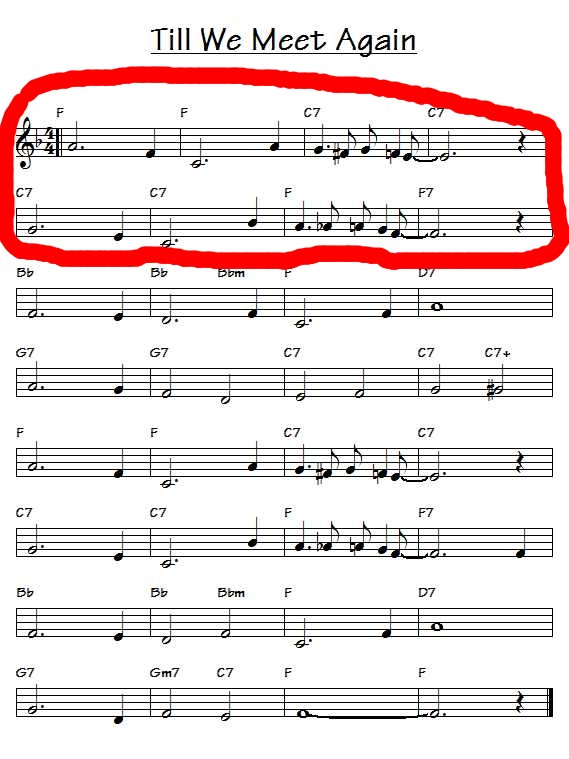
First you need to look at what goes on in this tune. So let's consider it, in the key of F.

We discover that it is a 32-bar tune (the most common type of all) and it is structured ABAB (each letter representing eight bars).

So you have two 'A' sections that are pretty much identical. These eight bars (marked in red below) use one of the most common chord progressions:

I    I    V7    V7    V7    V7    I    I

This movement from the tonic chord to the dominant and then back is found in very many tunes.


The F7 in the eighth bar leads perfectly into the Bb chord of Bar 9.

The 'B' sections use The Sunshine Chord Progression (also used in dozens of tunes). I have written about The Sunshine Progression in several articles. For example, click here to read one. Every jazzer must get the The Sunshine Progression into his fingers - in a range of keys.

In the first use of this progression, Bars 15 and 16 hold on to the dominant 7th (C7) rather than resolve completely to the tonic. The purpose of this is to lead back to the melodic theme all over again in Bar 17.

But when we reach the final eight bars of Till We Meet Again (B for the second time) we find the full Sunshine Progression - ending on the tonic to round the tune off perfectly.

So here is the full chord chart (in F):
Now: how about improvising? A simple way of creating an improvisation is to use this chord chart [F   F  C7   etc.] and simply play notes from the relevant chords as you go along. Basic arpeggios to begin with. For a beginner, this is not easy. That is why it helps to work with a slow tune such as this: it gives you time to think.

Don't forget that if you are a Bb or Eb instrument, then the Concert key of F will become G for you (Bb instruments, i.e. most trumpets and clarinets) or D for you (Eb instruments).

To give you some idea how this improvising-on-the-chords business works, I put the tune into Band-in-the-Box and then let my computer play it while with my cornet I tried to play notes from the arpeggios of the chords. I mostly used notes above the melody, in order to avoid clashing with it. To watch my attempt - or play along yourself - CLICK HERE.
Till We Meet Again was composed in 1918 by Raymond Egan, with words by Richard Whiting.

...............................
FOOTNOTE
The book Playing Traditional Jazz by Pops Coffee is available from Amazon.

10 January 2016

Post 350: TRY FLOATING ON THE 9th

Something to learn when you are mastering the art of improvisation is that playing the 9th above a chord can be very effective.
Assume that the chord for a couple of bars is C7th. This means the notes in the chord are:
  C  -  E  -  G  -  Bb.

While the rest of the band sustains this chord, try playing the D above it, in effect turning the chord into a 9th. It can be quite exciting. It gives a pleasant sensation of 'floating' above the chord. 

For a simple example on YouTube, 
CLICK HERE

and notice how (at 36 seconds until 38 seconds) Shaye on the cornet plays a series of Ds above the chord of C7th. It is one of her favourite devices, though she probably does it so instinctively that I doubt whether she herself is aware of it. In other performances, you will find her holding the 9th as one long continuous note.

When improvising, try occasionally playing a D above a C chord, an E above a D chord, a G above an F chord, a C above a Bb chord, etc.

You will also frequently come across moments in songs where the composers themselves use the 9th as the melody note. Here's a simple example. Think of the song from 1930 'I'm Confessing That I Love You'. It begins with the words 'I'm confessin' that I love you. Tell me do you love me too?'

That word 'too' is the 9th of the chord in the harmony at that point. If the song is being played in the key of F (as it usually is), the chord is D7th (D     F#   A    C) but the melody note is E.

You can hear the effect in your head, can't you?

27 November 2015

Post 310: HOW TO IMPROVISE - HELP IS AVAILABLE

Mr. John P. Birchall is a great enthusiast and educator in the field of traditional jazz. I have never met John but I became aware of him through the internet. I have exchanged emails and materials with John and he has always helped me with great kindness and generosity.

I want to tell you that John has - on his website - a mass of thoughtful, well-structured information that is intended to help anyone who is trying to play the music and perhaps finding it difficult to get to grips with the structures of harmonic progressions and with improvising.

For access to this wonderful resource (for which many thanks, John):
CLICK HERE.

20 November 2015

Post 298: MAJOR 6th AND MINOR 9th

Think of a chord containing the notes C - E - G - A. Which chord is it?

C6th, of course. But it is also the chord of A minor 7th (in its first inversion).

Knowing this can be very helpful if you are trying to keep your playing as simple as possible or if you are improvising over a chord progression at high speed.

You can make things even simpler if you omit the 'A' in the chord above. Your audience will not notice. It means you can play the chord of C major when the music asks for A minor 7th. And you will get away with it!

Obviously this applies right through the scale. Examples:

For B minor 7th you can substitute D major.
For C minor 7th you can substitute Eb major.
For D minor 7th you can substitute F major.
For E minor 7th you can substitute G major.
For F minor 7th you can substitute Ab major.

And so on.

In traditional jazz, you come across the progression:

VIm7 / I  |

This is exactly what I'm discussing. It's good to know you get away with playing it simply as:

  I  |

But please keep this secret just between you and me. I don't want to be accused of encouraging laziness!

And we don't want to get into Big Trouble with the British government's Jazz Band Regulator - OFFSTOMP.
============================
P.S. Since writing the above, I have received this helpful message from Tom Corcoran:

This is an interesting post about chords that are technically different but sound the same. One of the first things uke players learn is Am7=C6, which is the four open strings in standard uke tuning.

This website has some good information on synonym chords (that's a new term I just learned). I now see why Am7=C6; both chords contain the same notes, but in a different sequence. The diminished chords on the uke are also a good example of synonyms where the same chord shape and position can apply to four different keys.

=============================

Thanks, Tom. I like that notion of 'synonym chords' - it's new to me too. And that is a website we can certainly recommend.

And from Edward Desenne I have received this contribution:


I play both alto and soprano sax and clarinet, both transposing instruments. That means that if I play a minor third below concert pitch on my alto sax pitched in Eb I will play the same note as in concert pitch.

To play a C Major chord in concert pitch I need to finger an A minor 7th chord as notated in music on my alto sax, which is a tricky chord to finger on alto saxes, which is played more easily in second inversion. However if I wish to play an Eb minor 7th concert pitch chord I just play up a minor third a Major C chord on my alto sax, it's easiest natural scale.

That is why the easiest, natural scales for the alto sax are concert Eb, Ab Bb, E, F but the clarinet, trumpet, tenor sax and all instruments pitched in Bb only need to rise one whole tone in order to play the same note as in concert key. The fingering for playing most scales on tenor sax is much easier on alto sax and with a larger tonal range over the octaves, but sometimes the pitch of the alto corresponds better to accompany the female voice. End of my lecture!!!!!!

3 October 2015

Post 268: THE SAME 'IMPROVISATION' TIME AND AGAIN!

A reader from Essex, England, sent me this interesting comment:

I learnt from your blog that many tunes share the same chord progression e.g. the Sweet Sue Progression, which makes life easier for the rhythm section. But then I thought that perhaps this applies to the clarinet and the trombone parts as well. Could it be that a clarinet player has learnt after many hours of practice a standard part for a chord progression that fits many songs or put another way, if you played through all the tunes listed under the Sweet Sue Progression would the clarinet player play the same thing each time (obviously with variations to fit the particular tune)?

..............I know that some very talented musicians could make up something different every time but there must be lesser mortals who learn a set piece and always play that way.

The reader is right.

I'm sure there are great players who do not depend on learning and repeating pet phrases. But it is possible (and tempting) to use the same sequence of notes in several different tunes, if they fit.

I know a clarinettist who plays exactly the same notes in ensembles and exactly the same 'solo' choruses at every performance. Audiences don't notice, but I have heard his fellow musicians complain that what he offers is not really jazz and that playing-by-rote prevents him from contributing to the special excitement generated when instruments feed off each other and respond to what the other is saying.

However, even the very best traditional jazz players have developed a number of pet phrases (known as 'licks') that occur frequently in their playing over familiar chord sequences.

15 August 2015

Post 249: HOW TO IMPROVISE IN JAZZ


If you're wondering how on earth to go about learning to improvise, may I suggest you watch a wonderful tutorial on YouTube? It is given by the American trumpet-player Charlie Porter. It is full of wisdom, inspirational and also entertaining.

Charlie is a thousand times better at improvising on the trumpet than I am. And he is a natural gifted teacher. He's the man to follow (in this and other YouTube tutorials that he has generously given to the world).

To see the video
CLICK HERE.

And another super little video that gives you some idea about how the trumpet, trombone and clarinet go about collectively improvising is this one:
CLICK HERE TO VIEW.

As for me, I took up trying to play traditional jazz too late in life. I had no Charlie Porter to advise me and my learning processes were more pedestrian.

A wise old friend and jazz musician - Bill Stevens, who alas died several years ago - got me started by telling me there were two ways to improvise when playing jazz. He said you can improvise either on the melody or on the chords. Bill said that if you improvise on the melody, you will sometimes sound terrible but you will also achieve some exciting things. If you improvise on the chords, he said, you will always sound 'right' but will not be so exciting.

Since then, I have come to the view that there is a third way and that it is used (wittingly or unwittingly) by most jazz musicians: it is a mixture of the two above.

My advice will be less useful to you than Charlie Porter's but it may just give you a further means of support if you are really struggling.

Let us take for an example the first four bars of All of Me. And let us have it in the key of C. Written in 1932 by Seymour Simons and Gerald Marks, this song has long been a jazz standard. Here's how the melody and chords for those first four bars appear:
So the chords are two bars of C major and two of E7th:
To improvise on those four bars, you could simply play notes from the chords over the sixteen beats. Indeed, this is perhaps a good exercise for complete beginners. You might come up with something like this:
But when you feel confident, move on to something with a bit more sparkle. You must still work round and through notes from the chords but don't be afraid to throw in notes adjacent to them; and build in some syncopation, to keep things swinging. For example:


Now you are on your way!

Bill Stevens' 'chord' method of improvising over a complete tune involves doing this kind of thing with all the bars. The great majority of 'standards' (such as All of Me) comprise 32 bars, which you come to feel as four eights. There is usually some repetition of chord patterns within the tune, so this helps.

When learning a new tune, you may feel more confident if you memorise the notes of the melody and the chord sequence. You may be clever enough to work these out by yourself. But I find it easier to learn from 'busker's books' (sometimes called 'fake books') - obtainable in music shops or from the Internet, where there are many resources.

13 August 2015

Post 246: WHAT IS GOOD TRADITIONAL JAZZ?


I received this e-mail:

Hi Ivan,

You have strong opinions about what is good traditional jazz and what is bad. I know nothing about music. I can't read music. I never learnt to play an instrument. Can you please explain to me what makes some jazz performances better than others?


Wow! That's a tough question.

So let me say right from the start that appreciating any kind of art is a very personal matter. What pleases me may not please you. And that is just how it should be. So I will answer the question in my own way but shall not be surprised if you hold a completely different opinion.

Knowing about music


First, I don't think it's essential to know a lot about music in order to be stirred by traditional jazz or to feel the excitement that it generates. But it does add a little to the intellectual side of appreciation. For example, if you are listening to a piece made up of several different sections (e.g. Buddy's Habit or Climax Rag), it is satisfying to understand which point in the music the band has reached and to be aware when it modulates into a different key. It also makes it a little more interesting if you know something about the chord progression, no matter what tune the band is playing. In other words, you may appreciate it just a little more if you know about the 'grammar' of the music.

But with or without such knowledge, I think it's possible to distinguish between really well played traditional jazz and the not so good.

Preparing and Rehearsing

I think some bands over-rehearse. Things become too arranged and formalized. Much of the freedom and looseness that are features of the best traditional jazz are lost if the players have to concentrate too hard on their 'part' in the 'arrangement'. There is stiffness in the playing of some bands using this approach, especially if they become over-reliant on printed music on stands in front of them.

At the opposite extreme, it is common enough for good traditional jazz to be played without any rehearsal or preparation. Bring together the right mix of experienced players and a fine concert can occur.

But in general I think the best traditional jazz is produced by bands who rehearse at least occasionally, mainly to discuss their music and clarify their approaches to their repertoire. They should tidy up the trickier moments, ensure they are all using the same tune structure and chord progression and they should agree on any special tune endings. The little bit of extra work put in like that can be appreciated and pays off in a better public performance.

Amplification

In general, I think traditional jazz is likely to sound better if played without amplification. (So much 'music' in the last fifty years has been made hard to bear - for me, anyway - by the use of electronic devices and massive amplification.) It is so pleasant to hear musicians in a room with good acoustics and no amplification. You appreciate the sounds of all the instruments in their natural glory. There is no electrical 'humming' or blurring of tone. Performances in Preservation Hall (or in London's Wigmore Hall) testify to the truth of this.

But I accept that bands - in special circumstances - sometimes need amplification. In these cases, it is best if it can be kept to a minimum, for example one microphone for use by the vocalist.

Melody and Soul

Most tunes in our repertoire have stood the test of a very long time. So a good band performance must respect a good melody. There is soul in these old tunes and a good performance finds and expresses that soul. We should hear the melody clearly - maybe decorated and caressed; but it should always be there at the heart of the music. As the late great Chris Blount (clarinet) once said to me, 'If there's no soul, it's just a load of notes.'

Tempo

A good traditional jazz band sets a tempo which is appropriate to the tune and its chosen interpretation; and keeps to that tempo - other than for special effects. It's bad traditional jazz when a tune drags. (I have noticed this quite a lot in YouTube videos.) It can happen either because the tune is started too slowly or because the band slows down during the performance or because of labouring from the rhythm section - especially the drummer. (I don't know why, but On The Sunny Side of the Street is an example of a tune that is particularly prone to labouring!)

Collective Improvisation

When - in ensemble choruses - one instrument (usually the trumpet) is stating the melody, there should be creative support from the other 'front line' instruments (normally the clarinet and trombone). Teamwork is the key to great traditional jazz. If teamwork is good, the performance is more likely to impress. The support will use syncopation and counterpoint. It will be decorative and yet also - by finding the best phrases and harmonies - will push the tune along. You will feel that all three front-line players are listening and responding to each other's ideas and statements. Among today's top players, Barnabus Jones, Haruka Kickuchi and Charlie Halloran (trombones) and Chloe Feoranzo, James Evans, Jonathan Doyle, Aurora Nealand and Ewan Bleach (reeds) are examples of musicians to study on YouTube if you want to see this done supremely well.

Jazzy Devices

This is really an aspect of improvising. But it is important enough to deserve separate mention. A good performance (certainly an exciting one) usually requires a generous dose of those devices that make jazz - especially traditional jazz - so distinctive. Notes bluesily bent or flattened (in the right places), glissandi, breaks, syncopation, the use of 6ths and 9ths where they take us by surprise - all these elements enrich the performance. Without this 'jazziness' you may be left with some very pretty music for dancing but it will lack the spirit of early New Orleans jazz.

Rhythm Section

First, as my friend Barrie said to me, the expression 'rhythm section' is relatively modern and misleading. The whole band should think of itself as the rhythm section. But these days when leaders refer to their rhythm section, they mean the part of the band likely to consist of two or three or four players selected from percussion, banjo, guitar, piano, bass [string or brass]. In a good performance, these players will, as the saying goes, 'sound like one man'. They too must listen carefully to each other and to the trumpet, clarinet and trombone. In so many of the elderly British bands I have heard, or watched on YouTube, they certainly do not sound like one man: often the drummer is too loud and his rhythmic patterns are disruptive to what his colleagues seem to be trying to achieve. At least for the brighter and quicker tunes, most of the time the rhythm section in unison should play a pulsating but not too loud four-to-the-bar poom-poom-poom-poom (not um-CHUCK-um-CHUCK). This pumps the front line along and sets the audience's feet tapping. A good drummer drives the band without being loud or exhibitionist and a good pianist subjects his skills (in ensembles) to the need for a steady rhythmic and chordal underpinning of the music.

Solo Choruses

In performance, most bands include a sequence of 'solo' choruses (normally 32 bars, or even 64 bars) by several of the players in every tune. Often these solos have nothing much of interest to say (they are what Chris Blount would have called 'just a load of notes'), though, if the band has a very good pianist, they give him a rare opportunity to show what he can do. Often solo-takers try to play something stretching to the full their technical skills - showing how clever they are. I suppose this is fair enough if they are technically brilliant. Festival audiences can be counted on to applaud this sort of thing. But my view is that flashy and often raucous solo choruses are not an essential part of good traditional jazz.


Fortunately, in solo choruses a few players are technically brilliant and highly creative at the same time (James Evans again is a great example).

On the whole, though, I don't enjoy a performance padded out with numerous dull solo choruses in which the players have nothing but a string of clichés to offer. I prefer the more creative, unpredictable kind of playing (as best exemplified in the performances of Tuba Skinny) where one player takes the lead for a short time (perhaps 16 bars) but usually other players provide decorative accompaniment to this kind of 'soloing' (another example of good teamwork). Such playing gives the audiences constant delightful surprises.

Sometimes a rather special chorus contributes to a pleasing performance. For example, a band may try a 'front-line-only' chorus and even better a full-band quiet chorus (just tickling the notes) before turning up the volume for the end of the tune.

Ending the Tune

I like a tune to end well, either crisply or with a neat rehearsed coda. I think messy endings are bad.

Band Demeanour

I like all members of the band to take the music seriously. I do not like it when there is much talk between players during the performance of a tune. (Guffaws at each other's private 'jokes' are even worse.) Discreet hand signals for directing the music should be enough.

Listening Test

I will end by giving this tip to my enquirer - and to anybody else like him. When you next listen to a traditional jazz recording, try focusing your ear on just the bass player. If it's a good band, you will be amazed at the precision and importance of his or her contribution.

Now try focusing on just the clarinet. Listen carefully to the notes he or she is playing. How well and how cleverly do they blend into the overall sound?

Try listening intently to the drummer or indeed any of the instruments and you may be surprised at how much your appreciation of what the individuals do (or fail to do) helps you to sort out performances that are really 'good'.

7 March 2015

Post 183: CHORUSES AGAINST OFF-BEAT STOP CHORDS

I wish there was more variety of treatments of choruses in the performances of our bands. There are many ways of making 'solo' choruses more interesting. The use of long held notes (as backing) is one. Another is the use of stop chords (for example, the rest of the band - apart from the soloist - playing just the first two beats of each bar).

One of my favourites is the use of OFFBEAT stop chords. In other words, the soloist plays fluently over all four beats of the bar, while the rest of the band plays only the second and fourth beats.

Similarly, you can have the full rhythm section playing a chorus of offbeats only while the melody instruments all continue to play normally. That is very effective.

Like all good things, the device should be used sparingly. For example, in a 32-bar chorus, one instrument could play 16 bars against offbeat stop chords, with another taking over for the remaining 16 bars accompanied by conventional rhythm section backing.

The use of offbeat stop chords impresses audiences and indeed it does not always come easily to the musicians. In particular, the soloist must not let himself or herself be thrown by the unusual rhythm. It takes practice. When taking a solo against offbeat backing, it's best to hit the first note of the bar firmly, at least at the start, to establish clearly where it actually is!

The offbeat stratagem is not at all new. It is an authentic part of the New Orleans tradition.

You can hear Louis Dumaine demonstrating it well with his Jazzola Eight in 1927. Louis himself plays a chorus of Pretty Audrey against such a rhythmic background.
Notice what happens at 1 minute 15 seconds into the recording. Louis plays a full fast 32 bars against stop chords. It is an exciting effect.

In the same year, the great Sam Morgan Band made recordings in New Orleans. Notice what happens in the band's recording of Mobile Stomp.
At 1 minute 28 seconds, for the third chorus, the rhythm section switches to a stop chord offbeat rhythm, against which the reeds continue to improvise prettily over the full bars.

Let us all try more of these variations. Of course, the best bands already do.
for a clever variant in which the front line (cornet, trombone and reeds) plays the stop chords while the banjo takes the solo. Note what happens at 1 minute 37 seconds. What about that as an example to us all?

19 February 2015

Post 173: USE THOSE 6THS AND 9THS

Introducing flattened thirds and sevenths adds colour and excitement to a tune; but it's also interesting to throw sixths and ninths into your improvisations.

Listen to a great creative player such as Shaye Cohn and note how frequently she gives a lot of emphasis to 6ths and 9ths - especially at the start of one of the final choruses, when she is still finding fresh approaches. For example, a tune may begin with two bars firmly on the C major chord but you may find Shaye decisively hitting several 'A's (the 6th). Or in a tune beginning with the D major chord, she will deliberately and firmly go for the 'E' above the chord, making a 9th.

Composers have been well aware of the effect gained by making the sixth or the ninth the melody note at a particular point, too.

Think, for example, of You're The Cream in My Coffee played in the key of C. You find many of the melody notes are D played above a C major chord, or A played above a G chord.

Or take There'll Be Some Changes Made played in the key of C. What do you find? Lots of Bs above the A chord, and plenty of Es above the D chord. 

Another is If I Had You: Think of it in the key of Bb. Numerous times in this song, you find (yes - in the composed melody) a C being played above a Bb chord. You find a G being played above an F7th chord. And you find Cs being played above Eb chords.

I'm Crazy 'Bout My Baby is another. Its Middle Eight is unusual, its special effect being achieved by the fact that the melody notes are so often the 6ths or the 9th of the chords.

Effective, isn't it?
===============
Reader Barrie adds:
Hi Ivan,
I agree with your statement about using a 6th and a 9th. I use the 6th a lot, a very useful note. At times it can be sustained over several chords. I mainly use the 9th on the fourth bar of a 12 bar blues. It works well.

21 January 2015

Post 160: MIDDLE EIGHT OF 'MY BLUE HEAVEN'

Sometimes you come across a standard 32-bar tune in which the 'Middle Eight' follows a slightly uncommon pattern. I have noticed this can easily flummox jazz musicians - even very good ones  occasionally.

My Blue Heaven is a case in point. If you take it in the Key of Eb, then the Middle Eight - in simple terms - is:

one bar of Ab
one bar of C7th
two bars of F minor
two bars of Bb7th
one bar of Eb/Edim
one bar of Fm7/Bb7

The progression from the Ab chord to the C7th (it's the Georgia Progression) defies the usual 'circle of fifths' and that is what presents the challenge. So you have to be careful when improvising on this kind of tune and give it some thought while practising. This is the kind of improvisation that might result.
The music for My Blue Heaven was composed by the great Walter Donaldson in 1927.

He also wrote the music for - among others - My Little Bimbo, Oh Baby, Oh Sister Ain't That Hot, 'Taint No Sin To Take Off Your Skin, That Certain Party, Yes Sir That's My Baby, At Sundown, You're Driving Me Crazy, Carolina in the Morning, I Wonder Where My Baby is Tonight, Love Me Or Leave Me, Making Whoopee, and My Baby Just Cares for Me.

What a massive contribution to our music! Maybe one of these days I shall be able to persuade a band to give a concert entirely of Donaldson compositions.

Walter Donaldson was a New Yorker. He died in 1947 at the age of only 54.