Welcome, Visitor Number

Translate

Showing posts with label forming a band. Show all posts

11 October 2016

Post 436: YOUR LOCAL BAND NEEDS YOU!

The world of traditional jazz desperately needs more musicians - especially young ones. I have written on this subject before (about three years ago) and hundreds of people read the article, so it seems to be a topic worth considering again.

Would you consider playing in a traditional jazz band? How should you go about it?
You must start by reaching a reasonable level of technical proficiency on your chosen instrument. If you are a complete beginner, you will need lessons to get you started, mainly to set you up with good habits. I would recommend finding a qualified professional music teacher rather than someone who happens to play traditional jazz. (Players do not necessarily make good teachers.) Make sure you learn about scales, keys, chords and arpeggios and it will help if you learn to read music, at least at a basic level. After that, practice will be your main pursuit.
If you are already a competent musician, it does not follow that you will move easily into traditional jazz. Good piano soloists sometimes find it hard to adapt to their rôle in a band. Teamwork is the key to success in traditional jazz and players of the piano, guitar and banjo have to accept that for most of the time their job is simply to lay down the correct chords, firmly and clearly, rather than display virtuoso skills.

The one exception may be highly-skilled double bass players. If they are willing to adjust to the style and hardly use the bow at all, they can contribute extremely well with nothing more to guide them than the band's chord book. I remember how, during the 1950s, there were some double bass players, members of the symphony orchestras based in London, who would finish a concert with their orchestra and then head to a jazz club where they would join a traditional jazz jam session. It was easy enough for them to jump from Handel to Handy and from Mozart to Morton.

Becoming good enough to perform traditional jazz in public doesn't mean passing lots of exams. But be warned: it can take hundreds of hours of hard work in the woodshed.

You should start early on learning some tunes from the traditional jazz repertoire - easy ones to begin with. Laissez Les Bons Temps Rouler is a particularly good and easy one as it is fun but uses very few notes and virtually only two alternating chords.

Soon you could try Algiers StrutTin Roof BluesWhen The Saints Go Marching InCareless LoveDown By The Riverside, and Lily of the Valley.
There are plenty of sources of printed music, such as busker's books. But an excellent site you should consult is Lasse Collin's, where there's enough to keep you going for years: CLICK HERE TO VIEW.

And here's an important tip: when you first learn a tune, make sure you learn it accurately. If you get into a habit of playing a phrase or a sequence of chords wrongly, it is very hard to unlearn them later, after the tune has become embedded in your brain and fingers.

Develop an understanding of and fluency in different keys. Those most commonly (but by no means exclusively) needed in traditional jazz are Bb, Eb and F. Next most common are Ab and C.

Listen to lots of traditional jazz - especially noting the part played by your chosen instrument - to get a feel for what is required. Use the wonderful resource of YouTube. When you are ready, try playing some tunes along with bands on YouTube. That's almost as good as 'sitting in'.

A similar idea is to play along with backing tracks. Some of these are also freely available on YouTube. This will give you a great chance to assess your progress because, if you are confident and not discordant with a backing track, the chances are you will fit in with a jazz band.

Link up with other musicians. Maybe you can form a band in your town, starting with a nucleus as a trio or quartet. Meet regularly in one of your houses to rehearse and expand your repertoire.

How do you find these musicians? Put the word around among all your friends and acquaintances. Chat in the local music shop. Advertise in the local newspaper. See whether anybody in a social group is interested (e.g. in England, the U3A). There may be a regional website on which you can seek (free of charge) other musicians.

Listen to live traditional jazz bands and talk to the musicians: they are very good sources of information about both learners and established players in the area and may be able to put you in touch with people who could join your group.

For information on which bands are playing where, there is probably a regular publication you can consult. For example, here in England we have the monthly Jazz Guide - available in clubs and from bands and also by post if you pay the very reasonable subscription (payments by PayPal are accepted). You should be able to see a sample page and full information by clicking HERE.

And specifically for the North-West of England, a gentleman called Fred Burnett altruistically runs a website giving full bulletins concerning jazz in his region: click here.

When you feel ready, begin to practise more challenging and more complex tunes: there are hundreds in the repertoire.

Unless you are a born genius, you will need to learn the standard chords and also practise improvising your way though common chord progressions. In particular, work on the Circle of Fifths and The Sunshine Sequence and the basic 12-bar Blues Sequence as these will be useful in hundreds of jazz tunes. If you don't know what I mean, look at the blog posts in which I have written about them.

Are you worried about improvising? Watch Charlie Porter's excellent videos. For an example CLICK HERE.

When your group is good enough at fifteen or so tunes, start playing gigs! You can give your band a name and offer yourselves for free to a local pub or residential home and get your band officially launched.

Also, when you have built up confidence by playing along with YouTube, ask whether you may sit in for a couple of tunes with an existing band. Most bands are so keen to keep the music alive that they readily give opportunities to anyone who shares that mission.

Make sure you give your telephone number and email address to everyone who may be able to help you in the future - especially band-leaders. It may be worth having some business cards printed.

Band-leaders and agents keep lists of musicians within a radius of seventy miles. You never know when you may receive a call to deputise for a musician who is ill or on holiday.

Eventually you may succeed in obtaining a place in a reputable well-established band. There is a rapid turn-over of personnel and a need for new blood, especially these days when many elderly musicians are hanging up their trumpets and clarinets.

Most of today's traditional jazz musicians have gone through the stages I have described above, except that in their day they did not have the enormous benefit of YouTube and such sites as Lasse Collin's to help with learning and training. In years gone by, players had to listen to records and later to cassettes in order to pick up tunes by ear and learn from the masters.

14 February 2016

Post 389: LUNCHTIME JAZZ WITH 'THE SECRET JAZZ BAND'

Alan Cole - a very special percussionist
Regular readers will know I'm strongly in favour of having jazz performances at lunchtimes, especially in pubs here in England, because the elderly folk who make up most of the audience prefer to go out for a leisurely pub lunch and hear some good music, rather than be out late at night, having to make their way home from a jazz club at 11pm. Many of them have told me so. Another reason is that the music gets heard by some younger people too, and that is surely important.

Good news is that yet another pub in the English Midlands chose to have traditional jazz in the lunchtimes. The pub is The Boathouse at Barrow-on-Soar (beautifully situated on the river bank between Loughborough and Leicester). The Secret Jazz Band played there every second and fourth Monday of the month from May 2016, between 12.30pm and 2.30pm.
Some of the boating people moored up and stopped to have a lunch and hear the jazz, too.

(Note added later: These gigs came to an end three years later, because the premises underwent massive refurbishment and had a new management with different policies.) 

The Secret Jazz Band was formed in June 2014. The percussionist Alan Cole had been invited to provide a six-piece traditional jazz band for a once-a-month Thursday lunchtime session at another public house - The Dog and Gun in Syston, Leicester. He agreed to do this - and then set about forming a band.

Alan gave the band the working title of The Secret Jazz Band (secret because he did not know who the musicians would be) – and the name has stuck.

Alan did not have much difficulty in finding players who said they would be happy to spend a lunchtime, at least occasionally, taking part in a relaxed jam session. They knew it would provide a good opportunity to have fun and keep in practice.

Since then, The Secret Jazz Band has played every month at The Dog and Gun. The pub belongs to the 'Steamin' Billy' chain, whose management team are keen supporters of live music.
It is a pub that looks after its customers well, with a cosy log fire:
And if offers a good lunch:
With such a pool of musicians, the fans never know who will be in the 'secret' band.
Pete Crebbin often turns up and plays trombone.

The band does not get together to rehearse, so it wisely sticks to familiar, uncomplicated numbers – tunes such as Make Me A Pallet on the Floor, Running Wild, Alexander's Ragtime BandWhen You're Smiling, The Girls Go Crazy, Hindustan, Careless Love.

The audience grew over the months and reached a peak of 45 on one Thursday in the summer of 2018, so the bar was crowded.

Band manager Alan eventually had some business cards printed. He became ambitious enough to hope The Secret Jazz Band might attract bookings beyond the confines of the pubs!

The secret is out.
=================
FOOTNOTE
Sadly, as from February 2020 the performances at The Dog and Gun have been discontinued. Ill health and mortality had reduced the audience to a size at which the concerts were no longer viable. But the band continues and accepts gigs elsewhere.

14 May 2015

Post 211: TELEPHONE BANDS

Maybe you have heard the expression 'telephone band'. Even if you haven't, you can probably guess what it is. There are plenty of telephone bands operating in the field of traditional jazz.


What happens is that a bandleader builds up a list of traditional jazz musicians in his region (several for each instrument) but does not decide on the personnel for a particular gig until after he accepts the booking.

He then phones round among the musician contacts, taking into account the need to have a balanced band, with the appropriate range of instruments, and also considering which musicians live nearest to the venue, thereby avoiding long-distance travel. The chances are that all the musicians on his list are already players in other bands, so he can book them only if they do not already have a gig on the date in question.

Such bandleaders and agents are in a sense 'fixers'.

Even some well-known bands are in effect 'telephone bands'. You may notice frequent changes of personnel. This is because the leader has a pool of musicians from whom to choose.

Usually it is musicians who have gained wide experience and met many players over several years who decide to run one or more telephone bands. One - or more? Yes, we have a famous fixer in England who sometimes puts out two or three telephone bands to play in different places on the same date - for example on New Year's Eve, when there is great demand.

Obviously a telephone band is a strange animal, because musicians can find themselves playing a gig with others they have never met before.

Such bands will not have had a rehearsal and the tunes they play will probably all come from the straightforward core repertoire. It is unlikely that any of the musical arrangements will be very complex. But audiences tend not to notice these things.


However, the standard of a telephone band can be high. This is because such musicians are usually very experienced and competent. With a few brief words, they can agree the way a tune is to be treated. (For example, the leader might whisper: 'Play A - B - C - then back to B and stick on B').


They can even look like a regular band, especially if the leader requests them all to turn up in shirts of the same colour.

The musicians themselves derive pleasure from meeting, listening to and working with each other. They can learn much and also with good teamwork produce some high-quality music.
There are dozens of telephone band performances in England every week; and I guess the same must be true of most other countries where traditional jazz is played.

If you are thinking of setting yourself up as a bandleader, this is one way of going about it.

By the way, a telephone band is in some ways similar to a 'pick-up band', though not quite the same. Pick-up bands are put together for special projects, such as a providing a backing group for a recording, or accompanying a singer on a tour. They are likely to be technically highly-skilled; and they are also likely to rehearse seriously together before undertaking the work.

15 April 2013

Post 46: GETTING THERE AT LAST!

It’s a sad thing to report but I have to tell you I had to wait until I was 80 years old before I at last got to play in a really good six-piece traditional jazz band.

Why was that? Partly because I left it late in life to take an interest in the music.

When I was eight years old, my parents forced me to have a few piano lessons. I hated the tedious business of practising scales night after night, as required by my teacher. I pleaded with my parents to let me give up and they eventually did so. But at least I had learned the rudiments of music.

Fast forward to when I was over fifty years old. I happened to attend a jazz concert given by Kenny Ball and his Band. I was so excited by it that I suddenly had the crazy ambition to play in a jazz band.

Over the following months, having bought a second-hand trumpet, I worked hard – with the help of books – at mastering the blowing and the fingering. Soon I was able to play a few easy tunes.

I bought several ‘Busker’s Books’ in order to obtain tunes and lead-sheets.

I advertised in the local paper to find other people who might care to join me. Soon we had a band of half a dozen players, four of whom were complete beginners. We got together once a week, practised a great deal and soon were able to play a few simple tunes. We must have sounded awful but the hobby gave us enormous pleasure. Eventually we had the courage to offer ourselves to play free of charge in local care homes and a pub.

One day I sat in for a couple of tunes with a good jazz band that was in town. I managed fairly well, and one of the musicians took my phone number. This led to invitations to deputize and eventually play in a couple of reasonably experienced bands.

At the time I was still working hard learning tunes. It also dawned on me that chord sequences were vitally important and needed studying.

I bought a lovely cornet and went on to discover that I preferred it to the trumpet. After that, I increasingly played the cornet.

Over the years, I gradually became known among band-leaders for miles around. With older players retiring or dying, by the time I was 65 years old, I was offered many opportunities with various bands. I continued to study the music, learn more tunes and to practise regularly. I visited New Orleans to learn from the playing of the bands there.

I played many gigs in pubs, at jazz clubs, at bandstand summer concerts, at weddings and private parties. Many of the groups in which I played were quite good, though not remotely in the same league as the best young bands (such as The Shotgun Jazz Band and Tuba Skinny) currently established in New Orleans.

When I reached the age of 80, I had met and played with many fine musicians based in the English Midlands, where I now live. One of these was a clarinet player whose music was both very tasteful and also grounded in excellent technique. One day he was asked at short notice to put together a band to play at a jazz club near Derby, because the regular band had suddenly become unavailable. He phoned round among his musician friends and kindly invited me to be the cornet player.

turned up apprehensively at the gig because I did not know some of the other players and I had never even been to that jazz club. I need not have worried. The other five were superb musicians – three of them (the rhythm section) accurately providing that four-in-a-bar steady pulse that I consider so important, pumping the band along. The trombonist was perfect in every note, complementing what I was trying to do and moving the music along with understated power. Our leader, the clarinet player, offered exquisite decorations and the top-end excitement that our music needs.

My task was easier than I had expected: for much of the time I was able to concentrate on tone and to play a simple line for the clarinet and trombone to decorate.

The leader had sent us in advance a tune list – with keys – so the presentation of our programme on the night was smooth and impressive.

Here were six people who had never played or even rehearsed together as a band before. But, because they were fine musicians and great team players – all willing to listen and respond to what others in the band were doing – it was a great evening. At the end I was on a high. But good news was that the other players were all well pleased too: they felt the evening had been something special. Several members of the audience told us how much they had enjoyed it and they hoped we would return.

I was 80. But I had got there in the end!

6 March 2013

Post 6: GET RID OF THE FRONT LINE!

I don't know who started the fashion way back in the mid-20th Century for having a 'front line' of clarinet, trumpet and trombone and a 'back line' rhythm section with such instruments as percussion, banjo and bass. Maybe it was the George Lewis band.
The set-up thrusts the front line into the limelight and prevents the audience from seeing and appreciating the other musicians. The players at the back often complain that they can't clearly hear those at the front. Also, this formation makes it difficult for signals to be passed between the musicians (for example - who is going to 'take the solo' in the next chorus). A front-line player who is the band-leader frequently has to turn round in the middle of a tune to signal or speak to colleagues.

I know there are some cramped venues where such a set-up is hard to avoid. But I have often thought it would be better for both the band and the audience if the musicians arranged themselves in an arc or semi-circular formation, in the same way as string quartets and quintets do in the classical music world. The players would all be able to see and hear each other and the audiences would see all the players.

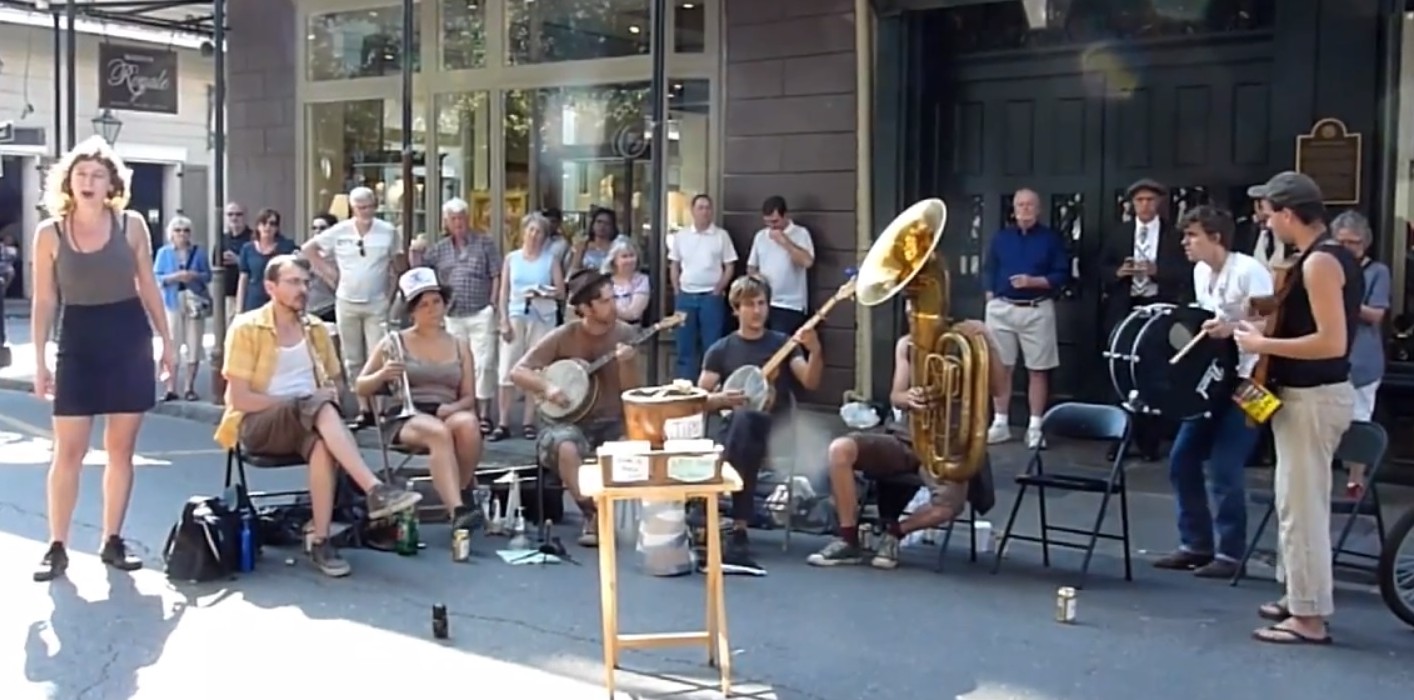
The wonderful young band Tuba Skinny, based in New Orleans, is setting us an example in this respect, as in so many others. Whenever there is sufficient space, they spread themselves out in front of their audience. Shaye Cohn, who gives the directions, sits where she can be seen by all her colleagues. The clarinet and the trombone occupy positions shoulder to shoulder with her because it is with them that she has to work closely to produce the band's wonderful polyphony. The tuba and banjo or guitar are in line so the audience has an unimpeded view of them. Every individual in the band can be seen and appreciated by the audience:
Get it?

Don't you agree that's a better way to present our music?
==========
Footnotes

Since I originally wrote the above article (in 2013), I have noticed a few more bands playing in the 'arc' formation. I'm very pleased about this. Let's get rid of the concept of a 'front line'!

My book Playing Traditional Jazz is available from Amazon.