Welcome, Visitor Number

Translate

Showing posts with label New Orleans musicians. Show all posts

24 December 2017

Post 581: MAY AND SHAYE - 'THRILLER RAG'

Thriller was one of the rags composed by May Aufderheide. She wrote it in 1909. May was also the composer of 'Dusty Rag', which is still a favourite with our bands.


I think May would have greatly enjoyed hearing Tuba Skinny, in 2017, adding Thriller Rag to their repertoire. As so often, we have to thank the videomaker RaoulDuke504 for recording their performance for us. You can watch it BY CLICKING HERE.

I believe the sheet music starts with the instruction 'Not Fast', but Shaye Cohn chooses to ignore this and play the piece at a pretty quick tempo. I don't think May Aufderheide would have disapproved of the effect this achieves. Such a tempo certainly provides the basis for 'thrills'.

In fact, although the whole band plays well, I think this performance is in particular a tour de force by Shaye herself.

The four-bar Introduction (from 10 seconds into the video until 14 seconds) is possibly the most thrilling part of all. Shaye leaps to the high Ab and rapidly tumbles down through arpeggios on the Ab diminished chord.


The Thriller comprises two 16-bar themes. Tuba Skinny play through Theme A twice, during the second of which (at 34 seconds) Shaye introduces some interesting variations. When they come to Theme B (54 seconds), Shaye frequently plunges down to the Ab below the stave; and yet then leaps up two octaves to the Ab above the stave for more of those descending arpeggios (e.g., 1 minute 08 seconds). This is something very difficult to do on a cornet, especially at this speed. I am not even sure I have heard Shaye do such a thing before. It's a sign that she is at the height of her powers and full of confidence.

By the way, from all I have said, you may have inferred correctly that the band plays Thriller Rag in the key of Ab - the key in which May Aufderheide composed it. But some bands (certainly here in England) have taken to playing it in F, which is - in a sense - cheating but makes it a good deal easier on the lips!

Also notice how well Shaye directs the performance. In addition to making it clear which instruments are to take 16-bar solos, there are at least six other discreet signals:
2 mins 10 secs: All the 'front line' to join in.
3 mins 09 secs: Return to Theme A.
3 mins 29 secs: Switch to Theme B - finger pointing down:
3 mins 43 secs: Washboard to play the 'break'.
4 mins 03 secs: Front line to play the break.
4 mins 08 secs: Final chorus (leg extend signal).

15 December 2017

Post 578: YES MA'AM ARE BACK

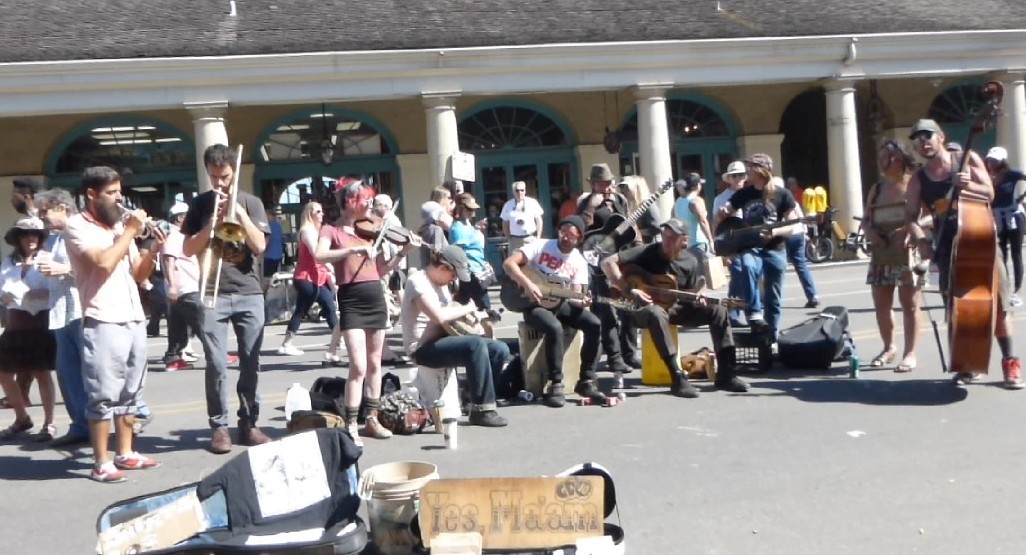
Watch this performance from December 2017 of the New Orleans busking string band Yes Ma'am.


I find it utterly compelling, so full of variety and brilliant musicianship. After the gently stated start, note the changes of tempo, the attention to dynamics, the brilliant little solos, Matt's footwork. It will give you some idea of what this group - and especially its founder and leader Matt Constanza - have achieved in the eight years since he formed the band.

But let me go back.

During my April 2016 visit to New Orleans, I was thrilled at last to hear the string band Yes Ma'am. I had admired their work on YouTube for several years but unfortunately did not come across them when I previously visited New Orleans in 2015.

However, in Royal Street on 7 April 2016, I bumped into my friend Randy (the great video-maker codenamed RaoulDuke504 - he who also filmed the video I have recommended above) and he gave me a tip-off that Yes Ma'am were playing at that moment at The French Market. I hurried over and sure enough there they were.

What a dazzling performance! I can assure you they are even more exciting in person than when seen on YouTube. Each musician individually is a virtuoso. The finger-work on some of the solo choruses was mind-boggling. The songs were witty; and the control of 'breaks' and rhythm (sometimes doubling-up) was so clever and effective. You can't help having a big smile on your face and you can't stop your feet tapping when Yes Ma'am are playing.
Elena Dorn has been with Yes Ma'am since
the early days. She plays the violin beautifully
and her subtle improvisations perfectly complement
the textures of the other instruments.
At the break, I was fortunate enough to have a chat with the leader - Matt Costanza. On YouTube, Matt (like Yes Ma'am in general) has always given me the impression of being very laid-back, devil-may-care, unconventional and bohemian in life-style. Well, maybe some of that is true. But I have to report that the man I met that day was also deadly serious about his music, modest, very articulate, extremely hard-working and also kind and generous in talking with me. He allowed me to take this photo.
I thanked Matt for the pleasure his band had given to YouTube viewers all over the world. I told him I was amazed at his own brilliance and versatility: he sits at the centre of the band, playing the guitar with great vigour and lustily singing, while simultaneously providing percussion: with his feet he plays a 'drum' and a tambourine and a bell! In the course of a performance he uses a huge amount of energy.

He very modestly said he did not consider himself a great player. In his opinion, the rest of the band were the technically-gifted players and he was privileged to have them working with him.

Well, there you have the recipé for a perfect team: a leader who is a dedicated, tireless, directing presence surrounded by other musicians whom he respects and encourages to display their skills.

Those Yes Ma'am songs tend to be tricky in structure. Think of the sudden tempo changes. How does the band get to perform them so slickly? And where do the songs come from?

Matt's answers were surprising. He told me he himself now composes about 90% of the material. The band hones and masters it during their many performances on the streets. 

I had guessed they must get together from time to time to rehearse. No, Matt told me. He could recall that they had had two rehearsals. No more.

But is all this really traditional jazz? That's a question I hear some people ask. Well, yes, it certainly is. The links and overlaps between jug bands and string bands and what has become 'conventional' traditional jazz (with a front line of trumpet, trombone and clarinet) go right back to the earliest days; and they have been gloriously revived by the young musicians in the New Orleans of today. Instrumentation in the string bands may be slightly different (though I should mention that Yes Ma'am sometimes - as in the picture below - includes a cornet and trombone), but the principles for playing and interpreting the music are exactly the same.
In the years during which Matt's band has been evolving, there have been several changes of personnel (and I believe he still draws from a pool of players). When I first discovered them on YouTube, they looked like this.
Although two of the ladies from that photo are still usually in the band, the line-up was rather different when I saw them in April 2016. I made a video and you can watch it by clicking on here.

If you would care to hear how they sounded at the end of 2015, click on this performance of Squishin' Bees, an up-tempo 12-bar blues in Bb.

For a very fine video of them with their late-2013 line-up playing a medley, CLICK HERE.

One of my favourites from their earlier days (2011) is this: CLICK HERE  to watch it.

Whatever you think, please watch right to the end: there are surprises along the way. And admire all the little details.

The band appeared to be absent from the streets of New Orleans after the end of 2016. According to an unofficial report, it seemed that Matt felt completely exhausted at the end of that year - hardly surprising, in view of the energy and hard work put into every performance. He decided to take a break, during which he could re-charge his batteries, probably compose some more songs, and make plans for the future. Well, I'm pleased to see he's back.

7 September 2017

Post 545: SHOCK AT THE JAZZ CLUB!

Recently, I attended a traditional jazz concert at one of the best and longest-established jazz clubs in England. It was in the outskirts of London, far from my home, and I had never been there before.

The club meets once a week in a very fine arts centre for evenings of entertainment by visiting bands. It has a large car park. The auditorium has plentiful and comfortable seating. There is a bar selling food, and drinks hot and cold. The stage is ready-equipped with a tuned piano and a splendid PA system, so the bands are well provided for.

I was most impressed by the enthusiasm, hard work and friendliness of the six committee-member volunteers who run the club.

As with so many of these clubs in England, the volunteers were elderly and had become very knowledgeable about traditional jazz because it had been one of their main interests for several decades. The audience too consisted entirely of elderly people.

Having arrived early, I was able to chat with most of the volunteers. Like others running such clubs all over the country, they were concerned that membership numbers were steadily falling. At present they had just enough regular attenders to keep the club running. But a few had died in the recent past. The gentleman who booked the bands doubted whether the club would still be in existence five years from now.

As usual, we all regretted that the younger generation in England seemed to be taking little interest in this kind of music; and that there were very few young musicians to be found in English traditional jazz bands.

A couple of them told me they spend a lot of time watching traditional jazz videos on YouTube; and they mentioned the bands (all British) that they liked to watch. I was amazed they didn’t mention the videos coming out of New Orleans or Tokyo.

It turned out that these jazz club committee members – such knowledgeable fans – were completely unaware of the resurgence of traditional jazz being played right now to the highest levels by young people in the streets, bars and clubs of New Orleans.

Of course, I told them about the New Orleans scene, and recommended that they should start watching those videos.

But this experience left me thinking. If these people, who have loved traditional jazz since the 1960s, are unaware of what is happening in New Orleans, possibly there may even be some readers of this blog who also need to make the discovery.

So, just in case you need a prompt, try these two videos. Click on to view:


29 August 2017

Post 542: HOW MANY MUSICIANS DOES IT TAKE TO FORM A JAZZ BAND?

How many musicians does it take to form a jazz band? I suppose you could get away with two: a clarinet and a banjo playing 'Rosetta' on a street corner would be just fine.

With four (say: sousaphone, banjo, clarinet and trumpet) you certainly have a band: you produce a full sound and can tackle a huge repertoire.

But of course, when most people think of a traditional jazz band, they picture six or seven musicians, with a 'front line' of three including a trombone and a 'rhythm section' of three or four, which may include a pianist and a drummer.

So is it possible to go above seven?

In theory, I would say 'No'. With greater numbers, there is a risk that the musicians will get in each other's way. What started as lovely music could become a din, especially if several of the instruments were using amplification.

So is it possible for a traditional jazz band to function with as many as ELEVEN players? Surely not.

Of course, in the case of bands playing from printed arrangements, there is no problem: the arranger has done the thinking and the musicians need only play what is on the stand in front of them. This is more akin to old-style dance band music and it is not the kind of traditional jazz to which I am referring.

I am more interested in bands where improvisation, teamwork and creativity are highly valued and nobody plays from printed music. 

Well, I can point you to an example where we see a traditional jazz band of ELEVEN musicians playing very well indeed.

How is this possible?

For a start, they are outstanding musicians, all respectful of each other's roles and of the overall sound. They are well directed - by a leader who gives neat and discreet signals, so that they all know who is taking the breaks and who is to take the next solo and when to go back to Part A. They are seated in such a way that everybody can see the leader's signals (very important). They make sure that all instruments can be heard. Note what discipline and restraint there is among the other players during the tuba solo chorus. Listen to the clarinet and saxophone and note how they never trespass on each other's notes. Importantly, nobody in the band is using amplification, so the overall acoustic effect is fine.

It is a performance filmed in Royal Street, New Orleans. We have to be deeply grateful to that indefatigable video-maker codenamed Wild Bill for being there to film the event for us. What we have is a group made up of some members of Tuba Skinny, with star guests sitting in. They are playing Shake it and Break It.


23 August 2017

Post 540: LOOSE MARBLES IN 2008

I have written before about the band Loose Marbles.

argued then, and I still believe, that this group has been the most important and most influential traditional jazz band to emerge in the Twenty-First Century. To read that article, CLICK HERE.

But how on earth did I miss, during all these years, some wonderful videos of the band that appeared on YouTube as long ago as 2008? I am thrilled to tell you that I have recently discovered them.

A generous video-maker whose name is given as Wayne G. Harvey attended a concert by the band at the Delaware County Institute of Science, which is situated in the Borough of Media, Pennsylvania. The Loose Marbles played on a stage in front of glass cases exhibiting mounted birds.

Mr. Harvey uploaded videos of twelve tunes from the concert. He could not have known at the time that these videos would become precious historical documents.

Why are they so important? For the following reasons.

They show the state of evolution of the Loose Marbles at that time. Ben Polcer on first trumpet and Michael Magro on clarinet were firmly in control (and how well they played together!). The repertoire was mainly very familiar tunes, but played in a thrilling way. Tuba Skinny had not yet formed; but we get to see three musicians who were to become founder members (Shaye, Barnabus and Kiowa) honing their skills in the company of Ben and Michael.

They show how the band liked to produce music without any electronic assistance. That's the way they still like it, whenever possible, and so do I. Even vocals were clearly delivered without amplification.

It is hard to believe that Barnabus and Shaye had taken up the trombone and cornet respectively only a year or two earlier, having previously played other instruments. Barnabus, in the trombone chair, is brimful of confidence. And Shaye - here playing second trumpet to Ben - is already showing great technique and harmonic creativity. She has spoken in an interview of how important this stage of her career was: playing second trumpet to Ben taught her to keep things simple and to complement his playing harmoniously.

It is interesting to see how Ben gave the illusion of adding a percussion player to the band with his devices operated by foot and hand. I believe he still does this occasionally.

The music always sounds exciting, mainly because of the energy and talent of the players, and partly because - with a 'front line' of four and Ben's percussive additions - it sounds almost like a 'big band', especially with the assistance of the Museum's acoustics, as the sound bounces off those glass cases!

The videos are also historically interesting because they show us those great dancers - Chance Bushman and Amy Johnson - sharing the little stage and contributing hugely to the audience's enjoyment. As we now know, the migration of dancers as well as of instrumentalists to New Orleans in the years after Katrina was a very important factor in the revival of traditional jazz in the streets of that City and has remained so.

You can find and enjoy all twelve of these videos easily enough on YouTube. But if you would like me to get you started, may I offer these contrasting tunes?

For Tiger RagCLICK HERE. (There's fine dancing in this; and listen carefully to Shaye supporting Ben in the opening minutes of full ensemble.)

For Some Day, SweetheartCLICK HERE.

For Whenever You're LonesomeCLICK HERE. (You may be surprised to hear Barnabus providing the vocal, and Shaye confidently taking a lovely and unpretentious solo chorus.)

Among the other fine videos from the concert are Over in The Gloryland, Isle of Capri, Willie the Weeper, 'Taint Nobody's Business If I Do and Ice Cream.

28 April 2017

Post 501: CALL ME BACK, PAL O' MINE

The morning started with a run through the new additions to YouTube from some of our favourite video-makers.

I soon had a very pleasant surprise. Louisiana-based RaoulDuke504 had filmed Maddy and Her Jazz Friends in the French Quarter on 27 April 2017, performing Call Me Back, Pal o' Mine. I do not think I had ever heard this song before, and certainly not played by a jazz band.
So it is yet another obscure tune from long ago. Maddy has a knack for unearthing really good ones. Remember Hold You Hand, Madam Khan, Baltimore and Buy Me a Zeppelin?

This tune, Call Me Back, Pal o' Mine, struck me as very pleasant indeed. It has a good melody and it feels as though it is based on familiar chord changes that should present no difficulty to jazzmen. So I hope very much that other bands will adopt it - with or without the vocal. You can watch Maddy's performance BY CLICKING HERE.

I immediately contacted that great benefactor of traditional jazz musicians the world over - Lasse Collin. He has made leadsheets for hundreds of tunes freely available to us on his website. I was so pleased that he also liked the tune and promised to produce a leadsheet for it without delay. A few hours later, he had completed the job, and he let me know that the result can be found at:
http://cjam.lassecollin.se/songs3/callmebackpalomine170428.html
Meanwhile, I had sought out the origin of the song and found that it was recorded in 1922, having been composed in 1921 by Harold Dixon, with words by Lawrence Perricone.

Maddy sings and plays it (in the key of Bb) in 4/4 time. But it seems it was composed as a WALTZ (as, indeed several of our 4/4 tunes originally were).

To hear a lovely but ancient piano roll recording of it (played in Ab) in lilting waltz time, CLICK HERE.

There is also an early Gennett waltz-tempo recording available BY CLICKING HERE.

In 1949, the song was recorded (this time in the key of F) by blues guitar legend Blind Willie McTell. You can hear it BY CLICKING HERE. My guess was that Maddy had probably learnt the song from this version; and indeed she has kindly confirmed this was so. In an email she kindly told me: 'Yes, I did learn it from the Blind Willie McTell recording which was on a compilation my dad listened to all the time when I was growing up.'

Conclusion: let's start playing this tune, with a big thank you to Maddy for reviving it, to Randy for filming it, and to Lasse for working out a leadsheet.

===================
Footnote:

Do not confuse this song with Dear Old Pal of Mine, composed during the First World War by Lieutenant Gitz Rice while he was serving in Belgium - though his song also went on to be famous at the time. If you seek it out on YouTube, you will find it is a quite different song from the one sung by Maddy.

22 January 2017

Post 469: JOHN ZARSKY AND THE TRAD STARS

Yet another interesting young band has come to my attention (mainly through YouTube) in recent days. It is based in New Orleans.

Actually it would be better to describe it as A Young Man with a Project rather than a Band, because it does not seem to have regular personnel. Various groupings of talented musicians from other bands are assembled under the name of John Zarsky and The Trad Stars.
I know nothing about it apart from what is revealed on YouTube and the band's webpage. Sample them (in quintet form, without drums) playing Milenburg Joys here:

John Zarsky is a young singer, arranger and trumpet player who seems to have studied (presumably music) at the University of Texas in Austin and then to have settled in New Orleans, perhaps in 2012.

He sets himself the goal of playing the works of Morton, Ellington, and many others as well and as respectfully as he possibly can. It appears that, to achieve this, he prepares charts (some of them inevitably complex) and then recruits four of five of the finest reading musicians based in the City to play them with him.

To judge from videos and the album produced, these musicians have been the following (not to mention a few more I can't identify) - a stellar cast indeed:

John Zarsky - trumpet and vocals
David L. Harris - trombone
Haruka Kikuchi - trombone
Charlie Halloran - trombone
Colin Myers - trombone
Joe Goldberg - clarinet
Chloe Feoranzo - clarinet
Jason Danti - clarinets and sax
Mark Weliky - guitar, banjo
Alex Belhaj - banjo
Cassidy Holden - string bass
Calvin Martin - string bass
Jason Jurzak - sousaphone
Devon Taylor - sousaphone
Mike Voelker - drums
Geoff Clapp - drums

There is a well-recorded video of a sextet line-up. The performance includes The Uptown Ruler (a composition by Zarsky himself). And in You Made Me Love You When I Saw You Cry, there is a notable bowed solo chorus on the string bass by Cassidy and a pretty improvised chorus by Chloe Feoranzo. You can watch the video here:

21 January 2016

Post 380: THE HOKUM HIGH ROLLERS

On the streets of New Orleans, there are now several great young 'string bands' to be heard. It is not just standard traditional jazz bands that have flourished there in the last ten years.
The Hokum High Rollers -
busking at night in Frenchmen Street
The string bands are direct descendants of the string and jug bands from the 1930s, such as The Dixieland Jug Blowers, The South Street Trio, The State Street Boys, The Dallas String Band, The Mississippi Sheiks, The Memphis Jug Band, The Grinnell GiggersThe Mississippi Mud Steppers, Bo Carter's Bands, King David's Jug Band and many others, who have inspired them and from whom they derive much of their repertoire. The music of string bands also of course fed directly into the 'country' and 'bluegrass' genres.

One of the best of today's bands is The Hokum High Rollers. There are plenty of good videos of them on YouTube. If you haven't yet watched it, try this one as an example of their brilliance: Click Here.

And have a look at this remarkable video of a tune they added to their repertoire at the end of 2016. It is Toots, a great ragtime number composed by Felix Arndt and recorded in 1914 by Arndt himself on piano with Dr. Clarence Penney on mandolin:
https://www.youtube.com/watch?v=cngV1J-LAU0
What vituosos they are! And if you wish to hear how true to the original their recording is, you can listen to the 1914 recording by Arndt and Penney here:
https://www.youtube.com/watch?v=90LK6A6nw44

I was delighted to come across The Hokum High Rollers busking in Royal Street during my April 2016 visit to New Orleans. Listening and watching from close quarters showed me they work hard, take their playing very seriously and have attained the highest technical standard of musicianship. They gave a very entertaining performance.

I recorded a video of them. You can watch it BY CLICKING HERE.

'But is this strictly traditional jazz?' you ask. Well, it certainly works in exactly the same way as traditional jazz and much of the repertoire overlaps. The main difference from more conventional traditional jazz lies in the instrumentation. But string bands even occasionally include a clarinet - or a cornet or trombone.

And the musicians are comfortable whether playing in a string band or in a stock traditional jazz band. For example, you will notice that two members of The Hokum High Rollers in my video are also members of Tuba Skinny. And the tune they are playing - Michigander Blues - has also become popular with many jazz bands since Tuba Skinny started playing it a few years ago.