So it was a great pleasure to come upon a video uploaded on to YouTube by the excellent Louisiana-based video-maker codenamed RaoulDuke504. It shows The Shotgun Jazz Band (in its five-piece form, with Charlie Halloran on trombone) giving a most tasteful, gentle performance of this song at Covington Trailhead, which is a lovely new public park about 35 miles north of New Orleans. This was in the middle of June 2016.

You can watch the video of The Shotgun Jazz Band by clicking here.
This performance is unusual because it includes the VERSE as well as the familiar Chorus. The width of Marla Dixon's repertoire and the depth of her memory constantly amaze me. I ought not to have been surprised that she knew the Verse or that she sings the vocal. Is there any song for which Marla does not know the words by heart?!
Apart from its great melody, it is the simplicity and structure of the Chorus that should make it appeal to many more traditional jazz bands. After all, it is virtually nothing but an eight-bar three-chorder. (Well, actually the eight bars are played twice; but you see what I mean.)
This performance is unusual because it includes the VERSE as well as the familiar Chorus. The width of Marla Dixon's repertoire and the depth of her memory constantly amaze me. I ought not to have been surprised that she knew the Verse or that she sings the vocal. Is there any song for which Marla does not know the words by heart?!
Apart from its great melody, it is the simplicity and structure of the Chorus that should make it appeal to many more traditional jazz bands. After all, it is virtually nothing but an eight-bar three-chorder. (Well, actually the eight bars are played twice; but you see what I mean.)
The chord pattern (without subtleties) is:
I | I7:4 | I | I | V7 | V7 | I | I:(V7)
In recent years we have been given plenty of lessons in what great musicians can achieve with even the simplest 8-bar themes. Think especially of Tuba Skinny and Late Hour Blues, Untrue Blues, Mississippi River Blues, Lonesome Drag, I'll See You in the Spring, Owl Call Blues, All I Want is a Spoonful, Papa Let Me Lay It On You, Too Tight Blues, Got a Mind To Ramble, Ice Man and so on. All these tunes have a basic eight-bar theme repeated many times, but with great creativity and subtlety in the variations.
The music for Moonlight Bay was written in 1912 by Percy Wenrich; the lyrics were by Edward Madden. Both men died in 1952.
Madden also wrote the words for such songs as By The Light of the Silvery Moon, Down in Jungle Town and Silver Bell.
Percy Wenrich was born in Missouri but from the age of 20 worked mainly in New York City. He composed rags such as The Smiler and Peaches and Cream, but he is probably best remembered for When You Wore a Tulip, Put on Your Old Grey Bonnet and of course Moonlight Bay.
Just in case my attempt may be of some use to a beginner, here's how I have worked it out with Band-in-a-Box. As usual, I can't guarantee 100% accuracy. Shotgun plays it in F:
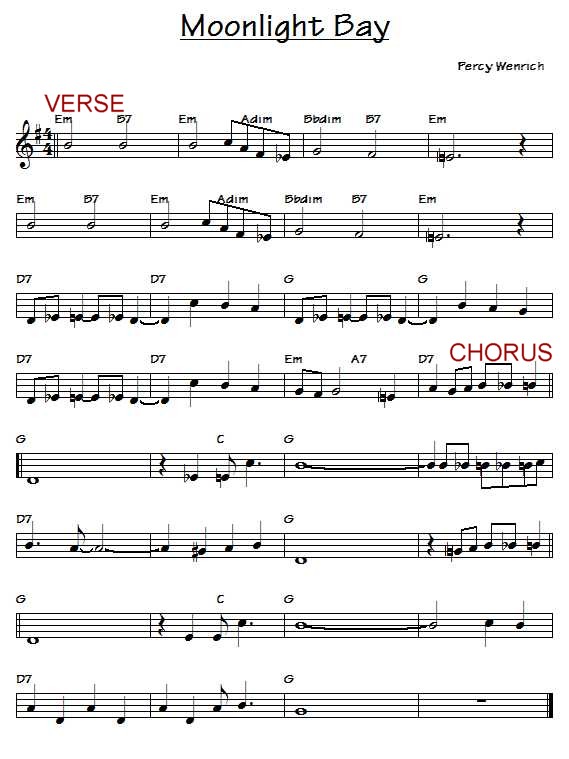
 But if, as a Bb instrument player, you prefer to see it in G, it works out like this.
The music for Moonlight Bay was written in 1912 by Percy Wenrich; the lyrics were by Edward Madden. Both men died in 1952.
Madden also wrote the words for such songs as By The Light of the Silvery Moon, Down in Jungle Town and Silver Bell.
Percy Wenrich was born in Missouri but from the age of 20 worked mainly in New York City. He composed rags such as The Smiler and Peaches and Cream, but he is probably best remembered for When You Wore a Tulip, Put on Your Old Grey Bonnet and of course Moonlight Bay.
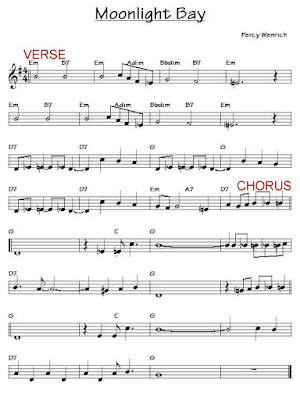
Just in case my attempt may be of some use to a beginner, here's how I have worked it out with Band-in-a-Box. As usual, I can't guarantee 100% accuracy. Shotgun plays it in F: