Welcome, Visitor Number

Translate

Showing posts with label Jonathan Doyle (clarinet and saxophone). Show all posts

24 December 2015

Post: 340 TUBA SKINNY IN AUSTRALIA - A GREAT VIDEO

One of the best half-hour traditional jazz videos that you will find anywhere on YouTube is a concert given by Tuba Skinny during their Australian tour in 2013.

As the video was professionally made and edited by Australian Television, the visual and sound qualities are exceptionally good.

The tunes played are 'Got A Man In The 'Bama Mines', 'Billygoat Stomp', 'Deep Henderson', 'Biscuit Roller', 'Dirty TB Blues', and 'Dallas Rag'.


At the time, the band was an eight-piece and included on strings those great musicians Ryan Baer (six-string banjo) and Westen Borghesi (tenor banjo). The reed player was Jonathan Doyle, who always contributed something very cultured to the Tuba Skinny sound.

My own favourite performances are 'Biscuit Roller', with its terrific vocal from Erika, and 'Deep Henderson' - a tour de force. I am always thrilled to hear how Barnabus and Shaye cope with those thrilling and difficult arpeggios in the third theme of 'Deep Henderson'. Listen out for them at 11 mins 50 seconds to 12 mins 02 seconds and again from 12 minutes 37 seconds to 12 minutes 49 seconds.

Also, the passion of Erika's singing and the supporting instrumental work in 'Dirty TB Blues' are outstanding.

This video was on YouTube for a couple of years and then sadly was taken down. But what a thrill it was when - a couple of years later - it mysteriously re-appeared!

23 December 2015

Post 338: TUBA SKINNY SHOW US HOW TO PLAY TRADITIONAL JAZZ

As you probably know, Tuba Skinny occasionally spend a week in Italy. For the end-of-2013 trip, they had John Doyle on reeds. By then, I had come to the conclusion that he is one of the greatest clarinet players in the history of traditional jazz; and I am now even more convinced. His technique and inventiveness are amazing, and yet he subjects his talents (as do all players in this great band) to the Tuba Skinny house style, in which everyone puts teamwork first and there is no room for exhibitionists.

In these videos (we must be very grateful to a film-maker codenamed NewOrleansJS for presenting them to us), we can enjoy these performances:

Big Chief Battleaxe (Thomas S. Allen, 1907). This is a routine performance by Tuba Skinny standards, which means it is far better than most bands could produce. But it seems to be the first number in their programme. You sense they are 'loosening up' and perhaps slightly affected by some tiredness after the long journey from New Orleans. As usual, Shaye directs the operation with all those little signals she has developed.

Crazy 'Bout You (Big Bill Broonzy and the State Street Boys, 1935). This is a simple, catchy 16-bar tune. Shaye starts on cornet and then switches to piano, taking a solo that reminds us she is also one of the best New Orleans pianists at present. It's a very happy number and Erika has the audience clapping along with her spirited, rocking vocal.

Willie the Weeper (Walter Melrose, Marty Bloom and Grant Rymal, 1920). The band plays a 4-bar Introduction; and then they go into the second theme of Willie The Weeper. Barnabus and John contribute lustily throughout. There is fine ensemble work and great backed solos on the second theme, though Shaye alone takes a solo (one of her amazing arabesques) on the first (G minor) theme. Note Shaye's direction of the band again. She takes so much trouble before they start - to get the tempo exactly right. Also note the brilliant final few notes with which she chops the tune off at the end.

Weary Blues (Artie Matthews, Mort Greene and George Gates, 1915). Unfortunately this recording starts well into the tune, missing the opening themes (in F) but we still have the Bb theme, with plenty of amazing, exciting stuff, played at a cracking pace. One of the highlights occurs where Shaye plays a terrific solo against offbeats from all six of the other players.

Six Feet Down (Erika Lewis, 2009). Erika sings her own superb composition in F; and there is a great solo by John, against ensemble background. The ever-popular Robin Rapuzzi also struts his stuff on washboard.

How can you view these videos? Go to YouTube and type in 'Tuba Skinny Orvieto 2013'. That should bring them all up.

12 September 2015

Post 261: WHO DOES THIS REMIND YOU OF?

Which of today's singer-guitarists - who divides her time between Texas and New Orleans - do you think of when you look at this picture?

When I saw this, my reaction was: Ah! Albanie Falletta at the age of six, with her first chord book!

I was wrong. It's actually an oil painting from 1772. The artist was Nicolas Lépicié. But here - for comparison - is the great Albanie with me when I had the pleasure of meeting her in April 2015.
And for a super example of Albanie singing and playing, CLICK HERE.

One of my correspondents recently told me he has become addicted to Albanie and her music. I'm not surprised.

26 May 2015

Post 214: A TUBA SKINNY STREET PERFORMANCE

One morning in April 2015, Tuba Skinny had agreed to play some street music ('busk', as we say in England) on Royal Street in the French Quarter of New Orleans. But when Shaye Cohn showed up, nobody else had arrived. Undeterred, she took out her violin and started to play all alone.


A few minutes later, Jonathan Doyle, the great clarinet player, arrived and joined her. So the two of them played as a duet, improvising a fast 12-bar blues in the key of D.


But it wasn't long before five other members of Tuba Skinny arrived. Shaye switched to her cornet, and away they went, giving a concert that witnesses told me was absolutely brilliant.


Here is one of the tunes filmed by the great video-maker digitalalexa at the time:
CLICK HERE TO VIEW.
When I heard about this concert, I was bitterly disappointed to have missed the performance. I was in New Orleans but happened to be in a different part of the City at the time.

But my friends David Wiseman and Bill Stock, both from England, were there and told me about it. Bill took the pictures above and kindly let me have them. He gave me this additional background to the story:
The busk was on Friday, the first main day of the French Quarter Festival. At his hotel in North Rampart Street, Alan Bates bumped into Todd, complete with tuba. Todd was visiting his Mum who was staying at the same hotel. He confirmed TS would be out in Royal Street from 11am.  Alan phoned me and we rallied the troops. We set off in search but were disappointed that there was no sign of the band at their usual spots. I then saw Jon Doyle on his bike, pedalling fast along Royal. We  flagged him down and he said that Shaye had called the band to the corner of Royal and Bienville Street. And that is where the story started. Their usual spots had been taken by other buskers but Shaye had obviously carried out an early recce to  find this location.

Things got better for me. A few hours later I saw Tuba Skinny playing in a Frenchmen Street bar. I also attended two more of their concerts.

28 January 2015

Post 162: WORLD'S BEST 'FRONT LINE' AWARD!

I remember seeing in a jazz magazine about thirty years ago a photograph with the caption 'The World's Best Front Line'.

It was a picture taken in a New Orleans bar and showed a trumpet player, with a clarinettist and a trombonist on either side of him, playing their hearts out and obviously pleasing the journalist or photographer.

I was reminded of this when it occurred to me that the World's Best Front Line Award for musicians active today could well go to Jonathan Doyle (left, clarinet), Shaye Cohn (cornet) and Barnabus Jones (trombone). When those three get together, there is no matching them for rapport, teamwork and musical brilliance.
Here they are at the 2014 French Quarter Festival, playing Willie The Weeper.

I'm indebted for the picture above to my British friend and traditional jazz enthusiast, David Wiseman.

How thrilling they can make any tune sound, even just a basic 12-bar, as in this recent video put up on YouTube by the generous digitalalexa, with Erika Lewis producing a terrific vocal as ever:
CLICK HERE TO WATCH.

Interestingly, of course, these musicians rarely appear literally as a 'front line' - preferring, when space allows, for their band to be spread out in a semi-circle, so that all the players can see each other and the audience can see all the musicians. It is also easier for signals to be given by the leader.

As I have said elsewhere, I wish more bands would adopt this formation.

And by the way, after I wrote the above, another sensational 'front line' emerged in New Orleans. It was The Shotgun Jazz Band's Haruka Kikuchi (trombone), Marla Dixon (trumpet) and James Evans (reeds).
My word, their playing is thrilling too! Try this:
Click on to watch them play 'Climax Rag'.
 .

23 January 2014

Post 116: 'DEEP HENDERSON' (AND TUBA SKINNY)


Tuba Skinny added to their repertoire a piece written in 1926 by Fred Rose and first made famous that year by the King Oliver Band. It is called Deep Henderson.

They must have worked hard getting this tune into their heads. It is a tricky, complicated piece, including a key change (going from F into Db for the Trio, unlike the original piano sheet music). It has several sections and many moments where the clarinet or the cornet have one-bar breaks or where a beat or two are completely silent. It is also very rhythmic and the overall effect can be, I think, terrifically exciting.

There are now several videos on YouTube of Tuba Skinny playing this tune. May I recommend that you seek them out?

9 June 2013

Post 101: CLARINET (AND SAXOPHONE) PLAYING - GOOD AND BAD

Please note: this article was first written with clarinet playing in mind. But it applies to saxophone players as well.

To hear a clarinet player doing just what a traditional jazz clarinet player should, CLICK ON THIS VIDEO. The clarinet listens well to the trumpet lead and harmonises beautifully. It is a great demonstration of what can be achieved even with very limited resources.

My friend Jonathan Graham - a fine guitarist and a trumpet player - told me he has been listening to lots of jazz recordings from the 1920s and has come to the conclusion that the clarinet is usually the most important instrument in the band.
It is the clarinet player who provides the drive, the energy, the decoration of the melody, syncopation, tone colouring, most of the polyphony - in fact much of the 'jazziness' of the music.

A good clarinet player has to know the chord changes of every tune - either by rote or intuitively - and he has to be a master of rapid arpeggios. His fingering must be confident and fast. He must also be skilful at throwing occasional long bluesy notes into his playing - usually flattened thirds and sevenths.

I guess that good clarinet players have spent hundreds of hours practising scales and arpeggios, perhaps backed by recordings that give them a clear melody around which to weave their magic.

The best clarinet players avoid playing right on the beat - especially on the first note of every bar. Coming in after the first quaver or on the second beat contributes better to the syncopation. They also avoid playing too many bars comprising nothing but quavers and crotchets. Triplets, semiquaver runs, dotted notes and trills - as well as those 'hanging' long bluesy notes mentioned above - add so much to the excitement.

Above all, in ensemble work, where the trumpet is stating the melody, you won't catch good clarinet or saxophone players on exactly the same notes as the trumpet. Why? For three reasons.

First, such duplication means a waste of the band's limited resources.

Second, it misses an opportunity for harmony and polyphony.

Third: the timbres of the two instruments clash. Listen to a trumpet alone playing, for example, a C for four beats. Fine. Now listen to a clarinet alone playing the same C for four beats. Fine. Now have them both together playing that C for four beats. Not so good. The sound is much less pleasant.

So, where the trumpet is assigned to stating the melody, the clarinet and saxophone must steer clear of it. (I have recently heard a jazz performance ruined by a saxophone player who was very loud, very weak on 'teamwork' and trying to play - most of the time - the same notes as the trumpet.) And this includes Middle Eights. Although Middle Eights can be tricky, the clarinet or saxophone player should take the trouble to learn their chord progressions correctly rather than cop out and simply play the melody of the Middle Eight (duplicating what the trumpeter is doing and annoying the rest of the band into the bargain), as I frequently hear a clarinet player do.

The situation can be particularly bad if a band has both a clarinet and a saxophone playing, probably in addition to trumpet and trombone. If the reed players do not play as team members, with a high level of musical awareness, the result can be excruciating. 

It is acceptable for the clarinet or saxophone to play the melody only when it is agreed in advance that it will 'take the lead', while the trumpet player either drops out for these bars or switches to improvising around the melody. Also, when playing a 'solo' chorus, the effect can sometimes be very pleasant if the clarinet player stays very close to the melody, perhaps in a low register. This can make a good contrast after an ensemble chorus led by the trumpet.

Breaks are another feature of traditional jazz in which the clarinet or saxophone can contribute so much to the excitement of the music. (If you don't know what I mean by 'break', I am referring to those moments when all the instruments except one drop out after the first beat of the bar, leaving that one instrument to play something interesting and decorative. Breaks are often assigned to the clarinet.)


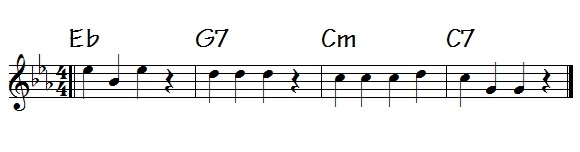
Consider for example the famous 4-bar break in Jazz Me Blues. A weak clarinet player may simply play this:
Technically that is all right. But it is hardly dynamic and exciting. It would be far better to play something on these lines:


In addition to all this, of course, the clarinet or saxophone often plays the melody - either because the tune is a clarinet feature, or because the band is a small group perhaps without a trumpet, or because the band has made an arrangement of the tune in which either the whole of the melody or one of the strains (in a rag, for example) is best played by the clarinet - if only for variety. All these situations give the clarinet player a great opportunity to demonstrate the instrument's beautiful tones and its expressive, soulful capabilities.

For an example of a modern clarinet-player and saxophone player getting things absolutely right, CLICK ON THIS PERFORMANCE. The clarinet player is John Doyle and the saxophonist is Ewan Bleach. It is also a joyous example of traditional jazz teamwork at its best.
========================

FOTNOTE
The book Playing Traditional Jazz, by Pops Coffee, is available from Amazon.

22 May 2013

Post 83: ALBANIE FALLETTA

Photo supplied by Bill Stock.
What a picture!

I first came across the guitarist and singer Albanie Falletta in this delightful video, where, on the north bank of the Mississippi in New Orleans, with two string-playing friends, she performs I'll See You in My Dreams: CLICK HERE TO VIEW. I was immediately charmed.

And here is a wonderful April 2015 video filmed by the great digitalalexa of 'Albanie and her Fellas' playing in Royal Street, New Orleans. You could hardly have a better introduction to her: CLICK HERE.

With the help of YouTube, I had found that Albanie played in The Thrift Set Orchestra in Austin, Texas, with such fine musicians as Jonathan Doyle, Hal Smith, David Jellema and Westen Borghesi. Here's an example: CLICK HERE TO VIEW.

She also turns up on YouTube in both Texas and Louisiana with her band 'Albanie And Her Fellas'. For example, you can catch her singing When It's Sleepy Time Down South BY CLICKING HERE. Or watch them busking in New Orleans BY CLICKING HERE, where the 'Fellas' happen to include Jonathan Doyle, Todd Burdick, David Jellema and Robin Rapuzzi.

There is also a video of Albanie playing with Tuba Skinny at a French Quarter Festival.

So for months Albanie has been one of my favourites.

Now imagine my joy when I visited New Orleans in April 2015 and suddenly noticed in Royal Street a young lady who looked exactly like the Albanie on YouTube. She had a guitar strapped to her back. 'Are you the famous Albanie?' I asked. 'Well, my name's Albanie,' she replied.

I found her just as sweet and charming as she appears in those videos. Albanie told me she came from Austin, where she started to teach herself to play the guitar at an early age. She has a good ear and usually has no trouble in working out the chords for a tune. She 'dropped out of high school' and took to busking and playing wherever she could. She has mastered her instrument to a high degree and sings very pleasantly.

I later discovered Albanie is highly respected by the entire community of New Orleans musicians. Dividing her time between Austin and New Orleans, she gets to play in many different groups.

Now that she is internationally famous and has reached a high level of proficiency, we might think she would be satisfied with her achievements. But Albanie surprised me by saying she still hoped one day to go to college and study music academically.

How modest these great young musicians on the New Orleans French Quarter scene always are!

I have two precious photo souvenirs. Here's a picture my friend Bill Stock from Essex, England, took of Albanie a few moments before I arrived. (Bill also happens to be the cameraman who made the video on the bank of the Mississippi - the video I mentioned at the top of this article.)

And here she is with me:
Pops Coffee Meets One Of His Idols
FOOTNOTE

Reader Phil has identified the bass player in the video on the bank of the Mississippi as Jeff Moran, leader of The California Feetwarmers, and has commented: Trivial perhaps but still interesting to me how musicians travel and learn from each other...Jeff was busking on the street in California with Chloe Feoranzo when Chloe was still a teenager. You can see the video Phil is referring to if you CLICK HERE.