Welcome, Visitor Number

Translate

Showing posts with label 8-bar tunes. Show all posts

2 December 2017

Post 573: REPEAT EIGHT BARS FIFTEEN TIMES

Can a band take a tune of just eight bars that lasts less than 20 seconds, and play through it FIFTEEN times without boring the audience? Can the band even keep it interesting and produce a little work of art?

Yes, it can be done. Tuba Skinny and other great bands frequently show us how.

Consider Jet Black Blues, an 8-bar tune based on a very simple chord progression (think The Magnolia Progression).

Lonnie Johnson wrote and recorded it in 1929. You can find his original recording (in which King Oliver also features) on YouTube.

Tuba Skinny added the tune to their repertoire some years ago.

At one of their performances, my friend David Wiseman filmed them. You may see the result BY CLICKING HERE.

Note how they vary the presentation and constantly provide fresh interest, in the fifteen runs through the tune:

1. Shaye on cornet states the tune.
2. The clarinet and trombone join in for an ensemble chorus.
3. Another ensemble chorus.
4. Craig on clarinet takes the lead, with quiet support from the cornet and trombone.
5. Another clarinet-led chorus.
6. Charlie on trombone takes the lead, with interesting stop-chord support from other members of the band.
7. The trombone again leads, this time with an amusingly different pattern of stop-chord support.
8. The cornet provides an improvisation on the eight bars.
9. Another cornet improvisation.
10. Jason on banjo takes the lead, with lovely tremolo work.
11. Jason again leads.
12. The clarinet leads, with long-note backing.
13. The clarinet again leads, with gentle backing.
14. The full ensemble plays the chorus.
15. A final run-through by the full ensemble is neatly rounded off with a 2-bar coda.

That's how it's done!

28 June 2016

Post 408: 'MOONLIGHT BAY'

Moonlight Bay - often called On Moonlight Bay - is one of those very pleasant memorable songs from over a century ago that are easy to play and to improvise on. And yet I have heard very few traditional jazz bands playing it in recent years.

So it was a great pleasure to come upon a video uploaded on to YouTube by the excellent Louisiana-based video-maker codenamed RaoulDuke504. It shows The Shotgun Jazz Band (in its five-piece form, with Charlie Halloran on trombone) giving a most tasteful, gentle performance of this song at Covington Trailhead, which is a lovely new public park about 35 miles north of New Orleans. This was in the middle of June 2016.


You can watch the video of The Shotgun Jazz Band by clicking here.

This performance is unusual because it includes the VERSE as well as the familiar Chorus. The width of Marla Dixon's repertoire and the depth of her memory constantly amaze me. I ought not to have been surprised that she knew the Verse or that she sings the vocal. Is there any song for which Marla does not know the words by heart?!

Apart from its great melody, it is the simplicity and structure of the Chorus that should make it appeal to many more traditional jazz bands. After all, it is virtually nothing but an eight-bar three-chorder. (Well, actually the eight bars are played twice; but you see what I mean.)


The chord pattern (without subtleties) is:


  I   |  I7:4  |  I    |  I   |   V7   |   V7  |  I  |  I:(V7)

In recent years we have been given plenty of lessons in what great musicians can achieve with even the simplest 8-bar themes. Think especially of Tuba Skinny and Late Hour Blues, Untrue Blues, Mississippi River Blues, Lonesome Drag, I'll See You in the Spring, Owl Call Blues, All I Want is a Spoonful, Papa Let Me Lay It On You, Too Tight Blues, Got a Mind To Ramble, Ice Man and so on. All these tunes have a basic eight-bar theme repeated many times, but with great creativity and subtlety in the variations.

The music for Moonlight Bay was written in 1912 by Percy Wenrich; the lyrics were by Edward Madden. Both men died in 1952.

Madden also wrote the words for such songs as By The Light of the Silvery Moon, Down in Jungle Town and Silver Bell.

Percy Wenrich was born in Missouri but from the age of 20 worked mainly in New York City. He composed rags such as The Smiler and Peaches and Cream, but he is probably best remembered for When You Wore a Tulip, Put on Your Old Grey Bonnet and of course Moonlight Bay.

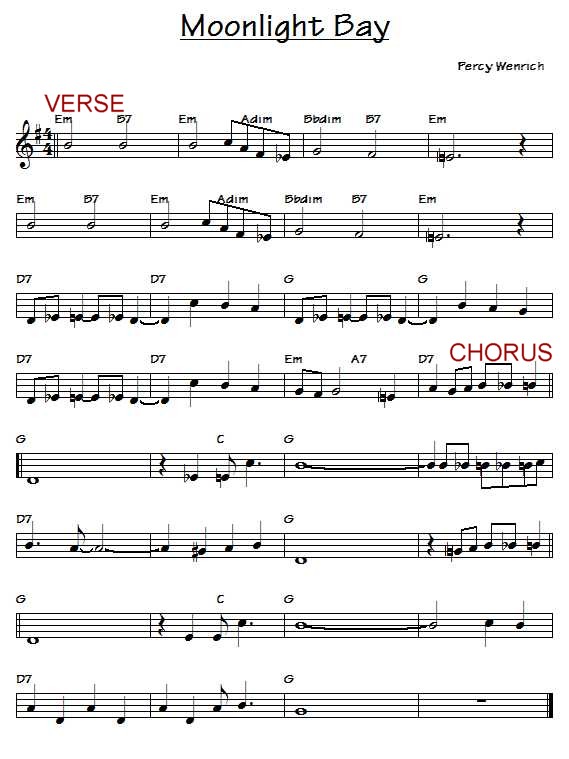
Just in case my attempt may be of some use to a beginner, here's how I have worked it out with Band-in-a-Box. As usual, I can't guarantee 100% accuracy. Shotgun plays it in F:
But if, as a Bb instrument player, you prefer to see it in G, it works out like this.

11 January 2016

Post 352: EIGHT-BAR TUNES; AND TUBA SKINNY

Tuba Skinny performing 'Owl Call Blues'

Tuba Skinny are fond of what I would describe as 'eight-bar melodies'. What I am referring to are themes of eight bars (measures), sometimes repeated, so you could say the tunes are either of eight bars or sixteen bars (often with a 'turn-around' in bars 7 and 8). A sixteen bar (8 + 8) example is Late Hour Blues - a song they introduced into their repertoire in April 2015.

I suppose this is inevitable with a band that garners so much of its material from the unsophisticated songs of the jug bands and blues guitarists of the 1920s and 1930s. They went in for simple, memorable themes that are really good to sing.

These eight-bar tunes (sometimes using only two chords and sometimes needing just four chords covering two bars each) have become specialities of Tuba Skinny's wonderful vocalist, Erika Lewis.

Not long ago, she added Untrue Blues to her eight-bar songs in a version that is remarkably faithful to the 1937 original by Blind Boy Fuller. Incidentally, Tuba Skinny play it in the key of A, which is awkward for some brass and clarinet players. Here's Erika: Click here to watch.

And here's the original by Blind Boy Fuller. He prefers the key of Bb: Click here.

But other Tuba Skinny numbers in this eight-bar category are:
Mississippi River Blues (Big Bill Broonzy, 1934)
Blue Spirit Blues (by Spencer Williams and famously recorded by Bessie Smith in 1929; it also has a 12-bar theme at the end)
Got a Mind To Ramble (Merline Johnson, 1930s)
Lonesome Drag (Tennessee Chocolate Drops, 1930; adapted by Erika Lewis)
Ice Man (Memphis Minnie, 1936)
Baby, Please Don't Go ('Big Joe' Williams, 1935) (Click here to watch video)
I'll See You in the Spring (The Memphis Jug Band, 1927)
Owl Call Blues (music by Shaye Cohn and words by Erika Lewis, 2014): you can watch Erika singing this haunting tune by clicking on here.
Papa, Let Me Lay It On You (Blind Boy Fuller, 1938) CLICK HERE for a video of this filmed by my friend David Wiseman.
Too Tight Blues (Blind Blake, 1927)
All I Want is a Spoonful (Papa Charlie Jackson, 1925)
You Gonna Quit Me, Baby (Blind Blake, 1927)
Jet Black Blues (Lonnie Johnson, 1929)

There's a lesson here for the rest of us. Maybe we should play more eight-bar tunes, especially if our band is lucky enough to have a singer.

4 February 2015

Post 166: WHEN YOU TRIM THE 12-BAR BLUES

The standard, basic chord structure of a 12-bar blues (without any subtleties) is this:

I | I | I | I7 | IV | IV | I | I | V7 | V7 | I | I | 


Hundreds of tunes are based upon it.

But there are some curious variants that are arrived at by chopping out some part of the structure.

For example, lop off the first two bars and you have this:
 I | I7 | IV | IV | I | I | V7 | V7 | I | I | 

This is exactly what you get in the 10-bar tune Frisco Bound, composed in 1929 by Memphis Minnie and Kansas Joe.

Lop off the first four bars:
 IV | IV | I | I | V7 | V7 | I | I | 
... and you have the chord progression for The Girls Go Crazy (and many other tunes with 8-bar themes - such as the second part of Down By The Riverside).

Omit Bar 9 and you get:
I | I | I | I7 | IV | IV | I | I | V7 | I | I | 
...which is what you have with the possibly unique 11-bar blues that is Jackson Stomp, composed in 1930 by  Charlie McCoy and Walter Vincson.
Memphis Minnie
And here's a curiosity - the only 13-BAR blues I can think of. It occurs as the Interlude in Blind Boy Fuller's Untrue Blues. This is essentially an eight-bar tune, but he has two guitar links of 13 bars, which seemed to be based on the 12-bar blues, but with Bar 10 repeated. When Tuba Skinny revived this tune in 2014, they scrupulously followed the original and kept the 13-bar section.
==========
Footnote

The book Playing Traditional Jazz by Pops Coffee is available from Amazon.

10 May 2013

Post 71: PEG LEG HOWELL

I have been led to Peg Leg Howell by the YouTube videos of young musicians in the streets of New Orleans. I had not previously heard of him. Many of today's performers have been inspired by Early American Black Country Music and they have revived the 90-year-old tunes of such guitarists as Peg Leg Howell, Frank Stokes and Blind Blake.

PEG LEG HOWELL (1888 - 1966) lived in Georgia and really did have a peg leg (a leg having been amputated after he was shot in a fight). His real name was Joshua Barnes Howell. He was a farm labourer and a self-taught busking guitarist. 
Howell's Trio
He is on the right; Williams on the left; Anthony centre.
As required by the mythology that often surrounds such characters, he served time in prison for alcohol offences. But in the 1920s he also made over twenty influential recordings of songs with Columbia Records. The two I must mention as having been particularly taken up again recently in New Orleans are: Banjo Blues and Too Tight Blues. Too Tight is an unusual blues in having several 8-bar three-chord vocals, interspersed with standard 12-bar instrumental improvisations. To see a jazz band playing it recently (though eschewing the 12-bar option),
CLICK HERE.
For a great foot-tapping version of Banjo Blues by fifteen of today's New Orleans buskers,
CLICK HERE.
And to hear the original 1928 recording by Peg Leg himself (with Eddie Anthony on violin),
CLICK HERE.


You can find a full Peg Leg Howell discography   BY CLICKING ON HERE.

24 March 2013

Post 24: 'ICE MAN'

One of the 2013 videos of Tuba Skinny, brought to us by the generous digitalalexa, is a performance of Ice Man.

The band is playing for fun, outdoors, late on a warm summer evening. It is almost completely dark.

You can watch the performance if you:

I had never heard of Ice Man (but I have now discovered there were several tunes of this title: one was written and recorded by Memphis Minnie in 1936). The one played by Tuba Skinny, however, is believed to be an old Cajun music theme, composer unknown.

It is one of the most delightful and infectious music performances you will come across.

Six members of the band are present and they are totally relaxed, making music just to please themselves and for the sheer joy of it.

Ice Man is essentially a simple eight-bar theme, using just the tonic and dominant chords. It's the kind of tune that could have been composed on the back of an envelope in about 15 minutes. Maybe it was!

My guess is that this was Tuba Skinny's first-ever performance of the tune. The context and treatment suggest that it was played at the request of (and led by) the guitarist, who was the only one who knew the words of the spoken 'verses'. The fact that they play it in the key of G (usually considered awkward for Bb brass instruments) supports the theory that the key was chosen to please the guitarist.

Tuba Skinny show us what can be achieved even with such simple material.

Notice the perfect line laid down by Todd Burdick's tuba. Enjoy Robin's use of the full range of his percussion, including the makeshift cymbal. And note how the two of them work smartly together at each 'cut-off' point. Enjoy the close-harmony singing of the two ladies (Shaye and Erika). Admire Barnabus's usual creative work on the trombone. And note as always Shaye's magical work on the cornet - a perfect bluesy 8 bars at 2 mins 50 secs, and her astonishing colouring behind the brief trombone solo at 1 min 49 secs.

Incidentally, if you are a beginner trying to learn to play traditional jazz, this would make a very good tune for you to try first. Here you go:
etc.