Welcome, Visitor Number

Translate

Showing posts with label expanding the repertoire. Show all posts

18 December 2017

Post 579: SHAYE COHN - TRADITIONAL JAZZ COMPOSER


Shaye Cohn is considered by many to be the best traditional jazz band leader, the best traditional jazz cornet player and one of the best traditional jazz piano players and violin players in the world today. I think it's time also for us to recognise her achievement as a composer of our kind of music.


While only in her early 30s, Shaye had already given us some wonderful compositions. Think of the very entertaining and clever Blue Chime Stomp. Remember the haunting Owl Call Blues. And there was Salamanca Blues - a lovely melancholy piece with themes in F and then Ab, giving plenty of opportunities to the trombone and guitar.  Watch it in this performance: CLICK HERE.  As you can hear, it starts with a pleasant 12-bar blues theme in F, played by Barnabus. After that, so many interesting things happen: an other-worldly 16-bar theme led by Shaye; then a switch to the key of A flat and some lovely 12-bar blues sequences (including those played with a 'break' on bars 7 and 8 by Craig and Barnabus and Todd - always signalled by Shaye's outstretched leg). It's an early example of the beauty and complexity of Shaye's compositions. I should think she must still be very proud of it.

The medium-tempo Tangled Blues is a particularly clever composition: as its title suggests, it sets us plenty to 'untangle', with pretty, wistful phrases popping up in different keys and in two different themes - one of which runs for the highly unusual length of 18 bars.

In some of her work, we might say she is following the Schoebel School of Composition. By this I mean that, just as Elmer Schoebel in such pieces as 'Stomp Off, Let's Go' and 'I Never Knew What a Girl Could Do' has unconventional linking passages that catch us off balance, so Shaye does not restrict herself to nothing but such 8-bar blocks of music as constitute about 95% of traditional jazz tunes. 


Indeed, Shaye often challenges the ubiquitous 32-bar structures [four 8-bar sections, a – a – b – a] followed by popular music composers of the 1920s and 1930s. Some of her structures verge on the byzantine.

Pearl River Stomp (from 2016) springs another Shaye surprise. It begins with a bright 16-bar theme in the key of Ab. This is played through several times. Various instruments in turn take the lead, with interesting backing from the others. But just when you think it will continue like this, no doubt ending with some ensemble choruses, there is an abrupt drop to the key of Db and an entirely new 16-bar theme is played (very much like Bogalusa Strut and complete with the break in Bars 7 and 8). And it is with this theme - played only two or three times - that the piece ends.

Elysian Fields includes some apparent 8-bar sections that weirdly morph into 9 bars, with the barely perceptible addition of a holding pause.

Then there is the mighty Mortonesque Pyramid Strut, composed while the band Tuba Skinny was touring in Australia. This is the most complex of Shaye's creations. It has four themes, as well as an 8-bar bridge, and uses two keys. Lots of 'breaks' are built in and there are witty moments - such as the Coda. You can find videos of all these tunes on YouTube.

A favourite of many fans is the hauntingly beautiful Deep Bayou MoanTo my ear, it's in Ab (F minor). Elegiac, introspective, Arcadian: it has all these qualities.

Shaye's composition Nigel's Dream sounds so authentically 1920s that you could easily be fooled into thinking it was a previously undiscovered manuscript by King Oliver.

You can hear Shaye and Tuba Skinny performing Nigel's Dream either at


or at


As ever, we must be grateful to the video-makers (in this case James Sterling and RaoulDuke504) for bringing this tune to our attention.

Its cheeky two-bar introduction involves nothing more than one 'Charleston' bar from the washboard followed by a single chord from the banjo, guitar and tuba. Then we are into Theme A - 32 bars in the key of C. Great use is made of a phrase (reminiscent of the Middle Eight of East Coast Trot) in which a flattened third is accentuated. Actually these 32 bars comprise two almost identical 16s; and at the end of the first sixteen (Bars 15 and 16) we have a 'break' (played by the banjo first time through and by the cornet and clarinet in a witty King Oliver-style mini-duet when the Theme is played again, led by the trombone, later).

The final bar of Theme A takes us through a modulating chord into the Key of Eb, in which Theme B is played. Twice through the sixteen bars (apparently both beginning with the chord sequence IV - IV - I - I) gives us a merry 32 bars. We then go straight back into Theme A (key of C again), with the trombone taking the lead. Then Theme B (in Eb) is re-visited. This is played through a couple of times with some boisterous, polyphonic ensemble, giving the piece a great ending. There is a neat Coda of just one bar.

What a composition! It's just as well written and well played as those King Oliver Jazz Band classics from the 1920s.
======================

18 February 2017

Post 478: 'THE MINER'S DREAM OF HOME'

It has been some time since I heard a band play The Miner's Dream of Home - one of the oldest tunes in our repertoire: it was composed in 1891.

It used to be a favourite of the late English trumpet-player and bandleader Sonny Morris. His playing was always tasteful and he enjoyed sentimental and gentle melodies such as this.

It is easy to play, since it has a simple 32-bar melody, to be taken only at a moderate pace; and the chord sequence is basic - pretty well intuitive.

So may I recommend it to you, especially if you are a 'learning' band wishing to increase your repertoire? Here's how I have it in my mini-filofax collection.


If you would like to hear the tune performed very pleasantly and with appropriate unpretentiousness by an English jazz quartet, click here. Should you wish to offer a vocal, the words are:

I saw the old homestead, and the faces I love.
I saw England's valleys and dells.
And I listened with joy, as I did when a boy,
To the sound of the old village bells.

The log was burning brightly.
'Twas a night that should banish all sin,
For the bells were ringing the old year out
And the new year in.

26 October 2016

Post 441: MINOR KEY VERSE; MAJOR KEY CHORUS

With thousands of tunes available in the traditional jazz repertoire, there are bound to be many that musicians never learn or get to play. However, I am sure we all keep striving to learn new ones - especially those we have been intending to pick up for months.

That's why I set about learning I'm Coming, Virginia today. It was a tune composed in 1927 by Donald Heywood and Will Marion Cook. I first enjoyed it on a Jack Teagarden recording decades ago. And of course the Bix Beiderbecke version is a classic.

I wanted the full song - Verse included. So I found the 'dots' on Lasse Collin's wonderful site (many thanks, Lasse!) and I entered them into my mini filofax system.
But what was this? The verse was in a minor key but the Chorus was in the major.

This made me wonder how often this switch from minor to major occurs in the popular old songs.

I guess there must be many whose verses in minor keys have been long forgotten and only the Chorus is now played. An example is the very popular Hindustan. It has a minor-key 16-bar verse, but I do not recall hearing any band play it in recent years. Similarly, Japanese Sandman has a 20-bar Verse in a minor key (usually Eb minor), followed by a 32-bar Chorus in the major key (Eb major, usually).

I think I'm right in saying that At The Jazz Band Ball, That Da Da Strain, She's Crying For Me, Shim-Me-Sha-WobbleWillie The Weeper and Lil Hardin's Droppin' Shucks all start with a minor theme and then have a second theme in the related major key. And the 1929 song The Ghost of the St. Louis Blues by J. Russel Robinson, with words by Billy Curtis, certainly has a 'spooky' minor Verse with a major Chorus. Exactly the same is true of Chloe.

Another is a nearly-forgotten song called I Don't Know Nobody Here and Nobody Knows Me, composed in 1924 by Jo Trent and Will Donaldson. The piano music shows a 16-bar Verse in D minor leading into an 18-bar Chorus in the key of D major.

And Lil Hardin uses the minor very heavily in the early stages of Perdido Street Blues before inviting the musicians to play 12-bar choruses in the related major key.

Cole Porter worked wonders with the minor-major effect in I Love Paris, where the first sixteen bars offer a lovely melody in a minor key and the second sixteen - like a flower suddenly blossoming - use virtually the same melody an octave higher but now in the major key.

Cole Porter plays a similar trick in My Heart Belongs to Daddy, which is essentially in a minor key, though there is a 'blossoming out' into the major in the second half of the Chorus, before the tune settles back on the minor in its final bar. And if you look closely at Cole Porter's You'd Be So Nice To Come Home To, you discover that he very skilfully contrasts minor with major chords.

There are tunes such as I'm The King of the Swingers, where we begin in the minor (I'm the King of the Swingers, the Jungle VIP.....) and then switch to the related major key (Oh oobee do, I wanna be like you.....) for the second half of the Chorus. And I think Mama's Gone, Goodbye may be said to have a minor verse leading into a major chorus.

But I am stumped in trying to think of other interesting examples.

Maybe you can help me?
=============
Reader responses

It seems that readers are just as stumped as I am. Only two responses have arrived so far. Robert Duis in the Netherlands offers Chega De Saudade, which has a verse of 32 bars in the minor, followed by a 36-bar chorus in the major. It is a 1958 bossa nova by Antonio Carlos Jobim. I have not personally heard a traditional jazz band play it. And Richard Bogen in Phoenix, Arizona, has told me that Shine On Harvest Moon (music composed in 1908 most probably by Nora Bayes-Norworth) has a 16-bar Verse in the relative minor. I did not know the Verse, but I have found it on the internet and yes: Richard is right.
===========

14 August 2016

Post 428: 'OLD AGE BLUES'

As at 31 August 2016, according to the survey released by the NWG Institute, the average age of active traditional jazz musicians in the United Kingdom was 76 years and 10 months. I think the situation in many other countries must be similar.

So it's high time we revived a fine tune from 1921 - Old Age Blues. The music was composed by Jess Williams and the words were written by Pete Curtis. Not much is known about Jess (Jesse?) Williams, except that he was born in 1892 and died in 1977. He was a fine piano player and composer of ragtime music and he ran an automotive parts business in Nebraska. We can see from the cover of Old Age Blues that Williams and Curtis were partners in publishing music, too, apparently.
It's a good tune, merry and well worth playing. But I have been unable to find any example on YouTube of a jazz band playing it. (There is an Old Age Blues on YouTube but it's a different tune from the one of which I am speaking.) So I have produced on my computer a Band-in-a-Box version of it. This is far from an ideal way of hearing it, but it gives some idea of the nature of the tune. You can listen to my attempt by clicking here.

Take a look at the structure of Old Age Blues. It has a 16-bar Verse and then a 16-bar Chorus. Players could use the Chorus as the basis for improvisations. The Verse is virtually A-A-B-A in structure, whereas the Chorus is A1 (8 bars) + A2 (8 bars)  
And here it is in F (for Bb instruments).


The words are worth using too:

VERSE
Folks, there's a man that's made me sad.
That ain't all. He's made me mad.
Since I was born, we've been good friends
But this very day our friendship ends. I'll
Tell you what he's done and
Give you his name for
If you live long he'll
Treat you the same.
We all call him 'Father'
Father Time and he
Gave me some blues I
Wish wasn't mine! (Those)

CHORUS
Old age Blues, those Dotage Blues:
They haunt you night and day. They
Come to you seems all at once
And never go away. They're
In your dreams and in your wake and
Do just what they choose. There's
No way beating them
No way cheating them - Those
Old Age Blues.

If you care to study the original piano sheet music, here it is.

18 July 2016

Post 414: 'PANAMA RAG'

Panama Rag (originally entitled Panama, A Characteristic Novelty) became a 'standard' in the repertoire of traditional jazz bands. It dates back over 100 years, having been written by William H. Tyers in 1911. Tyers, born in Virginia, the son of former slaves, lived from 1870 to 1924. The piece of music (despite the cover shown above) possibly has nothing to do with the country Panama or the Panama Canal which was under construction at the time: it is said by at least one source to have been named in honour of Aida Overton Walker and Her Panama Girls - a music hall act.
Whatever the truth, it is a great number and can sound good no matter at what tempo you take it. I have heard it performed gently and sedately (for example by The Ophelia Ragtime Orchestra) and also in a driving, pulsating way by some jazz bands at festivals.

It can be strenuous to play, especially for the trumpeter, as there are five themes - all of which are usually repeated. I tried writing it out. It is normally played in Eb, modulating into Ab, so I have transposed it into F modulating into Bb to suit my Bb trumpet.

As usual, I have fitted it into my mini-filofax collection of tunes arranged alphabetically (between, as it happens, Painting The Clouds With Sunshine and Papa De Da Da). You can see my scruffy effort below. But beneath that, I am presenting the version put on his website - http://cjam.lassecollin.se/ - by the great and generous Lasse Collin. It's much more helpful and tidier than mine, for those of you wishing to learn the piece.
Lasse's Version:

12 February 2016

Post 387: 'WHO WOULDN'T LOVE YOU?'

My friend Chris the pianist suggested that we should learn a tune called Who Wouldn't Love You?

I had never heard of it, but I was able to find several examples of the tune on YouTube and I then discovered that it was a pop song of 1942, written by Carl Fischer (music) and Bill Carey (words).

It's a very pleasant tune, apparently in 16 bars (8 + 8), but with the possibility of extending to 18 bars, for example with a tag in a final Chorus. Who Wouldn't Love You? has some appealing harmonies. The melody note seems occasionally to be on the 6th or 9th of the chord.

I wrote it out in G (for trumpet use): this means I will be playing it in Concert F, which seems right for it, though it also goes well in Bb, as in some performances on YouTube, such as this one (click on to listen).

I store all my tunes in mini-filofaxes and here's the result. It's a bit messy: I struggled with some of the chords and changed my mind in a couple of places.

13 January 2016

Post 363: HOAGY CARMICHAEL'S 'JUBILEE'

I was lucky enough to be at The Spotted Cat in New Orleans on 9 April 2016, when The Shotgun Jazz Band, in eight-piece form, played a rollicking tune called 'Jubilee'. Not only that; I managed to make a video of it - one you can watch by CLICKING HERE.

This tune was new to me, so when I returned to England, I set about trying to find out who wrote it and when. The first thing I discovered was that there was not much evidence of it on YouTube. There were several songs with the word 'Jubilee' in the title, but not one of them was the tune I had heard - until I came to one solitary video of a jazz trio playing it in 1991.

So it does not seem to be a tune in the standard repertoire of our bands. This is a pity, as it deserves to be. May I recommend it to band-leaders?

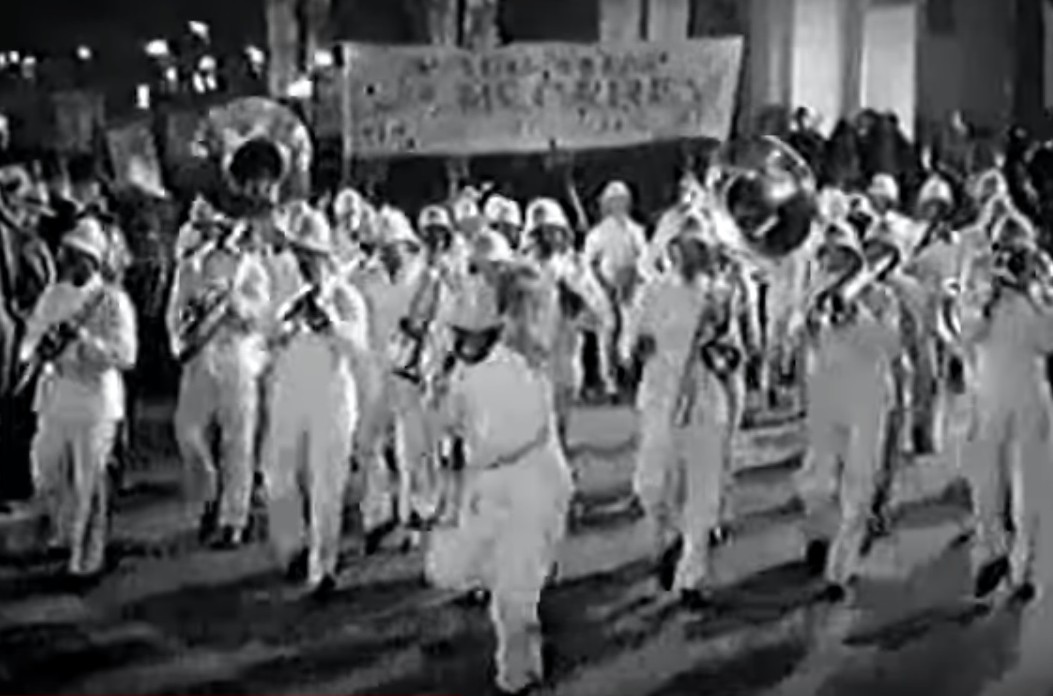
With help from my American correspondent Larry Smith, I learned the song was composed by none other than Hoagy Carmichael, with words by Stan Adams. They wrote it for a 1937 film called 'Every Day's a Holiday', in which Mae West and Louis Armstrong both appeared.
Louis Armstrong at the front of the Parade Band
in the film 'Every Day's a Holiday' (1937).
When you first listen to the tune, you sense that mastering the chord progression should be easy enough. And you also feel that the song has a 'tag'. You discover that it is a tune of 36 bars, unlike the common 32-bar form. What has happened is that Bars 29 and 30 are repeated twice, thereby spinning out the ending, so that it becomes a 36-bar song.

The Shotgun Jazz Band played the tune in the key of Eb Concert; and it went something like this:
If you would like the words, you can get them direct from Louis Armstrong at 50 seconds into this historic film extract:  CLICK HERE.

As for chords, you may be able to get away with a simplified version, for example:
I
I
I
I
I
I
I
I
III
III
III
III
III
III
III
III
IV
IV
IVm
IVm
I
I
II7
V7
I
I
I
VI7
II7
V7
II7
V7
II7
V7
IIm:V7
I
(It is a 36-bar tune)

But if you are happy to work at something more sophisticated, try this:
I:VIm7
IIm7:V5
I:VIm7
IIm7:V5
I:V7
I:V7
I
I
III:I#m
IV#m:VII7
III:I#m
IV#m:VII7
III:VII7
III:VII7
III
III
IV
IV
IVm
IVm
I
I
VIm6
VII7
I:VIm
IIm7:V7
I
VI7
II7
V7
II7
V7
II7
V7
IIm7:V7
I
(It is a 36-bar tune)
John Dixon, who is to be seen laying down the chords in the Shotgun Jazz Band video, has read this article and has kindly sent me this very helpful information - an even simpler way of approaching it:
For purposes of learning the chord progression, it’s easier to think of it as I, vi, ii, V in Eb, and then I, vi, ii, V in G (or the 3rd of whatever your root is), as it really swaps keys and it makes it easier to shout out the changes to someone on the fly. The whole thing is more like an exercise in technique than a regular tune. 

Footnote:
While doing my little bit of research, I came across a suggestion that Jubilee had actually been written at least ten years earlier, because there is a 1928 recording by Frankie Trumbauer and His Orchestra of a tune called Jubilee. So I checked the Trumbauer recording and can confirm it is a quite different tune, even though it has the same title. Trumbauer's tune was actually written by Willard Robison (the composer of A Cottage For Sale).

28 November 2015

Post 311: EXPAND YOUR REPERTOIRE - JUST LIKE TUBA SKINNY

Can you name ANY band that plays five or more of the following twenty-five tunes? Big Chief BattleaxeBilly Goat StompCannon Ball BluesCarpet Alley BreakdownChocolate AvenueDear AlmanzoerDreaming The Hours AwayFourth Street Mess AroundGladiolus RagGood Time Flat BluesIn Harlem's Araby, Jazz BattleJubilee Stomp, Kansas City Stomps, Michigander BluesMinor DragNew Orleans BumpOriental StrutPerdido Street BluesPyramid StrutRussian RagSkid-Dat-De-DatVariety Stomp and Wild Man Blues.

I certainly can't - apart from Tuba Skinny.

These are just a few of the tunes - mostly tricky and complicated in structure - that this wonderful band has magnificently mastered in its short existence. Yes, Tuba Skinny plays all twenty-five.

Listen to any programme given by your average traditional jazz band and the chances are that more than 90% of the tunes will be the usual standards structured in 32 bars (measures) or - in the case of blues - 12 bars. Of course a tune may have a short introduction and possibly a coda, but essentially the 32-bar or 12-bar melodies dominate our music.

But - as in so many other respects - the great young band Tuba Skinny is making us re-think this aspect of our playing.

How many bands do you know who play 10-bar tunes? Tuba Skinny do. Think of Frisco Bound.

How many bands do you know who play 11-bar tunes? Absolutely none, I guess. Apart from Tuba Skinny, with Jackson Stomp.

And what about 24-bar tunes? Can you even name one such tune (not counting 12-bar blues with two themes)?

Well, Tuba Skinny play a 24-bar tune: I'm Blue and Lonesome (Nobody Cares for Me). It is in no sense a double 12-bar. It begins with The Sweet Sue Chord Progression and then in bars 17 - 20 incorporates The Magnolia Chord Progression.

They introduced us to Ice Man (8 bars and only two chords!), a fun number with a simple theme.

Then there's Crow Jane - another tune well established in their repertoire. How many bars long is it? It uses both 8-bar and 10-bar lengths.

We have to admire Tuba Skinny for their fearless tackling of these unusually shaped tunes and the enormous range of their material.

They enjoy mastering difficult old classics, such as Fred Rose's Deep Henderson. This tune presents a challenge to any musicians. It is usually played by jazz bands in the key of F, modulating to the key of Db in Theme C (the Trio). Fred Rose's original piano music showed no key change.
Here's how it is structured:
8 BARS : Introduction, with various instruments taking a bar each in Bars 5, 6, 7 and 8.
32 BARS : THEME A. Rapid, tricky work for the reed player and a thrilling free-style middle eight.
32 BARS : THEME B. Interplay between two melodies. With a famous leaping middle eight that has to be played just right.
4 BARS : MODULATION, normally ending on Ab7, neatly leading into the key change to the unusual key of Db.
32 BARS : THEME C (THE TRIO). A super rhythmic riff in the new key. The middle eight is thrilling, with the cornet tearing through eight arpeggios on tricky chords including B7 (that's an awkward C#7 to the Bb instrument player!).

That gives you a total of  108 bars to be mastered and memorised, not counting any repeats or solo choruses that the band chooses to insert. Tuba Skinny play it magnificently. You can see and hear them do so on YouTube:

30 October 2015

Post 287: LASSE COLLIN'S GREAT CONTRIBUTION

Scattered around the Globe there are many individuals who have voluntarily and generously given hundreds of hours of their time to help support and propagate traditional jazz.

I can not list them all. But I personally am specially grateful to the anonymous person (?Scott Alexander) who created the highly-informative 'Red Hot Jazz' website:
CLICK HERE. (Unfortunately, I am told that nothing new has appeared on this site for several years, even though it is a 'work in progress'. It is possible that the creator has died, though obviously we must hope this is not the case.)
And I am grateful to the people who run the CD-publishing company Document Records. They have enabled us to hear so much of the almost-forgotten music of the 1920s and 1930s:
Then there is the great Dick Baker, about whom I have written before. For years he has been tirelessly researching the old tunes, trying to establish who composed what and to tidy up hundreds of confusions:
And I have a huge admiration for John Birchall, who has spent years building up a massive library of tunes our bands play, all in Band-in-a-Box form:
CLICK HERE.
There are also many great video-makers, who have done us huge favours by making the best music available on YouTube. I follow several of them, and have long been impressed especially by the work of the video-maker codenamed digitalalexa:
and the video-maker codenamed RaoulDuke504:
But today, especially on behalf of all of us who try to play the music, I want to praise Lasse Collin - a man who - month after month for many years - has been creating HUNDREDS of Lead Sheets from which we may learn the tunes.

It is virtually impossible to find or buy the sheet music for the wonderful tunes the bands played in the first half of the Twentieth Century. Lasse Collin has been working them out by ear to the best of his ability and publishing his findings (usually complete with lyrics where possible) - free to everyone - on his web-site.

Lasse says:
New Orleans jazz is played by heart and ear. You fake some good old tunes and improvise on the melodies and the chords they are built on. Most of the tunes were forgotten a long time ago;, nobody asked for them. ...... To preserve these tunes is more of a cultural achievement. Often you have to transcribe them from old recordings, because there has not been any sheet music available for many decades, if ever.


Lasse adds (with undue modesty) that his transcriptions 
are mostly an interpretation of the song and don't claim to be quite right, simply just "good enough for jazz". The upper section with the chords is for C-instruments (banjo, guitar, piano, bass), the lower with the melody is for instruments tuned in Bb (trumpet, clarinet, soprano- and tenor sax, trombone). Have a look at the tune, memorize it, put in your soul, and play it hot!

Here is an example of what he offers on his site.

You can also click on examples of Lasse's bands playing most of the tunes. Pretty good, eh?  And extremely useful to all of us who try to play the music. Well done, Lasse. We are all indebted to you! To explore Lasse's wonderful site for yourself,


ADDITIONAL NOTE added in August 2023 : Sadly, I have just heard that Lasse died on 23 December 2022.