Welcome, Visitor Number

Translate

23 February 2016

Post 398: MARLA DIXON AND 'OVER IN THE GLORYLAND'

One of the most exciting bands playing traditional jazz anywhere in the world at the moment is The Shotgun Jazz Band, led in New Orleans by Marla Dixon, who moved to New Orleans from Toronto in Canada. Examples of their work on YouTube have been truly thrilling. The band has been in existence and evolving for about six years but I think with the house style and personnel it arrived at by 2015, it achieved new heights. As their own website says:
With an emphasis on ensemble playing, a stomping rhythm section, and a genuine love of the hot, bluesy, no-frills melodies that once poured forth from New Orleans’ dance halls, Shotgun Jazz Band makes music that is both immediate in its influences and timeless in its appeal.

One of the videos on YouTube shows them playing Over In The Gloryland, the 1920 song by Acuff and Dean.
You can watch it by clicking on here. Some musicians are not keen on this tune because they say it has a 'dreary' chord structure, with an over-dependence on the home chord of Ab. But Marla and her team show how thrilling it can be. In Marla's playing we experience 'raw' New Orleans jazz at its best.

One of the devices that helps create this 'rawness' is the use of flattened thirds above the chords. (By the way, a banjo-playing friend tells me it might be better to think of these flattened thirds as 'flattened 10ths', as this conveys the fact that they are played above the chord.)

Notice the wonderful effect these notes have at precisely 4 mins 49 seconds and at 6 minutes 56 seconds. In both cases, during an Eb7 chord, Marla plays (and bends) a high Gb. I guess she does this instinctively and does not have think 'I'll put in a flattened third here and see how it sounds.'

There's a 2016 video (of The Girls Go Crazy) in which Marla may be seen using the flattened third to thrilling effect. She plays Db dozens of times on top of a Bb chord. Note the moment at 1 minute 14 seconds where she lingers on it, and see how many times you can count it thereafter. Click on here to watch it.

And Marla uses many flattened thirds in this video - click on to view of Canal Street Blues (a special thrill, this one, because when she introduces the tune she dedicates it to ME!).

And, by the way, if you would like to see another exhilarating video of The Shotgun Jazz Band - one I personally filmed when I was in New Orleans in April, 2015, CLICK ON HERE.

22 February 2016

Post 397: THE SHOTGUN JAZZ BAND PLAYS 'CANAL STREET BLUES' FOR ME!

Wow! I woke up to an amazing treat on the morning of 17 June 2016.


There was a brand-new video on YouTube, filmed three days earlier by James Sterling, of The Shotgun Jazz Band playing Canal Street Blues.

But what brought a Huge Smile to my face was that it starts with a dedication to ME! Marla introduces it by saying it is for their 'friend in the U.K. - Ivan'!


Not only that; Marla then goes on to lead the band in a terrific performance of this King Oliver classic. She drives everyone through more than a dozen varied and exciting ensemble choruses. She uses her mute and flattened thirds in the most thrilling fashion. Tom Fischer on clarinet makes a great job of the famous Johnny Dodds' solo choruses. And they even end with that super-neat little Oliver coda.

But I hope you will watch it for yourself. Do so by clicking here. I have a feeling this will become one of my all-time favourite videos!

21 February 2016

Post 396: THE PALMETTO BUG STOMPERS

One of the best bands I heard at The French Quarter Festival in New Orleans during April 2016 was The Palmetto Bug Stompers. I caught their performance on the French Market Stage on April 10th.
I had never seen the band in person before, even though I was aware that they had been in existence for at least fifteen years and that there are many good videos of them on YouTube.

Why did I think they were so good? Well, it begins with their rhythm section, which pulsates and drives in the best New Orleans tradition, without ever being too loud. They do not use a drum kit: instead, a washboard, guitar and bass work together as one man. And there is equally good taste in the 'front line' where the musicians listen well to each other, and interweave their patterns with beauty and subtlety. The tone is set by Will Smith on trumpet, who is not one of those exhibitionist trumpet-players who scream around the high notes just for the sake of it. Instead, he shows respect for the melodies and the soul of the music. So the band plays with good taste, and yet builds up excitement in a controlled way.

Where I stood, at the side of the band and in the middle of a large, noisy, jostling crowd, it was very difficult to take a video. I tried; and the result may be seen if you CLICK HERE. (One of the problems with the crowded Festival events is that it is sometimes more difficult to enjoy the bands than when they are playing in smaller, more intimate venues, where audience comfort and acoustics are better.)

May I recommend this band to you? Watch some more of their YouTube videos. And, if you ever get the chance, aim to see them.

20 February 2016

Post 395: JAMES EVANS, CHLOE FEORANZO - AND A MAGICAL MOMENT


During my April 2016 visit to New Orleans, one moment stood out as the most wonderful and magical.

I was in the audience at The Spotted Cat on Saturday 9 April when The Shotgun Jazz Band was playing. Chloe Feoranzo, the great young clarinet and saxophone player (and singer) had moved to New Orleans only a few days earlier and had not yet even finished unpacking her belongings. But she was already sitting in with some bands and booked to play in others.
The Shotgun Jazz Band, 9 April 2016
Left to Right:
Chloe Feoranzo, John Dixon, Marla Dixon,
Tyler Thomson, James Evans (here, unusually, on trombone)

With so many musicians engaged elsewhere in French Quarter Festival duties, The Shotgun Jazz Band was short of its regular staff: they had no trombone player. So the brilliant James Evans (like Chloe, one of the world's greatest traditional jazz reed players and also a very good singer) switched to trombone for some numbers (yes, he can play that instrument very well too!). And Chloe played the full gig on reeds.

When we reached the final number of the second set, Marla Dixon left the stand to go among the audience with the 'tips bucket' as she always does. This left James and Chloe in charge of the music. They chose to play Bye Bye Blues, both using their C Melody Saxes. It was a stunning performance that I shall never forget.

Thank goodness for James Sterling! He - a reader of my blog - had driven over from Florida and was filming it on his mobile phone. Thanks to James, you too can now witness (on YouTube) this very special performance of Bye Bye Blues.

It is astonishing to think that only four musicians were involved (two of them on saxes) and that such pulsating music resulted. We have John Dixon on banjo and Tyler 'Twerk' Thomson on string bass (in my opinion the best combination in the world, when it comes to driving music along in a rock-steady 4/4). The piece starts off normally enough with James Evans introducing the melody. The excitement gradually builds up. Note what happens from two minutes 55 seconds, after John Dixon's chorus. James and Chloe play one chorus 'trading eights' and then one 'trading fours' and then another 'trading twos'. Absolutely thrilling. It is amazing what is produced by James Evans and this young lady half his age. Just look at the faces of James Evans and Tyler Thompson. They knew something very special was going on. Finally, there is a throbbing 'all-in' chorus in which the two sax players are positively bouncing in their seats. I can tell you the audience loved it and there were tears of joy in the eyes of seasoned veterans.

Now turn up the volume and please watch the video for yourself by clicking here.

I spent quite a bit of time chatting with video-maker James Sterling and his wife Markay during my visit and I can tell you he is a wonderful and generous gentleman.

19 February 2016

Post 394: THE LOOSE MARBLES

If you were asked to name the most important traditional jazz band so far in the 21st Century, what would your answer be?

My own, unhesitatingly, is The Loose Marbles.

Why?

To put it briefly, because this band has done the most to regenerate our music and to encourage and stimulate the terrific resurgence of traditional jazz among the younger generation (particularly those now based in New Orleans) and because, with the help of YouTube and CDs, it has also encouraged a resurgence of our music throughout the world.

Many people believe (I used to be one of them) that The Loose Marbles were formed in New Orleans after Hurricane Katrina. The truth is, however, that The Loose Marbles gave their first performance much earlier - in Providence, Rhode Island, way back in September 2000.

The band was given its name by its founder, the clarinet-player Michael Magro, who grew up in Philadelphia, and he is still running the band today. I have met Michael only once - in New Orleans on 11 April 2016. I found him most friendly, serious-minded and eager to talk about his music.
Michael Magro
After all these years, none of his enthusiasm has diminished. Deeply influenced by the recordings of George Lewis, Albert Burbank and Jim Robinson, he is as passionate as ever about the music; and he is clear about how he wants to play it. I think it's fair to say that he likes to put the emphasis on ensemble work. He prefers the kind of traditional jazz that was played before Louis Armstrong and his Hot Five set the fashion for sequences of 'solo' choruses.

Yet Michael did not begin to teach himself the clarinet until he was in his mid-twenties.

Michael told me about those early days. He chose the memorable name Loose Marbles partly because of the connotations of the expression but also because the concept of 'looseness' was always part of his plan. This was to be a band without a regular fixed line-up. All good and like-minded musicians would be welcome in his pool of players. The Band played for a year or so before a break in its history.

Then Michael met Ben Polcer (trumpet and piano). Ben, the son of Ed Polcer, the traditional jazz trumpeter, had graduated at the Music School of the University of Michigan. He joined Michael in the Loose Marbles enterprise and has been driving The Loose Marbles along ever since. For a while they were based in Brooklyn, New York. In 2006 they developed for a few months by playing street music in Washington Square Park, New York City.

Then, the year after Hurricane Katrina, Michael and Ben permanently relocated to New Orleans, trying their luck by playing for tips on the streets. They have been based there ever since. On occasions, they would return to New York City in the summer months, again giving street performances.

I heard that they sometimes had so many musicians available that there would be two Loose Marbles bands in two different locations simultaneously.
The early days in New Orleans.
Michael is on the right. Shaye Cohn is playing piano.
During the following three or four years, so many of today's great traditional jazz musicians migrated to New Orleans and appeared as Marbles, honing their skills in the company of Ben and Michael. These included such people as Charlie Halloran, Aaron Gunn, Tomas Majcherski, Jason Jurzak, John Rodli, Robert Snow, Jon Gross, Dan Levinson, Alynda Lee Segarra, Kiowa Wells, Ryan Baer, John Royen, Peter Loggins, Robin Rapuzzi, Joseph Faison, Matt Bell, Max Bien-Kahn, Jonathan Doyle and many others. Shaye Cohn frequently worked with the band, but mainly on piano in the early post-Katrina days; and Barnabus Jones, who had recently taken up the trombone (in addition to being already a good violinist and banjo-player), was frequently present. They had a powerful vocalist in Meschiya Lake.

There is a video of considerable historical interest of The Loose Marbles in a 2008 configuration, performing at Preservation Hall. You can watch it by clicking here. And see them in the street the same year (with Kiowa singing and Shaye on piano) by clicking here.

As dancers migrated to New Orleans, they tended to join the Loose Marbles family too - stars such as Chance Bushman and Amy Johnson; and they became part of the spectacle. The band busked in Europe in 2007: enjoy the dancing by clicking here.

John and Marla Dixon (now at the heart of The Shotgun Jazz Band) arrived a little later, but they too intermingled with the Marbles and still work closely with them to this day.

Some of the musicians who played in The Loose Marbles have gone on to form bands of their own. Think of Tom Saunders and the Tom Cats, for example. And Meschiya Lake, branching out into a wide range of musical styles, now sings with her own very popular band Meschiya Lake and The Little Big Horns. Above all, there is Tuba Skinny. Shaye Cohn of Tuba Skinny has said: 'One thing really important to The Loose Marbles was ensemble playing. When I first started with them, I was playing second trumpet. So I had to work to find a voice where I could fit in. It taught me to play very simply, and to listen.'

So The Loose Marbles still exists and is attracting plenty of gigs. As the sixty or so musicians who have played in Loose Marbles all still feel part of the family, it is easy enough for Ben and Michael to put together half a dozen of them to play at a gig.

To view a really pleasing and exhilarating video of the band in 2015 CLICK HERE. Michael is still in a central rôle, leading off with the melody in the first chorus. Marla is on trumpet and vocal.

Interesting to think that, although we fans in our eighties regard all those musicians currently working so well in New Orleans as the 'young generation', the years seem to have passed so rapidly since Hurricane Katrina that it won't be long before Ben and Michael are considered the 'elder statesmen' of traditional jazz!

Having said that The Loose Marbles is the most important traditional jazz band of the early Twenty-First Century, I must add that I consider Michael Magro himself as the most important individual musician. If you speak, as I have, to some of those slightly younger musicians who have settled in New Orleans since Hurricane Katrina, you find they all have immense respect for him and they are all grateful for what he has done. Another reason why I consider him so important is that he has a very clear idea of how he wants a band to sound. As soon as he takes charge of a group of musicians, something magical happens. He is one of the few great leaders who can immediately impose a style that brings out the collective best in his colleagues. For proof of this, even as recently as 2016, watch this wonderful programme:
CLICK HERE.

Finally, here is a picture Bob Andersen sent me of a Loose Marbles 2009 line-up (including himself on this occasion). He scanned it from a newspaper of the time.
Bob says the picture was taken at the Portland, Oregon, Blues and Jazz Fest. You see Shaye on piano, Robert Bell on guitar, Jason on tuba, Ben, Michael and also Benji Bohannon on drums.

              ------------

The book Enjoying Traditional Jazz by Pops Coffee is available from Amazon.

18 February 2016

Post 393: JAZZ IMPROVISING FOR BEGINNERS - TRY THIS

I receive many emails from readers who tell me they are in the early stages of trying to play traditional jazz. They ask whether I can help them.

Unfortunately, I am no great expert and certainly not a music teacher. I tell them there is quite a lot of help available on the internet (such as Lasse Collin's site and Charlie Porter's videos) and I have referred to these in several of my articles.

These emailers tell me they hope one day to play in a band but at present they are mastering their instruments, and learning tunes and chord progressions.

Maybe you should start by watching this excellent little video, which makes very clear how the trumpet, trombone and clarinet can improvise collectively:
CLICK HERE TO VIEW.

While I was listening recently to a performance of Till We Meet Again, it occurred to me that I could at least recommend this super tune to you as something on which to practise.

Why?

Well, for a start you can take it quite slowly. Next, it includes two essential basic chord progressions that will turn up in very many tunes, so you need to feel comfortable improvising over them.

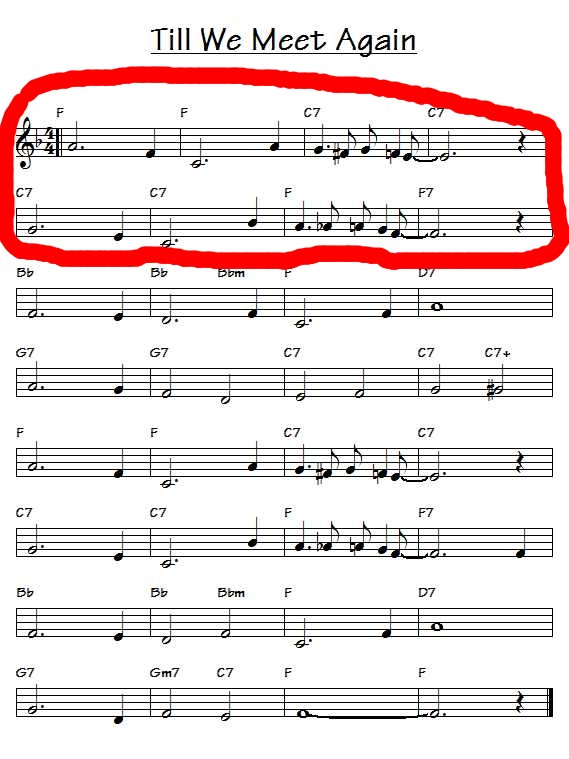
First you need to look at what goes on in this tune. So let's consider it, in the key of F.

We discover that it is a 32-bar tune (the most common type of all) and it is structured ABAB (each letter representing eight bars).

So you have two 'A' sections that are pretty much identical. These eight bars (marked in red below) use one of the most common chord progressions:

I    I    V7    V7    V7    V7    I    I

This movement from the tonic chord to the dominant and then back is found in very many tunes.


The F7 in the eighth bar leads perfectly into the Bb chord of Bar 9.

The 'B' sections use The Sunshine Chord Progression (also used in dozens of tunes). I have written about The Sunshine Progression in several articles. For example, click here to read one. Every jazzer must get the The Sunshine Progression into his fingers - in a range of keys.

In the first use of this progression, Bars 15 and 16 hold on to the dominant 7th (C7) rather than resolve completely to the tonic. The purpose of this is to lead back to the melodic theme all over again in Bar 17.

But when we reach the final eight bars of Till We Meet Again (B for the second time) we find the full Sunshine Progression - ending on the tonic to round the tune off perfectly.

So here is the full chord chart (in F):
Now: how about improvising? A simple way of creating an improvisation is to use this chord chart [F   F  C7   etc.] and simply play notes from the relevant chords as you go along. Basic arpeggios to begin with. For a beginner, this is not easy. That is why it helps to work with a slow tune such as this: it gives you time to think.

Don't forget that if you are a Bb or Eb instrument, then the Concert key of F will become G for you (Bb instruments, i.e. most trumpets and clarinets) or D for you (Eb instruments).

To give you some idea how this improvising-on-the-chords business works, I put the tune into Band-in-the-Box and then let my computer play it while with my cornet I tried to play notes from the arpeggios of the chords. I mostly used notes above the melody, in order to avoid clashing with it. To watch my attempt - or play along yourself - CLICK HERE.
Till We Meet Again was composed in 1918 by Raymond Egan, with words by Richard Whiting.

...............................
FOOTNOTE
The book Playing Traditional Jazz by Pops Coffee is available from Amazon.

17 February 2016

Post 392: FEWER NOTES CAN BE BETTER


One of the greatest pleasures a traditional jazz trumpet (or cornet) player can have is being in a band in which the other players are all excellent musicians who listen and respond creatively to each other. The rhythm section intelligently provides a steady pulsing beat with clear chords and nobody playing too loud; and in the ensembles the clarinet and trombone players put in such wonderful supporting and decorative notes that the trumpeter has little else to do than state the melody for them to hang their phrases on.

In a six-piece (or seven-piece) ensemble, the best effects are achieved if the trumpet lead plays far fewer notes than he or she would in a smaller group, such as a quartet, where the trumpet player has to work harder and feels obliged to play more notes to try to keep the music interesting.

16 February 2016

Post 391: BREXIT AND BLOGGING

My friends in Europe have been troubled recently by one burning question:-

Does Brexit mean we will no longer have access to Pops Coffee's Enjoying Traditional Jazz Blog?

Well, the good news is that the very first thing the new U.K. Government (led by Prime Minister Theresa May) is going to negotiate is that this Blog should have freedom of movement throughout all countries in the E.U.

She will be the 15th British Prime Minister under whose administration I have enjoyed traditional jazz. Two of them (Churchill and Wilson) were in fact Prime Minister twice.

Jazz started for me when Neville Chamberlain was Prime Minister and we almost wore out the latest Decca release by Johnny Dodds and His Chicago Boys - Shake Your Can, with a vocal by percussionist O'Neil Spencer, a workmanlike trumpet solo by Charlie Shavers and a restrained chorus by Johnny Dodds himself. Lil Hardin was on piano.
Johnny Dodds
(1892 -1940)

15 February 2016

Post 390: JAZZ IN LUNCH HOURS! AS IN DERBY.....

Why don't more clubs, pubs and venues put on traditional jazz in the LUNCH hours? After all, our audiences are mostly retired, elderly people who heartily enjoy going out for a good reasonably-priced lunch at a place where they can also be entertained by some music.

Many of them have told me this is better for them than going to jazz clubs that operate till late at night. They are simply unhappy about having to walk or drive home at around midnight. 

Well, I'm pleased to report that the message is getting across here in the English Midlands. I know of six pubs providing lunchtime jazz.

Let me give you the story behind a successful example.

In the beginning, there was a defunct building (The Coronation Hotel) for sale in Baker Street, Alvaston. This is on the south-eastern edge of the great city of Derby. Here's how it looked from the back:
The hotel was acquired in 2015 by The Steamin' Billy Brewing Co. Ltd., which then renamed it simply as The Coronation and carried out an extensive re-furbishment. Here's the front entrance as it appears today. It has a decent-sized car park.
Here is one of the bars:
Excellent food and drinks are available at reasonable prices.
The stone-baked pizzas are a speciality:
Best news of all, though, is that the management strongly supports traditional jazz. They invited Dave Harmer (the popular trombonist and manager of Leicester's New Orleans Hot Shots) to bring along some of his friends every Wednesday lunchtime to play for the diners.

So, starting on Wednesday, 9 December 2015, Dave provided a quartet.
Word soon got round and the audience grew to a good size, with quite a few 'regulars'. And there has been traditional jazz from 12.30pm until 2.45pm at The Coronation every Wednesday since then. 

If you would like to sample the music at The Coronation, CLICK HERE or CLICK ON HERE. In this latter, Dave himself provides the vocal. Better still, if you live in the Derby region, why not go along on Wednesday for some free traditional jazz and maybe have a good lunch too?
    ====
Important Footnote: I can confirm that, from 19 March 2020, the jazz lunch-hours at this pub have been discontinued because of the corona virus pandemic.

14 February 2016

Post 389: LUNCHTIME JAZZ WITH 'THE SECRET JAZZ BAND'

Alan Cole - a very special percussionist
Regular readers will know I'm strongly in favour of having jazz performances at lunchtimes, especially in pubs here in England, because the elderly folk who make up most of the audience prefer to go out for a leisurely pub lunch and hear some good music, rather than be out late at night, having to make their way home from a jazz club at 11pm. Many of them have told me so. Another reason is that the music gets heard by some younger people too, and that is surely important.

Good news is that yet another pub in the English Midlands chose to have traditional jazz in the lunchtimes. The pub is The Boathouse at Barrow-on-Soar (beautifully situated on the river bank between Loughborough and Leicester). The Secret Jazz Band played there every second and fourth Monday of the month from May 2016, between 12.30pm and 2.30pm.
Some of the boating people moored up and stopped to have a lunch and hear the jazz, too.

(Note added later: These gigs came to an end three years later, because the premises underwent massive refurbishment and had a new management with different policies.) 

The Secret Jazz Band was formed in June 2014. The percussionist Alan Cole had been invited to provide a six-piece traditional jazz band for a once-a-month Thursday lunchtime session at another public house - The Dog and Gun in Syston, Leicester. He agreed to do this - and then set about forming a band.

Alan gave the band the working title of The Secret Jazz Band (secret because he did not know who the musicians would be) – and the name has stuck.

Alan did not have much difficulty in finding players who said they would be happy to spend a lunchtime, at least occasionally, taking part in a relaxed jam session. They knew it would provide a good opportunity to have fun and keep in practice.

Since then, The Secret Jazz Band has played every month at The Dog and Gun. The pub belongs to the 'Steamin' Billy' chain, whose management team are keen supporters of live music.
It is a pub that looks after its customers well, with a cosy log fire:
And if offers a good lunch:
With such a pool of musicians, the fans never know who will be in the 'secret' band.
Pete Crebbin often turns up and plays trombone.

The band does not get together to rehearse, so it wisely sticks to familiar, uncomplicated numbers – tunes such as Make Me A Pallet on the Floor, Running Wild, Alexander's Ragtime BandWhen You're Smiling, The Girls Go Crazy, Hindustan, Careless Love.

The audience grew over the months and reached a peak of 45 on one Thursday in the summer of 2018, so the bar was crowded.

Band manager Alan eventually had some business cards printed. He became ambitious enough to hope The Secret Jazz Band might attract bookings beyond the confines of the pubs!

The secret is out.
=================
FOOTNOTE
Sadly, as from February 2020 the performances at The Dog and Gun have been discontinued. Ill health and mortality had reduced the audience to a size at which the concerts were no longer viable. But the band continues and accepts gigs elsewhere.

13 February 2016

Post 388: JAZZ IN JAPAN

First, may I suggest you watch RIGHT NOW this delightful video made by young traditional jazz musicians in Japan? It shows vividly how the music is thriving in that country and also how it can be played with joy. Watch it BY CLICKING ON HERE. If I have understood correctly, the Band is The Khachaturian Jazz Band (The Khacha Band, for short) and the players are Tomomitsu Maruyama (leader, banjo and vocals), Naho Ishimura (trumpet and tambourine), Kensuke Shintani (clarinet), Hishinuma Naoki (tuba), and Tomohiko Miwa (percussion).

I have never been to Japan and I know very little about traditional jazz in that country. But we all know there has long been - albeit on a small scale - a strong tradition of New Orleans-style jazz played particularly in Tokyo and Osaka. 

So let me state what I can; and if you can correct me on any points – or provide additional information with which I may enrich this article – please send me an email: ivantrad (@) outlook (dot) com.

There seem to have been Japanese musicians even before World War II who were influenced by American dance band and early jazz music. For example, listen to THIS RECORDING (CLICK ON) of Tiger Rag.

Later, it seems that a group of enthusiastic young musicians from about 1955 were hugely influenced by the New Orleans Jazz Revival, notably by such musicians as George Lewis, Jim Robinson and Bunk Johnson. The Band called The New Orleans Rascals was formed in 1961. And it still performs today, mainly, I think, in Osaka. Those young musicians started making records early in their career. And they enjoyed a terrific boost when George Lewis visited Japan with his band in 1963.
The New Orleans Rascals
The visit by George Lewis was a big sensation at the time, seminal and influential. In fact, its legacy is still strong. I think I am right in saying there are many musicians in Japan today who still feel that the ONLY correct way to play the music is in the style of George Lewis.

I remember that in about 1980 a friend who was crazy about The New Orleans Rascals gave me a cassette tape of their recordings. They certainly were very good, sounding much like a George Lewis band and playing his repertoire.

Over the years, The New Orleans Rascals have often played at festivals abroad and, in their turn, they have hosted many fine guest performers from other parts of the world.

Correspondent David Withers in New Zealand has told me the late Mike Durham, best known as the leader of The West Jesmond Rhythm Kings, lived in Japan in the 1980s, playing with a band called The Kobe Stompers.

Rhoichi Kawai (devotedly a disciple of George Lewis) has not only been the great clarinet player of The New Orleans Rascals; he also formed a club in 1958 – The Waseda University New Orleans Jazz Club – and it still exists today. Waseda University is in Tokyo. In fact Rhoichi Kawai has been the dominant figure in Japanese traditional jazz for decades. He is considered a great pioneer and is held in respect even by the much younger generation of musicians.

Members of the Club included Mari Watanabe, the fine pianist who moved to New Orleans about twenty years ago, and still plays there at Preservation Hall and The Palm Court Café. She is married to Roger Lewis, who plays the sax with The Tremé Brass Band and the Dirty Dozen Brass Band.

Another club member was the great pianist Natsuko Furukawa, whose brilliance may be appreciated in many videos. She now lives in Kawasaki where she runs the band Soul Food Café, with her husband playing the saxophone. They occasionally visit New Orleans. You can watch her in storming action by CLICKING HERE.

And how about sampling a performance of The Old Rugged Cross by The New Orleans Rascals in 1991, with leader Rhoichi Kawai on clarinet? To do so CLICK HERE.

Yoshio Toyama (trumpet), who has frequently visited New Orleans to play, was also a member. In more recent years, Kensuke Shintani (clarinet), Haruka Kikuchi (trombone) and Makiko Tamura (clarinet) were members. Another important former club member is Hiro Kodaira. He lived in New Orleans for many years and played the banjo in Jackson Square. Many street musicians there still remember him; but he returned to Japan after Hurricane Katrina.

It has been impossible for Japanese traditional jazz musicians to make a full-time living from the music. Traditional jazz is not quite popular enough among the general public – a situation common in most countries. Rhoichi Kawai himself, for example, had a day job running a jewellery store.

There seem to be quite a few bands currently on the scene. For example, (playing in Tokyo) The New Orleans Jazz Hounds include several young musicians. I know that the work of Makiko Tamura – the superb young lady clarinet player – is greatly admired all over the world, as readers of this Blog have made clear to me.

One of my readers - Lou in the USA - strongly recommended to me a video is which Makiko Tamura and Kensuke Shintani duet on clarinets in I've Found a New Baby. It was quite something. But, alas, it seems to have been recently removed from YouTube.

The leader of The New Orleans Jazz Hounds is Mikio Shoji (piano), who was mostly inspired by the late Danny Barker.

And there is Nobu Ozaki, the bassist with John Boutté, who seems to be the only Japanese traditional jazz person who didn't join the Waseda University New Orleans Jazz Club! He preferred to move young to New Orleans.

Kensuke Shintani (already mentioned) is a superb clarinet player on the current Japanese sceneAlso in Tokyo is Tomomitsu Maruyama who plays the banjo. You saw both these men in the video I recommended at the top of this article. Haruka Kikuchi considers Tomomitsu the best traditional banjo player in the world.

As far as I can tell, a gentleman called Giichi Oya has been extremely important in supporting and publicising the work of young traditional jazz musicians in Japan. We owe him a great debt of gratitude.

Some of the younger Japanese musicians, such as Haruka, are by no means stuck in the past but are absorbing the many influences that have infiltrated traditional jazz in New Orleans itself during recent years. I am referring to such influences as those of Baltic brass band music, Caribbean rhythms and calypsos, and even Mardi Gras Indian 'funky' music. Haruka Kikuchi, the great trombonist, set up home in New Orleans at the end of 2013, and has played with pretty well all the great bands there, even forming one herself, and she has happily toured as a member of the Mardi Gras Indian Funk Band called Cha Wa. Here she is in the centre of the band:
Haruka told me she wants to be a bridge to the next generation. She thinks the jazz culture she has found in New Orleans is slightly different from the one she left in Tokyo. She is glad she has settled in New Orleans because she says 'I have to learn and study many things here, and want to play good music. Just good music with everybody (no matter where they are from!).'

And have a look at this video - click on to view.  It is a distinctive Japanese group playing In The Mood and The Kentucky Waltz. Robert Wendorf (resident in Japan) drew it to my attention.
-----
Footnote

I have received this message from Tokyo:


Hello, my name is Steve Kim and I currently live in Tokyo. I really appreciate your post about Jazz in Japan!

I organize a large outdoor event, which while is mainly a Latin festival, I hope to have some of those groups on your post to perform at the event! The event is called Cinco de Mayo and while it is a Mexican event mostly celebrated in the US (kind of like the early St Patrick's Day), I have altered it a bit in Japan to include all of the Americas and hope to incorporate a little bit of New Orleans. I have had a band called Blitz and Squash Brass Band from Osaka in the event in Osaka and Tokyo. There was a trumpet player they invited from New Orleans called Travis Hill who performed at the event in 2014 came for the event in 2015 but tragically passed away during his visit due to illness. But I hope to revive the music in the event in Tokyo.

This was with Travis back in 2014 in Osaka.