Welcome, Visitor Number

Translate

13 January 2016

Post 364: TUBA SKINNY AND 'BEER GARDEN BLUES'

Be honest. Had you ever heard of Beer Garden Blues before Tuba Skinny unearthed it and started performing it in 2015? I certainly had not.

Robin Rapuzzi told me it is a tune the band now particularly enjoys.

The music was written in 1933 by Lewis Raymond and Clarence Williams; and lyrics were contributed by Walter Bishop.

It is normally played in the key of F, but making great use of the related key of D minor. In fact, a distinctive characteristic of the song is its strong minor flavour - in both Verse and Chorus.

The Verse comprises 16 bars. The Chorus has a 32-bar A-A-B-A structure.

You can hear the original Clarence Williams recording by clicking here. Surprisingly, the band omits the Verse but works its way through the Chorus five times (thus playing 5 x 32 = 160 bars in total). Much use is made of breaks, especially on Bars 23 and 24 of every Chorus; and the third Chorus is led by the washboard, with the others providing punctuation.

Clearly, Williams treated his own music very freely when he came to perform it. And Tuba Skinny do the same, making great use of the rhythms and the harmonies, but with slightly less than scrupulous respect for the original melody. Click here for a performance by them: they play through the Chorus six times [no Verse] on lines very similar to those of the Williams recording. Beer Garden Blues as originally written (with acknowledgement for the help provided by my American correspondent Larry Smith) is believed to have gone like this:

Post 363: HOAGY CARMICHAEL'S 'JUBILEE'

I was lucky enough to be at The Spotted Cat in New Orleans on 9 April 2016, when The Shotgun Jazz Band, in eight-piece form, played a rollicking tune called 'Jubilee'. Not only that; I managed to make a video of it - one you can watch by CLICKING HERE.

This tune was new to me, so when I returned to England, I set about trying to find out who wrote it and when. The first thing I discovered was that there was not much evidence of it on YouTube. There were several songs with the word 'Jubilee' in the title, but not one of them was the tune I had heard - until I came to one solitary video of a jazz trio playing it in 1991.

So it does not seem to be a tune in the standard repertoire of our bands. This is a pity, as it deserves to be. May I recommend it to band-leaders?

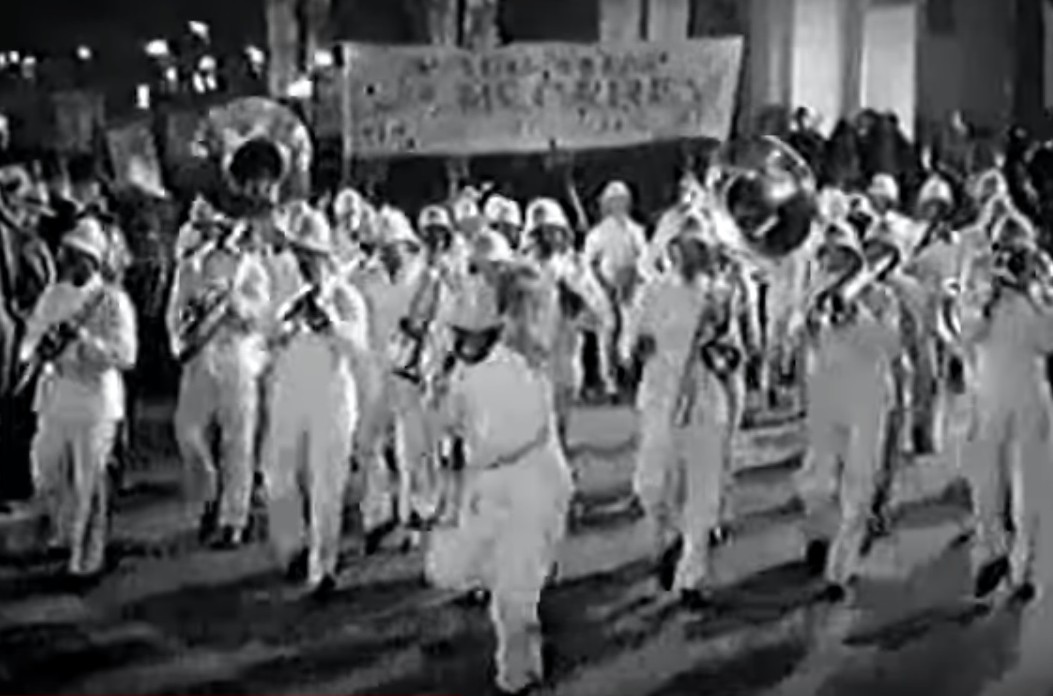
With help from my American correspondent Larry Smith, I learned the song was composed by none other than Hoagy Carmichael, with words by Stan Adams. They wrote it for a 1937 film called 'Every Day's a Holiday', in which Mae West and Louis Armstrong both appeared.
Louis Armstrong at the front of the Parade Band
in the film 'Every Day's a Holiday' (1937).
When you first listen to the tune, you sense that mastering the chord progression should be easy enough. And you also feel that the song has a 'tag'. You discover that it is a tune of 36 bars, unlike the common 32-bar form. What has happened is that Bars 29 and 30 are repeated twice, thereby spinning out the ending, so that it becomes a 36-bar song.

The Shotgun Jazz Band played the tune in the key of Eb Concert; and it went something like this:
If you would like the words, you can get them direct from Louis Armstrong at 50 seconds into this historic film extract:  CLICK HERE.

As for chords, you may be able to get away with a simplified version, for example:
I
I
I
I
I
I
I
I
III
III
III
III
III
III
III
III
IV
IV
IVm
IVm
I
I
II7
V7
I
I
I
VI7
II7
V7
II7
V7
II7
V7
IIm:V7
I
(It is a 36-bar tune)

But if you are happy to work at something more sophisticated, try this:
I:VIm7
IIm7:V5
I:VIm7
IIm7:V5
I:V7
I:V7
I
I
III:I#m
IV#m:VII7
III:I#m
IV#m:VII7
III:VII7
III:VII7
III
III
IV
IV
IVm
IVm
I
I
VIm6
VII7
I:VIm
IIm7:V7
I
VI7
II7
V7
II7
V7
II7
V7
IIm7:V7
I
(It is a 36-bar tune)
John Dixon, who is to be seen laying down the chords in the Shotgun Jazz Band video, has read this article and has kindly sent me this very helpful information - an even simpler way of approaching it:
For purposes of learning the chord progression, it’s easier to think of it as I, vi, ii, V in Eb, and then I, vi, ii, V in G (or the 3rd of whatever your root is), as it really swaps keys and it makes it easier to shout out the changes to someone on the fly. The whole thing is more like an exercise in technique than a regular tune. 

Footnote:
While doing my little bit of research, I came across a suggestion that Jubilee had actually been written at least ten years earlier, because there is a 1928 recording by Frankie Trumbauer and His Orchestra of a tune called Jubilee. So I checked the Trumbauer recording and can confirm it is a quite different tune, even though it has the same title. Trumbauer's tune was actually written by Willard Robison (the composer of A Cottage For Sale).

Post 362: 'EVERYBODY LOVES MY BABY'

That spirited song Everybody Loves My Baby is in the repertoire of most traditional jazz bands. It is one that has stood the test of time. Why? Because it has a neat, memorable, repetitive melody, making clever use of a minor chord and its related major. The words are appealing and easy to learn. It even has a far better verse than many of the popular songs of its time.

Everybody Loves My Baby was composed in 1922 by Jack Palmer and Spencer Williams. Looking at a copy of the original piano sheet music, I'm impressed at how faithfully today's bands keep to the original, even many decades later. This is something rarely achieved!

I think it is partly because most musicians know the lyrics; and those lyrics fix in our minds the correct notes of the tune.

We find that Williams and Palmer published it in the key of G (with much use of the related E minor chord). Our jazz bands tend to prefer the key of F (with D minor), because this is easier for tuning and fingering.

The original sheet music offers an eight-bar Introduction and a couple of bars or repeatable 'patter' before the Verse. We now tend to discard these. But we play the 16-bar Verse (I'm as happy as a king, feelin' good 'n' ev'rything) pretty much as written.
The Chorus has a standard  A - A - B - A structure, with the A Sections dominated by that 'Minor' flavour.


The 'Middle Eight' is very effective, with the repeated, stuttering, notes (mainly on the tonic, though with changing chords beneath them.)


And the tune ends well.

'Fine,' you say. 'But is there any chance of hearing a really great band such as Tuba Skinny playing this tune?'

Yes, there is! It's on YouTube and we must be grateful to that excellent video-maker codenamed WildBill for putting it there. It's a storming performance (in the key of F). Shaye sets a cracking pace and is on her very best form, both in playing and in directing the traffic (note the Chorus in which she trades fours with Barnabus). Erika provides the vocal. There's even the bonus of Ben Polcer playing superbly on piano. In this version, they have chosen to omit the Verse, but who cares about that? CLICK HERE TO VIEW IT.

Post 361: 'ENJOY YOURSELF (IT'S LATER THAN YOU THINK)'

When my grand-daughters were little, I had the pleasant duty once a week of collecting them from school. In the back of the car, on their way to their house, they always loved to sing at the tops of their voices. I taught them one or two silly songs.
Coffee Popsicles - Ellen (left) and Marianne
A particular favourite was Enjoy Yourself; It's Later Than You Think.

For a clear performance of this song on YouTube (by Guy Lombardo and his Royal Canadians), click here.

So I had a pleasant surprise when I discovered recently that Lasse Collin - on his wonderful website (click here to visit the site) had published a lead-sheet for the song, complete with the words.


For years, Lasse has generously provided a wonderful service to traditional jazz all over the world by making lead-sheets freely available. I do not know how many lead-sheets there are on his site, but my guess is there are about 1000. Many of them are supported by recorded performances.

Enjoy Yourself; It's Later Than You Think is not a song many bands play. But I recommend it. Why? Because every concert needs at least one 'fun' song or silly song, as a gentleman in an audience told me a few weeks ago. Also, this tune has the advantage of being very easy to play and improvise on. (That also makes it a good one for beginners, by the way.) It is fairly similar in its chord progression to Royal Telephone.

Somebody in the band should provide the vocal, as that is essential in a song where the fun is in the lyrics. You have the words provided by Lasse, but there are in fact more verses (not needed, in my view, but you can find them on the internet if you wish).

My friend Barrie in Lancaster, England, has told me this song is currently popular with Ska Bands.

The song belongs in our repertoire to the group that gives sound advice on how to conduct our lives. (I'm thinking of such as Pick Yourself Up, When You're Smiling, Try a Little Tenderness'Taint What You Do, Button Up Your Overcoat, Pennies From Heaven, The Clouds Will Soon Roll By, Smile, and If You Can't Be Good, Be Careful.)

Post 360: 'POSTAGE STOMP' - PLAYED WITH ENERGY AND DRIVE

What joy it is to hear an up-tempo tune played with real energy and drive, and with a total sense of control and great teamwork.

It is an experience that, I'm sorry to say, does not happen often enough here in England. So many of our musicians are very elderly and are really not up to producing that drive any more. (I am one of them.)

If you look at a performance given on 30 March 2016 by Tuba Skinny, filmed by the great Louisiana-based video-maker codenamed RaoulDuke504, you will see what we are failing to achieve.
They are giving a routine street performance of Postage Stomp. It's a simple 32-bar tune with the same chord pattern in the Middle Eight as dozens of other tunes:
 III7 - III7 - VI7 - VI7 - II7 - II7  - V7 - V7
This allows for 'breaks' in Bars 23/24.
Barnabus, the regular trombone player, is absent, but one chorus is taken by the saxophone and there is another in the first half of which cornet and clarinet trade fours. Further variety is provided by a percussion chorus (against stop chords) and a tuba-led chorus - with the clarinet, sax and cornet playing long notes to decorate the Middle Eight. Above all, though, four of the choruses involve dramatic, driving work from the full ensemble. There is brightness and energy from all quarters, with Robin on percussion and Shaye, so busy on cornet, never allowing the tempo or the excitement to drop. The banjo, guitar, tuba and drums keep the tune pounding along in rock-steady fashion.

To Tuba Skinny, this performance was probably nothing special - just another day at the office. But to us old guys who are struggling to play the music, it's an object lesson.

For those of you who are interested in such matters,  Postage Stomp is, I believe, a tune from 1930, featured that year by Maynard Baird and His Orchestra. I think it was composed by Sam Goble and Vic Johnston (members of Maynard Baird's Orchestra). They played it in the key of F and you can hear their bouncing, slickly-arranged version by clicking here. Tuba Skinny play it in Bb.

And, while we are on the subject of playing with energy and drive, have a listen to Tuba Skinny (in the same set as Postage Stomp), playing Dallas Rag. Do so by clicking here.  Sensational!
.

Post 359: GO BUSKING - TRY SOME OUTREACH WORK

Here's an unusual and wonderful sight - An ENGLISH band busking on the streets of ENGLAND:
It's Bazzer's Jazzers recently photographed in Lancaster.

I run up against surprising language problems occasionally. After I last wrote about busking, an American reader e-mailed to tell me it took him some time to work out what busking was. But it's a common enough word here in England.

When I refer to jazz bands 'busking', I mean 'giving impromptu un-booked concerts in the streets, to promote their bands and pick up some tips' - in the manner of the many street bands in New Orleans.

'Busking' is a word of ancient and obscure origins. It probably came originally from a Germanic word of medieval times. It seems to have entered English via the old Spanish word buscar or the French busquer (meaning seek out or go about selling things). Of course, in addition to musicians, there are other forms of buskers (street performers). And the word 'busking' is also sometimes used by musicians in a slightly different way, meaning 'having a go at playing something by ear, without having seen or properly learned the music'.

But for the purposes of this article, I mean simply giving an un-booked concert in public.

Some of the best venues in which traditional jazz groups can be heard are outdoors, in streets or open spaces, where members of the public are passing by.
Scene in America
We should make a greater effort to take traditional jazz into the streets. That's the way to increase its appeal to the younger generation and give pleasure to the masses.

In the September 2014 issue of Offbeat Magazine, there was an article by Geoffrey Himes in which he sought the views of Tuba Skinny. This band no longer needed to busk for tips: it had plenty of good gigs on offer from all round the world. And yet the players still loved to perform in the streets.

Shaye Cohn told him: It’s important to every single person in the band that we keep playing on the street. If we stopped, something important about the band would be gone. We can take more risks and play more freely when we’re busking. No one’s telling us what to do or what to play when we’re on the street; no one’s telling us when to start or when to stop or how much we should talk. It’s our time and we do what we want to do. When people stop on the street to listen, it’s because they’re drawn to it. It’s not because they’re a tourist in a bar trying to ‘experience’ New Orleans music.

When we travel, we try to busk a lot, because it connects us to the place we’re in. If we’re out in the open, people are going to pass by and react. People bump into you and say, ‘What kind of music is that? I never heard that kind of jazz.’ Which I can relate to because, at one point, I had never heard this kind of jazz either. You’re outdoors, which is nice, and it’s acoustic so we don’t have to worry if someone’s amplifier is drowning out someone else. Some spots are better: small streets with fewer cars and more pedestrians—which are easier to find in Europe than in the States.

I had burned out on classical piano; I had spent so many, many hours practising in a tiny rehearsal room going over the same four measures again and again. I needed more social activity in my life. Until I started busking, I had never achieved such a special rapport playing music with people.

Another joy of playing in the street is that small children are fascinated by the music and react to the rhythms. Toddlers can't stop themselves dancing.
The music also gives pleasure to many elderly people for whom it brings back memories. Street performing is indeed 'Outreach Work' and very important.

To hear an example of three friends of mine attempting a street performance with me CLICK HERE.

If you play al fresco in this way, you give a delightful surprise to people of all ages. Many passers-by (accustomed to ipods and disco music) will never have seen and heard anything like this - live - before.

You will be heard by two thousand people in a couple of hours. (Isn't that better than playing to 25 people in a club or pub?) And a young lady in those two thousand could well book you to play at her wedding reception, so you will attract a good gig too.

As Shaye says, you will not have to meet the demands of a promoter. And you can choose your own programme, even including a few 'experimental tunes' if you like. You can start and finish at any time and maybe take a break in a bar or coffee shop.

In my country (England), there are plenty of buskers on the streets. Yet I hardly ever see a traditional jazz group among them. The few I have spotted attracted great interest.

Things are very different in other countries (especially America) where such street performances as this are welcome and commonplace:-
I don't know why English musicians are reluctant to get out there. It seems such an obvious way of keeping in practice, having fun and spreading joy.

Maybe the English are too reserved and too ready to imagine obstacles. It is a myth that you need some kind of 'permit' or 'licence' (other than in a very few places), though of course you must not cause an obstruction or play in a spot where you could disturb nearby businesses.

(Sadly, correspondent Robert Duis tells me, the situation is bad in Holland, where he says playing music on the streets is permitted only in rare circumstances.)

In England, most people and local authorities will give you a warm welcome for brightening up the scene and making everyone feel cheerful.

If you pick an appropriate location in an English high street, with good acoustics, preferably on a sunny day, you can enjoy a terrific concert and soon have a delighted audience. A reader has told me it is possible in some places to colonise a disused shelter or bandstand, like this:
Another reason why some musicians are reluctant, I suppose, is that this is not a money-making enterprise. You can put down a collection box and hope for donations, but you will be lucky if you collect more than enough to pay for the band's travelling expenses and a drink.

However, I wish more bands (or small groups) would try this form of performance.
It is a great way of keeping the music alive and it can bring you bookings, so it's a way of publicising yourselves too.

I stumbled upon a lovely YouTube video which graphically and movingly demonstrates the points I am trying to make. Please have a look at it:

When a passer-by sees and hears you, the first ten seconds are the most important. Think about this vital point and it will help you get everything else right.

Choose carefully the spot where you set up. It is not fair to play in the same spot for more than an hour. (You may annoy a nearby shopkeeper who tolerates you but is not really happy to have you there.) And it is neither fair nor sensible to set up in a spot with another busker already performing nearby. Similarly, don't get too near someone who is collecting for a charity: people will think you are together.

Have a small repair kit with you, in case there are any problems with your musical instrument.

If you want to attract bookings, have a clear and visible notice; and have business cards available.

When people take an interest, make eye contact. Smile and say thank you if they put a coin in your box - even if it means missing half a bar.

Carry a notebook and pen: somebody may talk to you about a possible booking.

Be clean and smart. You could wear something distinctive – but don’t be scruffy.
When in a busy main thoroughfare, such as a high street, perform if possible between 10am and midday. Between those hours the public is most receptive. Later, people grow wearier and less responsive.

When there are plenty of people around, play merry tunes that you know you can play well.

Choose music that is mostly bright and cheerful.

Do not use amplification, or at least keep it minimal. You will attract complaints from shopkeepers and annoy your potential listeners if you are 'too loud'.

Don’t try to sell CDs unless you are licensed. In England, this does require a licence.

Don't make the excuse that your instrument is difficult to transport to such a venue. The lady below goes busking on her bicycle. It is a very pleasant tall, upright loop-frame model, complete with dynamo lighting and a very sensible chain-guard. I am a bicycle enthusiast.  I like cellos. I like ladies, especially ladies who play musical instruments. So this is the perfect street scene for me.

The lady cycles with the chair, stool, clothes pegs and CDs in her panniers. But how does she manage to carry the cello? In a cello bag on her back. And what about these chaps? An inspiration to us all!
Finally, here's Hannah - a great happiness-spreading street musician.

For a treat, watch her playing and singing by

CLICKING HERE.